Get ready for Vermont’s online learner’s permit test with 40 free questions on road signs, the 50 mph default limit, moose and winter driving, and junior license rules. Each answer comes with a short explanation the moment you pick it.
Ten questions per round, four rounds in all: Vermont signs, who goes first, speed and parking rules, impaired and distracted driving, and the junior license. Each answer is explained on the spot.
Round 1 · Questions 1–10
1Road signs
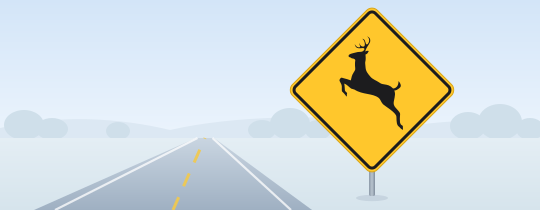
Dusk is settling over a wooded Vermont back road when you pass a yellow diamond sign showing a leaping deer. When does the Vermont Driver’s Manual say deer and moose are most likely to be on the road?
Show answer
Correct answer: In the late evening, overnight and in the early morning
Why
Vermont’s manual points to dusk, darkness and dawn as the riskiest hours. A moose can top 1,000 pounds, stands tall and dark, and its eyes may not shine back in your headlights, so scan both shoulders and ease off the gas. If one deer crosses, expect a second one close behind.
2Permit & teen rules
Vermont’s online learner’s permit test has 20 questions. How many do you need to get right to pass?
Show answer
Correct answer: 16
Why
You need 16 correct, which is 80%, so four misses is the most you can afford. Each question has four choices and one right answer. If you fail, wait at least a day before trying again, and pay the $39 test fee each time.
3Right-of-way
A summer storm has knocked out power, and the traffic lights at a busy Burlington intersection are completely dark. How does the Vermont Driver’s Manual tell you to handle it?
Show answer
Correct answer: Treat it as a stop sign facing every direction
Why
A dead signal works like an all-way stop in Vermont. Stop completely, let the first car to arrive go first, and if two arrive together, the driver on the left yields to the one on the right. A flashing red light calls for the same full stop.
4Parking
You find an open curb space on a Rutland street right next to a fire hydrant. What’s the minimum gap Vermont law requires between your car and the hydrant?
Show answer
Correct answer: 6 feet
Why
Vermont’s figure is 6 feet, and it’s easy to mix up with the state’s 20-foot crosswalk rule and 30-foot stop sign rule. Firefighters still need room to hook up a hose, so extra space never hurts. Never park in front of a driveway, either.
5Alcohol & phones
A 19-year-old drives home after one beer and blows 0.03 on a breath test. What happens in Vermont?
Show answer
Correct answer: A violation: the under-21 limit is 0.02, with a 90-day suspension
Why
Vermont sets a 0.02 limit for drivers under 21. Crossing it is a civil violation with a 90-day suspension and a referral to the Youth Substance Awareness Safety Program; skip or fail the program and it turns into a $300 penalty and 180 days. Refusing the roadside breath test counts as a violation too.
6Safe driving
Using the counting method taught in the Vermont Driver’s Manual, how far behind the car ahead should you stay in good conditions?
Show answer
Correct answer: At least 4 seconds
Why
Vermont teaches a 4-second gap. When the car ahead passes a fixed point such as a mailbox, start counting; if you reach that point before you get to four, drop back. Allow more time in rain or snow, in poor visibility, at higher speeds and behind motorcycles.
7Speed limits
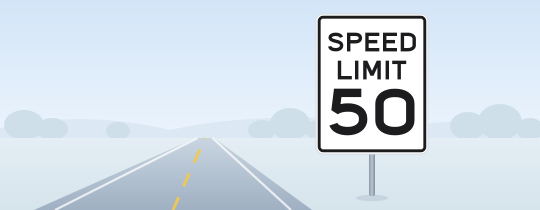
The 50 on this SPEED LIMIT sign is also Vermont’s default maximum speed. Where does that 50 mph default apply?
Show answer
Correct answer: On any Vermont highway where no different limit is posted
Why
Vermont’s general maximum is 50 mph wherever no other limit is posted. Towns and the state can post different limits for particular stretches, and Interstates usually allow 65. Even at 50, the basic speed rule still applies: slow down whenever conditions call for it.
8Sharing the road
You come up behind a bicyclist on a narrow Vermont road. How much clearance does state law require when you pass?
Show answer
Correct answer: At least 4 feet
Why
Vermont law counts bicyclists and pedestrians among its “vulnerable users,” and you must slow down and give them at least 4 feet. If the road is too tight for that, wait behind until it’s safe. Breaking the rule brings a civil penalty of at least $200.
9Permit & teen rules
During your first three months with a Vermont Junior Driver’s License, when may you carry passengers?
Show answer
Correct answer: Only with a licensed parent, guardian, driver ed instructor or adult 25+
Why
For the first three months you drive alone unless one of those adults rides along. In months four to six, family members such as brothers and sisters may ride too, and after six months the passenger limit ends. Never carry more people than you have seat belts.
10Road signs
Orange diamond signs and barrels line a stretch of Vermont highway at 11 p.m., and the crews have gone home for the night. How do the work-zone rules apply now?
Show answer
Correct answer: They still apply 24/7, with speeding fines doubled
Why
Vermont’s work-zone rules don’t clock out with the workers: they’re in force 24 hours a day, and a speeding ticket there costs double. Lane shifts, rough pavement and parked equipment stay put overnight. The manual suggests leaving a 4-second gap to the car ahead.
Round 2 · Questions 11–20
11Road signs
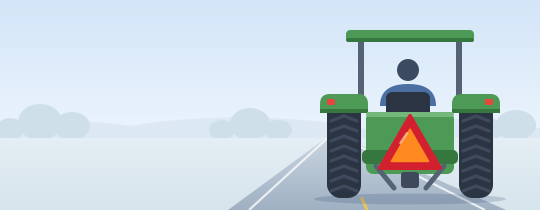
On a two-lane road through Vermont farm country, you catch up to a tractor with an orange triangle edged in red mounted on its back. What should you expect?
Show answer
Correct answer: It’s slow and may turn wide into an unmarked field entrance
Why
That emblem flags a slow-moving vehicle, typically a tractor or another piece of farm equipment. You’ll close the gap fast, so slow down early and hang back, because it may turn wide into a driveway or field you can’t see yet. Pass only where passing is legal and no oncoming traffic is in sight.
12Right-of-way
You’re about to turn left into a driveway, and a bicyclist is riding toward you in the oncoming lane. Under Vermont law, who goes first?
Show answer
Correct answer: The bicyclist, who has the right-of-way like any oncoming vehicle
Why
Vermont treats an oncoming bicyclist like an oncoming car when you turn left at an intersection or into a driveway. Let the rider pass, then make your turn with room to spare. Cutting across a cyclist or other vulnerable user without a safe distance can bring a civil penalty of $200 or more.
13Speed limits
You merge onto I-89 near Burlington. Unless signs post something else, what’s the top speed on Vermont’s Interstates?
Show answer
Correct answer: 65 mph
Why
The Vermont Driver’s Manual lists 65 mph as the Interstate maximum unless another limit is posted, while other roads default to 50. Keep right except to pass. Miss your exit? Carry on to the next one; never back up or use the median crossovers.
14Parking
Over one week, a friend parks in each of these spots around Brattleboro. Which spot breaks Vermont law?
Show answer
Correct answer: 40 feet short of the closest track at a railroad crossing
Why
Vermont wants a parked car at least 50 feet away from a railroad crossing’s closest rail, so 40 feet is too close. The other spots clear the state’s minimums: 6 feet for a hydrant, 20 feet for an intersection crosswalk and 30 feet before a stop sign. A fire station driveway needs 20 feet on the same side.
15Alcohol & phones
An officer has reason to believe you’re impaired and asks for an evidentiary breath test. What does refusing cost you in Vermont?
Show answer
Correct answer: A civil license suspension of six months
Why
Under Vermont’s implied consent law, driving means you’ve agreed to be tested. Refusing brings a six-month civil suspension, longer than the 90 days for testing at or over the limit, and it can start before any criminal case is decided. A second civil suspension lasts 18 months.
16Safe driving
You plan to turn right onto a side road. How does Vermont law say you must use your turn signal?
Show answer
Correct answer: Start it at least 100 feet before the turn and keep it on
Why
Vermont wants your blinker going without a break over the 100 feet or more leading up to a turn, which takes about 3 to 5 seconds. Signal before stopping or slowing suddenly, too. And don’t blink your turn signal to wave a driver around you: Vermont law bans using it as a courtesy “go ahead and pass” message.
17Permit & teen rules
You’re 19 and just got your Vermont learner’s permit. Who may ride in the front seat as your supervisor?
Show answer
Correct answer: A licensed, unimpaired driver aged 25 or older
Why
Vermont’s supervision rule covers every permit holder, adults included, so a licensed friend of 18 or 21 won’t do: you need a licensed, unimpaired companion aged 25 or older. A licensed parent or guardian, or a driver education instructor, also qualifies. A permit carries no time-of-day limit, so you can practice day or night.
18Lane markings
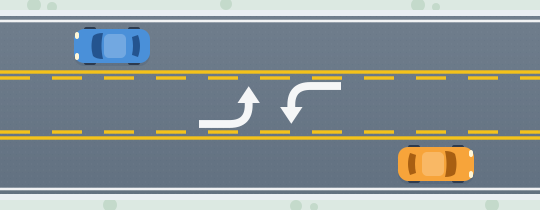
You need to turn left into a shopping plaza on a busy road with a shared middle lane marked with left-turn arrows facing both ways. How should you use that lane?
Show answer
Correct answer: Enter it just before the turn, with your whole car inside it
Why
A two-way left-turn lane is for turning, not traveling. Signal, slide into it just before your turn so your car is fully out of the through lane, and wait there for a gap. Drivers coming the other way may be using the same lane, so watch ahead.
19Sharing the road
On a Middlebury street with two lanes in your direction, the car in the lane beside you stops at a crosswalk. You can’t see why. What should you do?
Show answer
Correct answer: Stop as well, because a pedestrian may be crossing in front of it
Why
A stopped car can hide a person on foot, which is why Vermont’s manual says never to pass a vehicle that has stopped for a pedestrian. Wait until the crosswalk is clear, and don’t block it while you wait. Not yielding to someone in a crosswalk puts 4 points on your record.
20Crashes & emergencies
After a crash in Vermont where no one is hurt but the total damage comes to about $4,000, what must the driver do?
Show answer
Correct answer: Send a written crash report to the DMV within 72 hours
Why
Vermont requires a written report to the DMV within 72 hours whenever someone is injured or total property damage reaches $3,000. Insured drivers must also give the other party their insurer and policy details within five days. At the scene, move vehicles out of travel lanes if you can and call 911 if anyone is hurt.
Round 3 · Questions 21–30
21Right-of-way
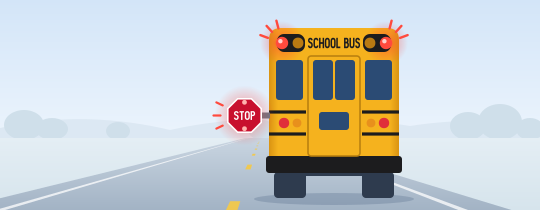
On a two-lane Vermont road, the school bus in front of you stops and its red lights start flashing. A pickup is coming toward it from the other direction. Who has to stop?
Show answer
Correct answer: Both of you, and you both stay stopped while the red lights flash
Why
Flashing red lights on a stopped school bus halt traffic from both directions in Vermont, on the road and even in a school yard. The exception is a bus on the other roadway of a divided highway. Passing a stopped bus puts 5 points on your record, and flashing yellow lights mean it’s about to stop.
22Road signs
Wet snow is plastered across a sign at a Vermont intersection and hides its words, but you can still tell the sign has eight sides. What do you do?
Show answer
Correct answer: Come to a complete stop, exactly as for a STOP sign
Why
The octagon is used for one message only: STOP. Halt at the stop line, or at the crosswalk if there’s no line, or where you can see cross traffic if there’s neither, then yield before you pull out. Vermont’s manual expects you to read signs by their shape on exactly this kind of snowy day.
23Speed limits
Fog is thickening on a winding road posted at 50 mph. What does Vermont’s basic speed rule require of you?
Show answer
Correct answer: Slow to whatever is safe for the fog and curves, even well under 50
Why
Vermont law says your speed must suit the conditions and let you avoid hitting anyone or anything on or beside the road. It also calls for slowing near curves, hilltops, intersections and railroad crossings and on narrow, winding roads. The posted number is a ceiling, not a target.
24Parking
You have to leave your car for a while on a rural Vermont highway. Where does the Vermont Driver’s Manual tell you to put it?
Show answer
Correct answer: Completely off the traveled road, visible from 150 feet away in both directions
Why
Out in the country, get every wheel off the traveled part of the road. Skip hills and curves: approaching drivers need to see your car from at least 150 feet in each direction. On a street with a curb, your right wheels go within 12 inches of it.
25Alcohol & phones
You’re 30, stopped at a red light in Burlington, when a text comes in. What does Vermont law say about picking up your phone?
Show answer
Correct answer: Not allowed: the handheld ban applies at red lights too
Why
Vermont bars every driver from holding and using a phone or other portable device behind the wheel, including at a light or in a traffic jam. Adults may make hands-free calls and use a GPS that is built in or securely mounted. To read that text, pull off the road where you can legally stay stopped.
26Safe driving
When does Vermont law require your headlights to be on?
Show answer
Correct answer: 30 minutes after sundown to 30 minutes before sunup, and in poor visibility
Why
Vermont’s headlight window opens 30 minutes after the sun goes down and closes 30 minutes before it comes up, and it also covers any time rain, snow, fog or dim light cuts clear visibility below 500 feet. Daytime running lights don’t count as headlights, and low beams are the choice whenever you meet or follow other traffic.
27Permit & teen rules
Before a Vermont Junior Driver’s License, how much supervised practice must a teen log on top of driver education?
Show answer
Correct answer: 40 hours, 10 of them at night
Why
Vermont asks for 40 practice hours, at least 10 of them at night, meaning the stretch from 30 minutes past sundown until 30 minutes before sunrise. A parent or guardian certifies the hours on the VN-219 log or in the RoadReady app. You also need to hold the permit for at least a year.
28Lane markings
Entering a divided highway at night, you notice the solid line along the right edge of your lane is yellow. What does that tell you?
Show answer
Correct answer: You’re driving the wrong way
Why
On divided highways and Interstates, the edge line on your right should be white and the yellow one should be on your left. Yellow on your right means oncoming traffic is headed straight at you, so get out of its path at once. Yellow center lines always separate traffic moving in opposite directions.
29Sharing the road
A town snowplow with its lights flashing is clearing the road ahead of you during a storm. What does Vermont law require?
Show answer
Correct answer: Slow down and yield to it, keeping well back
Why
Vermont requires drivers to yield to state, city and town maintenance vehicles working on the road, and plows are a prime example. They’re wider than most vehicles and can vanish in their own cloud of blowing snow, so leave plenty of room. Wait for a clear, safe chance before you think about passing.
30Road signs
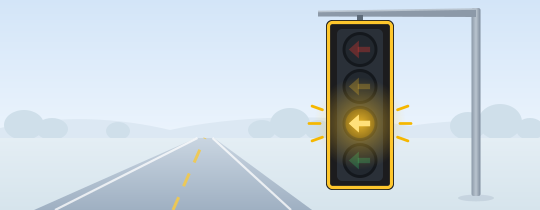
You’re waiting to turn left when the left-turn signal starts blinking a yellow arrow. What does that allow you to do?
Show answer
Correct answer: Turn left after yielding to oncoming traffic and pedestrians
Why
A flashing yellow arrow lets you turn, but the turn isn’t protected, since drivers coming toward you are on a green. Wait with your wheels pointed straight, and go only when the gap is long enough and the crosswalk is clear. A solid green arrow is the signal that stops oncoming traffic for you.
Round 4 · Questions 31–40
31Right-of-way
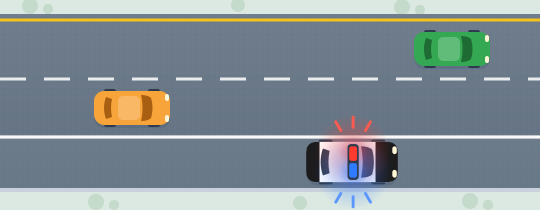
On a highway with two lanes in your direction, a police cruiser sits on the right shoulder with its lights flashing, and the lane to your left is open. What does Vermont’s Move Over law call for?
Show answer
Correct answer: Proceed carefully and move to the lane farther from the cruiser
Why
The law covers stopped police cars with blue lights, ambulances and fire trucks with red lights, and tow or repair trucks with amber lights. On a road with more than one lane your way, move over when it’s safe. If changing lanes isn’t possible, ease off to a careful, sensible speed for the conditions as you go by.
32Road signs
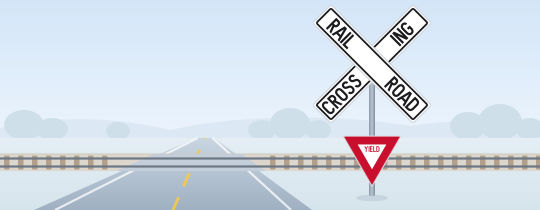
A white X-shaped RAILROAD CROSSING sign with a YIELD sign under it marks the tracks ahead, and you can plainly see a train approaching. Where does Vermont law say to stop?
Show answer
Correct answer: Somewhere between 15 and 50 feet back from the closest rail
Why
Vermont law puts your stopping point between 15 and 50 feet short of the closest rail whenever a train is near or plainly visible, the signals flash, a gate is down or a flagger signals. Go only once the way is truly clear. A small sign under the crossbuck may show the number of tracks; with two or more, one train can hide another.
33Right-of-way
You hear a siren and see flashing blue lights in your mirror on a Vermont road. What vehicle is it most likely to be, and what should you do?
Show answer
Correct answer: A police vehicle; move to the right edge, stop, and wait for it to go by
Why
Under Vermont law, an approaching police vehicle shows blue lights, while ambulances, fire trucks and volunteer firefighters show red. Whatever the color, pull to the right and stop, then stay put until the vehicle has gone by. Failing to yield to an emergency or police vehicle adds 5 points to your record.
34Right-of-way
You’re stopped at a red light on a one-way street in Montpelier, and the street you want to turn left into also carries one-way traffic. No sign forbids the turn. What does Vermont law allow?
Show answer
Correct answer: A left turn after a full stop, yielding to pedestrians and traffic
Why
Vermont permits a left on red in just one case: both streets carry one-way traffic, you’ve made a complete stop, and no sign says otherwise. A right on red works the same way from any street, but never on a red arrow unless a sign allows it. Watch for lighted NO TURN ON RED signs, which switch on while people are crossing.
35Speed limits
What happens to the penalty for speeding in a signed school zone in Vermont?
Show answer
Correct answer: It doubles
Why
Vermont doesn’t set one statewide school-zone speed; each zone posts its own limit, often for when lights flash or children are present. Exceed it and the civil penalty is twice the usual amount. Keep the phone down there too, since handheld fines double in school zones as well.
36Parking
You’ve parallel parked on a steep Burlington street, nose pointing down the slope, with the curb on your right. To keep the car from rolling into traffic, where do you aim the front tires?
Show answer
Correct answer: To the right, toward the curb
Why
Turn them right, into the curb, so the car rolls against it instead of into traffic if the brake slips, and then set the parking brake. On an uphill grade with no curb, the manual also has you turn them right, toward the road’s edge. Park within 12 inches of the curb, pointed the way traffic flows.
37Alcohol & phones
A passenger tucks an open bottle of wine into the car’s unlocked glove compartment. Is that legal on a Vermont road?
Show answer
Correct answer: No: an unlocked glove box counts as the passenger area
Why
Vermont bans open containers of alcohol or cannabis anywhere in the passenger area, and the law counts an unlocked glove compartment as part of it. Anything already opened has to ride outside that space. Drinking while driving is a separate offense with a fine of up to $500.
38Alcohol & phones
A driver is caught texting with the phone in hand in a Vermont work zone while workers are on the job. How does the penalty compare with the same offense elsewhere?
Show answer
Correct answer: The fine doubles to $200–$400, and a first conviction carries 4 points
Why
A first handheld or texting violation in Vermont usually costs $100 to $200 and 2 points. In a work zone with workers present, or in a signed school zone, the fine doubles and a first conviction carries 4 points. Reach 10 points within two years and your license is suspended.
39Safe driving
A January snowstorm leaves your car stuck on a quiet Vermont road. What does the Vermont Driver’s Manual advise?
Show answer
Correct answer: Stay with the car, running the engine about 10 minutes an hour
Why
Your car is shelter, and rescuers find a vehicle more easily than a person on foot. Running the engine in short bursts saves fuel, and a clear exhaust pipe keeps carbon monoxide out of the cabin. The manual also suggests keeping the tank at least half full all winter.
40Permit & teen rules
You’re 17 with a Vermont junior license and want to take a call through your car’s hands-free system. Is that allowed?
Show answer
Correct answer: No: under 18, no phone use except to reach police or emergency help
Why
Adult drivers in Vermont may talk hands-free, but anyone under 18 has to leave the device alone entirely; contacting police or emergency services in an emergency is the lone exception. A single texting violation can also get a permit or junior license recalled for 30 days.
Vermont DMV permit test at a glance
The key numbers to know before you start the online test.
Vermont · Learner’s permit test
16 of 20 to pass.
20 questions · 4 choices each
16 of 20 answers right to pass
Onlinethrough myDMV, not at a DMV office
Spanishone of 16 test languages, ASL included
$63$39 test plus $24 permit
1 daywait after a fail; no limit on tries
90 daysyour payment receipt works as a temporary permit
20/40vision standard
Under 18? Your road to a license
15Learner’s permitPass the 20-question online test (a parent or guardian signs first if you’re under 18), then complete the permit application. Test and permit cost $63 together.
1 yearPractice and driver edHold the permit at least a year, finish driver ed (30 hours in class, 6 behind the wheel, 6 observing) and log 40 practice hours, 10 of them at night.
16Junior licenseKeep six months free of permit recalls or suspensions, then pass the road test for your Junior Driver’s License.
3 moPassenger limitsFirst 3 months: no passengers unless a licensed parent, guardian, driver ed instructor or adult 25+ rides along. Months 4–6: family may ride too.
18Full licenseA regular Vermont license opens up at 18, as long as your last six months are free of recalls and suspensions.
18 or older? Take the same online test, practice with a licensed, unimpaired adult 25+ (or a licensed parent or driver ed instructor) beside you, then pass the road test. Driver ed and the 40-hour log apply only to 16- and 17-year-olds.
What’s on the Vermont permit test
Study the Vermont Driver’s Manual (VN-007, 2025 edition), which the DMV also posts in Spanish. The test blends road signs and signals, Vermont traffic law, safe driving and sharing the road. Start with these six areas.
Road signs
Know signs by shape even under snow: eight sides means STOP, a point-down triangle means YIELD, a round sign with an X and RR warns of a railroad ahead.
Orange signs mark work zones, where the rules apply 24/7 and speeding fines double.
A small sign under the crossbuck gives the number of tracks; with two or more, one train can hide another.
Right-of-way
Two cars reach a four-way stop together? The one on the left yields to the one on the right.
Turning left, you yield to oncoming cars and oncoming bicyclists alike.
School bus with red lights flashing: stop from both directions, unless it’s on the other roadway of a divided highway.
Speed limits
No sign posted? 50 mph is the most Vermont allows.
Interstates top out at 65 mph unless a sign says otherwise.
Speeding in a signed school zone or a work zone costs double.
Parking
Keep 6 feet from a hydrant, 20 from a crosswalk at an intersection and 30 from a stop sign or signal.
Park with your right wheels no more than 12 inches off the curb, pointed the way traffic moves.
Stopping on a rural highway: every wheel off the road, visible from 150 feet both ways.
Alcohol & phones
BAC limits: 0.08 for adults, 0.04 in a commercial vehicle, 0.02 under 21 and for school bus drivers.
Refuse an evidentiary test and lose your license for six months.
No handheld phone for any driver, even at a red light; under 18, not even hands-free.
Teen rules
Permit drivers need a licensed parent, guardian, driver ed instructor or adult 25+ in the front seat.
Junior license, first 3 months: no passengers without a licensed parent, instructor or adult 25+; months 4–6, family may ride.
One texting violation recalls a permit or junior license for 30 days.
Vermont numbers to know
Six Vermont figures that are easy to mix up on test day.
50 mphdefault limit where no sign is posted
100 ftof steady signaling before a turn
4 secfollowing distance the manual teaches
6 ftfrom a fire hydrant when you park
4 ftof clearance when you pass a bicyclist
0.02%BAC limit for drivers under 21
Your Vermont course, in your pocket
These 40 questions are just the warm-up. The app gives you 407 Vermont practice questions, 36 short lessons and the why behind every answer.
36 short lessonsFour levels, from fundamentals to expert, then a full practice exam.
407 Vermont questions298 of them with pictures.
Your most-missed questionsA review lesson built from the questions you miss most.
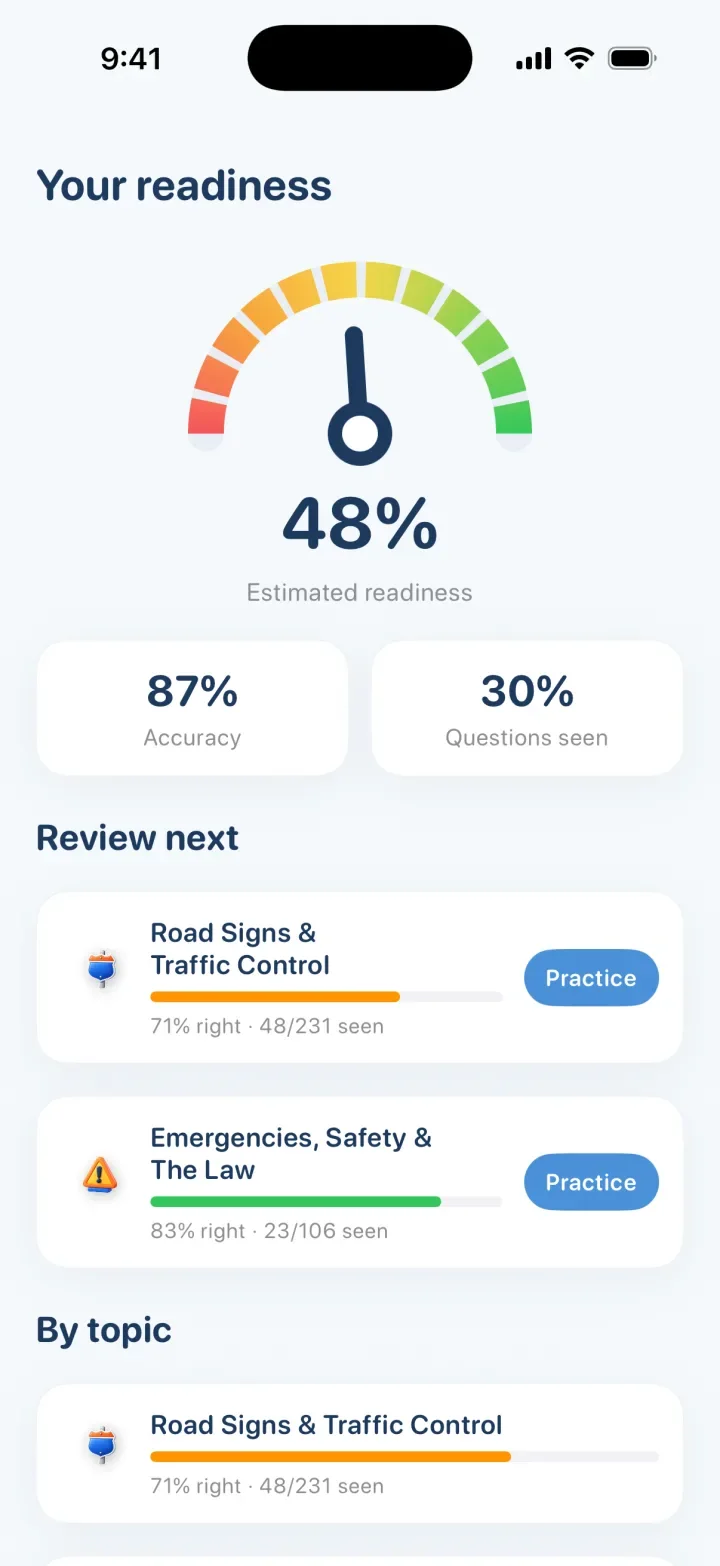
Exam simulatorTake full practice exams and watch your readiness grow.
Vermont permit
Your Vermont path is ready.
36 lessons, 407 questions and full practice exams. In English and Spanish.
How many questions are on the Vermont permit test, and what’s a passing score?
Twenty multiple-choice questions, each with four answer choices. You need 16 right (80%), so you can miss four at most. The test checks that you can read road signs and signals, know Vermont’s driving laws and share the road with bicyclists, motorcyclists and pedestrians.
Can I take the Vermont permit test online?
Yes. In Vermont the car permit test is taken online through myDMV, not in a DMV office. Under 18? Your parent or guardian has to sign off on your application before you begin. Passing doesn’t issue the permit by itself: you then complete the application and pay, and your receipt serves as a 90-day temporary permit until the card arrives by mail.
What if I fail the Vermont permit test?
Wait at least one day, then try again. There’s no cap on attempts, but the $39 test fee is due every time you take it.
Can I take the Vermont permit test in Spanish?
Yes. The online test comes in 16 versions, including Spanish and American Sign Language, and the DMV posts a Spanish edition of the Vermont Driver’s Manual. This practice test and the app are in Spanish too.
How old do you have to be to get a permit in Vermont?
15. Under 18, you hold the permit at least a year, finish driver education and log 40 practice hours, 10 of them at night, before a Junior Driver’s License at 16 or 17. For your first three months on that license, no passengers unless a licensed parent, guardian, driver ed instructor or adult 25 or older rides along; in months four to six, family may ride too. The junior license carries no nighttime curfew, but under 18 you can’t use a phone while driving, even hands-free, unless you’re calling for help in an emergency.
How much does a Vermont learner’s permit cost?
$63 if you pass on the first try: $39 for the knowledge test and $24 for the permit, which is good for two years. Later, the road test costs $23 and a Junior Driver’s License $39.
What should I expect on the Vermont road test?
Road tests are by appointment only, booked through myDMV or by phone. Bring your own registered, inspected and insured vehicle. Expect a hill start using the parking brake, a turnaround made by backing into a side street on your right, and parallel parking. Don’t pass? Your next attempt has to wait seven days or more.
What’s the best way to study for the Vermont permit test?
Read the Vermont Driver’s Manual, then keep practicing until you clear 80% with room to spare. Work through the 40 questions above, then let the app take you through 407 Vermont questions and 36 short lessons, with the reason behind every answer.