Get ready for the Indiana BMV knowledge exam, the state’s version of the DMV written test, with 40 free questions on road signs, speed limits, the Move Over law and probationary license rules. Pick an answer and the explanation appears instantly.
Four rounds of 10 questions cover both sections of the Indiana exam: road signs, plus the rules on right-of-way, speed, parking, alcohol, phones and probationary licenses. Every answer comes with an explanation.
Round 1 · Questions 1–10
1Sharing the road
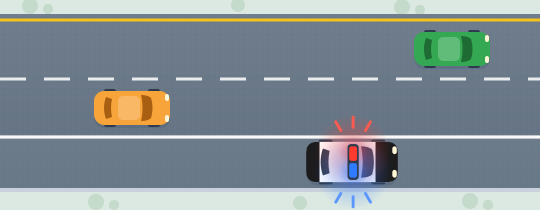
You’re driving the right-hand lane of an interstate with two lanes each way when you spot a police car stopped on the shoulder ahead, lights flashing. Heavy traffic in the left lane means you can’t move over. What does Indiana law require?
Show answer
Correct answer: Slow to at least 10 mph under the posted limit and pass carefully
Why
Indiana’s Move Over law gives you two choices: switch to a lane that isn’t next to the stopped vehicle when it’s safe, or, if you can’t, drop to at least 10 mph below the posted limit. The same rule covers tow trucks, road crews, utility and trash trucks with amber lights, and disabled cars showing hazard lights.
2Right-of-way
A storm has knocked out power, and the traffic lights at a busy intersection are completely dark. What must you do?
Show answer
Correct answer: Come to a full stop, then go in turn as if every approach had a stop sign
Why
Indiana treats a dark or broken signal like an all-way stop. Stop completely, then yield to vehicles already in the intersection, to those that stopped before you, to a car on your right that arrived with you, and to pedestrians.
3Speed limits
You’ve turned onto a street in an Indiana town’s urban district and haven’t passed a speed limit sign. What’s the limit?
Show answer
Correct answer: 30 mph
Why
Indiana sets 30 mph for urban districts unless signs say otherwise, and the manual applies it to most city residential streets. Alleys are slower still, at 15 mph. A limit is a ceiling, not a target: you must never drive faster than conditions safely allow.
4Road signs
Driving a two-lane state road, where should you look for the yellow pennant-shaped NO PASSING ZONE sign?
Show answer
Correct answer: On the left side of the road
Why
The Indiana manual places the pennant on the left side of two-way roads, right where a driver sizing up a pass is looking. Its long, pointed shape is used for no-passing zones alone, so you can recognize it before you can read the words. Finish any pass before you reach it, or don’t start one.
5Alcohol & phones
A 19-year-old driver is pulled over, and a breath test shows 0.03. What does Indiana law say?
Show answer
Correct answer: An offense, because the under-21 limit is 0.02
Why
For drivers under 21, Indiana draws the line at 0.02, and a court may recommend suspending the license for up to a year. At 0.08 or more, a driver of any age commits a crime, and the limit in a commercial vehicle is 0.04. For a new driver, the only safe amount before driving is none.
6Safe driving
What following distance does the Indiana Driver’s Manual recommend behind the vehicle ahead in normal conditions?
Show answer
Correct answer: At least 2 to 3 seconds
Why
Pick a sign or tree; when the car ahead passes it, count. If you reach the same spot in less than two to three seconds, drop back. Following too closely is a 6-point violation in Indiana, and the manual asks for three to four seconds behind a motorcycle.
7Parking
What is the minimum distance Indiana requires between your parked car and a fire hydrant?
Show answer
Correct answer: 15 feet
Why
Indiana law keeps every vehicle at least 15 feet clear of a fire hydrant (no stopping, standing or parking) so firefighters can reach it in seconds. Two more numbers worth pairing with it: 20 feet back from an intersection crosswalk, and 30 feet before a stop sign or traffic signal.
8Permit & teen rules
What’s the youngest age at which you can get an Indiana learner’s permit, and what does it take?
Show answer
Correct answer: 15, once you’re enrolled in driver ed with behind-the-wheel lessons
Why
Indiana lets you get a permit at 15 if you’re enrolled in an approved driver education program that includes behind-the-wheel lessons; you show a Certificate of Driver Education Enrollment. Without driver ed, the earliest permit age is 16. The course itself is 30 hours of class plus 6 hours of driving with an instructor.
9Lane markings
You want to turn left into a gas station from a five-lane road whose middle lane is marked for left turns from both directions. Which of these is a proper use of that middle lane?
Show answer
Correct answer: Pulling into it just before the station and waiting there for a gap
Why
Indiana’s manual reserves a two-way center lane for left turns only and forbids using it to pass. Signal, move in shortly before your turn, stop if needed, and wait there until oncoming traffic gives you a safe gap.
10Crashes & emergencies
Your car stalls on railroad tracks with a train coming. Once everyone is out, which direction gives you the best protection from flying wreckage?
Show answer
Correct answer: Diagonally off the rails, toward the approaching train
Why
Head off at roughly 45 degrees toward the oncoming train: when it strikes your car, wreckage sprays forward in the train’s direction of travel, so moving toward the train keeps you out of its way. Call 911 once you’re clear. If you’re stuck but no train is in sight, call the number on the blue Emergency Notification sign at the crossing.
Round 2 · Questions 11–20
11Road signs
A farm tractor is chugging along the county road in front of you, and a bright orange triangle edged in red is attached to its rear. According to the Indiana Driver’s Manual, what does the triangle mean?
Show answer
Correct answer: The vehicle can’t go faster than 25 mph
Why
That’s the slow-moving vehicle emblem. Indiana puts it on vehicles that can’t travel faster than 25 mph, so at highway speed you’ll close in on one within seconds. Start slowing as soon as you spot the orange, and pass only where the road ahead is clear and passing is allowed.
12Right-of-way
You’re turning left at a light that shows a plain green ball, not an arrow. What does the Indiana Driver’s Manual advise?
Show answer
Correct answer: Enter one vehicle at a time and yield to oncoming traffic
Why
On a plain green, oncoming traffic may have a green too, so your left turn has to wait for a safe gap. Indiana law has you yield to any oncoming vehicle in the intersection or close enough to be a danger, and the manual says only one vehicle at a time should move out to turn left.
13Alcohol & phones
A driver suspected of drunk driving refuses the chemical test an officer offers. If it’s a first refusal with no prior convictions, how long is the Indiana license suspension?
Show answer
Correct answer: 1 year
Why
By driving in Indiana you’ve already agreed to a chemical test when an officer has probable cause; that’s implied consent. Refusing brings a one-year suspension, two years with a prior drunk-driving conviction, while failing the test means 180 days. Saying no costs you more than taking the test.
14Parking
Which of these parking spots is allowed under Indiana law?
Show answer
Correct answer: 30 feet from a fire station driveway, on the same side of the street
Why
Near a fire station, Indiana requires 20 feet from the driveway on the same side (75 feet across the street where signs say so), so 30 feet is legal. The others are too close: stop signs need 30 feet, train crossings 50 feet measured from the closest rail, and hydrants 15 feet.
15Permit & teen rules
You’re 16 with an Indiana learner’s permit. Who may sit in the front passenger seat and supervise your practice?
Show answer
Correct answer: A licensed relative age 25 or older, or a driving instructor
Why
Permit holders under 18 may drive only with a licensed relative 25 or older, a licensed spouse 21 or older, or a licensed driving instructor beside them. Once you’re 18, any licensed driver 25 or older can supervise, family or not.
16Speed limits
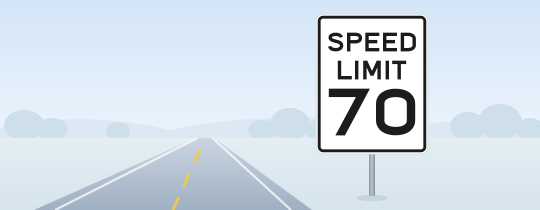
Indiana law allows up to 70 mph for cars on which of these roads?
Show answer
Correct answer: Interstates outside urbanized areas
Why
The 70 mph maximum applies on interstates outside urbanized areas, and trucks over 26,000 pounds are held to 65 there. Rural four-lane divided highways that aren’t interstates are generally capped at 60, I-465 has a limit of 65 set in state law, and roads with no other limit default to 55.
17Safe driving
Driving at night with your high beams on, how close can an oncoming vehicle get before Indiana law requires you to dim them?
Show answer
Correct answer: 500 feet
Why
Switch to low beams within 500 feet of an oncoming vehicle, and within 200 feet when you’re following another car. Headlights themselves must be on from sunset to sunrise and whenever you can’t see people and vehicles 500 feet ahead.
18Road signs
A yellow diamond sign with a horse-drawn buggy appears on a rural Indiana road. How should you handle a buggy you catch up to?
Show answer
Correct answer: Slow down well back; its driver has the same rights and duties as you
Why
Buggy warning signs are part of Indiana’s set of warning signs, and the manual treats people driving horse-drawn vehicles or riding horses like any other road user. Close the gap slowly, watch for the driver’s hand signals, and pass only with plenty of room once the road ahead is clear.
19Sharing the road
You’re about to pass a cyclist on a two-lane road. How much space does Indiana law require between your car and the bike?
Show answer
Correct answer: At least 3 feet
Why
Indiana requires at least 3 feet of clearance when you pass a bicycle or e-bike, and the law even lets you pass a cyclist in a no-passing zone when it’s safe. Cyclists may ride in the travel lane and up to two abreast, so be patient and pass only when you can give them room.
20Right-of-way
Your light turns green just as a funeral procession is moving through the intersection ahead. How do you respond?
Show answer
Correct answer: Wait; the procession keeps the right-of-way even against the signal
Why
In Indiana a funeral procession has the right-of-way, even when the lights would otherwise stop it. Let the whole line pass before you go, and never cut into it. A police officer directing traffic outranks the signal too.
Round 3 · Questions 21–30
21Road signs
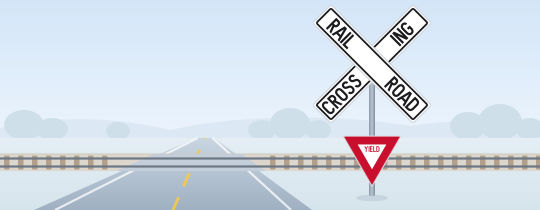
A railroad crossing ahead is marked by a white X-shaped crossbuck with a yield sign under it, and it has no lights or gate. How does the Indiana manual tell you to treat it?
Show answer
Correct answer: Like a yield sign: slow down, look both ways, and stop if a train is near
Why
A crossbuck alone works like a yield sign; a stop sign at the crossing would make the stop mandatory. If a train is coming, Indiana law has you stop no closer than 15 feet and no farther than 50 feet from the nearest rail. Once a train clears, check for a second one before you cross.
22Speed limits
On a highway with two lanes each way, you’re in the left lane and notice a faster car closing in behind you. What does Indiana law expect?
Show answer
Correct answer: Move right to let it pass when safe, unless you’re about to exit or turn left
Why
Indiana makes it an infraction to keep driving in the far-left lane once you know a faster vehicle is coming up behind you. The law’s exceptions cover heavy traffic, bad weather or obstructions, and getting ready to exit or turn left, so finish any pass and then move over. Tapping the brakes at a tailgater only invites a crash.
23Alcohol & phones
You’re 30 and driving. Under Indiana’s phone law, which of these is allowed while the car is moving?
Show answer
Correct answer: Talking through a hands-free, voice-controlled setup
Why
Indiana bars every driver from holding or using a phone while the vehicle is moving unless it’s hands-free or voice-operated; a real emergency call to 911 is the exception. A violation puts 4 points on your record. Mount the phone and set your route before you shift into drive.
24Permit & teen rules
During your first 180 days with an Indiana probationary license, when does your nightly driving ban start and end, unless a licensed adult 25 or older rides in the front seat?
Show answer
Correct answer: 10 p.m. to 5 a.m.
Why
For the first 180 days, new probationary drivers stay off the road from 10 p.m. to 5 a.m. After that and until 18, the limits ease: no driving 11 p.m. to 5 a.m. on Sunday through Thursday nights, and none from 1 to 5 a.m. on Saturday and Sunday. In both stages, state law still allows trips to, from or during a job, a school-sanctioned activity or a religious event.
25Right-of-way
You’re circling through a two-lane roundabout when a tractor-trailer more than 40 feet long moves through in the lane beside you. What does Indiana law expect from you?
Show answer
Correct answer: Yield to the truck, slowing or stopping if needed until it’s through
Why
Indiana makes every driver approaching or driving through a roundabout yield to a vehicle at least 40 feet long or 10 feet wide that’s moving through at the same time, even if you entered first. Riding side by side with a big rig in a multi-lane circle is risky, so ease off, let it clear, and never change lanes inside the roundabout.
26Parking
The Indiana manual gives one wheel rule for parking downhill beside a curb and another for parking uphill beside one. Which pair is right?
Show answer
Correct answer: Downhill: wheels turned toward the curb. Uphill: turned away from it
Why
Pointing downhill, wheels angled into the curb mean the car rolls into it, not into traffic, if the brakes let go. Pointing uphill, angle them away so the tire rests against the curb as the car settles back. On a hill with no curb, aim them toward the road’s edge, away from the travel lanes.
27Safe driving
Under Indiana law, what turns ordinary bad driving into aggressive driving?
Show answer
Correct answer: Three or more listed acts, such as tailgating, in a single trip
Why
Indiana counts it as aggressive driving when you commit at least three of the listed acts in one continuous trip: tailgating, unsafe stopping or slowing, needless horn use, failing to yield, ignoring traffic controls, unsafe speed, repeated headlight flashing and more. If someone drives that way around you, let them go and keep your distance.
28Lane markings
On a city street, the lane beside yours is painted solid green. Who is it meant for?
Show answer
Correct answer: Bicycles
Why
Green-painted pavement highlights a bike lane, while red marks a bus or transit lane. Don’t drive or park in a bike lane, yield to riders using it, and check behind you for bikes before you open your door.
29Sharing the road
A motorcycle rider has waited at a red light that just won’t turn green. Under Indiana law, what may the rider do?
Show answer
Correct answer: Go through after stopping for at least 2 minutes, with caution
Why
Indiana lets riders of motorcycles, motor-driven cycles and bicycles proceed through a steady red after waiting at least 120 seconds when the light won’t change, as long as they yield and go carefully. Autocycles don’t get this option. As a driver, don’t be surprised when a rider moves on a red at a long light.
30Crashes & emergencies
Your car breaks down on a curving stretch of highway. How far behind it does the Indiana manual say to place a reflective triangle?
Show answer
Correct answer: 500 feet
Why
The manual’s breakdown checklist puts the triangle 200 feet behind your car on an ordinary stretch and 500 feet back on a hill or curve, so drivers coming around the bend get warning in time. Pull as far onto the shoulder as you can, switch on your hazard lights and get out on the passenger side.
Round 4 · Questions 31–40
31Road signs
Which kind of place does a five-sided sign in fluorescent yellow-green, showing two people walking, warn you about?
Show answer
Correct answer: A school area
Why
The Indiana Driver’s Manual assigns the pentagon to school areas, and fluorescent yellow-green is the color for warnings about schools, pedestrians, bicycles and playgrounds. Slow to the posted school-zone limit; many Indiana school zones apply from 7 a.m. to 4:30 p.m. on weekdays or whenever the beacons flash.
32Right-of-way
An ambulance with its siren on and red lights flashing is coming up behind you on a city street. What does Indiana law require?
Show answer
Correct answer: Pull to the right edge, clear of any intersection, and stop until it passes
Why
Yield, move to the right-hand edge of the road clear of the intersection, and stay stopped until the emergency vehicle has gone by. Failing to yield to one costs 6 points on your Indiana record, the same as following too closely.
33Alcohol & phones
You’re 20 with a probationary license. Which phone use does Indiana allow while you drive?
Show answer
Correct answer: A call to 911 in an emergency
Why
Indiana’s rule for drivers under 21 is strict: no phone or other telecommunications device at all while driving, hands-free included. The one exception is calling 911 in an emergency. The ban is tied to age, not experience, so it covers every driver under 21, however long they’ve been licensed.
34Speed limits
Signs announce WORKSITE ADDED PENALTIES as you enter an orange-coned work zone. If a police officer tickets you for speeding there, what’s the smallest fine for a first offense?
Show answer
Correct answer: $300
Why
When an officer writes the ticket, Indiana’s work-zone speeding fines start at $300 for a first offense, climb to at least $500 for a second within three years, and hit $1,000 for a third in that span. Work-zone limits are always set at least 10 mph below the usual limit, and some apply only while lights flash, so read every orange sign.
35Permit & teen rules
You’re 16 and got your probationary license last month. Which passenger may ride with you without a licensed adult 25 or older in the front seat?
Show answer
Correct answer: Your younger brother
Why
For the first 180 days with a probationary license, Indiana bars passengers unless a licensed driver 25 or older (or a licensed spouse 21+, or a driving instructor) sits up front. Family is the exception: your own child or stepchild, a brother or sister (step- and half-siblings count) or your spouse may ride, and state law adds a parent, guardian or grandparent. Fewer friends in the car means fewer distractions while you build skill.
36Road signs
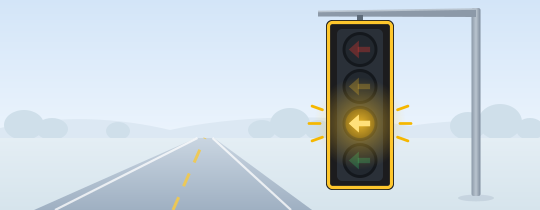
Over the left-turn lane, the signal shows only a flashing yellow arrow. What may you do?
Show answer
Correct answer: Turn left once you’ve yielded to oncoming cars and pedestrians
Why
A flashing yellow arrow permits the turn but doesn’t protect it: oncoming cars and anyone in the crosswalk still go first. Pull up, wait for a safe gap, then turn. A flashing red light would mean something different: a full stop first, as at a stop sign.
37Safe driving
You’ve just missed your exit on an Indiana interstate. What’s the right move?
Show answer
Correct answer: Continue to the next exit and turn around there
Why
Never back up toward a missed exit, and never U-turn on an interstate: the median crossovers are for emergency and highway maintenance vehicles only. Take the next exit and find your way back from there. Stop on the shoulder only for a real emergency.
38Alcohol & phones
After a party, a passenger in your car has a half-finished bottle of wine. Where may it legally ride while you drive on an Indiana highway?
Show answer
Correct answer: Locked in the console, or in the trunk
Why
Indiana bans opened or partly emptied alcohol containers anywhere in the passenger area, whether the car is moving or stopped along the road, and the rule covers everyone inside. Put it in a locked console or the trunk; in a vehicle with no trunk, behind the last upright seat.
39Permit & teen rules
Since July 1, 2026, what’s the earliest age for an Indiana probationary license if you’ve completed driver education?
Show answer
Correct answer: 16
Why
A 2026 law lowered the age for driver ed graduates to 16; it used to be 16 years and 90 days. Skip driver ed and the minimum rises to 16 years and 270 days. Either way, you need 180 days on your permit and 50 logged practice hours, 10 of them at night.
40Sharing the road
On a four-lane highway divided by a grassy median, a school bus on the other side stops with red lights flashing and its stop arm out. What should you do?
Show answer
Correct answer: Continue with caution; you don’t have to stop
Why
When a barrier or an unpaved median separates you from the bus, only traffic heading the same way as the bus has to stop, and you may go on with care. On roads without that kind of separation, drivers from both directions stop and wait until the arm is pulled back. Passing a stopped bus illegally can cost your license for 90 days.
Indiana BMV knowledge exam at a glance
What to know before you walk into a BMV branch.
Indiana · BMV knowledge exam
80% on each part.
2 sections · Signs and rules
At least 80% right in each part
$9for your learner’s permit
Walk-inat a BMV branch; come 30+ minutes before closing
Next dayretest the next business day after a fail
Spanishone of many languages offered for the exam
180 dayshow long a passed exam stays valid
20/40vision for a license with no restriction
Under 18? Your road to a license
15Learner’s permitEnroll in driver ed (30 hours of class plus 6 behind the wheel), then pass the vision screening and the knowledge exam. Skipping driver ed? The permit waits until 16.
6 moSupervised practiceHold the permit at least 180 days and log 50 hours, 10 after dark, with a licensed relative 25+, a licensed spouse 21+ or an instructor beside you.
16Probationary licenseFinished driver ed? Since July 1, 2026, you can be licensed at 16 once you pass the driving test. Without it, the minimum is 16 years and 270 days.
Day 1First 180 daysNo driving 10 p.m.–5 a.m. except for work, school activities or religious events, and no passengers beyond close family unless a licensed adult 25+ sits up front.
To 18Night limits and phone banNo driving 11 p.m.–5 a.m. Sunday through Thursday nights or 1–5 a.m. on weekends until 18, and no phone at all, even hands-free, until 21.
18 or older and never licensed? Same core steps: vision screening and knowledge exam, practice with any licensed driver 25+ (or your spouse 21+), at least 180 days on the permit, 50 logged hours with 10 at night, then the driving test.
What’s on the Indiana permit test
Everything on the exam comes from the Indiana Driver’s Manual (July 2026 edition): road signs from chapter 6, and traffic laws from chapters 6 through 8 on signals, safe vehicle operation, crashes and emergencies. Start with these six areas.
Road signs
Shapes speak first: an octagon means STOP, a pentagon marks a school area, a pennant warns of a no-passing zone.
Fluorescent yellow-green flags schools, pedestrians and bikes; orange means a work zone, where Indiana posts added penalties.
An orange triangle with a red border marks a vehicle limited to 25 mph; a buggy sign means horse-drawn traffic ahead.
Right-of-way
A dark traffic signal works like an all-way stop: stop, then go in turn.
Entering a roundabout, yield to traffic already circling and to any truck 40 feet or longer moving through.
School bus with red lights and stop arm out: stop from both directions, unless a barrier or unpaved median divides the road.
Speed limits
No sign? 30 mph in an urban district, 15 in an alley, and 55 where no other limit applies.
70 mph is the top limit in Indiana law, on interstates outside urbanized areas; heavy trucks max out at 65.
Work-zone limits sit at least 10 mph below normal, and a first ticket costs at least $300.
Parking
Park at least 15 feet from a hydrant and 20 feet back from an intersection’s crosswalk.
Leave 30 feet before a stop sign or signal; at a railroad crossing, stay 50 feet clear of the closest rail.
Parallel parking: right wheels within 12 inches of the curb. Facing downhill, turn them toward it.
Alcohol & phones
BAC lines: 0.08 for any driver, 0.04 in a commercial vehicle, and just 0.02 if you’re under 21.
Refuse a chemical test and your license is suspended for a year.
Every driver must go hands-free; under 21, no phone at all except a 911 call.
Teen rules
Under 18 with a permit, your supervisor is a licensed relative 25+, a licensed spouse 21+ or an instructor.
First 180 days licensed: no driving 10 p.m.–5 a.m. and no passengers beyond close family without a licensed adult 25+ up front.
Drop out, get expelled or skip school habitually, and the BMV suspends your driving privileges.
Indiana numbers to know
Six Indiana figures to lock in before you head to the branch.
2–3 secfollowing distance behind the car ahead
15 ftminimum gap between your parked car and a hydrant
15–50 fthow far back from the closest rail you stop for a train
500 ftdim your high beams for an oncoming car
3 ftof space when you pass a cyclist
0.02%blood alcohol limit if you’re under 21
Your Indiana course, in your pocket
These 40 questions are just the warm-up. The app gives you 489 Indiana practice questions, 36 short lessons and the why behind every answer.
36 short lessonsFour levels, from fundamentals to expert, then a full practice exam.
489 Indiana questions339 of them with pictures.
Your most-missed questionsA review lesson built from the questions you miss most.
Exam simulatorTake full practice exams and watch your readiness grow.
Indiana permit
Your Indiana path is ready.
36 lessons, 489 questions and full practice exams. In English and Spanish.
What score do I need to pass the Indiana BMV permit test?
80% on each section. The exam is split into a road-sign section and a traffic-law section, and the Bureau of Motor Vehicles (BMV), Indiana’s answer to the DMV, scores them separately, so a strong signs score can’t cover for a weak rules score. The BMV doesn’t publish a set question count; what matters is clearing 80% in both parts.
How many times can I take the Indiana knowledge exam?
The BMV doesn’t publish a limit on attempts. If you fail, you can test again on the next business day. Once you pass, the result stays valid for 180 days.
Can I take the Indiana permit test online?
Not yet. Right now the knowledge exam is taken in person, on a computer at a BMV branch, and you don’t need an appointment: walk in at least 30 minutes before the branch closes. Book ahead only if you want the exam read aloud or need an interpreter. A 2026 state law allows a BMV-approved online exam starting January 1, 2027, so check the BMV site if you test after that.
Can I take the Indiana permit test in Spanish?
Yes. Spanish is one of many languages the BMV offers for the knowledge exam, and if your language isn’t on the list you can bring your own interpreter by appointment. The BMV also posts a Spanish manual, the Manual del Conductor de Indiana, but that edition dates from February 2023, before the 2026 change that lets driver ed graduates get licensed at 16. This practice test and the app are in Spanish too.
How old do you have to be to get a permit in Indiana?
15, if you’re enrolled in a BMV-licensed driver ed course that includes behind-the-wheel training; otherwise 16. Hold the permit at least 180 days and log 50 supervised hours, 10 at night. With driver ed done, you can get a probationary license at 16; without it, at 16 years and 270 days. For the first 180 days, no driving 10 p.m.–5 a.m. and no passengers unless a licensed adult 25+ rides up front (close family excepted).
How much does an Indiana learner’s permit cost?
$9, and the permit is good for two years. The BMV’s fee chart lists no separate charge for the knowledge exam, and the BMV doesn’t charge for the driving test it gives. A standard driver’s license costs $17.50 for drivers under 75.
How do I book the Indiana driving test?
Make an appointment 48 hours to 3 weeks ahead at a BMV branch, or test with a driver training school in the BMV’s program. Arrive 15 minutes early in your own registered, insured car. Running a stop sign or signal, speeding, skipping your seat belt or not stopping for a school bus means an automatic fail, and after a fail you wait 7 days to retest.
What’s the best way to study for the Indiana permit test?
Read chapters 6 to 8 of the Indiana Driver’s Manual, then practice until you clear 80% on signs and on rules without guessing. Start with the 40 questions above, then let the app take you through 489 Indiana questions and 36 short lessons, each answer explained.