Get ready for the NH DMV knowledge test: 40 free questions covering New Hampshire road signs, speed limits, DUI and phone laws, and the Youth Operator rules for new drivers. Choose an answer and a short explanation appears instantly.
Four rounds of 10 questions: New Hampshire signs, who yields to whom, speed and parking rules, DUI and phone laws, and Youth Operator limits. Every answer comes with a short, plain-English explanation.
Round 1 · Questions 1–10
1Speed limits
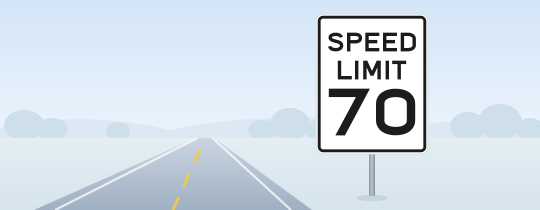
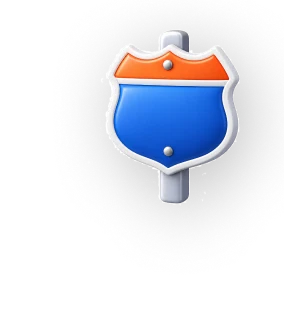
New Hampshire law sets a 70 mph limit, like the one on this sign, for just one stretch of highway. Where is it?
Show answer
Correct answer: On I-93 between mile marker 45 and the Vermont border
Why
Most New Hampshire interstates and the four-lane divided turnpikes cap out at 65 mph. The single exception is I-93 north of mile marker 45, all the way up to the Vermont line. These are absolute maximums, so even 1 mph over breaks the law, and bad weather can call for far less.
2Teen license rules
What does a 15½-year-old in New Hampshire need before practicing behind the wheel?
Show answer
Correct answer: Proof of age and a qualified supervisor in the front seat
Why
New Hampshire issues no learner’s permits. From 15½, you may practice as long as you carry proof of age, drive a non-commercial vehicle and have a qualified supervisor beside you. The knowledge test comes later, when you apply for your license at 16 or older.
3Right-of-way
Just after a pickup has stopped at the street on your left, you halt at the same four-way stop. Who goes first?
Show answer
Correct answer: The pickup, because it arrived first
Why
New Hampshire’s manual runs four-way stops on a first-come, first-served basis. The yield-to-the-right rule only settles a tie, when two cars stop at the same moment. Here the pickup was clearly first, so let it go and catch the other driver’s eye before you roll.
4Alcohol & phones
After two beers at a cookout in Concord, a 19-year-old driver’s breath test reads 0.03. Is that a violation in New Hampshire?
Show answer
Correct answer: Yes, because the limit under 21 is 0.02
Why
For drivers under 21, New Hampshire draws the line at 0.02, so a 0.03 reading is over it, and the manual notes that even 0.02 can affect your driving. Adults are held to 0.08, and a driver impaired by any drug, even prescription or over-the-counter medicine, can be charged at any reading. Coffee and cold air don’t help: only time clears alcohol, about an hour per ounce.
5Parking
How much curb must you leave between your parked car and a fire hydrant in New Hampshire?
Show answer
Correct answer: At least 15 feet
Why
Parking or standing within 15 feet of a hydrant breaks New Hampshire law, so firefighters can hook up a hose without hunting for space. The same statute adds 20 feet from an intersection crosswalk and 30 feet on the approach to a STOP sign or signal. Treat the three numbers as a set.
6Road signs
Traffic on I-93 slows as you pass a fluorescent pink sign. According to the color code in the New Hampshire Driver’s Manual, what does pink point to?
Show answer
Correct answer: A crash or other incident that crews are handling ahead
Why
The NH manual reserves pink for incident management: crashes and other traffic incidents that responders are handling right now. Orange belongs to road work, brown to recreation and purple to E-ZPass lanes. Expect sudden braking, closed lanes and people on foot near the scene.
7Safe driving
After an overnight storm, a thick slab of snow and ice covers your car’s roof. What does New Hampshire’s Jessica’s Law expect?
Show answer
Correct answer: Clear the snow and ice off the vehicle before you drive
Why
Since 2002, New Hampshire has expected you to brush the snow and scrape the ice off your entire vehicle, roof and hood included, before driving. If a chunk flies off and puts someone in danger, the charge can be negligent driving, with a $250 to $500 fine for a first offense. Keep a long-handled brush in the car all winter.
8Sharing the road
You’re traveling at 50 mph as you come up behind a bicyclist. What’s the least side clearance New Hampshire law accepts when you pass?
Show answer
Correct answer: 5 feet
Why
The law starts at 3 feet when you’re going 30 mph or less and adds a foot for each 10 mph above that, so at 50 mph you need at least 5 feet. If oncoming traffic won’t let you give that much room, stay behind until it can. Extra space also covers you if the cyclist swerves around a pothole.
9Teen license rules
A 17-year-old holds a Youth Operator license. During which hours is driving off-limits?
Show answer
Correct answer: 1 a.m. to 4 a.m.
Why
New Hampshire’s curfew for Youth Operators under 18 runs from 1 to 4 a.m. Breaking it, or the passenger limit, can cost up to $100 and as much as 30 days without a license the first time. The curfew ends when you turn 18, even though the Youth Operator license itself lasts until 21.
10Right-of-way
You’re following this school bus along a two-lane road in Rochester when it halts, red lights flashing and stop arm out. How far back does New Hampshire law require you to stop?
Show answer
Correct answer: At least 25 feet
Why
New Hampshire sets the gap at 25 feet or more, and drivers coming from the other direction must stop too. Hold your position until the bus starts moving again or its red lights shut off, because children may be crossing in front of it. A first violation costs $150.
Round 2 · Questions 11–20
11Road signs
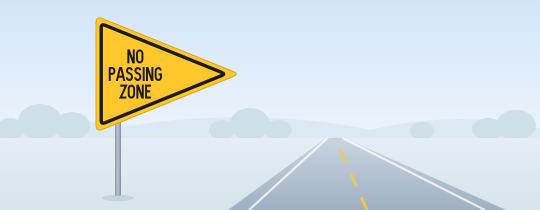
On a two-lane road near Plymouth, a yellow pennant tapering to a point appears beside the left edge of the pavement. What should you take from it?
Show answer
Correct answer: From here on, you may not pass
Why
The pennant marks where a no-passing zone begins, and it’s posted along the left edge of the pavement, right where a driver eyeing a pass would look. From that point on, stay in your own lane. The manual also forbids passing on curves and hills, at intersections, before a railroad crossing or bridge, and on the shoulder.
12Alcohol & phones
After a first-ever DUI arrest, a New Hampshire driver says no to a breath test. What does that refusal cost?
Show answer
Correct answer: 180 days without a license
Why
Driving in New Hampshire means you’ve already consented to a blood, breath or urine test after an alcohol or drug arrest. Saying no the first time means a 180-day suspension; with a prior DUI or refusal on record, it’s two years. A DUI conviction carries its own penalties: no less than a $500 fine and a revocation of 9 months to 2 years.
13Speed limits
Where no speed limit is posted, which pair of New Hampshire default limits is correct?
Show answer
Correct answer: 30 mph in a business district, 35 mph in a rural residence district
Why
State law sets 30 mph for business and urban residence districts and 35 mph for rural residence districts. Most other roads default to 55 mph, or 45 on an unimproved rural highway. Whatever the default, conditions can demand less, because your speed must always be reasonable and prudent.
14Teen license rules
Your 22-year-old cousin has been licensed for years. Can he supervise your practice drives in New Hampshire?
Show answer
Correct answer: No, a supervisor who isn’t a parent, guardian or instructor must be 25 or older
Why
New Hampshire’s list is short: a certified driving instructor, your parent or legal guardian, or a responsible licensed adult aged 25 or older, seated beside you. That supervisor is legally liable for any traffic violation you commit, so choose someone who takes the job seriously.
15Safe driving
As the car ahead passes a road sign, you start counting. In daylight on a road you know, what’s the least you should count before you reach the same sign?
Show answer
Correct answer: Four seconds
Why
New Hampshire’s manual sets the floor at four seconds, measured from a fixed point the car ahead has just passed. Add at least one more second at night, and two more on an unfamiliar road after dark. Following too closely can also bring a $100 ticket.
16Parking
You find a curb space in Nashua whose front end sits 25 feet before a STOP sign. May you leave your car there?
Show answer
Correct answer: No, you need at least 30 feet
Why
A car parked closer than 30 feet to a STOP sign or traffic signal can block other drivers’ view of it, so New Hampshire forbids it. At 25 feet you’re 5 feet inside the zone; look for another spot. Train crossings call for a bigger buffer still: 50 feet from the closest rail.
17Right-of-way
Across a raised median on a divided highway, a school bus going the opposite way has stopped with its red lights on. What should you do?
Show answer
Correct answer: Continue with care, since you don’t need to stop
Why
New Hampshire’s stop rule has one exception: traffic on the other side of a highway divided into separate roadways may keep going. On an undivided road, everyone stops: drivers behind the bus and drivers coming toward it. Passing a stopped bus on the right can cost $500 plus a suspension of up to 30 days.
18Lane markings
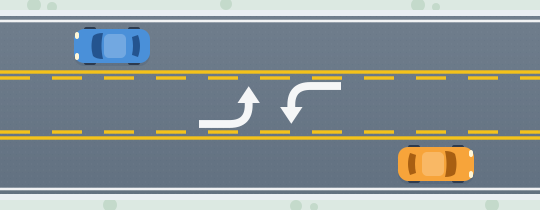
This road’s center lane has a solid yellow line on each outer edge and a dashed one inside, with turn arrows facing opposite ways. What is it for?
Show answer
Correct answer: Only for left turns, by traffic from either direction
Why
Drivers from both directions share it to make left turns, and nothing else. The New Hampshire manual forbids passing in it or using it to travel down the road. Enter it shortly before your turn, signal, and keep an eye out for someone turning toward you from the other end.
19Crashes & emergencies
After a fender-bender that no police officer investigated, the repairs look like about $1,500. What does New Hampshire require?
Show answer
Correct answer: A written report to the DMV within 15 days
Why
If anyone is hurt or killed, or the damage tops $1,000, New Hampshire wants a written report (form DSMV 400) at the DMV within 15 days, unless a police officer investigated the crash. At the scene, stop and swap names, addresses, license, insurance and registration details. If you can’t tell whether repairs will pass that amount, file anyway.
20Road signs
At a quiet intersection, the signal facing you flashes red, on and off. What’s required of you?
Show answer
Correct answer: Come to a full stop, then proceed once it’s safe, as you would at a STOP sign
Why
A blinking red light carries the same duty as a STOP sign: wheels fully stopped, yield, then proceed when it’s safe. Blinking yellow is the one that only asks you to slow down and take care. And when a police officer is waving traffic through, follow the officer, whatever the light shows.
Round 3 · Questions 21–30
21Speed limits
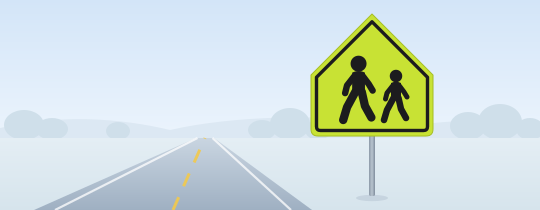
You pass this five-sided yellow-green sign as you enter a posted school zone, 20 minutes before classes begin. What speed limit applies?
Show answer
Correct answer: 10 mph below the usual posted limit
Why
New Hampshire’s school-zone limit is 10 mph under the normal posted speed. It runs from 45 minutes before school opens until it opens, and from closing time until 45 minutes after, so 20 minutes before the bell is well inside the window. Expect children darting out between parked cars.
22Alcohol & phones
A text buzzes in while you wait at a red light in Manchester. Can you pick up the phone to read it?
Show answer
Correct answer: No, because the hand-held ban covers you while stopped in traffic too
Why
New Hampshire’s hand-held ban covers you while driving and while you’re halted at a light or stuck in traffic; only pulling off the road to a spot where stopping is legal lets you pick up the phone. Adults may use hands-free calling and a mounted or voice-guided GPS. Fines start at $100 and climb to $250, then $500, for repeat offenses within 24 months.
23Road signs
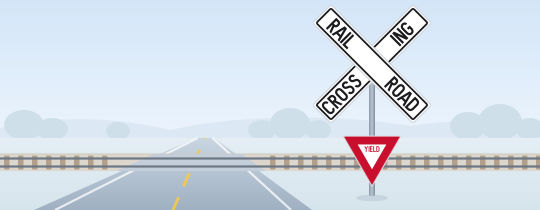
A railroad crossing ahead is marked by nothing but a white X-shaped sign above a YIELD sign: no flashing lights, no gate. A train is coming. Where does New Hampshire law tell you to stop?
Show answer
Correct answer: Between 15 and 50 feet back from the closest rail
Why
That white X, the crossbuck, stands at the crossing itself; without lights or a gate, spotting trains is up to you. When one is approaching, New Hampshire wants your front bumper at least 15 feet from the closest rail, yet no more than 50 feet back. Go only after it has passed and you can see the track is clear in both directions.
24Teen license rules
How many hours of supervised practice does a New Hampshire teen have to log before applying for a license?
Show answer
Correct answer: 40 hours, including 10 at night
Why
Teens under 18 certify 40 hours behind the wheel with a parent or guardian, at least 10 after dark, on top of driver education. Logging may begin at 15½, and the hours go on the DSMV 509 log you bring to the DMV. Mix in rain, snow and highway miles, not just easy trips.
25Safe driving
Which of these conditions makes headlights mandatory in New Hampshire?
Show answer
Correct answer: Snow so heavy that you can’t clearly see vehicles 1,000 feet away
Why
Lights go on 30 minutes after sundown and stay on until 30 minutes before sunup, plus any time rain, snow or fog hides people and vehicles 1,000 feet ahead. In fog or falling snow, use low beams, because high beams bounce glare back at you. Switching them on early costs nothing.
26Parking
Which of these spots is illegal for parking in New Hampshire?
Show answer
Correct answer: On a bridge
Why
New Hampshire bans stopping or parking on a bridge, in a highway tunnel, on sidewalks and crosswalks, in an intersection and beside a car already parked at the curb. The other three spots clear the state’s minimums: 50 feet from a rail, 30 feet before a STOP sign and 15 feet from a hydrant. Parking in a disability space without a placard costs at least $250.
27Right-of-way
Halfway around a roundabout, you hear a siren and spot flashing lights in your mirror. What does the New Hampshire manual tell you to do?
Show answer
Correct answer: Carry on to your exit, get out of the circle, then pull over
Why
A car stopped in the circle can trap the emergency vehicle behind it. Drive out at your exit, then move to the right and stop until it passes. Before you enter any roundabout, yield to traffic already circulating in both lanes, and give big trucks room, since they may straddle both.
28Lane markings
Down the middle of your two-lane road run two yellow lines: dashed on your side, solid on the other. What does that mean?
Show answer
Correct answer: You may pass when it’s safe, but oncoming drivers may not
Why
With a double center line, read the line closest to you: broken lets you pass when the way is clear, solid means you stay put. Yellow lines mark where opposing traffic meets; white lines separate lanes headed the same way. Never pass on the shoulder, paved or not.
29Crashes & emergencies
New Hampshire doesn’t make drivers buy auto insurance. What happens if you cause a crash without coverage?
Show answer
Correct answer: You owe the damages yourself, and if you can’t pay, the DMV suspends your license until they’re settled
Why
New Hampshire has no mandatory insurance law, but a driver who causes a crash without coverage can be held responsible for every repair and medical bill. If you can’t pay, the DMV suspends your license until the claims are settled, and an uninsured crash can also mean filing SR-22 proof of insurance for years. A New Hampshire liability policy must carry at least 25/50/25 coverage.
30Alcohol & phones
At 17, with a Youth Operator license, which phone use is allowed behind the wheel?
Show answer
Correct answer: Calling 911 about a crash you just passed
Why
New Hampshire keeps drivers under 18 off phones and other mobile devices completely, even hands-free ones. Reporting an emergency to 911 or another public safety agency is the only exception for calls; following a mounted or voice-guided GPS is still fine. For anything else, find a safe place to park first.
Round 4 · Questions 31–40
31Sharing the road
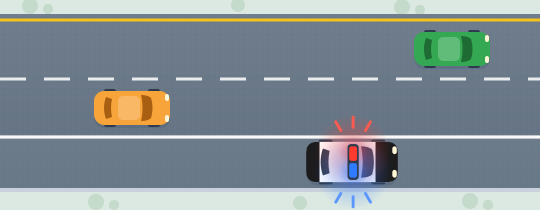
On I-95 near Portsmouth, a state trooper’s car sits on the right shoulder with red and blue lights flashing, as pictured. What does New Hampshire law expect from you?
Show answer
Correct answer: Slow down and give it a wide berth, moving a lane left if you safely can
Why
New Hampshire’s move-over rule, Sherrill’s Law, covers police stops, crashes, fires and road or utility work, and the current manual adds stopped vehicles showing hazard lights, flares or warning signs. Ease off the gas, shift away from the shoulder when traffic allows, and leave as much room as you can. Ignoring it brings a fine.
32Road signs
Approaching a STOP sign, you see no white stop line, but a crosswalk is painted across your lane. Where do you stop?
Show answer
Correct answer: Before the crosswalk
Why
New Hampshire sets the order: stop at the white line if there is one; if not, before the crosswalk; if there’s neither, before you enter the intersection. The wheels have to stop turning completely. If parked cars hide the cross street, stop first, then creep ahead until you can see.
33Speed limits
Traffic on I-89 is moving normally on a dry day. What is the slowest speed New Hampshire law allows you to drive there?
Show answer
Correct answer: 45 mph
Why
New Hampshire puts a 45 mph floor under its interstates whenever conditions make that speed safe. Creeping far below the flow forces others to brake and swerve around you, and impeding traffic is itself illegal. In snow, ice or thick fog, safety comes first and the minimum gives way.
34Teen license rules
You’re 16 and got your Youth Operator license four months ago. With no adult along, how many non-family passengers under 25 may ride with you?
Show answer
Correct answer: One
Why
For the first six months, a Youth Operator under 18 may carry only one non-family passenger under 25, unless a licensed adult 25 or older is also in the car. Separately, under-18 drivers may not have more occupants than seat belts. Keeping the car quiet helps you focus during those first months.
35Safe driving
Under New Hampshire law, your turn signal must blink without a break for at least how many feet before you turn at an intersection?
Show answer
Correct answer: 100 feet
Why
State law wants your signal running without a break for at least the final 100 feet before you turn. On the highway, the manual asks for 500 feet before a lane change or exit, and more in rain, snow or fog. Signaling early lets drivers behind you plan ahead instead of braking hard.
36Parking
You’ve parked on a sloping street in Portsmouth and are about to walk away. What does New Hampshire law require first?
Show answer
Correct answer: Engine off, key out, brake set and front wheels turned to the curb or roadside
Why
State law says an unattended car must have its engine stopped, its key removed and its brake set, and on any grade the front wheels must point toward the curb or roadside. Should the brakes fail, the tires catch the curb instead of rolling into traffic. Make it a habit on every slope, not just the steep ones.
37Right-of-way
A fire engine answering an alarm speeds past you. Once it’s ahead, how close may you follow it under New Hampshire law?
Show answer
Correct answer: No closer than 500 feet
Why
New Hampshire keeps drivers at least 500 feet behind fire apparatus on its way to an alarm. You also may not drive into or park within the block where it stops. Trailing it to cut through traffic puts you right where crews need room to work.
38Alcohol & phones
A friend leaving a dinner party has an opened, recorked bottle of wine to bring home in your car. Where may it ride under New Hampshire law?
Show answer
Correct answer: In the trunk
Why
Only alcohol in its original sealed container may travel in the passenger area. Once a bottle has been opened, even if it’s been recorked, it goes in the trunk. Breaking the rule brings a $150 fine, and the driver can also lose the license for 60 days.
39Safe driving
Which people does New Hampshire law require to wear seat belts?
Show answer
Correct answer: Drivers and passengers under 18
Why
New Hampshire’s belt law covers drivers and passengers under 18, and children under 7 must ride in a child restraint unless they’re at least 57 inches tall. Adults aren’t required to buckle up, but the state strongly urges it for everyone. A belt is your best protection in a crash.
40Speed limits
A road crew is working right next to your lane on a highway normally posted at 55 mph. Under New Hampshire’s speed law, what is the highest the work-zone limit can be?
Show answer
Correct answer: 45 mph
Why
New Hampshire sets the limit around workers on or near the road at least 10 mph under the normal posted speed, so a 55 zone drops to 45 or lower, and signs show the reduced figure. Even where no new limit is posted, the Driver’s Manual tells you to slow down in every work zone. Orange signs mark these areas, and posted fines there may be doubled.
New Hampshire DMV knowledge test at a glance
What to expect when you sit down at the DMV touch screen.
New Hampshire · DMV knowledge test
80% to pass.
40 questions · 4 choices each
32 of 40 answers right to pass
8 missesis your limit: a ninth wrong answer ends the test
40 minon the clock for all 40 questions
10 daysbefore you can retest after a fail
Spanishon screen and in audio, one of 8 test languages
In personby appointment at a DMV office; no online test
$10/yrYouth Operator license fee, test included
Under 18? Your road to a license
15½Start practicingNo permit in New Hampshire: carry proof of age and drive with a parent, guardian, driving instructor or licensed adult 25+ beside you.
15¾Driver edEnroll once you’re 15 years and 9 months old: 30 hours of class, 10 hours behind the wheel and 6 hours observing.
40 hLogged practiceRecord 40 supervised hours, at least 10 of them at night, on the DSMV 509 log that you and a parent sign.
16Youth Operator LicenseBring your green driver ed certificate, your log and the parent or guardian authorization (DSMV 38), then clear three tests: vision, knowledge and a road test.
16–17Limits until 18No driving 1–4 a.m., no phone even hands-free, and for the first 6 months just one non-family passenger under 25 unless a licensed adult 25+ is along.
18 or older? Driver education isn’t required: bring the DSMV 450 application, proof of identity and residency and the fee, then clear three tests: vision, knowledge and a road test. Until you turn 21, your card is a vertical Youth Operator license.
What’s on the New Hampshire knowledge test
Study the New Hampshire Driver’s Manual (DSMV 360, revised 11/25). By law, the exam must include questions on distracted driving, impaired driving and driving in poor weather. Here are the essentials in six key areas.
Road signs
Shapes first: eight sides for STOP, an upside-down triangle for YIELD, five sides for a school, a pennant for no passing.
Colors in the NH manual: orange for road work, brown for recreation, pink for incidents, purple for E-ZPass.
Round and yellow with RR? Tracks are coming up. The white X-shaped crossbuck stands at the crossing itself.
Right-of-way
Unmarked intersection? The car on the right goes first. At a four-way stop, whoever stops first goes first.
School bus with red lights flashing: stop 25+ feet back from either direction, unless a divided highway separates you.
Hear a siren? Move to the right edge, out of the intersection, and stop. Keep 500 feet behind fire trucks.
Speed limits
Your speed must always be reasonable and prudent for conditions, whatever the sign says.
No sign? 30 mph in business and urban residence districts, 35 in rural residence districts, 55 on most other roads.
65 mph on most interstates, 70 on I-93 north of mile marker 45, and a 45 mph interstate minimum.
Parking
Keep 15 feet from a hydrant, 20 from an intersection crosswalk and 30 short of a STOP sign or traffic light.
Stay 50 feet back from a railroad crossing’s closest rail, and never park on a bridge or sidewalk, or in a tunnel.
On any slope, point the front wheels toward the curb or roadside, set the brake and take the key.
Alcohol & phones
BAC limits: 0.08 at 21 and up, 0.02 under 21, 0.04 for commercial drivers.
Say no to a chemical test after a DUI arrest and your license is gone for 180 days; two years with a prior.
No hand-held phone for anyone, even at red lights. Under 18, no phone at all, hands-free included.
Teen rules
No permit: from 15½, practice with a parent, guardian, instructor or licensed adult 25+ beside you.
Under 18, no driving from 1 to 4 a.m., and never more people aboard than seat belts.
First 6 months: one non-family passenger under 25, unless a licensed adult 25+ rides along.
New Hampshire numbers to know
Six numbers from New Hampshire law and the Driver’s Manual to know cold before test day.
100 ftof signaling before a turn
4 secminimum following distance in daylight
25 ftback from a school bus with red lights flashing
15 ftbetween your parked car and a fire hydrant
3 ftto pass a cyclist at 30 mph or less, plus 1 ft per extra 10 mph
0.02%alcohol limit if you’re under 21
Your New Hampshire course, in your pocket
These 40 questions are just the warm-up. The app gives you 447 New Hampshire practice questions, 36 short lessons and the why behind every answer.
36 short lessonsFour levels, from fundamentals to expert, then a full practice exam.
447 New Hampshire questions315 of them with pictures.
Your most-missed questionsA review lesson built from the questions you miss most.
Exam simulatorTake full practice exams and watch your readiness grow.
New Hampshire driver’s license
Your New Hampshire path is ready.
36 lessons, 447 questions and full practice exams. In English and Spanish.
How many questions does the New Hampshire DMV knowledge test have, and how many must I get right?
The car test has 40 multiple-choice questions, each with four answer choices on a touch screen, and you get 40 minutes. You need 80% to pass, which means 32 right. The computer ends the test as soon as you miss a ninth question, and state law requires questions on distracted driving, impaired driving and bad-weather driving.
Do I need a learner’s permit in New Hampshire?
No. New Hampshire doesn’t issue learner’s permits, and a permit from another state doesn’t carry over. From 15½ you can practice with proof of age and a parent, guardian, certified driving instructor or licensed adult 25 or older beside you, then take the knowledge test when you apply for your license at 16.
What happens if I fail the NH knowledge test?
You wait 10 calendar days, then book a new appointment. Questions are drawn at random, so your retest won’t repeat the first one. Once you pass, the result stays good for one year, and you can schedule the road test, sometimes the same day if a slot is open.
Can I take the New Hampshire knowledge test online?
No. You test in person at one of the DMV’s offices, and every licensing test requires an appointment. Book online through the DMV’s scheduling system or call 603-227-4000; 14 offices around the state handle driver licensing, from Concord and Manchester to Gorham and Keene.
Can I take the New Hampshire DMV test in Spanish?
Yes. The automated test comes in Spanish both on screen and as audio through headphones, and it’s also offered in French, Portuguese, Arabic, Mandarin, Farsi and American Sign Language besides English. The Driver’s Manual is English-only, so studying with this page and the app, both available in Spanish, fills the gap.
What are the rules for teen drivers in New Hampshire?
You can apply at 16 after driver education (30 hours of class, 10 behind the wheel, 6 observing) and 40 logged practice hours, 10 at night, with a parent or guardian’s written consent. New drivers aged 16 to 20 get a Youth Operator License. Until 18 there’s no driving from 1 to 4 a.m. and no phone at all, hands-free included, and for the first 6 months only one non-family passenger under 25 may ride along unless a licensed driver aged 25+ is in the car.
How much does a New Hampshire driver’s license cost?
The knowledge test has no separate fee: it’s covered by the license fee you pay before testing. A Youth Operator license costs $10 for each year until you turn 21, capped at $50 in total, while a standard license is $50 and a REAL ID license $60. Fees aren’t refunded once you’ve taken a test.
How should I study for the New Hampshire DMV test?
Work through the New Hampshire Driver’s Manual (DSMV 360) one section at a time, and practice until 32 of 40 comes easily. These 40 questions make a good first lap; the app adds 447 New Hampshire questions and 36 short lessons, with every answer explained.