Prep for the NY DMV written test with 40 free questions covering signs, right-of-way, speed limits, parking and New York’s junior license rules. Tap an answer and get the explanation on the spot.
Four rounds of 10 questions on road signs, right-of-way, speed limits, parking, alcohol and New York’s junior license rules. Each answer comes with a short explanation.
Round 1 · Questions 1–10
1Right-of-way
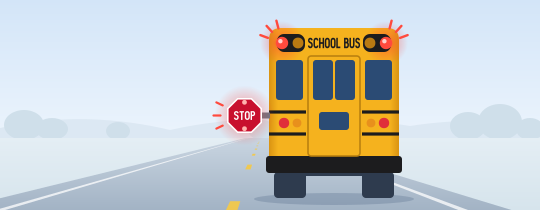
You are following a school bus on a two-lane road. It stops, its red lights begin to flash and the stop arm swings out, so you stop as well. When may you drive on?
Show answer
Correct answer: When the bus moves again, or its driver or a police officer signals you to go
Why
In New York, a school bus flashing red lights holds traffic from both directions, and you stay put until the bus pulls away or the bus driver or an officer waves you on. DMV advises stopping at least 20 feet back. Passing a stopped bus costs 8 points and a fine of $250 to $400 for a first offense.
2Road signs
On the New York permit test, 4 of the 20 questions are about road signs. Besides getting at least 14 answers right overall, what do you need to pass?
Show answer
Correct answer: At least 2 of the 4 road-sign questions right
Why
New York checks the sign questions on their own: you need at least 2 of the 4 right, even if your total reaches 14. Miss three signs and a strong overall score still fails. Learn each sign by its shape and color so you can name it before you can read it.
3Speed limits
You are driving on a rural New York highway where no speed limit is posted. What is the fastest you may legally drive?
Show answer
Correct answer: 55 mph
Why
When no other limit is posted, 55 mph is the maximum anywhere in New York State. Faster limits, up to 65 mph, apply only where signs show them, and New York City defaults to 25 mph. Even at 55, the basic speed rule still applies, so slow down when weather or traffic calls for it.
4Parking
You want to wait in your car beside a fire hydrant while a friend runs into a store. When may you stop within 15 feet of the hydrant in New York?
Show answer
Correct answer: When a licensed driver stays in the car, ready to move it
Why
New York bans parking, stopping and standing within 15 feet of a hydrant, with one exception: someone with a license stays behind the wheel, ready to drive off if fire crews need the space. Step out, even for a minute, and you are breaking the rule.
5Alcohol & phones
A 19-year-old driver is stopped and has a BAC of 0.03%. Under New York’s Zero Tolerance Law, what is the penalty for a first violation?
Show answer
Correct answer: A six-month license suspension plus a $125 civil penalty
Why
Drivers under 21 with a BAC of 0.02% to 0.07% lose their license for six months and pay a $125 civil penalty, plus a $100 fee to end the suspension. A second violation means the license is revoked for at least a year, or until you turn 21 if that is later. If you are under 21, plan on no alcohol at all before you drive.
6Safe driving
What following distance does the New York Driver’s Manual teach for normal driving conditions?
Show answer
Correct answer: A gap of two seconds or more
Why
New York teaches the two-second rule: when the vehicle ahead passes a fixed marker such as a sign or overpass, count off two seconds; if you reach the marker first, drop back. Stretch the gap to three or four seconds or more in bad weather or behind a big truck. Tailgating costs 4 points.
7Permit & teen rules
You are 17, live in Westchester and hold a Class DJ junior license. Can you drive yourself into Manhattan for a concert?
Show answer
Correct answer: No, a junior license does not allow driving anywhere in New York City
Why
A junior license (Class DJ) cannot be used anywhere in New York City’s five boroughs, under any circumstances. A 17-year-old who has completed approved driver education and holds a Class D license may drive anywhere in the state. If you will drive in the city often, DMV suggests holding off on the road test until 18 and practicing there on your permit, in a dual-control car with a parent or instructor.
8Road signs
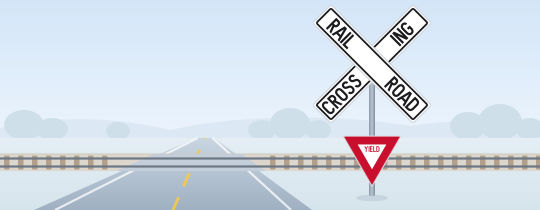
Where a road crosses railroad tracks, you see a white X-shaped sign reading RAILROAD CROSSING. What does it tell you to do?
Show answer
Correct answer: Yield to trains, and stop if one is approaching
Why
The crossbuck works like a YIELD sign for trains: slow down, look and listen both ways, and stop if a train is coming. Where several tracks cross the road, a small sign below the X shows how many, so after one train passes, check for another. A round yellow sign with an X and the letters RR warns that a crossing is ahead.
9Right-of-way
On a two-lane, two-way road, an ambulance with flashing red lights and a siren comes toward you in the oncoming lane. What should you do?
Show answer
Correct answer: Move to the right edge and stop until it has passed
Why
New York requires you to pull to the right and stop whenever an emergency vehicle approaches from any direction, including one heading toward you in the other lane. Stay stopped until it goes by. If you are inside an intersection when it appears, clear the intersection first, then pull over.
10Sharing the road
On a country road you come up behind someone riding a horse along the shoulder. What should you do?
Show answer
Correct answer: Slow down, pass with plenty of room and leave the horn alone
Why
Horses startle easily, and New York law forbids using your horn as you approach or pass one. Drop your speed, give the horse a wide margin and keep it steady until you are well past. Horse-drawn buggies carry the orange slow-moving vehicle triangle, so treat them with the same care.
Round 2 · Questions 11–20
11Speed limits
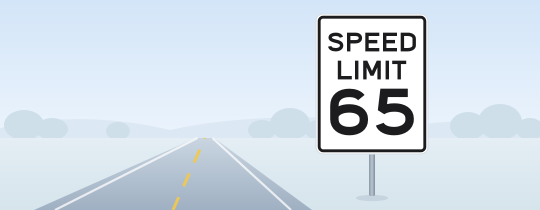
On the New York State Thruway you pass a white sign reading SPEED LIMIT 65. Which statement about that limit is true?
Show answer
Correct answer: It is the highest limit allowed on any New York road
Why
New York caps posted limits at 65 mph, and only qualifying highways such as the Thruway and some interstates may use it; expressways are normally 55 mph. A posted limit is the most you may drive in good conditions, so ease off in rain, fog, snow or heavy traffic.
12Right-of-way
You are on a four-lane highway divided by a grassy median. On the far side, facing the other way, a school bus sits at a stop, red lights blinking. What does New York law require?
Show answer
Correct answer: Stop and wait, even though the bus is across the median
Why
New York makes no exception for divided highways: a school bus showing flashing red lights stops traffic in both directions, on every road in the state and even in school parking lots. Stay stopped until the bus moves or the driver or an officer signals. Afterwards, drive slowly and watch for children along the roadside.
13Parking
How close to a STOP sign may you park on the side of the street where traffic approaches it?
Show answer
Correct answer: No closer than 30 feet
Why
New York keeps the last 30 feet before a STOP sign, YIELD sign, traffic light or flashing signal free of parked cars, so approaching drivers can see the sign and the cross street. Two more to know: a hydrant needs 15 feet of clear curb, and a crosswalk at an intersection needs 20.
14Alcohol & phones
You are 30 and your phone rings while you are driving. Which way of taking the call is legal in New York while the car is moving?
Show answer
Correct answer: Talking through a hands-free system without touching the phone
Why
New York bans talking on a hand-held phone and using any portable electronic device while the vehicle is moving, but hands-free calls are allowed. A conviction brings 5 points and a fine of $50 to $200 the first time, with higher fines for repeats. Set your music and navigation before you pull out.
15Permit & teen rules
You are 16, live in Rochester and hold a junior learner permit. Who could supervise your practice drive at 4 p.m.?
Show answer
Correct answer: Your 25-year-old neighbor with a valid license for the car, sitting beside you
Why
Every New York permit holder must drive with a supervisor aged 21 or older whose license covers the vehicle, sitting in the front seat; with a junior permit, that supervisor is the only front-seat passenger. Upstate, any such adult can supervise from 5 a.m. to 9 p.m.; later at night, only a parent or guardian, or a driver ed teacher or driving instructor. New York City is stricter still: dual-control cars and a parent, guardian or instructor only.
16Road signs
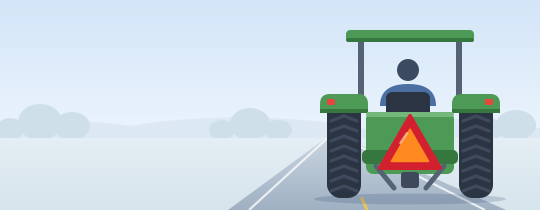
On a rural road you come up behind a tractor with an orange triangle edged in red on its back. What does that emblem tell you?
Show answer
Correct answer: The vehicle travels much slower than normal traffic
Why
The reflective orange triangle marks a slow-moving vehicle, such as farm equipment, road machinery, a horse-drawn buggy or a rural mail carrier. You will close the gap quickly, so ease off the gas early. Pass only where it is legal and you can see well ahead.
17Safe driving
It is midafternoon, but steady rain has you running the windshield wipers. What does New York law say about your headlights?
Show answer
Correct answer: Turn them on, because your wipers are in use
Why
New York requires headlights whenever you use the wipers because of rain, sleet, snow or hail, whenever you can see less than 1,000 feet ahead, and at night: they go on 30 minutes after the sun sets and stay on until 30 minutes before it rises. Daytime running lights and parking lights do not count. In rain or fog, stay on low beams so the light does not bounce back into your eyes.
18Lane markings
On a city street, a lane marked with white diamonds is reserved for buses during posted hours. Where the line beside it changes from solid to broken, what may an ordinary car do?
Show answer
Correct answer: Move into it to turn right at the next intersection
Why
A white diamond marks a lane set aside for buses, car-pools, bicycles or other special vehicles while the posted rules are in force. On city streets, a broken line beside it shows where other drivers may move in to turn right at the upcoming corner. Otherwise, stay out unless your vehicle meets the signed rules.
19Road signs
In New York, which kind of sign has a green background with white letters?
Show answer
Correct answer: A sign showing directions and distances to places
Why
Color tells you the type of sign before you can read it: green gives directions and distances, blue points to services, yellow warns of hazards, orange marks work areas, and most rules come in black on a white rectangle. Train your eye on color first, then read the details as you get closer.
20Alcohol & phones
A 17-year-old with a junior license is convicted of texting while driving for the first time. What happens to the license?
Show answer
Correct answer: A 120-day suspension
Why
For junior permit and license holders, a first phone or texting conviction brings a 120-day suspension. A second one within six months of getting the license back means a revocation lasting a year or more. The simple fix: put the phone out of reach before you start the car.
Round 3 · Questions 21–30
21Right-of-way
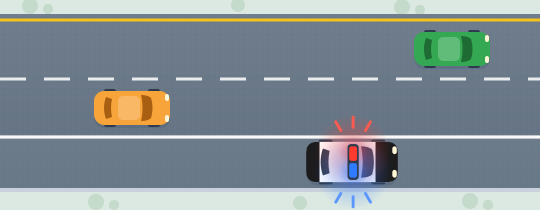
On an interstate with two lanes in your direction, you are in the right lane when you spot a police car stopped on the shoulder ahead with its emergency lights flashing. What does New York’s Move Over Law require?
Show answer
Correct answer: Slow down and, when it is safe, move out of the lane next to the shoulder
Why
The Move Over Law applies on every road: slow down and take extra care around emergency or hazard vehicles stopped with lights flashing. On interstates, parkways and other multi-lane controlled-access highways, you must also leave the lane beside the stopped vehicle when it is safe to change lanes. There, the law covers any vehicle stopped on the shoulder, so give a stranded car the same room.
22Road signs
A STOP sign stands at a corner with no white stop line and no crosswalk marked on the pavement. Where should you stop?
Show answer
Correct answer: Just short of the intersection, at the first spot with a clear view of cross traffic
Why
Work down the list: a stop line comes first; with no line, stop before the crosswalk; with neither, stop where you first get a clear look at cross traffic, still short of the intersection. Yield to pedestrians and vehicles, then go when it is safe.
23Speed limits
You are driving through Queens on a street with no speed limit signs. What is the limit?
Show answer
Correct answer: 25 mph
Why
New York City has its own default: 25 mph unless a sign shows a different limit. Crowded crosswalks, double-parked trucks and cyclists leave little room for error, and a lower speed buys you time to react. Outside the city, the statewide default is 55 mph.
24Parking
You are looking for a parking space on the street opposite a fire station’s driveway. How far from the driveway must you stay?
Show answer
Correct answer: 75 feet
Why
New York sets two distances for fire stations: 20 feet from the driveway on the same side of the street and 75 feet on the opposite side. Picture a long ladder truck swinging out of the station; the extra room on the far side gives it space to make the turn.
25Alcohol & phones
A driver arrested for DWI in New York refuses a chemical test. What happens, even if a court later clears the driver of DWI?
Show answer
Correct answer: At least a one-year revocation and a $500 civil penalty
Why
By driving in New York, you are treated as having agreed to a chemical test. Refusing carries its own penalty: at least a one-year revocation and a $500 civil penalty, or $750 for a repeat within five years, no matter how the DWI case ends. A refusal also triggers a $250 Driver Responsibility Assessment each year for three years.
26Safe driving
Driving at night with your high beams on, you catch up to a car traveling ahead of you. Within what distance of it must you switch to low beams?
Show answer
Correct answer: 200 feet
Why
New York requires low beams once you are 200 feet or less behind another car, and once an oncoming vehicle is 500 feet away or closer. Bright lights in a mirror can dazzle the driver ahead as badly as they blind oncoming traffic. Headlights reach only about 350 feet, so at night keep to a speed that lets you stop within that distance.
27Permit & teen rules
Before the road test, New York applicants under 18 hand in form MV-262 certifying their supervised practice. What must it show?
Show answer
Correct answer: At least 50 hours, 15 of them after sunset
Why
Junior permit holders must log 50 or more hours behind the wheel with a supervisor, at least 15 of them after sunset, and a parent or guardian signs MV-262 to confirm it. DMV also recommends spending at least 10 of those hours in moderate to heavy traffic. Bring the signed form to the examiner on road test day.
28Lane markings
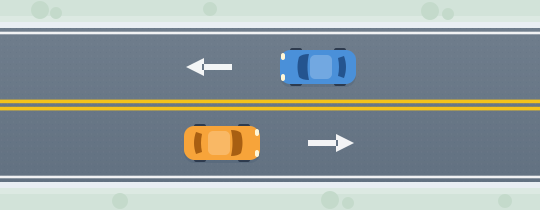
A two-lane road has two solid yellow lines down the center. When may you cross them?
Show answer
Correct answer: Only to turn left into or out of a driveway, or to make a legal U-turn
Why
Double solid lines rule out passing and lane changes for traffic in both directions. The exception is a left turn into or out of a driveway, or a legal U-turn. Yellow center lines always divide traffic moving in opposite directions, so crossing them to pass puts you head-on with oncoming cars.
29Right-of-way
A pickup truck showing a flashing blue light comes up behind you on a country road. What does the blue light mean in New York?
Show answer
Correct answer: A volunteer firefighter is answering a call; yield as a courtesy if it is safe
Why
New York lets volunteer firefighters show blue lights on their personal cars, and volunteer ambulance or rescue members show green. These are not emergency vehicles, so the law does not make you yield, but let them by as a courtesy when you safely can. Amber lights mark hazard vehicles such as snowplows and tow trucks.
30Crashes & emergencies
You back into a parked car, causing about $1,800 in damage, and track down the owner to swap information. No one is hurt. What else does New York require within 10 days?
Show answer
Correct answer: File a Report of Motor Vehicle Crash (MV-104) with DMV
Why
You must report a crash to DMV on form MV-104 within 10 days if anyone is hurt or killed, or if any one person’s property damage is more than $1,000. Not reporting is a misdemeanor and can cost you your license. After hitting a parked car, track down the owner or call the police before you leave.
Round 4 · Questions 31–40
31Road signs
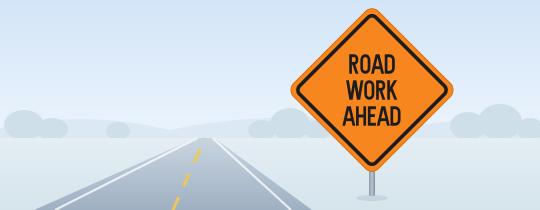
On a Sunday you pass an orange diamond-shaped sign reading ROAD WORK AHEAD, but no workers or machines are in sight. If you speed through the work zone, what happens to the fine?
Show answer
Correct answer: It doubles, even with no workers or equipment around
Why
In New York, speeding fines double in a work zone whether or not a crew is on site, and a speeding conviction there carries 8 points. Lanes can shift or narrow without notice, so keep to the posted limit until a sign shows the zone has ended. Hand signals from a flagger carry the same weight as a sign.
32Right-of-way
A storm has knocked out the power, and the traffic lights at a busy crossing are completely dark. No officer is directing traffic. What must you do?
Show answer
Correct answer: Treat it like a STOP sign: stop fully, then follow the right-of-way rules
Why
New York law treats a dark or broken signal like a STOP sign: come to a full stop, then take turns under the normal right-of-way rules. If a police officer is directing traffic, the officer’s signals override the lights and signs. Some drivers will not notice the outage, so look every way before you go.
33Speed limits
A sign near a school shows a lower speed limit for school days. Under New York law, when does that reduced limit apply?
Show answer
Correct answer: On school days, during the posted hours between 7 a.m. and 6 p.m., or while its beacons flash
Why
The number on a school speed limit sign is set zone by zone, but state law fixes when it applies: school days, during the hours shown between 7 a.m. and 6 p.m., or whenever the sign’s beacons are flashing. Kids walk near schools at other times too, so stay alert. U-turns are banned in school zones.
34Parking
A sign at the curb reads NO STANDING. What are you allowed to do there?
Show answer
Correct answer: Let a passenger hop in or out while you stay at the wheel
Why
New York uses three levels of curb signs. NO PARKING still lets you stop to load or unload goods or people; NO STANDING allows only a quick passenger pickup or drop-off while the driver stays put; NO STOPPING allows a stop only to obey an officer, a sign or a signal, or to avoid a conflict with traffic.
35Alcohol & phones
Below the 0.08% DWI level, what blood alcohol concentration is legal evidence in New York that a driver is impaired (DWAI)?
Show answer
Correct answer: More than 0.05%
Why
New York has three alcohol levels to know: over 0.05% is evidence of impairment (DWAI), 0.08% or more is DWI, and 0.18% or more is Aggravated DWI. For a 150-pound man, one standard drink adds about 0.02%, and the body needs roughly an hour to clear it. Black coffee or a cold shower will not speed that up; only time works.
36Safe driving
Before turning at an intersection, how far ahead does New York law require you to signal, at a minimum?
Show answer
Correct answer: 100 feet
Why
Your signal must be blinking through the final 100 feet leading up to the turn, and the manual uses the same distance for lane changes and expressway exits. On faster roads, signal earlier so drivers behind you have time to slow down. Make sure the signal shuts off after the turn so it does not mislead anyone.
37Permit & teen rules
Which of these is off-limits to anyone driving on a New York learner permit, even with a qualified supervisor?
Show answer
Correct answer: Bridges and tunnels run by the Triborough Bridge and Tunnel Authority
Why
Permit holders may not drive on Triborough Bridge and Tunnel Authority bridges and tunnels, on streets inside New York City parks, on four Westchester parkways, including the Taconic State and Saw Mill River, or inside an area DMV uses for road tests. Plan practice routes around them. Expressways are not on the list, and DMV recommends practicing on them before you get your license.
38Sharing the road
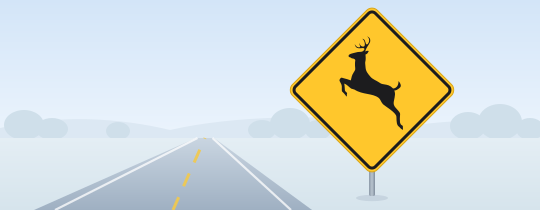
At dusk in November, you pass a yellow diamond-shaped sign showing a leaping deer, and moments later a deer bounds across the road ahead. What should you expect next?
Show answer
Correct answer: More deer close behind, since they often travel in groups
Why
Deer usually move in groups, so one crossing often means others are close behind. In New York, about two-thirds of deer-vehicle crashes happen in October, November and December, mostly around dawn and dusk. Slow down, scan both shoulders and be ready to brake.
39Safe driving
Your 14-year-old cousin is riding in the back seat and has not buckled up. Under New York law, who can be ticketed?
Show answer
Correct answer: You, the driver, because she is under 16
Why
In New York, the driver answers for every passenger under 16: each unbuckled child can bring $25 to $100 in fines and 3 points. Riders 16 and older are responsible for their own belts in any seat, with a fine of up to $50. Make “everyone buckled” your rule before you shift into drive.
40Permit & teen rules
A 16-year-old upstate with a junior license wants to drive home alone from a friend’s party at 10:30 p.m. Is that allowed?
Show answer
Correct answer: No; at that hour, solo trips are only between home and work or a school course
Why
Upstate, a junior licensee may drive alone from 5 a.m. to 9 p.m. Overnight, solo driving is limited to direct trips between home and a job or a school course, and a party is neither. Otherwise, a licensed parent or guardian, or a driver ed teacher or driving instructor, aged 21 or older, has to ride along.
New York DMV written test at a glance
What to expect at the DMV, in a few numbers.
New York · Class D permit test
14 of 20 to pass.
20 questions · 4 on road signs
14 of 20 answers right to pass
2 of 4road-sign questions you must get right
Onlinetest option if you’re under 18, with a parent watching
$80–$90permit fee at 16 to 16½, first license included
6 pointsof ID documents to apply
20/40vision standard, in at least one eye
20test languages, Spanish included
Under 18? Your road to a license
16Learner permitPass the vision test and the 20-question written test. A parent signs your consent.
6 moSupervised practiceHold the permit at least six months and log 50 hours with a driver 21 or older, 15 of them after sunset.
5 hrsPre-Licensing CourseTake the 5-hour course, unless you finished a 48-hour driver education program.
DJJunior licensePass the road test. No driving in New York City, and only one passenger under 21 from outside your family.
17/18Full Class DGet a full license at 17 once you finish driver ed and earn the certificate, or at 18 without it.
18 or older? Same permit, test and 5-hour course, but no six-month wait and no 50-hour log before your road test.
What’s on the New York permit test
The test covers chapters 4 to 11 of the New York State Driver’s Manual (MV-21). Six areas to master before test day.
Road signs
4 of the 20 test questions are road signs, and you must get at least 2 of them right.
Yellow diamonds warn, orange marks work zones, green gives directions and blue points to services.
A slashed red circle bans the move it shows; a white X-shaped crossbuck means yield to trains.
Right-of-way
Arrive together with no signs or signals? The driver on the left yields to the one on the right.
Turning left, let oncoming cars going straight or turning right go first.
School bus flashing red: stop from either direction, even across a divided highway.
Speed limits
No sign? 55 mph is the limit statewide; 65 mph is the highest that can be posted.
New York City defaults to 25 mph unless a sign says otherwise.
Speeding fines double in a work zone, even with no workers around.
Parking
Stay 15 feet from a fire hydrant, and 20 feet back from an intersection’s crosswalk.
Leave 30 feet before STOP and YIELD signs and traffic lights, and 50 feet before a railroad crossing.
NO PARKING allows a quick load or unload; NO STANDING, only passengers; NO STOPPING, neither.
Alcohol & phones
Over 0.05% is impaired (DWAI), 0.08% is DWI and 0.18% is Aggravated DWI.
Under 21, a BAC of 0.02% to 0.07% costs you your license for six months.
Hand-held calls and texting while moving cost 5 points; hands-free calls are fine.
Teen rules
A junior permit means a supervisor 21 or older beside you, and no one else up front.
A junior license can’t be used anywhere in New York City.
A first phone or texting conviction suspends a junior permit or license for 120 days.
New York numbers to know
Six figures that keep showing up on test day, all in one place.
100 ftkeep your signal on before a turn
500 ftdim your high beams for oncoming traffic
15 ftfrom the nearest rail when you stop for a train
55 mphstatewide limit unless a sign says otherwise
0.02%BAC that brings Zero Tolerance penalties under 21
2 secfollowing gap, longer in bad weather
Your New York course, in your pocket
These 40 questions are just the warm-up. The app gives you 542 New York practice questions, 36 short lessons and the why behind every answer.
36 short lessonsFour levels, from fundamentals to expert, then a full practice exam.
542 New York questions317 of them with pictures.
Your most-missed questionsA review lesson built from the questions you miss most.
Exam simulatorTake full practice exams and watch your readiness grow.
New York permit
Your New York path is ready.
36 lessons, 542 questions and full practice exams. In English and Spanish.
How many questions are on the New York permit test, and what score do I need?
There are 20 questions, and you need at least 14 right, which is 70%. Four of them are about road signs, and 2 of those 4 must be correct no matter how well you do on the rest. The material comes from chapters 4 to 11 of the New York State Driver’s Manual.
Can I take the New York permit test online?
Yes, if you’re under 18. You take it online through DMV’s pre-screening tool with a parent or guardian watching, then finish the permit at a DMV office, where that adult signs form MV-263 in front of DMV staff. Wait at least three business days after you pass, or you’ll have to take the test again at the office. Some high schools also give the test through DMV’s OKTA program.
Can I take the New York permit test in Spanish?
Yes. The Class D permit test is given in 20 languages, Spanish included, and DMV publishes the manual in Spanish as the Manual del conductor (MV-21S). The school-based OKTA test comes in English and Spanish too. This practice test is in Spanish as well, and so is the app.
How old do I have to be to get a learner permit in New York?
16. Bring form MV-44, proofs of identity and age worth at least 6 points, and your Social Security number, then pass the vision and written tests. At 16 or 17 a parent must consent, unless you’re 17 and hold a driver ed completion certificate (MV-285). Under 18, you hold the permit at least six months and log 50 supervised hours, 15 after sunset, before the road test.
What are the junior license rules in New York?
A junior license (Class DJ) can’t be used anywhere in New York City, and Long Island has its own tighter limits. Upstate, you may drive alone from 5 a.m. to 9 p.m.; at night, only straight between home and work or a school course, unless a parent, guardian or instructor rides along. You may carry at most one passenger under 21 from outside your immediate family, and a first phone or texting conviction means a 120-day suspension.
How much does a New York learner permit cost?
It depends on your age and on whether you live in the Metropolitan Commuter Transportation District (New York City and seven nearby counties). A Class D or DJ permit costs from $64.25 to $102.50; at 16 to 16½, for example, it’s $80, or $90 in the district. An Enhanced permit adds $30. The fee also covers your first license and your first two road tests.
What do I need to bring to the New York road test?
Your photo learner permit, the original certificate from the 5-hour Pre-Licensing Course (MV-278) unless a driver ed certificate is on file, and, if you’re under 18, the MV-262 form certifying your practice hours. Bring a registered, insured and inspected car, plus a supervising driver 21 or older if you drive there. If you don’t pass, you can test again after at least 14 days.
What’s the best way to study for the New York permit test?
Read chapters 4 to 11 of the New York State Driver’s Manual. Learn the road signs cold, since you need 2 of the 4 sign questions. Then practice until 14 out of 20 feels easy. Start with the 40 questions above, then let the app walk you through 542 New York questions and 36 short lessons, with an explanation for every answer.