Get ready for the NDDOT Rules of the Road test, North Dakota’s version of the DMV written test, with 40 free questions on road signs, 80 mph interstates, gravel-road limits and teen license rules. Pick an answer and the explanation appears right away.
Four sets of 10 questions covering North Dakota signs, right-of-way, speed limits from gravel roads to the interstate, parking, DUI and phone laws, and teen license rules. Tap an answer to see why it’s right.
Round 1 · Questions 1–10
1Road signs
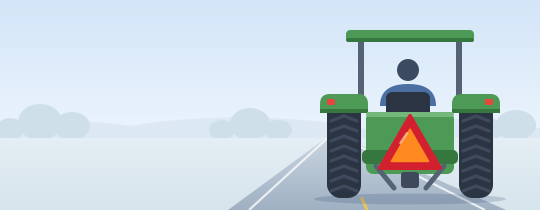
Late in harvest season you top a hill and find a tractor ahead with an orange triangle, outlined in red, fixed to its back. What does that emblem tell you?
Show answer
Correct answer: It moves at 25 mph or less, so you'll close in on it fast
Why
North Dakota's manual ties the slow-moving vehicle emblem to vehicles and towed equipment going 25 mph or slower. At highway speed the gap shrinks in seconds, so lift off the gas the moment you spot the triangle and pass only where it's legal and you can see far ahead.
2Right-of-way
Your gravel road ends at a T where it meets a paved county road, and there are no signs or signals. A pickup on the county road is coming from your left as you arrive. Who should go first?
Show answer
Correct answer: The pickup, because your road is the one that ends
Why
North Dakota law has its own rule for uncontrolled T intersections: traffic on the road that ends gives way to traffic on the road that continues, even when it comes from the left. At an ordinary crossroads with no signs, the familiar rule applies and the driver on the left yields to the one on the right.
3Road signs
Green signs with white numbers stand along North Dakota highways, one every mile. Where do those milepost numbers start counting from?
Show answer
Correct answer: At the south or west state line, or the route's starting point
Why
Mileposts begin at the state's south or west border, or wherever the route starts inside North Dakota, so the numbers climb as you head north or east. Keep track of the last one you passed: it helps a 911 dispatcher find you fast.
4Permit & teen rules
What is the youngest age at which a North Dakota teen may apply for a Class D instruction permit?
Show answer
Correct answer: 14
Why
You can apply at 14, and the permit is issued once you pass the knowledge test and the vision screening. Anyone under 18 also needs a parent or legal guardian to sign as sponsor and accept financial responsibility for the new driver.
5Alcohol & phones
A 19-year-old in Fargo has a couple of drinks, then drives home with a blood alcohol concentration of 0.03%. What is true under North Dakota law?
Show answer
Correct answer: It's over the 0.02% limit for drivers under 21
Why
North Dakota holds drivers under 21 to 0.02%, a quarter of the 0.08% adult standard, and commercial drivers have their own 0.04% limit. Since people under 21 may not buy or drink alcohol at all, the only safe number before driving is zero.
6Parking
You spot an open curb space next to a fire hydrant in Grand Forks. How much room must you leave between your car and the hydrant?
Show answer
Correct answer: 10 feet
Why
North Dakota law bans parking within 10 feet of a fire hydrant, and the same 10 feet applies to a crosswalk at an intersection. Crews need space to reach the hydrant and hook up a hose without delay.
7Safe driving
Behind a pickup on a dry highway, you note when it passes a mile marker and count until your bumper reaches the same spot. What count does the North Dakota manual treat as the minimum in good conditions?
Show answer
Correct answer: Three seconds
Why
The manual's baseline is a three-second gap, stretched to four seconds or more on slick roads, behind motorcycles or large trucks, or when you're towing. On snow and ice, double whatever gap you normally keep.
8Speed limits
A white rectangular sign reads SPEED LIMIT 80. In North Dakota, 80 mph is the default limit set by law for which kind of road?
Show answer
Correct answer: Rural interstate highways with controlled access
Why
North Dakota's statute sets 80 mph on access-controlled, divided interstate highways unless a lower limit is posted. Other divided multilane highways default to 70 mph, and paved two-lane highways reach 65 mph only where posted for it. Watch for lower posted limits through cities and work zones.
9Crashes & emergencies
Two cars collide at a city intersection in Dickinson. Nobody is hurt, but the combined damage looks like about $5,000. What must the drivers do?
Show answer
Correct answer: Report it right away to the city police
Why
A crash with an injury, a death or at least $4,000 in apparent damage has to be reported immediately: to the local police inside a city, otherwise to the county sheriff or the Highway Patrol. Drivers must also trade names, addresses, insurers and policy numbers.
10Speed limits
You're driving through a residential neighborhood in Minot and haven't seen a speed sign for several blocks. What limit applies by default?
Show answer
Correct answer: 25 mph
Why
Unless local authorities post a different number, North Dakota sets 25 mph in business and residential districts and in public parks. Kids, parked cars and bikes appear with little warning there, so go slower still on narrow or crowded streets.
Round 2 · Questions 11–20
11Road signs
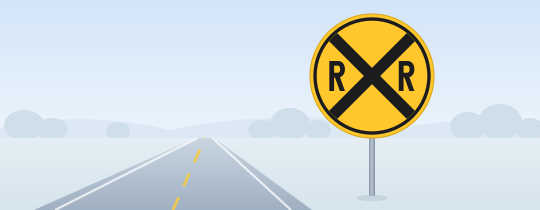
A round yellow sign with a black X and two R's warns of a railroad crossing. Trees and a grain elevator hide the tracks from view. Unless another speed is posted, how fast may you go within 50 feet of the crossing?
Show answer
Correct answer: 20 mph
Why
When you can't see clearly along the tracks, North Dakota caps your speed at 20 mph for the final 50 feet before the crossing, and the same cap applies near an intersection where your view is blocked. Slow early enough that you could stop short of the rails if a train shows up.
12Right-of-way
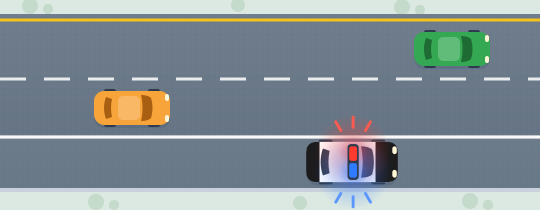
On a two-lane highway, a sheriff's car sits stopped at a crash scene ahead with red and blue lights flashing. There's only one lane in your direction. What does North Dakota law expect from you?
Show answer
Correct answer: Pull to the right edge and stop, then pass with care once the road is clear
Why
For an emergency vehicle parked at a scene with its lights going, North Dakota tells approaching drivers to move to the right edge and stop. Once stopped, you may continue past at your own risk when the way is clear, unless an officer directs you otherwise. On the interstate and multilane highways outside cities, the manual has you move over a lane instead.
13Speed limits
Out in the country you turn onto a gravel road with no speed limit sign. What is the most North Dakota law allows here in good conditions?
Show answer
Correct answer: 55 mph
Why
Gravel, dirt and other loose-surface roads default to 55 mph in North Dakota, as do paved two-lane county and township roads with no posted limit. Your tires grip loose gravel far less than pavement, so ease off below the limit when you need to and avoid sudden steering.
14Permit & teen rules
You're 15 and practicing on your instruction permit. Which of these people may sit beside you as your supervisor?
Show answer
Correct answer: Your 20-year-old neighbor, licensed since age 16
Why
Your supervisor must be 18 or older, hold a license, have at least three years of driving experience and sit right next to you. Only the two of you may ride in the front seat, unless the vehicle has no back seat.
15Alcohol & phones
A Bismarck driver with no earlier DUI-related record is arrested and refuses the chemical test the officer asks for. How long is the license revoked?
Show answer
Correct answer: 180 days
Why
Driving in North Dakota means you've already agreed to chemical testing. A first refusal costs the license for 180 days, and earlier DUI-related suspensions or revocations within seven years push that to two or three years. Refusing can also be charged as a DUI in its own right.
16Parking
You'd like to park on the street just before a stop sign posted at the roadside. What distance does North Dakota require between your car and the sign?
Show answer
Correct answer: 15 feet
Why
Stay 15 feet back from a stop sign, a traffic signal or a flashing beacon at the side of the road so other drivers can see it. Keep the same 15 feet between your car and the closest rail at a train crossing.
17Safe driving
You're about to turn right into a gas station. How far ahead of the turn must your signal be on under North Dakota law?
Show answer
Correct answer: At least 100 feet
Why
Under North Dakota law, the signal has to run without a break over the closing 100 feet of your approach to a turn, and the same goes for lane changes and merges. An early signal gives the driver behind you time to brake and tells people on foot what you plan to do.
18Road signs
On a two-lane highway, a yellow sign shaped like a long sideways pennant stands on the left shoulder. What is it telling you?
Show answer
Correct answer: A no-passing zone begins
Why
The pennant is placed on the driver's left, right where you look when deciding to pass, and it marks where a no-passing zone starts. Its partner, the white rectangular DO NOT PASS sign, goes on the right. Hold your lane until the zone ends and the center line lets you pass again.
19Sharing the road
You come up behind a bicyclist on a two-lane highway outside Jamestown. How much space must you leave as you pass?
Show answer
Correct answer: At least 3 feet
Why
North Dakota requires a gap of at least three feet between your car and a bicyclist you're overtaking, and you may pass only when it's safe. If oncoming traffic or a curve won't allow that room, stay behind the rider until it does.
20Right-of-way
At a red light, you're heading down a one-way street and plan a left onto a cross street that is also one-way, with its traffic moving to your left. No sign forbids turning on red. What may you do?
Show answer
Correct answer: Stop fully, then turn while yielding to pedestrians and traffic
Why
North Dakota permits a left turn on red from one one-way street onto another, just as it permits a right turn on red, once you have stopped completely and given way to people crossing and to cross traffic. A NO TURN ON RED sign takes both options away.
Round 3 · Questions 21–30
21Right-of-way
You're cruising in the right lane of I-29 and see a Highway Patrol car stopped on the right shoulder ahead, lights flashing. What does North Dakota's move-over law ask you to do first?
Show answer
Correct answer: Shift to the lane farther from the patrol car if you can do it safely
Why
On the interstate and on multilane highways outside city limits, North Dakota wants you in a lane that isn't next to a stopped emergency vehicle. The rule also covers NDDOT maintenance trucks with amber or white lights and any vehicle showing hazard flashers. If traffic won't let you change lanes, slow down and go by with caution.
22Road signs
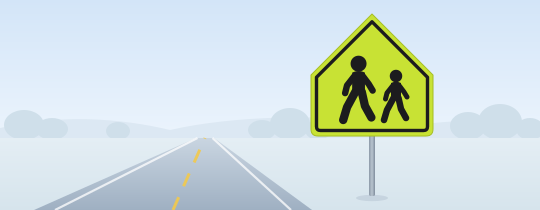
Near an elementary school, a five-sided fluorescent yellow-green sign shows two children walking. It's 8 a.m. and kids are arriving. With no other speed posted, how fast may you drive past the school?
Show answer
Correct answer: 20 mph
Why
North Dakota sets 20 mph for passing a school at recess or while children are coming to or leaving school, unless local authorities post a lower limit. School and pedestrian signs may be fluorescent yellow-green or ordinary yellow, so give both colors the same respect.
23Speed limits
A four-lane divided U.S. highway links two North Dakota towns. It isn't an interstate, and no other limit is posted. What is the speed limit by statute?
Show answer
Correct answer: 70 mph
Why
North Dakota allows 70 mph on paved, divided multilane highways and saves 80 mph for access-controlled interstates. A paved two-lane highway is held to 65 mph, and only where it's posted for that speed. A lower posted number always wins.
24Permit & teen rules
At 15 with a restricted North Dakota license, you may not drive at night unless an exception applies. On a summer evening when the sun sets at 9:35 p.m., when does that limit begin?
Show answer
Correct answer: 9:35 p.m.
Why
The restriction runs from sunset or 9 p.m., whichever comes later, until 5 a.m., so on long summer evenings it starts at sunset. You may still drive with a parent, guardian or another adult 18 or older in the front seat, or when heading straight to or from work, a school-sponsored activity or a religious activity.
25Alcohol & phones
Driving home from a wedding, your passenger wants to bring a bottle of wine that has already been opened. Where may it ride in North Dakota?
Show answer
Correct answer: In the trunk
Why
Nobody in a vehicle on a public road or in a public parking area may drink from or hold an open container of alcohol. An opened bottle goes in the trunk; North Dakota doesn't count the glove box as a safe spot. Breaking the rule brings a $50 fee.
26Parking
Which of these parking spots breaks North Dakota law?
Show answer
Correct answer: 15 feet from the driveway of a fire station
Why
Fire trucks need a clear path, so North Dakota keeps parked cars at least 20 feet from a fire station's driveway, and 75 feet away on the opposite side of the street where signs say so. The other three spots respect the 10-foot gaps for hydrants and crosswalks and the 15-foot gap for stop signs.
27Safe driving
Driving at night on a rural highway with your high beams on, you see headlights coming toward you. Within what distance must you switch to low beams?
Show answer
Correct answer: 500 feet
Why
Low beams are required once oncoming traffic gets within 500 feet, and when the car you're trailing is 300 feet or less ahead. If an approaching driver leaves the brights on, shift your eyes to the right-hand edge of your lane rather than staring into the glare.
28Safe driving
You want studded tires for a North Dakota winter. When may you legally drive on them?
Show answer
Correct answer: October 15 through April 15
Why
Studded tires are legal only from October 15 to April 15, with school buses as the one exception allowed to run them all year. Even on good winter tires or chains, double your following distance on snow and ice.
29Crashes & emergencies
A sudden blizzard strands your car on a rural highway, and you can barely see past the hood. What does the North Dakota manual tell you to do?
Show answer
Correct answer: Stay with the car, crack a window and run the engine in short bursts
Why
Your car is your shelter: in a snowstorm, the deadliest move is setting out on foot and losing your way. Run the engine and heater only in short bursts with a window cracked to keep carbon monoxide out, and before a winter trip dial 511 for road conditions.
30Right-of-way
You're pulling out of a shopping center in town, and the driveway crosses a sidewalk before it meets the street. Where does North Dakota law require you to stop?
Show answer
Correct answer: Before the sidewalk, then yield to all traffic on the street
Why
Leaving an alley, driveway or private road in town, you come to a full stop before the sidewalk area and then give way to everyone using the road. People on foot can step out from behind parked cars or buildings, so roll forward slowly after the stop.
Round 4 · Questions 31–40
31Safe driving
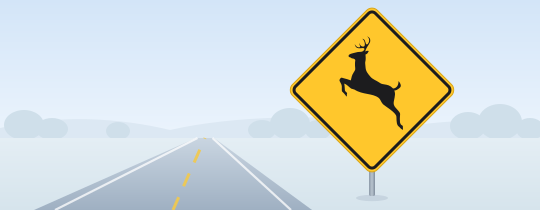
At dusk on a rural road you pass a yellow diamond sign with a leaping deer, and seconds later a deer bounds onto the pavement right in front of you. What does the North Dakota manual advise?
Show answer
Correct answer: Slow down and hold your lane rather than swerve
Why
The manual warns that swerving to miss an animal can turn a deer strike into something worse, like hitting another car or a tree, or rolling over. Watch hardest for deer at dawn and dusk, ease off near deer crossing signs and keep scanning both ditches.
32Right-of-way
You're on a four-lane divided highway with a wide grassy median. Across the median, a school bus on the other roadway stops and turns on its flashing red lights. What does North Dakota law require of you?
Show answer
Correct answer: Keep going with care, since it's on a separate roadway
Why
On an ordinary road, drivers coming from either direction must halt when a school bus shows its red flashers or swings out its stop arm. A highway with separate roadways is the exception: a bus on the far side of the median doesn't stop you. Stay alert anyway, since children may be close to the road.
33Road signs
Orange diamond-shaped signs mark a highway work zone, crews are out on the road, and the posted speed sign there carries a minimum fee notice. What does going 1 to 10 mph over that limit cost?
Show answer
Correct answer: A $150 minimum fee
Why
North Dakota law sets a $150 minimum fee for speeding 1 to 10 mph over in a posted work zone while workers are present, plus $2 for each mph beyond that. The manual still lists $80, but the current statute says $150. Treat orange signs as an early cue to slow down and watch for flaggers.
34Permit & teen rules
A 25-year-old learning to drive on a North Dakota instruction permit wants to take a quick phone call while the car is moving. What does the law say?
Show answer
Correct answer: It's banned for permit holders of every age, except to get emergency help
Why
North Dakota's device ban reaches everyone driving on an instruction permit, not only teens: no talking, texting or reading messages while the vehicle moves. The only exceptions are calling for emergency help, preventing a crime about to happen, or protecting someone whose life or safety is in danger. Licensed drivers under 18 face the same ban.
35Alcohol & phones
You're 35, waiting at a red light in Williston, when a text arrives. May you read and answer it before the light turns green?
Show answer
Correct answer: No, the ban covers stops at traffic lights too
Why
North Dakota bars every driver from writing, reading or sending texts and emails while driving, and a pause at a signal still counts. The fee is $100. Park somewhere legal before you pick up the phone.
36Parking
You park facing uphill on a country road that has a shoulder but no curb. Which way should your front wheels point?
Show answer
Correct answer: Toward the shoulder, at the road's edge
Why
With no curb to catch a tire, aim the wheels toward the shoulder; if the brake ever slips, the car rolls away from traffic. With a curb, uphill means wheels turned away from it and downhill means wheels turned toward it. Set the parking brake either way.
37Safe driving
In the middle of the afternoon, blowing snow cuts how far you can see. When does North Dakota law require your headlights to be on?
Show answer
Correct answer: Whenever you can't see people and vehicles 1,000 feet ahead
Why
Headlights are required from sunset to sunrise and any time rain, snow, sleet, hail, fog or smoke keeps you from making out people and vehicles 1,000 feet away. In a whiteout they also help other drivers find you, so switch them on early.
38Permit & teen rules
Before a 15-year-old can take the North Dakota road test, how much supervised driving must a parent certify?
Show answer
Correct answer: 50 hours, including night and winter driving
Why
Drivers under 16 log at least 50 hours with a supervisor, and the mix has to include night driving, gravel or dirt roads, rural and city streets, and winter conditions. A parent signs for the hours on road-test day, and they come on top of driver education.
39Lane markings
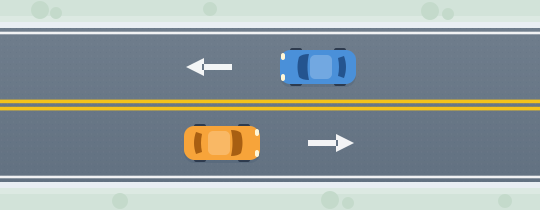
A two-lane road has two solid yellow lines side by side down its center. When may you cross them?
Show answer
Correct answer: Only to turn left, such as into a driveway
Why
A double solid yellow line bans passing for traffic in both directions, yet you may cross it to turn left into a driveway, alley or side road. A single solid line on your side bans passing for you alone, while a broken line lets you pass once it's safe.
40Alcohol & phones
An adult is convicted of a first DUI in North Dakota after testing at 0.10%. How long is the license suspended?
Show answer
Correct answer: 91 days
Why
A first DUI brings a 91-day suspension, stretched to 180 days at 0.18% or higher, along with a fine of at least $500 and an addiction evaluation. Only time clears alcohol from your body; coffee and cold showers do nothing.
North Dakota Rules of the Road test at a glance
Know these before your NDDOT appointment or your online test.
North Dakota · Class D Rules of the Road test
Signs, laws and your eyesight.
Online or in person · 14 languages
$5per attempt at a driver license office, one a day
$10per attempt online, from home
Spanishone of 14 languages for the test
24 hourswait before an online retake
$15for the instruction permit
20/40each eye, for a license with no daylight-only limit
Under 18? Your road to a license
14Instruction permitPass the vision screening and the Rules of the Road test, with a parent or guardian signing as your sponsor.
12 moDriver ed and practiceUnder 16: finish driver ed, log 50 supervised hours and hold the permit 12 months or until you turn 16 (six months at least).
15Restricted licensePass the road test. Drive family vehicles only, and from sunset or 9 p.m. (whichever is later) to 5 a.m. have an adult 18+ up front, unless you're headed straight to or from work, a school activity or a religious activity.
16Full Class DThe restrictions lift at 16, but the phone stays off while you drive until you turn 18.
18 or older? Skip driver ed and the waiting period: pass the knowledge and vision tests, practice with a licensed supervisor, then take the road test.
What’s on the North Dakota permit test
Your study guide is NDDOT’s 2025-2027 Noncommercial Driver License Manual (Class D). By law, the test covers road signs and North Dakota traffic law. Start with these six areas.
Road signs
An orange triangle with a red border marks a vehicle doing 25 mph or less, like a tractor or combine.
Green mileposts count up from the south or west state line.
Round yellow sign: railroad ahead. Can’t see down the tracks? 20 mph for the last 50 feet.
Right-of-way
Uncontrolled T intersection: the road that ends yields to the road that continues.
Emergency vehicle at a crash scene on a two-lane road: pull right, stop, then pass with care.
School bus flashing red: both directions stop, except across a divided highway.
Speed limits
80 mph on rural interstates, 70 on other divided multilane highways.
55 mph on gravel and dirt roads, 25 in business and residential districts.
20 mph past a school at recess or while kids come and go.
Parking
10 feet from a hydrant and from a crosswalk at an intersection.
15 feet from a roadside stop sign, signal or beacon, and from the nearest rail.
Parallel parked, keep your tires within a foot (12 inches) of the curb.
Alcohol & phones
BAC limits: 0.08% at 21 and up, 0.02% under 21, 0.04% for commercial drivers.
Refusing a chemical test costs your license for 180 days to 3 years.
No texting for anyone behind the wheel, red lights included: $100.
Teen rules
Permit at 14, with a licensed driver 18+ who has 3 years’ experience beside you.
Restricted license at 15: family cars only, plus a night limit from sunset or 9 p.m. (whichever is later) to 5 a.m.
On a permit at any age, or licensed under 18: no phone use while driving.
North Dakota numbers to know
Distances, limits and dollar figures straight from North Dakota law and the manual.
80 mphdefault limit on rural interstates
100 ftof steady signal before you turn or change lanes
10 ftbetween your parked car and a fire hydrant
15–50 ftback from the rail when a crossing signal stops you
0.02%alcohol limit if you’re under 21
$4,000in damage makes a crash reportable
Your North Dakota course, in your pocket
These 40 questions are just the warm-up. The app gives you 482 North Dakota practice questions, 36 short lessons and the why behind every answer.
36 short lessonsFour levels, from fundamentals to expert, then a full practice exam.
482 North Dakota questions340 of them with pictures.
Your most-missed questionsA review lesson built from the questions you miss most.
Exam simulatorTake full practice exams and watch your readiness grow.
North Dakota permit
Your North Dakota path is ready.
36 lessons, 482 questions and full practice exams. In English and Spanish.
How many questions are on the North Dakota permit test, and what score do I need?
NDDOT doesn’t publish a question count or a passing score for the Class D Rules of the Road test. By law, the exam checks your eyesight, whether you can read and understand regulatory, warning and guide signs, and how well you know North Dakota traffic law. Make 80% on every practice round your target and you’ll walk in prepared.
Can I take the North Dakota permit test online?
Yes. KnowTo Drive is the one online testing platform NDDOT recognizes. It’s open to North Dakota residents 14 and older, costs $10 per attempt and runs on a desktop or laptop with a webcam, with a 60-minute time limit. Under 18, a parent or guardian registers with you and certifies that they watched the test. Passing online doesn’t print a permit: you still book a driver license office appointment to show your documents.
How many times can I retake the North Dakota knowledge test?
At a driver license office you get one $5 attempt per day, so after a miss you come back another day. Online you can try again after 24 hours, but five failed online attempts lock you out of online testing for a year; you can still test in person at an office.
Can I take the North Dakota permit test in Spanish?
Yes. The Class D test is offered in 14 languages, Spanish among them, and eight offices also have automated audio and American Sign Language versions. NDDOT posts a Spanish edition of the manual (2023-2025) too. This practice test and the app are both available in Spanish as well.
How old do you have to be to get a permit in North Dakota?
14. If you start under 16, you finish driver education, log 50 supervised hours and hold the permit 12 months or until you turn 16 (never less than six months) before the road test. Pass at 15 and you get a restricted license: family vehicles only, and from sunset or 9 p.m. (whichever is later) until 5 a.m. you need an adult 18 or older in the front seat unless you're driving straight to or from work, a school activity or a religious activity. Those limits end at 16, while the phone ban lasts until 18. Start at 16 or 17 and you hold the permit six months, or until you turn 18.
How much does a North Dakota permit cost?
The knowledge test costs $5 per attempt at a driver license office or $10 per attempt online. Once you pass, the instruction permit is $15. Later on, the road test costs $5 and the license itself $15.
Who gives the permit test in North Dakota?
The Driver License Division of the North Dakota Department of Transportation (NDDOT) handles permits, knowledge tests and licenses, the work a DMV does in other states. Every office visit needs an appointment. Road tests are given in eight cities: Bismarck, Devils Lake, Dickinson, Fargo, Grand Forks, Jamestown, Minot and Williston.
What’s the best way to study for the North Dakota permit test?
Read the 2025-2027 Noncommercial Driver License Manual, with extra care on the chapters about signs and the rules of the road. Then work through the 40 questions on this page and keep going in the app: 482 North Dakota questions and 36 short lessons, each answer explained.