Get ready for Idaho’s Class D knowledge test with 40 free questions on road signs, open-range driving, Idaho speed limits, the hands-free law and GDL rules for teens. Pick an answer and the explanation appears instantly.
Four rounds of 10 questions on Idaho road signs, right-of-way, speed limits, parking, alcohol and phone laws, and teen GDL rules, each with a short explanation.
Round 1 · Questions 1–10
1Road signs
Near dusk on a two-lane Idaho highway, you pass a yellow diamond sign showing a leaping deer. A moment later one deer bounds across the road ahead of you. What is the smart move now?
Show answer
Correct answer: Slow down and keep scanning both shoulders, since others are likely close behind
Why
Deer, elk and moose usually travel in groups, so the first one you see is often a preview of the rest. The Idaho Driver’s Handbook says to slow down as soon as one appears near the road. If a small animal darts out, brake rather than yanking the wheel: leaving your lane is often worse than the animal itself.
2Speed limits
You’re driving through a residential district with homes on both sides and no speed limit sign anywhere in sight. What is the highest legal speed under Idaho law?
Show answer
Correct answer: 35 mph
Why
Idaho sets 35 mph as the default in residential, business and urban districts unless signs say otherwise. That is a ceiling, not a goal: the basic speed rule still requires a pace that is reasonable for kids, parked cars and driveways.
3Right-of-way
You and a pickup on the cross street stop at a four-way stop at exactly the same moment. The pickup is on your right. Who should go first?
Show answer
Correct answer: The pickup, because it is on your right
Why
At an all-way stop the first vehicle to stop is the first to go. When two arrive together, the Idaho Driver’s Handbook has the driver on the left yield to the driver on the right. Make eye contact before you move, because not everyone knows the rule.
4Parking
What is the smallest gap Idaho law allows between a fire hydrant and a parked car?
Show answer
Correct answer: 15 feet
Why
Idaho law keeps parked cars at least 15 feet away from any hydrant. Firefighters need room to hook up a hose fast, and every second counts at a fire. Fifteen feet is roughly one car length, so when in doubt leave a full space.
5Alcohol & phones
A 19-year-old is pulled over in Idaho. At what blood alcohol concentration is that driver over the legal limit?
Show answer
Correct answer: 0.02 or more
Why
Drivers under 21 in Idaho face a 0.02 limit, so the only safe plan is no alcohol at all. Adults are over the limit at 0.08 and commercial drivers at 0.04. Only time sobers you up: coffee, food and fresh air do not lower your BAC.
6Permit & teen rules
Idaho teens begin with a driver training instruction permit. What is the earliest age to get one?
Show answer
Correct answer: 14½
Why
At 14½ you can buy the driver training permit and start an approved course, and the permit must be in hand before the first class. The course is 30 hours in the classroom, 6 hours observing in a training car and 6 hours driving with an instructor.
7Safe driving
The Idaho Driver’s Handbook names a minimum following distance behind the car ahead. How much time is it?
Show answer
Correct answer: Three seconds
Why
Pick a sign or pole the car ahead passes and count; if you reach it before three seconds, back off. The handbook says to add time at high speed and in bad weather. Behind a motorcycle, leave more than three seconds.
8Sharing the road
A bicyclist ahead of you slows at a STOP sign, checks for traffic, yields and rolls through without putting a foot down. Under Idaho law, what has the rider done?
Show answer
Correct answer: Nothing wrong: Idaho lets cyclists treat a stop sign like a yield sign
Why
This is the well-known “Idaho stop.” A cyclist may slow, yield and continue through a stop sign without stopping completely, and at a red light may go ahead with caution after stopping and yielding. The rule is for bikes only, so you still stop fully, and expect riders to keep moving.
9Road signs
Driving through ranch country, you come to a yellow warning sign that reads OPEN RANGE. What should you take from it?
Show answer
Correct answer: Cattle or other livestock may be loose on or near the road, with no fence to keep them off
Why
On Idaho open range, ranchers may let animals graze without fences, so a cow can be standing in your lane around any bend. Livestock being moved along or across the road have the right-of-way. Ease off the gas, especially after dark, when a dark animal is hard to pick out.
10Crashes & emergencies
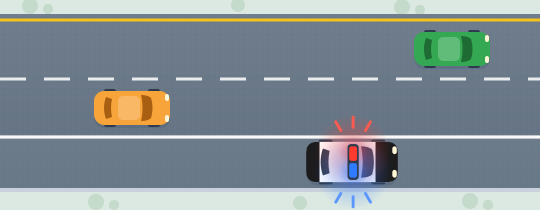
On a highway with two lanes in your direction, you’re in the right lane when you spot a police car stopped on the shoulder with its lights flashing. What does Idaho’s move-over law require?
Show answer
Correct answer: Slow below the posted limit and move into the left lane if it’s safe
Why
Idaho’s move-over law covers stopped police and emergency vehicles, tow trucks and highway incident response vehicles showing flashing lights. Slow down below the posted limit and, with two or more lanes going your way, leave the lane next to them when you can do it safely. If you can’t change lanes, slowing down is still required.
Round 2 · Questions 11–20
11Road signs
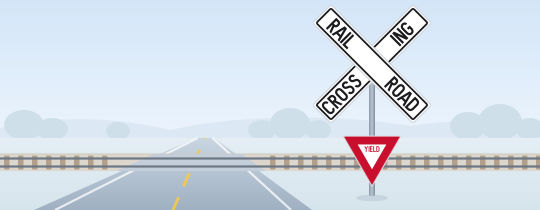
A rural crossing has only a white X-shaped RAILROAD CROSSING sign with a YIELD sign beneath it: no lights, no gate. You hear a horn and see a train approaching. Where does Idaho law tell you to stop?
Show answer
Correct answer: At least 15 feet but no more than 50 feet from the nearest rail
Why
A train close enough to be a hazard calls for a full stop even where there are no signals, and Idaho Code wants your front bumper somewhere between 15 and 50 feet short of the closest rail. The handbook notes that a 150-car freight train at 50 mph needs about 7,000 feet to stop, roughly 1⅓ miles, so it can never stop for you. Wait until the train has passed and the tracks are clear before you go.
12Speed limits
Which statement about speed limits on Idaho interstates is accurate?
Show answer
Correct answer: The default is 75 mph, and some stretches are posted at 80 mph
Why
Idaho law sets 75 mph on interstates unless posted otherwise, and ITD may post 80 mph where an engineering study backs it up. Urban sections can be posted lower, at 65 mph. Off the interstate, state highways default to 65 mph and other roads to 55.
13Right-of-way
Your street ends at a through road, forming a T, with no signs or signals. A car on the through road, coming from your left, reaches the intersection at about the same moment you do. Who has the right-of-way?
Show answer
Correct answer: The car on the through road
Why
Idaho Code has a special rule for a T: when two cars arrive together, the driver on the road that ends yields to the driver on the road that continues, from either side. The yield-to-the-right rule is for crossroads, not for a T. Stop if you need to, wait for a safe gap, then make your turn.
14Parking
You want to park on the approach to a corner controlled by a STOP sign. How far back from the sign must your car be under Idaho law?
Show answer
Correct answer: 30 feet
Why
On the side you approach from, Idaho requires 30 feet of open curb before a stop sign, a yield sign, a flashing beacon or a traffic light. A car parked closer would hide the sign from drivers behind it. A crosswalk at an intersection needs 20 feet, and a hydrant 15.
15Alcohol & phones
You’re stopped at a red light in Idaho and want to read a new text. What does the state’s hands-free law say?
Show answer
Correct answer: Holding the phone is illegal even at a light; use voice commands instead
Why
Since July 2020, Idaho drivers may not hold a phone or other mobile device while driving, and that includes waiting at a light. Voice commands, one-touch calling and hands-free navigation are fine. Fines start at $75 and rise to $150 and $300 for repeat offenses within three years.
16Permit & teen rules
An Idaho teen has passed driver ed and is now driving on a supervised instruction permit. What must happen before the teen can apply for a license?
Show answer
Correct answer: Six months without a traffic conviction, plus 50 logged hours, 10 of them at night
Why
Idaho requires at least six months on the supervised permit after the course, with no traffic convictions, and 50 hours behind the wheel, 10 after dark. A parent or guardian signs off on those hours. A traffic conviction or a permit-rule violation along the way cancels the permit, and the six months start over.
17Safe driving
On a snowy Idaho highway you end up behind a working snowplow moving at 30 mph. How much space does the handbook tell you to leave?
Show answer
Correct answer: Six car lengths: two for every 10 mph
Why
The handbook’s rule is two car lengths for every 10 mph, so 30 mph means six. A plow blade throws up a cloud of snow that can blind you, and the sand it spreads can chip your car. Never pass on the side where the plow is throwing snow.
18Lane markings
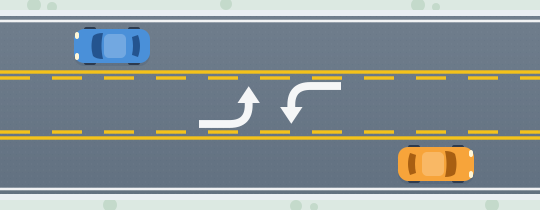
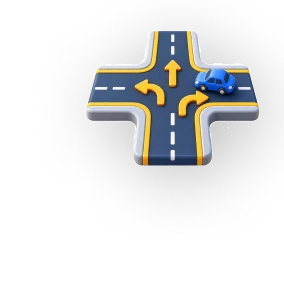
On a busy street, the middle lane has yellow paint along both edges, a solid stripe outside and a broken stripe inside, plus left-turn arrows pointing in both directions. How may you use it?
Show answer
Correct answer: Only while you wait to turn left, or to make a permitted U-turn
Why
This is a shared center turn lane, used by drivers from both directions. Enter it only for a left turn or a permitted U-turn, and don’t cruise along in it. Keep an eye out for someone coming the other way who wants the same space.
19Road signs
Orange diamond signs and rows of barrels line a section of Idaho highway under repair. What sets this stretch apart from the rest of the road?
Show answer
Correct answer: Speeding can cost more here, so slow down and watch for workers
Why
Orange is the color of work zones. In Idaho, speeding in a posted work zone can bring a stiffer fixed penalty, and fines go up where signs say so. Expect lane shifts, rough pavement and crews working close to traffic, and leave extra room.
20Crashes & emergencies
You’re in a fender-bender in Idaho. Nobody is hurt, but the damage to the other driver’s car looks like about $2,000. Must you report it to police right away?
Show answer
Correct answer: Yes, because the damage is over $1,500
Why
Idaho law requires an immediate report to police for any crash that injures or kills someone or causes more than $1,500 in property damage. Body work adds up fast, so even a small bump can cross that line. If you hit a parked car and can’t find the owner, leave a note with your name and phone number.
Round 3 · Questions 21–30
21Right-of-way
You’re behind a school bus on a two-lane road when it stops, turns on its flashing red lights and swings out its STOP arm. What does Idaho law require?
Show answer
Correct answer: Stop and stay stopped until the bus moves or turns off its red lights
Why
Traffic from both directions must stop for a school bus showing its red signals, and you stay put until the bus pulls away or the lights go off. Passing it costs a $300 fine the first time. The one exception: on a highway four or more lanes wide, with two each way, oncoming drivers may continue; drivers behind the bus always stop.
22Speed limits
On a rural two-lane highway posted at 65 mph, you pull out in your car to pass a slow camper. How fast does Idaho law let you go during the pass?
Show answer
Correct answer: Up to 15 mph over the limit, slowing back down once you return to your lane
Why
Idaho has an unusual exception: on a two-lane road posted 55 mph or more, a car, pickup or motorcycle that isn’t towing may go up to 15 mph over the limit to get around a slower vehicle. Once you’re back on the right, drop to the limit again. It never applies in a construction zone.
23Right-of-way
You’re on a one-way street, stopped at a steady red light. The cross street is also one-way, with traffic moving to your left, and you’d like to turn onto it. No sign forbids the turn. What may you do?
Show answer
Correct answer: Turn after a full stop, once you’ve yielded to pedestrians and cross traffic
Why
Idaho allows a turn on a steady red after a complete stop: right turns, and left turns onto a one-way street, unless a sign says no. Give way to people in the crosswalk and to traffic moving on the green first. A red arrow or a NO TURN ON RED sign takes the option away.
24Parking
When you parallel park on a two-way street in Idaho, what is the farthest your right wheels may be from the curb?
Show answer
Correct answer: 18 inches
Why
Idaho Code requires your right wheels to sit parallel to the curb and within 18 inches of it. It matters on the road test too: ending a curb park more than 18 inches out counts as a critical error, which fails the Class D skills test by itself.
25Alcohol & phones
An Idaho officer who suspects DUI asks a driver for an evidentiary breath test, and the driver says no. What follows a first refusal?
Show answer
Correct answer: A $250 civil penalty and a one-year license suspension
Why
By driving in Idaho you have already agreed to breath, blood or urine testing, and you have no right to speak with a lawyer first. Refusing brings a $250 civil penalty and a one-year suspension with no driving at all, two years for a second refusal within 10 years. After that comes a year with an ignition interlock.
26Permit & teen rules
Who must ride along when an Idaho teen drives on a supervised instruction permit?
Show answer
Correct answer: A licensed driver 21 or older, in the seat beside the teen
Why
Under Idaho’s GDL rules the supervisor is a licensed driver 21 or older sitting next to the teen, with no one else in the front seat. Everyone in the car must be buckled, and the permit has to come along. Drivers 17 and up on a regular instruction permit need a licensed driver 18 or older beside them.
27Safe driving
When may you legally run studded snow tires in Idaho?
Show answer
Correct answer: October 1 through April 30, unless ITD adjusts the dates for weather
Why
Idaho allows studded tires from October 1 to April 30, and ITD can shift the window when the weather calls for it. Plan to swap them out before May. Whatever tires you run, leave cruise control off on wet or icy pavement.
28Sharing the road
On an open-range highway at night, a driver hits a steer that wandered onto the road from unfenced pasture. Under Idaho law, can the driver make the rancher pay for the damage to the car?
Show answer
Correct answer: No, the owner isn’t liable for vehicle damage on open range
Why
On open range, ranchers have no duty to keep animals off the highway, and the owner isn’t liable when a vehicle hits one. A careless driver can even end up owing for the animal. Slow down where OPEN RANGE signs are posted, especially at night.
29Road signs
A barricade partly blocks the road. Its orange-and-white stripes slope downward toward the right. How should you get past it?
Show answer
Correct answer: Pass on the right side
Why
Barricade stripes act like arrows: go the way they slope down. Stripes sloping down to the left send you left, and a V pattern means the road is closed. Slow down early so you have time to read them.
30Lane markings
Two solid yellow lines run down the center of a two-lane road. When may you cross them?
Show answer
Correct answer: Only when turning left into a driveway or business, or out of one
Why
Double solid yellow lines mean no passing for traffic in either direction. The one exception is a left turn across them into a driveway or business entrance, or out of one, after yielding to oncoming traffic.
Round 4 · Questions 31–40
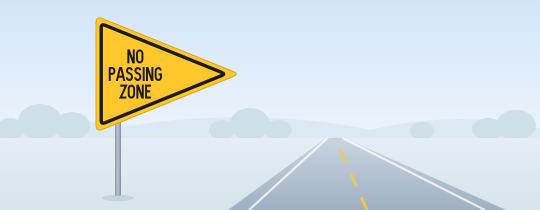
31Road signs
A yellow, pennant-shaped sign stands on the left shoulder of a two-lane highway, facing your direction of travel. What does it mark?
Show answer
Correct answer: The start of a stretch where you may not pass
Why
The pennant is the one sign with this shape, and it always means NO PASSING ZONE. Idaho places it on the left side of the road, right where a driver swinging out to pass will look. Hold your lane until you reach a section where passing is allowed again.
32Speed limits
An Idaho school zone sign shows a lower limit that applies when children are present. A single student is waiting at the curb. Does the lower limit apply?
Show answer
Correct answer: Yes, even one child counts
Why
Idaho law is clear that “children present” includes even one child. Obey the posted school-zone limit, which differs from place to place, and expect a minimum $75 penalty for breaking it. Watch for kids stepping out between parked cars.
33Right-of-way
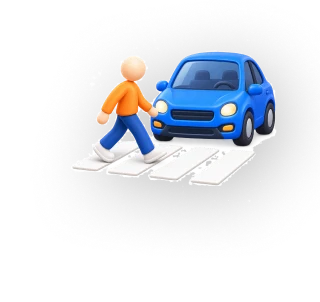
On a four-lane city street, the car in the next lane, just ahead of you, stops at a marked crosswalk. You can’t see why. What should you do?
Show answer
Correct answer: Stop too, because someone may be crossing out of your view
Why
Idaho law forbids passing a vehicle that has stopped at a crosswalk for a pedestrian. The stopped car can hide a person stepping straight into your lane. Where no signal is working, drivers must slow down or stop for anyone crossing in a crosswalk.
34Parking
Visiting a friend in a hilly neighborhood, you park nose-up on a steep street right next to a curb. Before you walk away, how should your front wheels be angled?
Show answer
Correct answer: Away from the curb, toward the street
Why
Facing uphill against a curb, turn the wheels away from it: if the car rolls back, the rear of the front tire catches the curb. Facing downhill, turn them toward the curb. With no curb, point them toward the edge of the road so a rolling car heads off the pavement.
35Alcohol & phones
After a picnic, a half-finished bottle of wine is coming home with you in your sedan. Where may it ride under Idaho law?
Show answer
Correct answer: In the trunk
Why
Idaho forbids anyone in a vehicle on a public road from drinking from or holding an open container of alcohol. The trunk is the legal spot for an opened bottle; a vehicle with no trunk can carry it behind the rearmost seat that’s still upright. The glove box and the floor don’t qualify.
36Permit & teen rules
A 15-year-old has just been licensed in Idaho. Unless a licensed driver 21 or older is the only front-seat passenger, when may this teen drive?
Show answer
Correct answer: 5 a.m. to 10 p.m. only
Why
Idaho can license a driver at 15, but until the 16th birthday driving is limited to 5 a.m. through 10 p.m. The exception is a licensed driver 21 or older in the seat beside the teen, with no one else up front. The time limit ends at 16.
37Safe driving
Driving at night with your high beams on, you see an oncoming car’s headlights. Within what distance does Idaho law require you to switch to low beams?
Show answer
Correct answer: 500 feet
Why
Idaho requires low beams within 500 feet of an oncoming vehicle and within 200 feet when you’re following one. High beams light about 350 feet ahead and low beams only about 100, so at night keep your speed low enough to stop within what you can see.
38Permit & teen rules
During the first six months with a license, how many passengers under 17 may a 16-year-old Idaho driver carry?
Show answer
Correct answer: One, not counting relatives
Why
For the first six months, an Idaho driver under 17 may carry no more than one passenger under 17, unless the passengers are related by blood, adoption or marriage. Fewer friends in the car means fewer distractions while you build experience. The limit ends after six months, or when you turn 17.
39Sharing the road
You’re towing a heavy trailer up a long two-lane grade in rural Idaho, and cars are lining up behind you. When must you pull off to let them by?
Show answer
Correct answer: Once three or more vehicles are stuck behind you and there’s a safe spot
Why
Idaho expects a slow driver holding up three or more vehicles on a two-lane highway or rural road to pull over where it’s safe and let them pass. Turnouts and wide shoulders are made for this. It also heads off risky passes by impatient drivers.
40Crashes & emergencies
Two cars collide on I-84. No one is hurt, and both cars can still be driven. What does Idaho’s Quick Clearance law expect the drivers to do?
Show answer
Correct answer: Move the vehicles onto the shoulder, the median or an emergency lane
Why
When a crash on an interstate or major divided highway injures no one, Idaho wants the vehicles moved out of traffic to the shoulder, median or an emergency lane. Cars left in a live lane invite a second, worse crash. Trade information once everyone is safely off the road.
Idaho DMV knowledge test at a glance
The numbers that matter before your trip to the county office.
Idaho · Class D knowledge test
34 of 40 to pass.
40 questions · In person
34 of 40 answers right to pass
$5per knowledge test attempt
3 dayswait after a fail before you retest
Spanishwritten or audio, one of 12 test languages
In personat a county driver’s license office
20/40vision needed in at least one eye
$20Class D instruction permit at 17 and up
Under 18? Your road to a license
14½Driver training permitBuy the permit before your first class, then finish an approved course: 30 hours in class, 6 observing and 6 behind the wheel.
6 moSupervised permitPass the course and your permit becomes a supervised instruction permit. Drive at least six months without a ticket and log 50 hours, 10 after dark, with a licensed driver 21+ beside you.
15+Tests and licensePass the 40-question knowledge test and the road test. With a parent’s signed GDL verification, your license can arrive as early as 15.
15–16Early limitsUntil 16, drive only 5 a.m.–10 p.m. unless a licensed driver 21+ is your one front-seat passenger. Under 17? For your first six months, carry no more than one passenger under 17, not counting family.
16Full privilegesThe time limit ends on your 16th birthday; the passenger rule ends after six months on your license or at 17.
17 or older? No driver ed needed: pass the knowledge test, get a $20 Class D instruction permit good for a year, practice with a licensed adult 18+ beside you, then pass the road test.
What’s on the Idaho permit test
Study the Idaho Driver’s Handbook (July 2026 edition) from the Idaho Transportation Department: the test questions are drawn from it, covering traffic laws, signs by shape and symbol, signals, pavement markings and required equipment. Start with these six areas.
Road signs
Color tells you a lot: yellow warns, orange marks a work zone, green guides, blue points to services, brown to scenic and historic sites.
A yellow pennant on the left side of the road means a no-passing zone starts.
OPEN RANGE means livestock may be loose on the road, and they have the right-of-way.
Right-of-way
Four-way stop: first to stop goes first; arrive together and the car on the right goes.
After a full stop you may turn right on red, or left on red onto a one-way street, unless a sign says no.
School bus with red lights on: both directions stop, except oncoming traffic on a road with two lanes each way.
Speed limits
No sign in town? 35 mph, and never faster than conditions allow.
Defaults outside town: 75 mph on interstates, 65 on state highways, 55 on other roads.
Passing on a two-lane road posted 55 or more? You may briefly go up to 15 mph over the limit.
Parking
Keep 15 feet from a hydrant, 20 from a crosswalk at an intersection, 30 from a stop sign.
Leave 50 feet between your car and a crossing’s closest rail, and 20 feet from a fire station driveway.
Right wheels within 18 inches of the curb; facing downhill, turn them toward it.
Alcohol & phones
BAC limits: 0.08 for adults, 0.04 in a commercial vehicle, 0.02 under 21.
Refuse an evidentiary test and face a $250 penalty plus a one-year suspension.
Hands-free only, even at a red light; fines start at $75.
Teen rules
Supervised permit: a licensed driver 21+ beside you and everyone buckled.
Under 16, drive between 5 a.m. and 10 p.m. unless a licensed driver 21+ rides up front.
A traffic conviction on the supervised permit cancels it and restarts the six-month clock.
Idaho numbers to know
Six figures from Idaho law and the handbook to have down cold.
100 ftof steady signal before you turn
15 ftbetween a fire hydrant and your parked car
15–50 ftfrom the nearest rail when you stop for a train
3 secminimum following distance
500 ftto dim your high beams for an oncoming car
0.02BAC limit for drivers under 21
Your Idaho course, in your pocket
These 40 questions are just the warm-up. The app gives you 490 Idaho practice questions, 36 short lessons and the why behind every answer.
36 short lessonsFour levels, from fundamentals to expert, then a full practice exam.
490 Idaho questions311 of them with pictures.
Your most-missed questionsA review lesson built from the questions you miss most.
Exam simulatorTake full practice exams and watch your readiness grow.
Idaho permit
Your Idaho path is ready.
36 lessons, 490 questions and full practice exams. In English and Spanish.
How many questions are on the Idaho DMV knowledge test, and what’s a passing score?
40 questions, and you can miss up to six, so 34 correct (85%) is a pass. The questions come from the Idaho Driver’s Handbook. You’ll also take a vision screening, where you need 20/40 or better in at least one eye, with glasses or contacts if you wear them.
What happens if I fail the Idaho written test?
Wait three days, pay the $5 test fee again and retake it. If you have failed three times in one of the offered languages, you may ask for a translator, who can’t be a family member, to read the test to you.
Can I take the Idaho permit test online?
No. Idaho gives the knowledge test in person at county sheriff driver’s license offices. Some offices take appointments and some don’t, so check with yours before you go. Phones, smart watches, notes and the handbook stay out of the testing area.
Can I take the Idaho knowledge test in Spanish?
Yes. ITD offers the Class D knowledge test in Spanish, written or audio, among 12 options that also include Arabic, Chinese, Russian, Vietnamese and American Sign Language. There’s a Spanish handbook too, the Manual del Conductor (July 2026), and this practice test and the app both work in Spanish.
How old do you have to be to drive in Idaho, and when do teens take the test?
You can start driver ed at 14½ on a driver training permit. Teens under 17 don’t test for that permit: they take the knowledge and road tests after the course and at least six months of supervised driving with 50 logged hours, 10 at night. A license can come as early as 15, with driving limited to 5 a.m.–10 p.m. until 16 and a cap of one non-family passenger under 17 during the first six months.
How much does an Idaho permit and license cost?
The knowledge test is $5 a try. A teen driver training permit is $21.50 ($16.50 for the parent-led version), and a Class D instruction permit for drivers 17 and older is $20. The skills test costs up to $35 in total, and the 3-year license most teens and young adults get costs $30.
What is the Idaho road test like?
The Class D skills test takes about 30 minutes and is given by private third-party examiners. You pass with 12 or fewer errors, but any critical error, such as parking more than 18 inches from the curb, is an automatic fail. After a fail, wait three days and pay both the county and examiner fees again.
What’s the best way to study for the Idaho knowledge test?
Read the Idaho Driver’s Handbook, since the test questions come from it, then practice until 34 of 40 feels easy. Start with the 40 questions above, then let the app take you through 490 Idaho questions and 36 short lessons, with every answer explained.