In Kentucky, the State Police give the permit test and the Transportation Cabinet issues your license. Get ready with 40 free questions on KY road signs, speed limits, DUI laws and teen rules, each with an instant explanation.
40 questions in four rounds of 10, built on the Kentucky Driver Manual: signs, right-of-way, KY speed limits, DUI and phone laws, and teen limits. Tap an answer to see why it’s right.
Round 1 · Questions 1–10
1Sharing the road
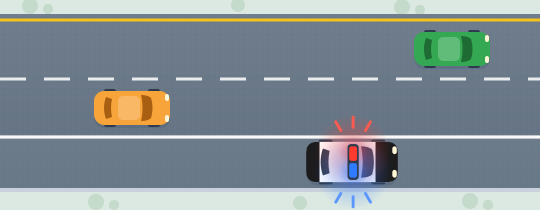
On a Kentucky interstate, a police car sits on the right shoulder with its lights flashing. You’re in the right lane, and there’s a safe gap in the lane to your left. What does the Slow Down, Move Over law expect?
Show answer
Correct answer: Move over into the left lane; if you can’t do that safely, slow down
Why
Kentucky’s Slow Down, Move Over law tells you to shift a lane away from a stopped vehicle with flashing lights when it’s safe, and to slow down when it isn’t. Since July 2024 the law covers every stationary vehicle with flashers, including tow trucks, highway crews and stranded motorists. On a two-lane road, slow down and pass with extra care.
2Speed limits
You’ve been on a Kentucky interstate for miles without seeing a speed limit sign. What limit applies when none is posted?
Show answer
Correct answer: 65 mph
Why
Kentucky’s default for interstates and parkways is 65 mph. The Secretary of Transportation can raise specific highways to 70 mph, and those stretches are signed. Other state highways default to 55 mph.
3Right-of-way
You and a pickup truck pull up to a four-way stop at the same moment. The pickup is on the cross street to your right. Who goes first?
Show answer
Correct answer: The pickup, since it’s on your right
Why
Arrival order decides a four-way stop: whoever stops first leaves first. If two arrive together, the Kentucky manual tells you to yield to the driver on your right. Catch the other driver’s eye and wait until the pickup is clearly moving before you pull out.
4Alcohol & phones
Kentucky has a zero-tolerance rule for drivers under 21. At what alcohol concentration is a driver under 21 breaking the law?
Show answer
Correct answer: 0.02
Why
For drivers under 21, the line in Kentucky is 0.02. Drivers 21 and older are over the limit at 0.08, and anyone impaired by alcohol or drugs can be charged at any level. If you’re under 21, the only sensible number is zero.
5Permit & teen rules
Before a Kentucky teen can take the road test for an intermediate license, how much supervised driving has to be logged?
Show answer
Correct answer: 60 hours, at least 10 of them at night
Why
Kentucky teens need 60 hours of supervised practice, 10 of them after dark, recorded on a Practice Driving Log signed by a parent or guardian. You show it to the KSP examiner at the road test. Spread the hours over the 180 days you must hold the permit anyway.
6Road signs
A white square sign shows a black left-turn arrow inside a red ring, with a red bar slashed across it. What does it mean?
Show answer
Correct answer: You may not turn left here
Why
On Kentucky’s white regulatory signs, a red circle with a slash forbids whatever symbol it covers. Red on a sign always means stop or not allowed. Go straight and find a legal place to turn instead.
7Safe driving
On a dry road in daylight, what is the minimum following distance the Kentucky Driver Manual teaches?
Show answer
Correct answer: 4 seconds
Why
Kentucky’s minimum is a 4-second gap to the car in front. Pick a fixed marker such as a sign; when the car in front passes it, count, and you shouldn’t reach it before four. Add time on slick roads, behind trucks and motorcycles, and after dark: at least one extra second at night.
8Parking
The Kentucky Driver Manual’s hill-parking rule is about where the car would go if it ever rolled. You’re parked nose-down on a steep street, right beside a curb. Where should your front tires point?
Show answer
Correct answer: Turned in toward the curb
Why
Kentucky’s rule of thumb: set the wheels so a rolling car would run into the curb. Facing downhill, that means turning them toward it. With no curb, turn them so the car would roll off the road instead of into traffic, and set the parking brake either way.
9Right-of-way
A school bus heading the other way stops on a four-lane road and turns on its flashing red lights and stop arm. The road has no median, only a double yellow line down the middle. Under Kentucky’s current rule, what do you do?
Show answer
Correct answer: Stop and stay stopped until the bus finishes loading and moves
Why
Under Kentucky’s updated 2026 rule, oncoming drivers may keep going only where four or more lanes are divided by an unpaved median or an elevated barrier. Painted lines don’t qualify, so you stop just like the traffic behind the bus. Older manuals said four lanes were enough, so study the current edition.
10Crashes & emergencies
At a city intersection you bump another car, causing roughly $1,200 in damage. Nobody is hurt, and no police officer investigates the crash. What does Kentucky law require you to file?
Show answer
Correct answer: A written report to the Kentucky State Police within 10 days
Why
If a crash causes more than $500 in property damage and no officer investigates, Kentucky requires a written report to the Kentucky State Police within 10 days. KSP’s civilian collision report can be filled out online. With no injuries, state law also has you move the cars to the shoulder first.
Round 2 · Questions 11–20
11Right-of-way
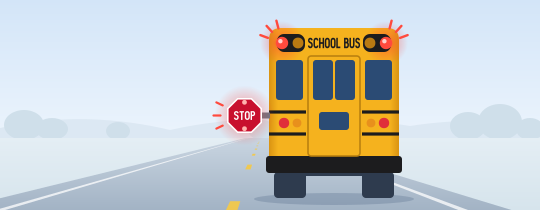
You’re behind a school bus like this one on a two-lane road, its red lights flashing and stop arm out, so you stop. Kentucky’s bus-stop law treats one other kind of bus the same way. Which one?
Show answer
Correct answer: A church bus with its stop arm and signal lights on
Why
Kentucky’s rule covers church buses as well as school buses. When either one stops with its signals on, drivers coming from both directions on a road like this stop and stay stopped until loading is done and the bus pulls away. Failing to stop puts 6 points on your Kentucky record.
12Speed limits
You’re on a two-lane state highway between small towns in Kentucky, and no speed limit sign is in sight. How fast may you go?
Show answer
Correct answer: 55 mph
Why
Kentucky state highways other than interstates and parkways default to 55 mph. That’s a limit for good conditions: curves, hills, slow farm machinery and rain all call for less. Driving too fast for conditions is a 3-point violation in Kentucky, even below the limit.
13Alcohol & phones
After a DUI arrest in Kentucky, an officer asks the driver to take a breath test. What can follow if the driver refuses?
Show answer
Correct answer: License suspension, and the refusal can be used in court
Why
Under Kentucky’s implied consent law, driving means you’ve already agreed to a lawful breath, blood or urine test. Refusing can lead to a license suspension, can be used against you in court, and doubles the minimum jail time on a second or later DUI. Before testing, you get 10 to 15 minutes to try to reach a lawyer.
14Permit & teen rules
Mia, 16, has a Kentucky learner’s permit, and her 45-year-old dad is riding in the front seat. A movie lets out at 12:30 a.m. With no emergency, school or work reason, may Mia drive them home?
Show answer
Correct answer: No, under-18 permit holders can’t drive from midnight to 6 a.m. without good cause
Why
Kentucky bars permit holders under 18 from driving between midnight and 6 a.m. unless there’s good cause, such as an emergency, a school activity or work. A late movie doesn’t count, so Dad should take the wheel. The same curfew applies once she moves up to an intermediate license.
15Road signs
In the Kentucky Driver Manual’s chart of sign shapes, which shape is used for the advance warning that a railroad crossing is ahead?
Show answer
Correct answer: A circle
Why
The railroad advance sign is round and yellow, with a big X and the letters RR. It tells you to slow down, look and listen before you reach the tracks. The five-sided shape belongs to school signs, and the downward triangle is used only for YIELD.
16Safe driving
Your high beams are on along a dark Kentucky road when another car’s headlights appear ahead, coming toward you. Within what distance of that car must you switch to low beams?
Show answer
Correct answer: 500 feet
Why
Kentucky has you dim within 500 feet of an oncoming vehicle and within 300 feet of one you’re following. Headlights are required from 30 minutes after sundown until 30 minutes before sunup. Glare from a driver who won’t dim is no reason to flash yours back; keep your eyes on the right-hand edge line until the car is past.
17Parking
You’re dashing into a store for one minute and leaving your car at the curb. What does Kentucky law require before you walk away?
Show answer
Correct answer: Shut off the engine and take the key
Why
Kentucky law says a driver who leaves a vehicle must stop the engine and remove the key. Set the parking brake, park as close to the curb as you can, and lock up even for a quick errand. An idling car with nobody inside is an easy theft.
18Right-of-way
Your light turns green, but a funeral procession led by an escort with flashing lights is still passing through the intersection. What does Kentucky law expect you to do?
Show answer
Correct answer: Wait for the whole procession, without cutting between its cars
Why
A funeral procession led by an escort with flashing lights has the right-of-way at Kentucky intersections. Driving between its vehicles is against the law, and so is passing it, except outside city limits or on interstates and parkways. Breaking these rules can bring a $250 fine or 90 days in jail.
19Sharing the road
You come up behind a cyclist on a narrow two-lane road in a no-passing zone. The oncoming lane is clear far ahead. What does Kentucky law allow?
Show answer
Correct answer: Passing with at least 3 feet of room, crossing the center line if needed
Why
Kentucky requires at least 3 feet of space when you pass a bicycle or electric scooter in a single lane. To give that room, you may cross the center line, even in a no-passing zone, when the opposite lane is clear far enough ahead. If it isn’t clear, slow down and wait behind the rider.
20Safe driving
Is it legal in Kentucky to drive with earbuds in, listening to music?
Show answer
Correct answer: No, headphones and earphones are prohibited while driving
Why
Kentucky prohibits wearing headphones or earphones behind the wheel, with narrow exceptions for job safety, hearing protection and drivers with a hearing impairment. You need to hear horns, sirens and train whistles. Play music through the car’s speakers instead.
Round 3 · Questions 21–30
21Road signs
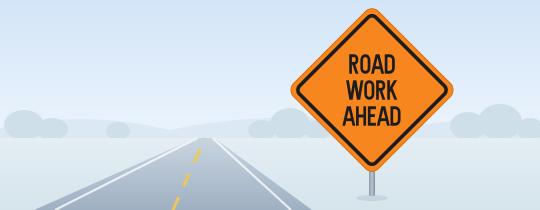
An orange diamond reading ROAD WORK AHEAD marks the start of a highway project in Kentucky. When are traffic fines in a zone like this doubled?
Show answer
Correct answer: When signs announce the zone and the doubled fines, and at least one worker is present
Why
Kentucky doubles work-zone fines when signs announce both the work zone and the higher fines and at least one worker is on site. The hazards don’t clock out with the crew, though: shifted lanes, rough pavement and parked equipment stay put. Slow down before the first cone, not at it.
22Speed limits
What is Kentucky’s speed limit in a residential neighborhood when no sign is posted?
Show answer
Correct answer: 35 mph
Why
Kentucky sets 35 mph as the unposted limit in business and residential districts. A posted sign always replaces the default, so watch for lower limits on local streets. Kids, pets and cars backing out of driveways are reasons to stay well under it.
23Right-of-way
A fire truck with its siren wailing passes you and keeps going in your direction. How closely does Kentucky law let you follow it?
Show answer
Correct answer: No closer than 500 feet
Why
Following an emergency vehicle closer than 500 feet is illegal in Kentucky. When one approaches with flashing lights or a siren, pull to the right edge, stay out of the intersection, and stop until it goes by. Then merge back in carefully, well behind it.
24Alcohol & phones
According to the Kentucky Transportation Cabinet, how long is the license suspension for a first DUI within ten years?
Show answer
Correct answer: 6 months, or 4 months with an ignition interlock
Why
A first Kentucky DUI within ten years brings a 6-month suspension that can be cut to 4 months with an ignition interlock. Add a $200 to $500 fine plus court costs, 48 hours to 30 days in jail and a 90-day alcohol program. Line up a sober ride before the first drink.
25Permit & teen rules
Jordan, 17, has a Kentucky intermediate license and is driving with no adult in the car. How many unrelated passengers younger than 20 may he carry?
Show answer
Correct answer: One
Why
Until 18, a Kentucky intermediate driver may have no more than one unrelated passenger under 20, and permit holders follow the same cap. Brothers, sisters and other relatives don’t count toward it. Fewer friends in the car means fewer distractions while you’re new.
26Road signs
The signal ahead changes from green to yellow while you’re still far enough back to stop smoothly at the line. What should you do?
Show answer
Correct answer: Stop, since red comes next
Why
A steady yellow warns that red is next, so stop if you can do it safely. A car already in the intersection when the light changes may finish crossing, but entering once it’s red is illegal in Kentucky. Rushing a yellow leaves no margin if a cross-street driver starts on their green.
27Safe driving
You plan to turn right at the next intersection. How early does the Kentucky Driver Manual want your turn signal on?
Show answer
Correct answer: At least 100 feet before the turn
Why
Kentucky asks for your signal at least 100 feet before an intersection turn. KSP’s way to picture it: a line of six or seven cars, nose to tail. Signaling early gives the drivers behind you time to slow down.
28Parking
Your family’s car can parallel park itself. May you use that feature on the Kentucky State Police road test?
Show answer
Correct answer: No, you must park without it
Why
Parallel parking is part of the KSP road test, and you must do it without parking assist; cruise control is off-limits too. A backup camera is allowed, but the examiner still expects mirror checks and a look over your shoulder. Practice with the feature switched off.
29Lane markings
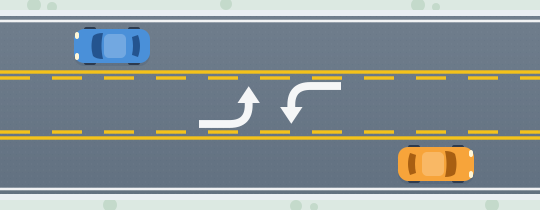
Down the middle of a street runs a lane edged with a solid yellow line outside and a broken yellow line inside, with turn arrows pointing both ways. How may you use it?
Show answer
Correct answer: Only for making left turns, by drivers from either direction
Why
That’s a shared center left-turn lane, and the Kentucky manual reserves it for left turns from both directions. Using it to pass or to travel along the street is not allowed. Move into it just before your turn and watch for an oncoming driver doing the same.
30Crashes & emergencies
Your car breaks down on a rural Kentucky highway at night. You get it fully off the road, turn on the flashers and raise the hood. Where should your flares go?
Show answer
Correct answer: About 200 to 300 feet behind the car
Why
The Kentucky manual places flares about 200 to 300 feet behind a disabled vehicle, far enough to give approaching drivers time to react. Pull completely off the road if you can and keep the flashers on. Stand well away from traffic while you wait for help.
Round 4 · Questions 31–40
31Road signs
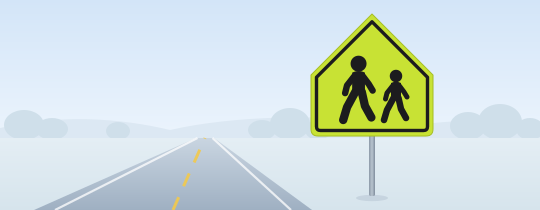
Near an elementary school you pass a five-sided, fluorescent yellow-green sign showing two children. Just ahead, a school speed limit sign has its yellow lights flashing. Which speed limit applies to you now?
Show answer
Correct answer: The reduced school-zone limit shown on that sign
Why
Kentucky enforces the lower school-zone limit whenever its lights are flashing or children are around. The pentagon shape marks school signs, and the Kentucky manual notes that school and pedestrian signs may be fluorescent so they stand out. Ease off before the zone begins and watch for crossing guards.
32Speed limits
You’re circling a shopping-center parking lot that’s open to the public, hunting for a space. What speed limit does Kentucky set there?
Show answer
Correct answer: 15 mph
Why
Kentucky caps speed at 15 mph in off-street parking facilities open to the public. Lots are full of shoppers stepping out between cars and drivers backing out who can’t see you. Creep along each row and expect someone to move without looking.
33Right-of-way
You’ve made a full stop at a red light and want to turn left. In Kentucky, when is a left turn on red allowed?
Show answer
Correct answer: Only when you’re leaving a one-way street and entering a street that is also one-way
Why
Kentucky permits a left on red in a single case: both streets must be one-way, the one you leave and the one you enter, and you must stop completely first. Right on red is allowed more broadly, after a full stop, unless a sign says no. Either way, people in the crosswalk go first.
34Alcohol & phones
Which of these makes a Kentucky DUI an aggravated one, with mandatory jail time?
Show answer
Correct answer: Carrying a passenger younger than 12
Why
Kentucky’s aggravating circumstances include a passenger under 12, a BAC of 0.15 or higher, driving more than 30 mph over the limit, going the wrong way on a limited-access highway and refusing the test. Any one of them makes jail time mandatory. A BAC of 0.08 alone is a DUI, but not an aggravated one.
35Alcohol & phones
You’re 25 and driving on a Kentucky highway. Which phone use does state law allow while the car is moving?
Show answer
Correct answer: Using GPS, or dialing or selecting a contact to make a call
Why
Kentucky law bars drivers of every age from writing, sending or reading texts while the vehicle is moving. From 18 on, you may still use GPS and dial or pick a contact to make a call; drivers under 18 can’t use a phone at all, not even hands-free. Set your route before you pull out and let messages wait.
36Permit & teen rules
Sam, 16, has held a Kentucky learner’s permit for five months when he’s convicted of running a stop sign. What happens to his road test timeline?
Show answer
Correct answer: The 180-day waiting period starts over
Why
A moving violation that puts points on a teen’s record, like a stop-sign violation (3 points), restarts Kentucky’s 180-day period, counted from the date of the violation. Points pile up too: under 18, more than six can bring a suspension, while adults reach that line at 12. One ticket can set a teen back months.
37Permit & teen rules
A 17-year-old with a Kentucky intermediate license wants to take a call through the car’s Bluetooth while driving. Is that allowed?
Show answer
Correct answer: No, under 18 any phone use while moving is banned, hands-free included
Why
Kentucky’s rule for drivers younger than 18 is total: no phone or other personal communication device while the car is in motion, hands-free included, and officers can pull you over for that alone. GPS is fine only if you enter the destination while stopped. A violation also adds points and restarts the 180-day clock.
38Road signs
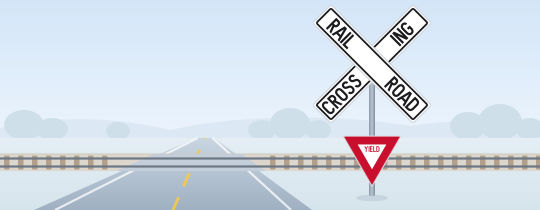
A rural road crosses a railroad track that has no flashing lights and no gate, just a white X-shaped RAILROAD CROSSING sign with a YIELD sign under it. How should you treat this crossing?
Show answer
Correct answer: As a yield: slow down, look and listen both ways, and stop if a train is near
Why
The Kentucky Driver Manual gives the crossbuck the same meaning as a yield sign. A train can’t swerve and needs a long distance to stop, so it always goes first: check both directions and be ready to brake. Expect buses and hazmat trucks ahead of you to stop at the tracks every time.
39Safe driving
Your 6-year-old nephew is 45 inches tall. Under Kentucky’s child passenger law, how must he ride?
Show answer
Correct answer: In a booster seat
Why
In Kentucky, children under 8 who measure 40 to 57 inches need a booster seat, and kids 40 inches or shorter ride in a federally approved child safety seat. Once a child is taller than 57 inches, the regular belt can do the job. The booster lifts him so the lap-and-shoulder belt fits the way it was designed to.
40Speed limits
Heavy fog leaves you able to see only about 100 feet ahead. According to the Kentucky Driver Manual, what is the fastest speed that’s safe?
Show answer
Correct answer: 25 mph, with low beams on
Why
When rain, snow or fog keeps your view to roughly 100 feet, the manual says you can’t safely go faster than 25 mph. Low beams are the right choice because high beams reflect off the fog straight back at you. If it thickens, find a safe place well off the road and wait.
Kentucky permit test at a glance
What to know before your Kentucky State Police appointment.
Kentucky · KSP written test
80% to pass.
Road rules + signs · In person
At least 80% of your answers right
In personat a KSP testing site, by appointment only
No waitto retake a failed written test
Spanishone of 12 languages for the written test
$15learner’s permit ($18 for REAL ID)
20/40vision screening before the written test
3 weekshow far ahead KSP opens test slots, at 8 a.m.
Under 18? Your road to a license
15Learner’s permitPass the vision screening and written test at a KSP site. A parent or guardian signs, and you bring the TC 94-200 school compliance form.
180 dSupervised practiceHold the permit at least 180 days and log 60 hours, 10 at night, always with a licensed driver age 21+ riding up front beside you.
16Intermediate licensePass the KSP road test with your signed Practice Driving Log. Until 18: no driving midnight–6 a.m. without good cause, and one unrelated passenger under 20 at most.
17Full licenseAfter 180 days on the intermediate license and a 4-hour driver education course (Alive at 25 is free, RightLane online is $12.50), you move up to a full license. Phones stay off-limits until 18.
18 to 20? Skip the intermediate stage: hold the permit 180 days, then pass the road test for a full license. At 21 or older, the wait drops to 30 days, with a licensed driver 21+ always beside you.
What’s on the Kentucky permit test
The test is based on the Kentucky Driver Manual, the only study source KSP approves; the newest edition is dated July 23, 2026. Start with these six areas.
Road signs
Yellow diamonds warn; a five-sided sign means a school is near.
Round yellow RR sign: a railroad crossing is ahead. The white crossbuck works like a yield sign.
Orange means work zone. With the signs posted and a worker present, fines double.
Right-of-way
Four-way stop tie? The car on the right goes first.
School or church bus with red lights: stop both ways, unless a raised barrier or unpaved median splits 4+ lanes.
Siren behind you: pull right and stop, then stay 500 feet back.
Speed limits
65 mph on interstates and parkways unless posted; 70 where the state raises it.
55 on other state highways, 35 in business and residential districts.
15 mph in public parking lots; 25 mph when fog or rain cuts your view to 100 feet.
Parking
On a hill, aim the wheels so the car would roll into the curb, or off the road if there’s none.
Leaving the car: engine off, key out, parking brake set.
Road test: parallel park with no park assist, and check mirrors even with a backup camera.
Alcohol & phones
Limits: 0.08 at 21 and over, 0.02 under 21, 0.04 in a commercial vehicle.
Refusing a breath, blood or urine test can cost your license and be used in court.
No texting at any age; under 18, no phone at all, even hands-free.
Teen rules
Hold the permit 180 days and log 60 hours, 10 of them at night.
Under 18: no driving midnight to 6 a.m. without good cause.
One unrelated passenger under 20, on the permit and the intermediate license.
Kentucky numbers to know
Six Kentucky figures to have down before your appointment.
100 ftof signaling before you turn
4 secminimum gap behind the car ahead
500 ftdim your high beams for oncoming cars
65 mphinterstates and parkways, unless posted
0.02alcohol limit for drivers under 21
3 ftof room when you pass a bicycle
Your Kentucky course, in your pocket
These 40 questions are just the warm-up. The app gives you 477 Kentucky practice questions, 36 short lessons and the why behind every answer.
36 short lessonsFour levels, from fundamentals to expert, then a full practice exam.
477 Kentucky questions315 of them with pictures.
Your most-missed questionsA review lesson built from the questions you miss most.
Exam simulatorTake full practice exams and watch your readiness grow.
Kentucky permit
Your Kentucky path is ready.
36 lessons, 477 questions and full practice exams. In English and Spanish.
What score do I need to pass the Kentucky permit test?
80%. The written knowledge test, given by the Kentucky State Police after a vision screening (20/40 or better), covers driving rules, regulations, procedures and highway signs. Even if the test is read to you aloud, the road-sign questions are yours to answer alone.
What happens if I fail the Kentucky written test?
You can come back and retake it on the next available day. Every test is by appointment: KSP opens slots at 8 a.m. on each testing day, three weeks out, and you can book at any regional testing site in the state, whatever your county.
Can I take the Kentucky permit test online?
No. Kentucky has no online or at-home permit test. The Kentucky State Police give the written test in person at regional testing sites, by appointment only, with no walk-ins. Book early and do your studying online before test day.
Can I take the Kentucky permit test in Spanish?
Yes. KSP gives the written test in 12 languages, Spanish among them, and every testing office has tablets that can read the test aloud in English and several other languages. A Spanish Kentucky Driver Manual exists, but it’s the 2023 edition and still lists 16 as the permit age, so check the current English manual for the rules that changed. This practice test and the app are both in Spanish too.
How old do you have to be to get a permit in Kentucky?
15. Teens hold the permit at least 180 days and log 60 supervised hours, 10 at night, before taking the road test for an intermediate license at 16. Until 18 there’s no driving from midnight to 6 a.m. without good cause, no more than one unrelated passenger under 20, and no phone use at all behind the wheel. After 180 days on the intermediate license and a 4-hour driver education course, you can get a full license at 17.
How much does a Kentucky learner’s permit cost?
$15, or $18 for a REAL ID permit, whatever your age. A teen’s intermediate license costs the same, and a standard 4-year license is $21.50 ($24 for REAL ID). Under 18, bring your birth certificate, Social Security card, proof of Kentucky residency and the TC 94-200 school form, and a parent or guardian named on the birth certificate has to come along and sign.
What’s on the Kentucky road test?
A KSP examiner checks stops, backing, turning around, a hill start, parallel parking, intersections, lane use and right-of-way. A collision, a traffic violation or a dangerous move can end the test as an automatic fail, and parking assist and cruise control aren’t allowed. Bring a licensed driver 21 or older and a registered, insured car; after a fail, you wait seven full days to retest.
What’s the best way to study for the Kentucky permit test?
Read the Kentucky Driver Manual, the July 2026 edition, since KSP builds the test on it and calls it the only approved study source. Then work through the 40 questions above and keep going in the app: 477 Kentucky questions and 36 short lessons, with every answer explained.