In Massachusetts, the DMV is the RMV: the Registry of Motor Vehicles. Get ready for its learner’s permit exam with 40 free questions on rotaries, road signs, speed limits, OUI and Junior Operator rules, each explained the moment you answer.
Four rounds of 10 questions on Massachusetts rotaries, road signs, speed limits, parking, OUI and phone laws, and Junior Operator rules. Each answer comes with a short explanation.
Round 1 · Questions 1–10
1Right-of-way
Rotaries are a Massachusetts specialty. A yellow diamond sign with three curved arrows forming a loop tells you one is just ahead. When you reach its entrance, who has the right-of-way?
Show answer
Correct answer: Vehicles already circling inside the rotary
Why
Massachusetts law gives cars already circling the rotary the right-of-way, and YIELD signs at the entrances back that up. Wait for a gap, merge in and travel counterclockwise. Yield to people on foot as you enter, too.
2Road signs
On a Massachusetts highway, you start seeing signs in fluorescent pink. What are they for?
Show answer
Correct answer: Managing traffic around an incident such as a crash
Why
Massachusetts uses fluorescent pink for traffic incident management, so expect emergency crews, a blocked lane or a detour. Construction signs are orange, and purple marks electronic tolling. Slow down and follow any detour signs.
3Speed limits
You're driving through a Massachusetts neighborhood where houses stand less than 200 feet apart for well over a quarter mile. No speed sign is posted, and the town hasn't adopted a lower limit. What's the limit?
Show answer
Correct answer: 30 mph
Why
Massachusetts calls this a thickly settled district, and like a business district it defaults to 30 mph. Cities and towns may choose to lower that default to 25 mph on local roads, and the ones that do post signs at their borders. Keep an eye out for them as you cross town lines.
4Alcohol & phones
A 19-year-old driver is stopped after a party and blows 0.03%. What does Massachusetts' zero-tolerance law mean for them?
Show answer
Correct answer: A license suspension, because the under-21 limit is 0.02%
Why
Under 21, a BAC of 0.02% or more brings a license suspension however the court case ends: 180 days at ages 18 to 20 and a year under 18. For a first offense, enrolling in a state-approved alcohol education program gets it waived or cut to 180 days. One drink can add about 0.02 to an average person's BAC, so the only safe amount before driving is none.
5Right-of-way
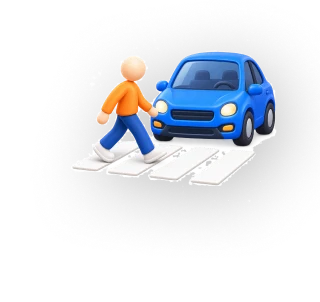
On a two-lane street with no traffic light, a woman is walking across a marked crosswalk. She's still on the opposite half of the road, about 6 feet from your lane. What does Massachusetts law say?
Show answer
Correct answer: Yield, because she's within 10 feet of your half of the road
Why
Where no signal controls a marked crosswalk, Massachusetts makes you yield to a pedestrian who is on your half of the road or within 10 feet of it. Overtaking a car that has stopped for someone in a crosswalk is also illegal. Fines can reach $200.
6Parking
There's an open spot on the street beside a fire hydrant. What's the closest you may park to it in Massachusetts?
Show answer
Correct answer: 10 feet
Why
The Massachusetts Driver's Manual keeps parked cars at least 10 feet from a hydrant or fire lane, so firefighters can hook up a hose without delay. Pair it with the 20-foot rule for intersections. Cities and towns set many other parking rules, so read the local signs before you leave the car.
7Safe driving
In good weather, what's the minimum following distance the Massachusetts Driver's Manual recommends?
Show answer
Correct answer: Three seconds
Why
Leave a gap of three seconds or more to the car in front, and stretch it in rain, snow or darkness. Give a motorcycle four seconds or more, and heavy equipment like a dump truck ten or more. Tailgating is illegal in Massachusetts and can cost up to $100.
8Permit & teen rules
You're 16 with a learner's permit. Who can sit next to you so you can legally practice?
Show answer
Correct answer: A licensed driver 21 or older with at least a year of experience
Why
Massachusetts permit holders may drive only with a licensed driver who is 21 or older and has a year or more of experience, seated in the front passenger seat. Driving without one counts as unlicensed driving, and a first offense suspends the permit for 60 days. A supervisor in the back seat doesn't count.
9Road signs
Orange diamond signs and barrels mark a construction zone on Route 2. If you're ticketed for speeding there, what changes?
Show answer
Correct answer: The fine is doubled
Why
Massachusetts doubles speeding fines in a marked construction zone. Orange is the color for work zones, so treat it as an early cue to slow down and leave space. Expect lane shifts, workers close to traffic and equipment entering the road.
10Sharing the road
You're overtaking a bicyclist on a narrow Cambridge street. How much space does Massachusetts law require between your car and the rider?
Show answer
Correct answer: 4 feet
Why
Massachusetts requires at least 4 feet of clearance, at a reasonable speed, when you pass a bicyclist, pedestrian, roadside worker or other vulnerable road user. If the lane is too narrow, wait and use the next lane when it's safe, even across the center line. After passing, don't turn right in front of the rider.
Round 2 · Questions 11–20
11Road signs
A five-sided fluorescent yellow-green sign with two walking children marks a school zone ahead. No other speed limit is posted. How fast may you drive through the zone?
Show answer
Correct answer: 20 mph
Why
Massachusetts sets 20 mph in school zones unless a different limit is posted, and some zones show it with flashing yellow lights or only during set hours. That fluorescent yellow-green color flags school, bicycle and pedestrian warnings. Watch for children stepping out between parked cars.
12Right-of-way
You're following a school bus on a two-lane road when it stops, its red lights start flashing and the stop arm swings out. What must you do?
Show answer
Correct answer: Stop, and stay stopped until the red lights go off
Why
Massachusetts law halts traffic behind the bus and traffic coming toward it whenever the red lights flash; only drivers on the far side of a divided highway may keep going. Stay put until the lights shut off. Even when the bus is moving, keep 100 feet or more behind it, and know that a first passing violation costs at least $250.
13Speed limits
Out in the countryside, away from any thickly settled or business district, you're on an undivided two-lane road with no speed sign in sight. What's the default limit?
Show answer
Correct answer: 40 mph
Why
Massachusetts sets 40 mph on undivided roads outside thickly settled and business districts when no limit is posted. A divided highway in the same kind of area defaults to 50 mph. Posted signs always override these defaults, and bad conditions can call for less.
14Alcohol & phones
You're 30, waiting at a red light in Springfield, when a text comes in. Under Massachusetts' hands-free law, what's the right move?
Show answer
Correct answer: Leaving it alone until you're parked out of the travel lanes
Why
Massachusetts drivers may not hold a phone at all, and reading or sending texts is banned, even at a red light or a stop sign. Keep the phone mounted on the windshield, dashboard or center console and touch it only to start hands-free mode. Fines climb from $100 to $250 to $500.
15Road signs
At a railroad crossing, the red lights start flashing and the gate comes down. Where does Massachusetts law have you stop?
Show answer
Correct answer: Between 15 and 50 feet from the closest track
Why
When crossing lights flash, a gate is lowered or a railroad worker signals, stop at least 15 feet but no more than 50 feet from the nearest track. Wait until the lights go dark or the gate rises completely. A violation costs $100 to $200.
16Parking
Your car sits on a steep Worcester street, nose pointing downhill, right beside the curb. To keep it from rolling into traffic, how should you set the front wheels?
Show answer
Correct answer: Toward the curb
Why
Facing downhill, turn the wheels toward the curb, so a rolling car runs into the curb instead of into the street. Facing uphill against a curb, turn them away from it; with no curb at all, angle them toward the edge of the road. Set the parking brake every time.
17Safe driving
Your turn signals have stopped working, so you stick your left arm out the window and bend it up at the elbow. What does that tell drivers behind you?
Show answer
Correct answer: You're turning right
Why
Massachusetts law spells out all three: arm straight out for a left turn, bent upward for a right turn and bent downward to slow or stop. Examiners can ask for them on the road test, and not knowing them is a common reason for failing. Use them whenever your lights quit.
18Permit & teen rules
You got your Junior Operator License two months ago. A 16-year-old classmate who isn't family asks for a ride home. When is that legal?
Show answer
Correct answer: Only if a licensed driver 21 or older, with a year of experience, sits up front
Why
For the first six months with a JOL, you can't carry passengers under 18 unless they're immediate family or a licensed driver 21+ with a year or more of experience rides in the front seat. The rule ends after six months or at 18, whichever comes first. A first violation costs your license for 60 days.
19Speed limits
An ice cream truck is parked ahead with its amber lights flashing. Under Massachusetts law, going faster than what speed within a tenth of a mile of it counts as evidence of an unsafe speed?
Show answer
Correct answer: 15 mph
Why
Massachusetts treats anything over 15 mph within one-tenth of a mile of a vendor truck with flashing amber lights as evidence of an unsafe speed. Kids often dart out from around these trucks without looking. Slow down early and be ready to stop.
20Sharing the road
At a corner, a person holding a white cane steps off the curb to cross in front of you. What does the Massachusetts White Cane Law require?
Show answer
Correct answer: Stop completely and wait until they've reached the other side
Why
The White Cane Law requires a full stop for a blind pedestrian using a white cane or a guide dog, and you stay stopped until they finish crossing. Don't honk or wave them on: they depend on hearing traffic, and a horn can startle or confuse them.
Round 3 · Questions 21–30
21Lane markings
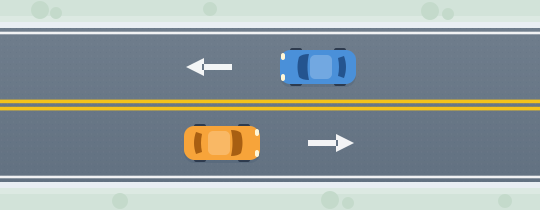
Two solid yellow lines run down the middle of your road. When does the Massachusetts Driver's Manual let you cross them?
Show answer
Correct answer: To turn left, once it's safe
Why
A double solid yellow line means no passing for traffic in either direction, but you may cross it to make a left turn once oncoming traffic is clear. State law also lets you move across the center line to give a cyclist or pedestrian 4 feet of room when that's safe. Passing ordinary traffic waits until the line on your side is broken.
22Road signs
A road marker shows a black number on a white rectangle with a black border. In Massachusetts, what kind of road is it?
Show answer
Correct answer: A state route
Why
Massachusetts state route numbers appear in black on a white rectangle edged in black. Interstate markers look different: a red, white and blue shield. Recognizing route markers at a glance helps you follow directions without slowing down.
23Right-of-way
The light is red, you're in the left lane at a Boston intersection, and you'd like to go left. In which case is a left turn on red legal after a complete stop?
Show answer
Correct answer: When you're leaving a one-way street and the cross street is one-way too
Why
Massachusetts permits a left on red in a single case: both streets run one way, the one you're on and the one you're turning into. Make a full stop and let people crossing and other traffic go first. Right on red follows the same steps wherever no sign forbids it, and breaking the turn-on-red rules costs at least $35.
24Speed limits
Heavy rain is pounding a road posted at 50 mph, and you can barely make out the lane lines. You slow to 40. Could you still be ticketed for speeding?
Show answer
Correct answer: Yes, if 40 mph is still too fast for the conditions
Why
Massachusetts' basic speed law requires a speed that's reasonable and proper for traffic, the road and the weather, not simply one under the sign. The Driver's Manual uses this very example: 40 mph in a downpour on a 50 mph road can earn a ticket. Ask yourself whether you could stop within the distance you can see.
25Alcohol & phones
A 35-year-old with no prior OUI is arrested for OUI and refuses the breath test. What happens to the license?
Show answer
Correct answer: The officer takes it right away, and it's suspended for 180 days
Why
Under the Implied Consent Law, driving in Massachusetts means you've agreed to a chemical test if you're arrested for OUI. Refuse, and the officer takes your license on the spot; for a driver over 21 with no prior OUI, the suspension is 180 days. Drivers 18 to 20 lose it for 3 years plus 180 days.
26Right-of-way
You're approaching a multi-lane rotary on a road with two lanes heading in. There are no lane signs, and your exit is three-quarters of the way around. Which approach does the Massachusetts Driver's Manual recommend?
Show answer
Correct answer: Enter from the left lane, then exit into the right lane
Why
Without lane signs, the left lane is for three-quarter turns and U-turns, and the right lane for quarter turns and going straight; coming from a one-lane road, you stay right the whole way. Whichever lane you use, you leave the rotary into the right lane, so check your mirror and signal right before your exit. Missed it? Go around once more instead of stopping.
27Safe driving
It's midday, a light drizzle has your wipers on, and your car's daytime running lights are lit. What does Massachusetts law require?
Show answer
Correct answer: Turning on your headlights and taillights
Why
In Massachusetts, any time you need your wipers you also need your headlights and taillights, and daytime running lights don't count. The law also wants them on during the dark hours, which start 30 minutes past sunset and end 30 minutes ahead of sunrise, plus any time you can't clearly see 500 feet.
28Permit & teen rules
Under the Junior Operator Law, during which hours may a 17-year-old with a JOL not drive unless a parent or legal guardian is in the car?
Show answer
Correct answer: 12:30 a.m. to 5:00 a.m.
Why
From 12:30 to 5:00 in the morning, a Junior Operator needs a parent or guardian along to drive. From 12:30 to 1:00 and from 4:00 to 5:00, police enforce it only after stopping you for another violation, but driving then is still illegal. Permit holders under 18 face an earlier start: midnight.
29Alcohol & phones
You're driving home from a restaurant with a partly finished bottle of wine. Where can it ride legally in Massachusetts?
Show answer
Correct answer: In the trunk
Why
Massachusetts bans open containers of alcohol anywhere in the passenger area, with fines of $100 to $500. Even a bottle the restaurant reseals for you can't ride there; the trunk or a locked glove box is fine. A driver under 21 caught with an open container can also be arrested and lose the license.
30Permit & teen rules
How many hours of supervised driving must a Massachusetts teen log, on top of driver's ed, if they don't take a driver skills development program?
Show answer
Correct answer: 40 hours
Why
Massachusetts requires at least 40 hours of supervised driving, certified by a parent or guardian. Completing an RMV-licensed driver skills development program lowers that to 30. Driver's ed itself adds 30 hours of class, 12 hours at the wheel and 6 hours watching another student drive.
Round 4 · Questions 31–40
31Sharing the road
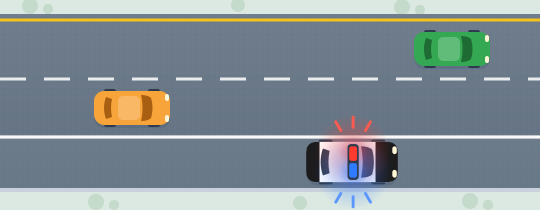
A police cruiser is stopped on the right shoulder with its lights flashing, and there's room in the lane to your left. What does the Massachusetts Move Over Law ask you to do?
Show answer
Correct answer: Slow down and, if it's safe, move left so you're not in the lane beside it
Why
When you pass a stopped emergency vehicle, highway maintenance vehicle or tow truck with flashing lights, slow to a safe speed. Where there are two or more lanes going your way, move over to leave a free lane between you when you can. Ignoring the law can cost up to $100.
32Road signs
A storm has knocked out power, and the traffic lights at a busy crossroads are completely dark. How should you handle the intersection?
Show answer
Correct answer: Treat it as if there were a stop sign on every approach
Why
The Massachusetts Driver's Manual says a dark signal turns the intersection into an all-way stop: stop fully, then take turns. A flashing red light works the same way as a STOP sign. Don't assume the busier road keeps the right-of-way.
33Speed limits
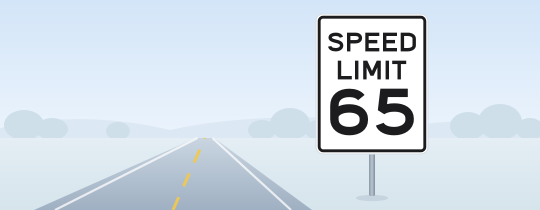
Out on a Massachusetts interstate, you pass a SPEED LIMIT 65 sign like this one. What's true about 65 mph in Massachusetts?
Show answer
Correct answer: It's the highest limit posted anywhere in the state
Why
Limited-access highways in Massachusetts are posted between 50 and 65 mph, so 65 is as high as limits go; smaller highways top out at 55, and an unposted divided highway defaults to 50. The Turnpike also has a floor of 40 mph. When rain, snow or traffic make 65 unsafe, slow down.
34Right-of-way
You're entering an intersection on a green light when an ambulance with lights and siren comes up behind you. What should you do?
Show answer
Correct answer: Get through the intersection, then pull as far right as you can and stop
Why
Massachusetts has you pull to the right and stop for a police car, fire truck or ambulance on an emergency call, but never inside an intersection: clear it first, and don't just creep along. Once it passes, stay more than 300 feet behind any fire truck or other emergency vehicle running with lights or siren.
35Parking
You're parking on a side street close to the corner. How far back from the intersection must your car be?
Show answer
Correct answer: At least 20 feet
Why
Massachusetts bans parking within 20 feet of an intersection, so turning drivers can see pedestrians and cross traffic. You also can't park in a crosswalk, in front of a driveway, on a sidewalk or in a bike lane. Many other parking rules and fines are set by each city or town.
36Alcohol & phones
You're 17 and drive on a Junior Operator License. When may you use your cell phone behind the wheel?
Show answer
Correct answer: To report an emergency
Why
Drivers under 18 may not use any mobile device while driving in Massachusetts, hands-free included; reporting an emergency is the only exception. A first offense brings a $100 fine and a 60-day suspension, and a Junior Operator must also retake the permit exam and road test. Silence the phone and stow it before you start.
37Safe driving
On a dark road with your high beams on, you spot a car coming toward you. When must you switch to low beams?
Show answer
Correct answer: Once it's 500 feet away or closer
Why
Dim your high beams when an oncoming vehicle is within 500 feet, and when you're 200 feet or less behind another car. High beams light roughly 350 feet ahead and low beams only about 100, so ease off the gas after you dim.
38Permit & teen rules
A 17-year-old Junior Operator is convicted of speeding for the first time. What happens to the license?
Show answer
Correct answer: It's suspended for 90 days
Why
A Junior Operator's first speeding conviction brings a 90-day suspension, and any later one a full year. Getting the license back means passing the permit exam again, completing a retraining class and taking another road test. Adult drivers, by contrast, face a 30-day suspension after three speeding violations within 12 months.
39Safe driving
You're heading for an exit ramp on a Massachusetts highway. When should your turn signal start blinking?
Show answer
Correct answer: 500 feet or more before the ramp
Why
On highways, Massachusetts asks for your signal at least 500 feet before an exit or turn, giving faster traffic time to react. On ordinary streets the minimum is 100 feet. Signal every time, even when the road looks empty.
40Crashes & emergencies
After a crash in Massachusetts, nobody is hurt, but the other car has about $1,500 in damage. What do you have to file, and how soon?
Show answer
Correct answer: A Motor Vehicle Crash Operator Report within 5 days
Why
When a crash injures or kills anyone, or damages any one vehicle or property by more than $1,000, each driver must file a Motor Vehicle Crash Operator Report within 5 days. It goes to the RMV and to the police in the town where it happened, with a copy to your insurer. If no one is hurt, first move the cars out of the travel lanes.
Massachusetts RMV permit exam at a glance
What to know before your RMV Service Center visit.
Massachusetts · Class D learner’s permit exam
18 of 25 to pass.
25 questions · 25 minutes
18 of 25 answers right to pass
$30exam fee, paid again for each retake
Onlinefrom home within 60 days of your RMV visit
Spanishone of 37 exam languages, online too
25 minto answer all 25 questions
2 yearshow long your learner’s permit lasts
20/40vision needed in your better eye
Under 18? Your road to a license
16Learner’s permitWith a parent’s or guardian’s consent, pass the vision check and the 25-question exam. From then on, drive only with a licensed adult 21+ beside you.
6 moPractice and driver’s edHold the permit six months with a clean record, finish driver’s ed (30 hours of class, 12 at the wheel, 6 observing) and log 40 supervised hours.
16½Junior Operator LicensePass the road test, with a sponsor 21 or older riding along, and you’re a Junior Operator.
To 18Until you turn 18No driving 12:30–5 a.m. without a parent or guardian, no phone at all, and for the first six months no passengers under 18 except family unless a qualified adult 21+ rides up front.
18 or older? Driver’s ed isn’t required: pass the vision check and the permit exam, then the road test with a qualified sponsor.
What’s on the Massachusetts permit test
Study the Massachusetts Driver’s Manual (revised April 2026). The RMV exam covers rules of the road, road signs, OUI and license suspensions, the Junior Operator Law and sharing the road with pedestrians and cyclists. Six areas to master first:
Road signs
Fluorescent yellow-green flags school, bike and pedestrian warnings; orange means a work zone, where speeding fines double.
Fluorescent pink warns of a traffic incident ahead, and purple points to electronic tolling.
A flashing red light means stop, just like a STOP sign; a dark signal means an all-way stop.
Right-of-way
Entering a rotary, yield to cars already in it; signal right just before you exit.
Reach an intersection at the same time as another car? The one on the right goes first.
School bus flashing red: stop from both directions, unless it’s across a divided highway.
Speed limits
20 mph in a school zone and 30 mph in a thickly settled or business district, unless posted.
Outside thickly settled and business districts: 40 mph, or 50 on a divided highway. 65 mph is the highest posted limit.
Basic speed law: never faster than is reasonable for traffic and conditions, whatever the sign says.
Parking
Keep 10 feet from a hydrant and 20 feet from an intersection.
Wheels within 12 inches of the curb, and leave a 12-foot lane open beside you.
Downhill at a curb, turn the wheels toward it; uphill, turn them away.
Alcohol & phones
BAC limits: 0.08% at 21 and over, 0.02% under 21, 0.04% in a commercial vehicle.
Refuse a chemical test and the officer takes your license on the spot, for at least 180 days.
Hands-free only for every driver; under 18, no phone at all, even hands-free.
Teen rules
Permit drivers need a licensed adult 21+, with a year’s experience, in the front seat.
First 6 months with a JOL: no passengers under 18 except family, unless a qualified adult rides up front.
Curfew: 12:30–5 a.m. for Junior Operators, midnight–5 a.m. on a permit, unless a parent or guardian rides along.
Massachusetts numbers to know
Six figures from Massachusetts law and the Driver’s Manual to learn by heart.
100 ftof signaling before a turn; 500 ft on highways
4 ftof space when passing a cyclist or pedestrian
3 secminimum following distance in good weather
15–50 ftfrom the nearest track when a crossing signals a stop
500 ftfrom an oncoming car: switch to low beams
0.02%BAC that suspends a driver under 21
Your Massachusetts course, in your pocket
These 40 questions are just the warm-up. The app gives you 522 Massachusetts practice questions, 36 short lessons and the why behind every answer.
36 short lessonsFour levels, from fundamentals to expert, then a full practice exam.
522 Massachusetts questions321 of them with pictures.
Your most-missed questionsA review lesson built from the questions you miss most.
Exam simulatorTake full practice exams and watch your readiness grow.
Massachusetts permit
Your Massachusetts path is ready.
36 lessons, 522 questions and full practice exams. In English and Spanish.
How many questions are on the Massachusetts permit test, and what’s a passing score?
The Registry of Motor Vehicles (RMV), Massachusetts’ answer to the DMV, gives a Class D learner’s permit exam of 25 multiple-choice questions with a 25-minute limit. You need 18 right, which is 72%, so you can miss no more than 7. Expect rules of the road, signs, OUI and suspensions, the Junior Operator Law and sharing the road.
How much does the permit exam cost, and what if I fail?
The exam fee is $30. Didn’t pass? You can take it again once you pay another $30 through your myRMV profile. Pass, and your learner’s permit is good for 2 years.
Can I take the Massachusetts permit test online?
Yes. You start the application online, then visit an RMV Service Center for your documents, vision check and photo. From that visit you have 60 days to take the exam at home on a computer with its camera on, alone in a quiet room; phones and tablets aren’t allowed. Leave the browser window or run past 25 minutes and the exam counts as a fail.
Can I take the Massachusetts permit test in Spanish?
Yes, both at a service center and online. The RMV gives the exam in 37 languages, including Spanish, Portuguese and Haitian Creole, and you can choose an audio version that reads each question through headphones. The Driver’s Manual has a Spanish edition too, and this practice test and the app work in Spanish as well.
How old do you have to be to get a learner’s permit in Massachusetts?
You can apply at 16; under 18, a parent or guardian must sign your application. Teens then hold the permit for six months with a clean record, finish driver’s ed (30 classroom hours, 12 hours driving and 6 observing), log 40 supervised hours and have a parent attend a 2-hour class. The earliest you can get a Junior Operator License is 16½.
What are the rules for a Junior Operator License?
Until you turn 18, you can’t drive from 12:30 to 5 a.m. unless a parent or guardian is with you, and you can’t use a phone at all, even hands-free. For the first six months, no passengers under 18 other than family, unless a licensed driver 21+ with a year’s experience rides up front. A first passenger or night-rule violation costs your license for 60 days; a first speeding conviction, 90 days.
What do I need for the Massachusetts road test?
A sponsor who is 21 or older, has driven for at least a year and holds a valid U.S. license; they ride in the back seat. The test costs $35, and the examiner may ask you to parallel park, back up about 50 feet, make a three-point turn, start on a hill and use hand signals. If you don’t pass, you wait two weeks before trying again.
What’s the best way to study for the Massachusetts permit test?
Read the Massachusetts Driver’s Manual first, then practice until you clear 18 of 25 with room to spare. Start with these 40 questions; the app has 522 Massachusetts questions and 36 short lessons, with every answer explained.