Get ready for the Missouri written test, given by the State Highway Patrol, with 40 free questions on lettered-route speed limits, the hands-free law, school buses and teen driving limits. Choose an answer and the explanation appears instantly.
Four rounds of 10 questions on Missouri road signs, right-of-way, speed limits, parking, alcohol and phone laws, and teen rules. A short explanation follows every answer.
Round 1 · Questions 1–10
1Lane markings
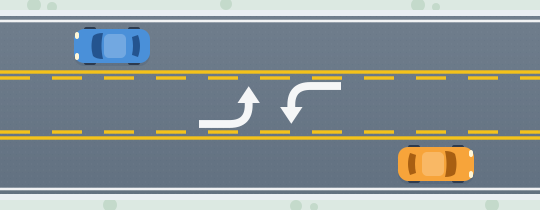
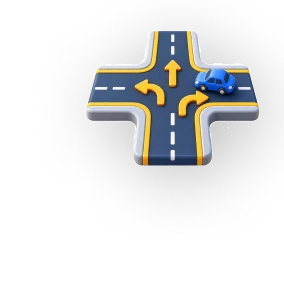
A busy Springfield street has a center lane edged with solid and dashed yellow lines, with turn arrows pointing both ways. According to the Missouri Driver Guide, what’s the longest distance you may drive in it?
Show answer
Correct answer: 500 feet
Why
That’s a two-way left-turn lane, shared by left-turning drivers from both directions. Missouri lets you use it only to slow down and turn left, for no more than 500 feet, and never as a way to merge in from a side street. Signal, slide in close to your turn and wait there for a gap.
2Right-of-way
You and a pickup reach a Missouri intersection with no signs or signals at about the same moment. The pickup is coming from the road on your right. Who should go first?
Show answer
Correct answer: The pickup, because it’s on your right
Why
When two cars reach an uncontrolled intersection almost together, Missouri law makes the driver on the left wait for the one approaching from the right. A vehicle already in the intersection goes first, whichever side it came from. Make eye contact before you move, since the other driver may not know the rule.
3Speed limits
Many two-lane Missouri state roads go by letters instead of numbers, such as Route A or Route KK. Unless MoDOT posts a different limit, how fast may you drive on them?
Show answer
Correct answer: 55 mph
Why
State law holds Missouri’s lettered routes to 55 mph unless MoDOT approves a higher limit, and even then they can’t go above 60. Treat 55 as a ceiling, not a target, and slow down further for hills, curves and farm traffic.
4Alcohol & phones
Who has to follow Missouri’s Siddens Bening Hands Free Law?
Show answer
Correct answer: Every driver, of any age
Why
Since August 28, 2023, Missouri has had one phone rule for all ages: while driving you may not hold or prop up a phone with any part of your body, type or read texts, or watch or record video. The law replaced the state’s older texting statute, so teens and adults now play by the same rule. Mount the phone and set your route before you pull out.
5Permit & teen rules
You’re 15 and just passed the vision, road sign and written tests at a Highway Patrol exam station. What do you still need before you can practice driving?
Show answer
Correct answer: Buy the permit at a license office, with a parent or guardian along
Why
The Highway Patrol’s exam record is not a permit. Take it to a Department of Revenue license office, where a parent or legal guardian signs for you, and pay $10 for the instruction permit. Your 182-day permit period only starts once the permit is issued, so don’t put it off.
6Safe driving
It’s 2 p.m. and a steady drizzle has your windshield wipers running on I-44. What does Missouri law say about your headlights?
Show answer
Correct answer: They must be on whenever weather makes you use your wipers
Why
Missouri ties headlights to wipers: if the weather has your wipers going, your headlights must be on, and in fog they’re required even when the wipers aren’t. Night use starts 30 minutes past sunset and lasts until 30 minutes ahead of sunrise, and lights are also required whenever you can’t clearly make out people or vehicles 500 feet away. In daytime rain, lights help other drivers spot you sooner.
7Parking
You park facing downhill on a steep Jefferson City street with a curb. Which way does the Missouri Driver Guide want your front wheels turned?
Show answer
Correct answer: Sharply to the right, toward the curb
Why
Facing downhill, curb or no curb, the guide’s hill diagram turns the wheels right, toward the roadside, so a car that starts rolling heads away from traffic. The one exception is facing uphill against a curb, where they turn left. Then set the parking brake and leave the car in park, or in gear with a manual transmission.
8Road signs
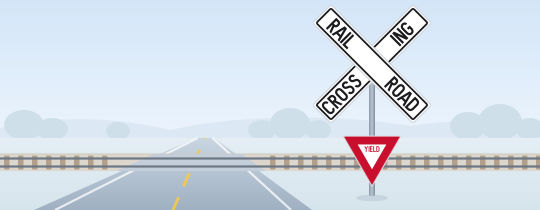
On a quiet road in rural Missouri, a railroad crossing has signs only: a white X-shaped crossbuck, with no flashing lights and no gate. What does the Missouri Driver Guide say the crossbuck means?
Show answer
Correct answer: Treat it like a YIELD sign: slow down, look and be ready to stop
Why
A crossbuck carries the same meaning as a YIELD sign, and any train gets the right-of-way. Slow down, look and listen in both directions, and if you have to stop, state law sets your stopping point between 15 and 50 feet short of the closest rail. Never race a train, and don’t start across until there’s room for your whole car on the far side.
9Alcohol & phones
A 19-year-old is pulled over in Columbia, and a breath test shows a blood alcohol content of 0.03%. What happens under Missouri law?
Show answer
Correct answer: The officer takes the license and issues a 15-day driving permit
Why
Missouri’s limit for drivers under 21 is 0.02%, far below the 0.08% that applies at 21 and over. At that level the officer takes the license and hands over a notice that works as a 15-day permit; the suspension starts after those 15 days unless the driver requests a hearing. If you’re under 21, the only safe amount before driving is none.
10Crashes & emergencies
You have a minor fender bender on a busy Missouri highway. Nobody is hurt and both cars still run. What does Missouri’s Move It law require?
Show answer
Correct answer: Move the vehicles off the roadway to the shoulder or a nearby safe spot
Why
Missouri’s Move It law, which MoDOT promotes as “Steer It and Clear It,” has drivers in a minor no-injury crash get their vehicles out of the travel lanes. Once you’re safely off the road, exchange names, addresses, license and plate numbers and insurance information. From a cell phone, *55 reaches the Missouri State Highway Patrol; in a metro area, 911 works too.
Round 2 · Questions 11–20
11Speed limits
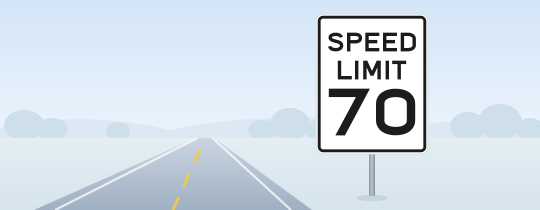
You’re crossing rural Missouri on an interstate posted SPEED LIMIT 70. Skies are clear and traffic is light. What’s the slowest speed the law normally allows you to drive?
Show answer
Correct answer: 40 mph
Why
Missouri sets a 40 mph minimum on interstates; only bad weather or other special conditions justify going slower. Since August 28, 2026, state law allows up to 75 mph on rural interstates, but MoDOT raises limits road by road, so the number on the sign is your limit. Crawling along so slowly that you block traffic is illegal on any road.
12Right-of-way
A summer storm has knocked out power, and the traffic lights at a Kansas City intersection are completely dark. How should you handle it?
Show answer
Correct answer: As a four-way stop: stop fully, then go in the order cars arrived
Why
The Missouri Driver Guide treats a signal that isn’t working like a four-way stop. Every driver stops completely, and whoever got there first goes first. Expect some drivers to forget the rule, and be ready to wait rather than force your turn.
13Alcohol & phones
A driver arrested for DWI in Missouri refuses to take a breath test. What happens to the driver’s license?
Show answer
Correct answer: A one-year revocation, starting with a 15-day temporary permit
Why
By driving on Missouri roads, you’ve already agreed to a chemical test of your breath, blood, saliva or urine when an officer lawfully asks. Saying no brings a one-year revocation whether or not you’re ever convicted, and the officer issues a 15-day temporary permit. Getting the license back later takes SATOP, a reinstatement fee and two years of SR-22 insurance proof.
14Permit & teen rules
Before a Missouri teen can move from the instruction permit to an intermediate license, how much supervised driving must be completed?
Show answer
Correct answer: 40 hours, with at least 10 at night
Why
Missouri asks for 40 hours of driving instruction with a qualified supervisor, at least 10 of them between sunset and sunrise. A parent, guardian or grandparent goes to the license office to confirm the hours, and DOR offers a log sheet to keep track. No driver ed course is required, but the permit must be held for at least 182 days.
15Lane markings
You’re on a two-lane Missouri highway behind a slow car. In which of these places does state law forbid moving into the left lane to pass?
Show answer
Correct answer: Less than 100 feet before a railroad crossing or an intersection
Why
Missouri bars using the left half of the road to pass when you’re less than 100 feet from a railroad crossing or an intersection, as you near a hilltop, on a curve you can’t see around, or closer than 100 feet to a bridge, tunnel or viaduct that hides what’s coming. Cross traffic or a train could appear right in your path. If you have any doubt, stay put and wait for a clear, legal stretch.
16Right-of-way
You’re following a school bus on a two-lane road outside Joplin. It stops, flashes its red lights and swings out the stop arm. What does Missouri law require of you?
Show answer
Correct answer: Stop short of the bus and wait until it moves or the driver waves you on
Why
On a two-lane road, red lights flashing plus a swung-out stop arm means drivers from both directions stop and stay put until the bus starts rolling or its driver signals them on. Flashing amber lights come first, as a heads-up that the bus is about to stop. Failing to stop costs 5 points and can bring a 90-day suspension for a first offense.
17Safe driving
You’re using your high beams on a dark Missouri highway. When must you switch to low beams?
Show answer
Correct answer: Within 500 feet of oncoming traffic and 300 feet of a car ahead
Why
Missouri law asks for low beams once an oncoming vehicle is within 500 feet, and within 300 feet when you’re coming up behind someone. High beams at that range glare straight into the other driver’s eyes or mirrors. Your headlights only show about 350 feet of road, so keep your night speed low enough to stop within that distance.
18Road signs
Late at night, the traffic signal ahead of you is flashing red. What does the Missouri Driver Guide tell you to do?
Show answer
Correct answer: Stop completely, then go when it’s safe, as at a STOP sign
Why
A flashing red signal carries the same meaning as a stop sign: full stop, yield, then continue when the way is clear. A flashing yellow only asks you to ease off and go ahead carefully. If a signal is completely dark, handle the intersection as a four-way stop.
19Parking
Which of these is on the Missouri Driver Guide’s list of places where you may not park?
Show answer
Correct answer: On a bridge
Why
Missouri’s no-parking list includes bridges, intersections, crosswalks and sidewalks, spots that block a driveway or fire hydrant, curbs painted yellow, and the left side of a two-way street. You also may never park facing against traffic. Before you walk away, look for signs and painted curbs.
20Sharing the road
You come up behind a bicyclist on a narrow two-lane road. How much room does the Missouri Driver Guide tell you to leave when you pass?
Show answer
Correct answer: A full lane width
Why
Missouri’s guide treats bicycles, mopeds and motorcycles alike when you pass: give them a whole lane, just as you would a car. If oncoming traffic or a tight road makes that impossible, stay behind until there’s a clear stretch. When you turn across a bike lane, yield to riders in it.
Round 3 · Questions 21–30
21Road signs
A five-sided fluorescent yellow-green sign showing two children warns of a school zone ahead. When does Missouri expect you to obey the lower school speed limit?
Show answer
Correct answer: When the zone’s lights are flashing or children are present
Why
The five-sided shape is reserved for school signs, and yellow-green is replacing plain yellow on school crossing signs. Slow to the posted school limit while the zone’s lights flash or children are around, and stop if a school traffic patrol signals you. Handling a phone in a marked school zone can cost up to $500.
22Speed limits
You’ve turned into a neighborhood in a small Missouri town and haven’t passed any speed limit sign. What limit applies?
Show answer
Correct answer: 25 mph
Why
Per the Missouri Driver Guide, the limit in any city, town or village is 25 mph unless signs show something else. Cities can post their own limits by ordinance, so keep scanning for signs. Kids, parked cars and driveways make neighborhood streets busier than they look.
23Sharing the road
On a divided highway with two lanes in your direction, a Highway Patrol car sits on the right shoulder with red and blue lights flashing. What does Missouri’s Move Over law require?
Show answer
Correct answer: Move to the lane away from it if that’s safe; if not, slow to a safe speed
Why
When the road has at least two lanes going your way, Missouri wants you out of the lane next to any stopped vehicle showing red, red-and-blue, amber or amber-and-white lights. If changing lanes isn’t safe or possible, drop to a safe speed as you go by. A tow truck or road crew vehicle parked with amber lights flashing gets the same room, and breaking the law is a class A misdemeanor.
24Permit & teen rules
You’re 16 with a Missouri intermediate license and no licensed driver 21 or older in the car. Unless you’re heading to or from a school activity, work or an emergency, during which hours may you not drive?
Show answer
Correct answer: 1 a.m. to 5 a.m.
Why
Missouri’s intermediate license keeps you off the road from 1 a.m. to 5 a.m. unless a licensed driver 21 or older rides along. School activities, jobs and emergencies are the exceptions. Plan late nights so you’re home before 1.
25Alcohol & phones
Under Missouri’s hands-free law, which of these may you do while driving?
Show answer
Correct answer: Start a call with one tap on a mounted phone, then talk hands-free
Why
Missouri allows hands-free calls started with a single touch or swipe, voice-to-text, GPS navigation and listening to audio. It bans holding or supporting the phone with any part of your body, typing or reading texts, and watching or recording video. A first ticket can cost up to $150. A third within two years, or any violation in a work zone with workers present or a marked school zone, can cost up to $500.
26Safe driving
You’re about to turn right into a driveway on a Missouri street. How far ahead of the turn should your signal be on?
Show answer
Correct answer: At least 100 feet before the turn
Why
Give at least 100 feet of signal ahead of any turn or lane change, the Missouri Driver Guide says. That gives drivers behind you a few seconds to see your plan and ease off. Check your mirror before braking, and make sure the blinker shuts off once you’ve turned.
27Right-of-way
You’re stopped at a steady red light in St. Joseph. Unless a sign forbids it, which turn does Missouri allow after a complete stop?
Show answer
Correct answer: A right turn, after yielding to pedestrians and traffic
Why
Missouri lets you turn right on red after a full stop when the way is clear; a NO TURN ON RED sign cancels that option. Pedestrians in the crosswalk and cross traffic still go first. For anything else, a left turn included, the Driver Guide says to wait for the green.
28Road signs
Heading toward the Lake of the Ozarks, you notice a brown sign beside the highway. What kind of information do brown signs point you to?
Show answer
Correct answer: Recreation and cultural interest areas
Why
In the Missouri Driver Guide’s color code, brown marks recreation and cultural interest sites. Blue signs list motorist services such as gas, food and lodging, and green signs give directions and distances. Orange is saved for work zones, where crews may be close to traffic.
29Speed limits
The limit on a winding Ozark highway is 60 mph, but the pavement is wet and you can barely see around the next curve. What does the Missouri Driver Guide expect from you?
Show answer
Correct answer: Slow down: the limit is the top speed for ideal conditions
Why
A speed limit is the top speed for good conditions, not a goal. Missouri drivers must slow for hills, curves, slick pavement and short sight lines, and for pedestrians, cyclists and slow vehicles. Pick a speed that lets you stop if something is waiting around that bend.
30Parking
On the Missouri driving test, you’ll parallel park in a space 25 feet long. How close to the curb must you end up?
Show answer
Correct answer: Within 18 inches
Why
The Highway Patrol examiner gives you two minutes to fit into a space 25 feet long and 7 feet wide and finish with the car 18 inches or less from the curb. A shaky parallel park costs only a few points and won’t fail you by itself; losing more than 30 points in total does. Practice with cones or boxes before test day.
Round 4 · Questions 31–40
31Road signs
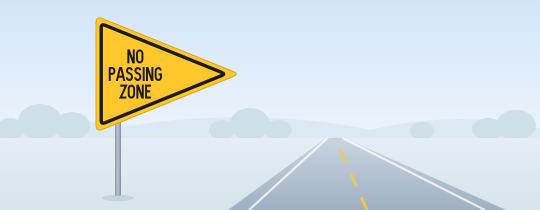
A yellow pennant-shaped sign is posted at the left edge of a two-lane Missouri highway. What is it warning you about?
Show answer
Correct answer: A no-passing zone starts here
Why
In the Missouri Driver Guide’s list of sign shapes, the pennant belongs to one sign only: the no-passing zone. It sits on the left side of the road, right where you’d look before pulling out to pass. Stay in your lane until the zone ends and the road ahead is clearly open.
32Speed limits
Unless signs say otherwise, what speed limit does Missouri law set for interstates inside an urbanized area, such as the St. Louis metro?
Show answer
Correct answer: 60 mph
Why
Within urbanized areas, Missouri’s default cap for interstates, freeways and expressways is 60 mph. Out in the country, expressways default to 65 and rural interstates go higher still, and MoDOT can post a different number on any of them, so the sign in front of you is the legal limit. Dense traffic, frequent merges and closely spaced exits are why the city number is lower.
33Permit & teen rules
For the first six months with a Missouri intermediate license, how many passengers under 19 who aren’t immediate family may ride with you?
Show answer
Correct answer: One
Why
Missouri allows just one non-family passenger under 19 for the first six months, and up to three after that. Immediate family, such as brothers, sisters and stepsiblings, doesn’t count toward the cap. Whoever rides along, everyone in the car wears a seat belt while you hold an intermediate license.
34Right-of-way
A school bus traveling toward you on a Missouri highway with at least four lanes stops and switches on its flashing red lights. What does the law require of you?
Show answer
Correct answer: Keep going with care; you’re not required to stop
Why
Missouri lifts the stop requirement in three cases: the bus is on a separate roadway of a divided highway, it’s heading the opposite way on a road of four lanes or more, or it’s in a school loading zone where pedestrians may not cross. Everywhere else, drivers in both directions stop. Even when the law lets you continue, slow down and watch for children near the road.
35Permit & teen rules
You’re 15 with a Missouri instruction permit. Besides a parent, stepparent, grandparent, legal guardian or driving instructor, who else may supervise your driving?
Show answer
Correct answer: A driver 25+ licensed at least 3 years, with a parent’s written OK
Why
Until you turn 16, Missouri limits your supervisor to a parent, stepparent, grandparent, guardian, qualified driving instructor, or a driver 25 or older who has been licensed at least three years and has your parent’s written OK. That person sits beside you in the front seat. Once you’re 16, any licensed driver 21 or older can ride along.
36Safe driving
On some Missouri four-lane highways, signs route you through a J-turn instead of letting you cross straight over. How does it work?
Show answer
Correct answer: Turn right with traffic, move to the far left lane, then turn left
Why
Instead of crossing or turning left through both directions of fast traffic, you join the flow on your right, work over to the far left lane and then turn left to go the way you want. Each step deals with traffic coming from only one direction. Signal before every move.
37Alcohol & phones
Under Missouri’s Abuse and Lose law, how long can a 17-year-old caught with drugs while driving lose the license?
Show answer
Correct answer: 90 days
Why
Abuse and Lose covers drivers under 21: an alcohol-related traffic offense, having or using alcohol or drugs while driving, or altering a license can cost 90 days of driving. A separate minor in possession conviction brings a 30-day suspension the first time, 90 days the second and a one-year revocation the third. Keep alcohol and drugs out of the car entirely.
38Safe driving
Snow has packed down on the road between Kirksville and Macon. How much following time does the Missouri Driver Guide suggest behind the car ahead?
Show answer
Correct answer: Eight to ten seconds
Why
In normal conditions the guide’s rule is three seconds: start counting when the car ahead passes a fixed object and stop when you reach it. Snow and ice stretch stopping distances, so widen that gap to about eight to ten seconds. Brake early and gently to keep the tires from sliding.
39Road signs
Orange signs and barrels line a Missouri highway work zone, and a crew is working next to your lane. If you’re caught speeding there, what’s added on top of the regular fine?
Show answer
Correct answer: At least $250 for a first offense
Why
Orange marks construction and maintenance work, and Missouri backs it with money: speeding or passing in a signed work zone while workers are present adds at least $250 the first time and $300 for a repeat. Expect lane shifts, sudden stops and people on foot near the pavement. Ease off at the first orange sign, not when you finally spot the crew.
40Right-of-way
You’re approaching a roundabout in O’Fallon. Which of these does the Missouri Driver Guide tell you to do?
Show answer
Correct answer: Yield to traffic in the circle and at crosswalks, then go counterclockwise
Why
Vehicles already circulating have the right-of-way, and so do bicyclists and pedestrians at the crossings. Enter to the right, travel counterclockwise and never turn left to get in; once inside, don’t stop or change lanes. If an emergency vehicle comes up while you’re in the circle, take your exit first and then pull over.
Missouri DMV written test at a glance
What to know before you walk into a Highway Patrol exam station.
Missouri · Class F written test
20 of 25 to pass.
25 questions · Multiple choice
20 of 25 answers right to pass
Freewritten and driving tests at the Highway Patrol
Walk-inno appointment needed for the written test
2 triesper day on the written test, until you pass
Spanishone of 20 language options for the written test
$10instruction permit, good for up to 12 months
20/40vision needed; glasses or contacts are fine
Under 18? Your road to a license
15Instruction permitPass the vision, road sign and written tests at a Highway Patrol station, then buy the $10 permit at a license office with a parent or guardian.
6 moSupervised practiceHold the permit at least 182 days and log 40 hours behind the wheel, 10 of them at night. No driver ed course is required.
16Intermediate licensePass the driving test with a clean record: no traffic convictions in the past 6 months and no alcohol offenses in the past 12.
16–17Intermediate limitsNo driving 1–5 a.m. without a licensed driver 21+, except for school, work or emergencies. One non-family passenger under 19 for six months, then three.
18Full licenseWith no alcohol offenses or traffic convictions in the past 12 months, retake only the vision and sign tests.
18 or older? No 182-day wait and no 40-hour log: pass the vision, road sign, written and driving tests, then buy your Class F license.
What’s on the Missouri permit test
Every written test question comes from the Missouri Driver Guide (revised August 2026), minus the commercial-vehicle chapter. Here are the six areas to master before test day.
Road signs
Shapes first: an octagon is STOP, a point-down triangle YIELD, a pennant a no-passing zone, a pentagon a school.
Orange marks work zones; speeding there while crews work adds at least $250.
A white crossbuck works like a YIELD sign; the round yellow sign is your early railroad warning.
Right-of-way
Unmarked intersection, same arrival: the driver on the left gives way to the driver on the right.
A dead traffic light is a four-way stop: first to stop, first to go.
Bus with red lights and stop arm out: stop both ways, unless it’s across a divided highway or oncoming on a road of four or more lanes.
Speed limits
No sign in town? 25 mph. Lettered routes like Route KK default to 55.
Interstates inside urbanized areas default to 60 and rural expressways to 65, unless posted otherwise.
On interstates, 40 mph is the minimum unless weather or conditions call for less.
Parking
Never on a bridge, a crosswalk or sidewalk, beside a yellow curb, or along the left-hand curb of a two-way street.
On a hill, turn the wheels toward the roadside; facing uphill against a curb, turn them away from it.
Disability spaces need a placard and the person on board or getting in or out; otherwise it’s a $50–$300 fine.
Alcohol & phones
BAC limits: 0.08% for adults, 0.04% in a commercial vehicle, 0.02% under 21.
Refuse a chemical test and lose your license for a full year.
Hands-free for every driver: no holding the phone, no typing or reading texts, no video behind the wheel.
Teen rules
Under 16 with a permit? Ride with a parent, grandparent, guardian, instructor, or a driver 25+ licensed 3 years with a parent’s written OK.
Intermediate license: off the road 1–5 a.m. unless it’s school, work, an emergency or a driver 21+ rides along.
Permit or intermediate driver at the wheel? Every person in the car buckles up.
Missouri numbers to know
Six figures from the Missouri Driver Guide and state law worth knowing by heart.
100 ftof signaling before a turn or lane change
15–50 ftthe stopping zone before a crossing’s nearest rail
500 ftdim your brights for oncoming cars (300 ft when following)
0.02%BAC that costs a driver under 21 the license
55 mphdefault limit on lettered routes like Route A or KK
3 secfollowing gap; 8–10 seconds on snow or ice
Your Missouri course, in your pocket
These 40 questions are just the warm-up. The app gives you 471 Missouri practice questions, 36 short lessons and the why behind every answer.
36 short lessonsFour levels, from fundamentals to expert, then a full practice exam.
471 Missouri questions321 of them with pictures.
Your most-missed questionsA review lesson built from the questions you miss most.
Exam simulatorTake full practice exams and watch your readiness grow.
Missouri permit
Your Missouri path is ready.
36 lessons, 471 questions and full practice exams. In English and Spanish.
How many questions are on the Missouri written test, and what’s a passing score?
It’s 25 multiple-choice questions, and 20 correct answers (80%) earn a pass. Before the permit, you also pass a vision test and a separate road sign test. Every question comes from the Missouri Driver Guide, and the test isn’t open book.
Who gives the permit test in Missouri, the DMV or the Highway Patrol?
Two agencies share the job. The Missouri State Highway Patrol gives the written and driving tests free of charge at exam stations in all 114 counties, and the written test needs no appointment. The Department of Revenue (DOR) then issues your permit or license at a local license office.
What if I fail the Missouri written test?
Try again: you can take the written test up to two times a day until you pass, and passed results stay good for one year. The driving test is stricter, with one attempt per day; after three failures you need written approval from DOR and extra behind-the-wheel training before testing again.
Can I take the Missouri permit test in Spanish?
Yes. Since November 2024 the Highway Patrol has offered the Class F written test in 20 language options, including Spanish and an American Sign Language video version. You can also ask for an oral test. The Driver Guide itself is in English, so this practice test and the app, both available in Spanish, make studying easier.
Can I take the Missouri permit test online?
No. Missouri gives the written test only in person at Highway Patrol driver exam stations, on a touch screen, a tablet or paper. Teens bring a certified birth certificate, an unexpired passport or a Missouri nondriver ID that is current or less than six months past its expiration; school IDs, Social Security cards and laminated birth certificates don’t count.
How old do you have to be to get a permit in Missouri?
15. Hold the instruction permit at least 182 days and log 40 hours of supervised driving, 10 at night, before the intermediate license at 16; a driver ed course isn’t required. With the intermediate license, you can’t drive 1–5 a.m. without a licensed driver 21+ (school, work and emergencies excepted), and for six months you may carry only one passenger under 19 who isn’t family, then three.
How much does a Missouri permit cost?
The tests are free. The instruction permit costs $10 at a license office and is valid for up to 12 months; the intermediate license is $14, and a full Class F license is $16.50 for three years or $33 for six. Keep in mind that the Highway Patrol’s test record is not a permit, so buy the permit before you drive.
What’s the best way to study for the Missouri permit test?
Read the Missouri Driver Guide (revised August 2026), skipping the commercial-vehicle chapter, then practice until 80% feels easy. Start with the 40 questions above, then let the app take you through 471 Missouri questions and 36 short lessons, with every answer explained.