Get ready for the California DMV written test with 40 free practice questions on signs, right-of-way, speed limits and curb colors. Pick an answer and see instantly why it’s right.
Four rounds of 10 questions on signs, right-of-way, speed limits, parking, alcohol and teen rules. Every answer comes with a quick explanation.
Round 1 · Questions 1–10
1Road signs
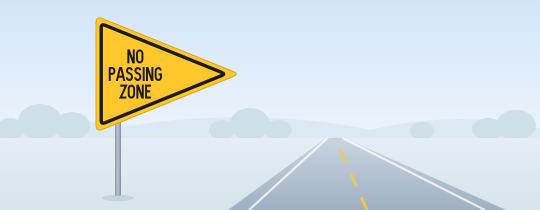
Cruising on a two-lane highway, you spot a yellow sign shaped like a pennant, a long triangle lying on its side, posted on the driver's side of the road. What is it telling you?
Show answer
Correct answer: Passing is not allowed from this point on
Why
The pennant is the one sign with that shape, and it always means NO PASSING ZONE. It is placed on the left side of the road, where your eyes go when you are thinking about pulling out to pass. Once you see it, stay in your lane and do not start a pass.
2Right-of-way
At a four-way intersection with no signs or signals, you and another car pull up at the same moment. The other car is coming from the street on your right. Who should go first?
Show answer
Correct answer: The other driver, because that car is on your right
Why
When two vehicles reach an uncontrolled intersection together, the driver on the left yields to the driver on the right. A vehicle that is already inside the intersection goes before both of you. A T-shaped junction works differently: whoever is on the road that ends gives way to traffic on the through road, from either direction. Even when you have the right-of-way, make sure the other driver is actually stopping before you go.
3Speed limits
The posted limit on your freeway is 65 mph, but thick fog has rolled in and you can see only a short way ahead. Under California's Basic Speed Law, how fast may you legally drive?
Show answer
Correct answer: Only as fast as the fog safely allows, even far below 65
Why
The Basic Speed Law requires a speed that is reasonable for the weather, visibility, traffic and road surface. A posted limit is a maximum for good conditions, not a target, so driving at the limit in heavy fog can still get you a ticket. A useful check: could you stop within the distance you can clearly see ahead?
4Parking & curb colors
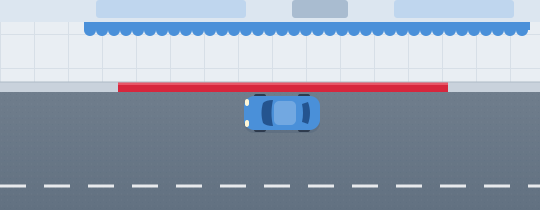
You find an open space along a red-painted curb and want to wait there for a few minutes, engine running, while a friend runs into a shop. Is that allowed?
Show answer
Correct answer: No, stopping there is banned even with someone at the wheel
Why
A red curb bans stopping, standing and parking, even if you stay behind the wheel. Only buses may stop at a red curb that is marked as a bus loading zone. If you just need to drop someone off, look for a white curb instead.
5Alcohol & phones
A 19-year-old driver is pulled over and tests at 0.02% blood alcohol concentration. Which statement is correct?
Show answer
Correct answer: It is illegal, because drivers under 21 may not drive with 0.01% or more
Why
California has zero tolerance for drivers under 21: a BAC of 0.01% or more is a violation. At 0.05% or more an under-21 driver can also be arrested for DUI, while 0.08% is the general limit for drivers 21 and older. If you are under 21, the only safe amount to drink before driving is none.
6Safe driving
What following distance does the California DMV recommend behind the vehicle ahead?
Show answer
Correct answer: At least three seconds
Why
A three-second gap gives you time to notice a problem and brake before you reach the vehicle ahead. To check it, note when that vehicle passes a fixed point such as a sign and count the seconds until you reach the same point. Add more space when someone is tailgating you, when rain or fog cuts visibility or grip, and behind a motorcycle riding over metal grates, rail tracks or gravel.
7Permit & provisional license
You are 16 and hold an instruction permit. Which of these people may supervise your practice driving?
Show answer
Correct answer: A 30-year-old neighbor whose California license is not on probation
Why
A permit holder under 18 must practice with a California-licensed adult aged 25 or older whose license is not on probation; a parent, guardian, spouse or licensed driving instructor also qualifies. A young adult relative under 25 does not count, however experienced. Remember that a permit never allows solo driving, not even to your road test.
8Road signs
What does a red-and-white triangular sign with one point facing down require you to do?
Show answer
Correct answer: Slow down and give way to nearby traffic, stopping if needed
Why
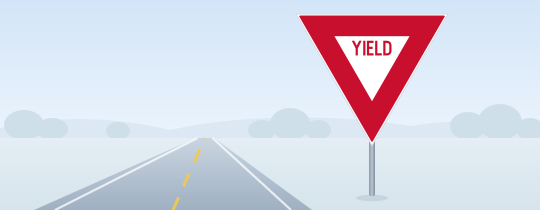
Only the YIELD sign uses a triangle with its point aimed at the ground. If nobody is coming, you may roll on without stopping, but any car, bike rider or pedestrian who is already crossing, or near enough to create a danger, goes before you. Ease off the gas early so that, if you do need to stop, the stop is smooth.
9Right-of-way
On a steep mountain road too narrow for two cars to pass, you are heading downhill when you meet a car coming up. Who should back up?
Show answer
Correct answer: You, the driver heading downhill
Why
On a narrow grade, the car climbing the hill has the right-of-way. The downhill driver is expected to back up, because reversing up a slope is easier to control than rolling backward down it. Back up slowly and use the nearest wide spot or turnout to let the other car through.
10Lane markings
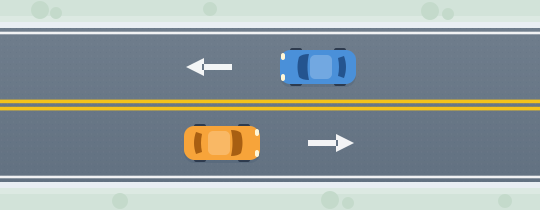
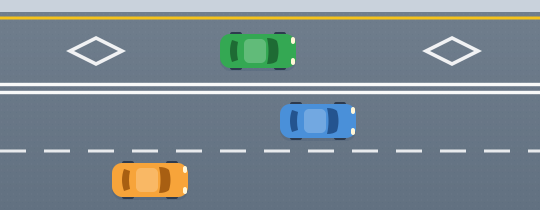
Your lane is separated from oncoming traffic by two solid yellow lines. When may you cross them?
Show answer
Correct answer: To turn left at an intersection or driveway, or to make a legal U-turn
Why
Double solid yellow lines mean no passing for traffic in either direction. You may still cross them to turn left at an intersection or into or out of a driveway, or to make a legal U-turn. If two sets of yellow lines are 2 feet or more apart, treat them as a barrier and cross only at a marked opening.
Round 2 · Questions 11–20
11Road signs
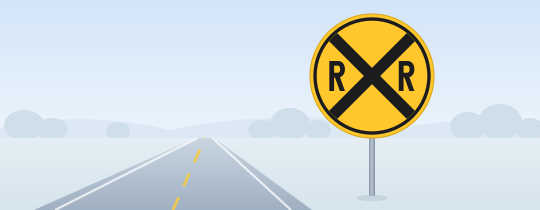
Ahead you see a round yellow sign marked with a large X and the letters RR. What should you expect?
Show answer
Correct answer: A railroad crossing
Why
A circular warning sign is used for only one purpose: telling you a railroad crossing is coming up. Slow down, look and listen in both directions, and if a train is approaching, stop no closer than 15 feet to the closest rail.
12Right-of-way
Your light is solid green (no arrow) and you want to turn left, but an oncoming car is close enough to be dangerous. What should you do?
Show answer
Correct answer: Wait for the oncoming car to pass, then turn
Why
A solid green light lets you turn left, but it gives you no priority over oncoming traffic. Drivers turning left or making a U-turn must yield to approaching vehicles close enough to be a hazard. If you are unsure about a gap, let that car pass and wait for the next opening.
13Speed limits
If no sign shows a different limit, what is the top legal speed on a two-lane undivided highway?
Show answer
Correct answer: 55 mph
Why
Unless a sign allows more, 55 mph is the ceiling on a two-lane road with no median and just one lane each way. Elsewhere, 65 mph is the general highway maximum, and 70 mph is legal only where it is posted. Oncoming cars pass just a few feet from you on these roads, so the lower limit leaves more time to react.
14Parking & curb colors
You need to stop for a moment to let a friend out of the car. Which curb color is meant for exactly this kind of brief stop?
Show answer
Correct answer: White
Why
White is the curb color for quick stops: letting riders in or out, or dropping mail into a box at the curb. Green allows parking for a limited time, blue is for vehicles displaying a disabled placard or plate, and red bans stopping altogether. Keep the stop short and move on once your passenger is out.
15Alcohol & phones
A 17-year-old with a provisional license wants to answer a call through the car's hands-free system while driving. Is that allowed?
Show answer
Correct answer: No, drivers under 18 may not use a phone at all, except in an emergency
Why
The rule for drivers under 18 is stricter than the adult rule: no phone or wireless device use while driving, even through a hands-free system. The only exception is calling for help in an emergency. Silence your phone or turn on a do-not-disturb setting before you pull away.
16Safe driving
Driving at night with your high beams on, within what distance of an oncoming vehicle must you switch to low beams?
Show answer
Correct answer: 500 feet
Why
Bright high beams can temporarily blind other drivers, so switch to low beams once an oncoming vehicle is within 500 feet. You must also dim them when following another vehicle within 300 feet. In rain or fog, stick to low beams, because high beams reflect back as glare.
17Permit & provisional license
Which requirement must a California teen meet before taking the behind-the-wheel test for a provisional license?
Show answer
Correct answer: Hold the permit at least 6 months and log 50 hours of supervised practice, 10 of them at night
Why
Teens must keep their permit at least six months and log 50 hours of supervised practice, with at least 10 hours after dark, before the road test. They also need 6 hours of professional behind-the-wheel training. Spread the night hours across the six months instead of cramming them in at the end.
18Right-of-way
You hear a siren and see a fire truck with flashing red lights approaching from behind. What does California law require?
Show answer
Correct answer: Pull to the right edge, clear of intersections, and stop
Why
A fire truck, ambulance or police car running its siren and red lights has priority over you. Ease over to the right edge, come to a stop, and stay put until it has gone by. If you are already inside an intersection, finish crossing it before you pull over, so you do not block the emergency vehicle. Afterwards, do not follow it closer than 300 feet.
19Parking & curb colors
While hunting for street parking, you find an open spot beside a fire hydrant. How far from the hydrant does California law require your car to be?
Show answer
Correct answer: At least 15 feet
Why
You must keep at least 15 feet between your vehicle and a fire hydrant so firefighters can reach it and connect hoses quickly. The same 15-foot gap applies to the driveway of a fire station. On an unpainted curb, judge the distance generously rather than squeezing in.
20Lane markings
In the middle of a street, one lane is shared by drivers going both ways. Each edge of it has a solid yellow stripe on the outside and a dashed yellow stripe on the inside. What is the farthest you may travel in it?
Show answer
Correct answer: Up to 200 feet
Why
This is a two-way center left-turn lane, used only to set up and make left turns or U-turns. You may not drive in it for more than 200 feet, and it is never meant for passing. Watch for drivers coming the other way who may be turning from the same lane.
Round 3 · Questions 21–30
21Road signs
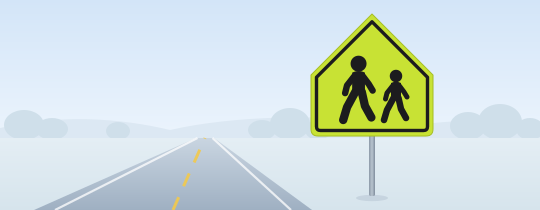
A five-sided sign, pointed at the top and colored fluorescent yellow-green, appears beside the road. What is it warning you about?
Show answer
Correct answer: A school or school crossing nearby
Why
Fluorescent yellow-green marks warnings about schoolchildren, people on foot, cyclists and playgrounds. Among warning signs, the five-sided shape with its point up belongs to the school sign alone; the only other sign with that outline is the blue-and-yellow county route marker. Expect kids to dart out. In California, the default limit near a school is 25 mph while children are around, unless a lower limit is posted.
22Right-of-way
A pedestrian using a white cane is about to cross the street in front of you. What is the right response?
Show answer
Correct answer: Stop and wait for the person to finish crossing
Why
A white cane or a guide dog signals that the person walking is blind or has limited sight, and California gives such a pedestrian priority wherever they cross. Do not honk: a sudden horn can startle and confuse someone who is judging traffic by sound. Stop well short of their path and wait until they are fully across.
23Speed limits
You are driving past a school less than 500 feet away, and kids are playing outside on the grounds. No sign shows any other limit. How fast may you go?
Show answer
Correct answer: 25 mph
Why
Near a school, the limit is 25 mph while children are arriving, leaving or on the grounds, and some cities post 15 mph in certain school zones. Kids can step into the street without warning, so slow down before you reach the school, not as you pass it.
24Parking & curb colors
Your car is pointed up a steep street, and there is a curb on your right. Before you walk away, which way should the front wheels point?
Show answer
Correct answer: Turned away from the curb, with a front tire resting against it
Why
Facing uphill with a curb, turn the wheels left, away from it, and let the car roll back a few inches so the front tire rests against the curb. If the brakes ever slip, the curb keeps the car from rolling into traffic. Downhill, or on a hill with no curb, point the wheels toward the right edge instead, and always set the parking brake.
25Alcohol & phones
Where in your car may you legally carry an opened bottle of wine?
Show answer
Correct answer: In the trunk
Why
Open containers of alcohol, and cannabis that is not sealed, must ride in the trunk or another area where passengers do not sit. The glove box does not count, and pushing a cork back into a bottle does not make it sealed again. If you take a leftover bottle home from a restaurant, put it in the trunk before you start driving.
26Safe driving
Halfway across a rail crossing, your engine quits and will not restart. You can see a train coming. What is the safest thing to do?
Show answer
Correct answer: Get everyone out and run from the tracks at an angle toward the oncoming train
Why
Leave the car right away and take every passenger with you. Get clear of the rails on a slant, heading toward the train rather than away from it: the crash flings the car and its debris forward along the train's path, so staying on the near side keeps you out of harm's way. Once you are safely clear, call 911.
27Permit & provisional license
In your first year with a provisional license, which hours are off-limits for driving without a qualified adult, unless an exception applies?
Show answer
Correct answer: 11 p.m. to 5 a.m.
Why
For the first 12 months, provisional drivers may not drive from 11 p.m. to 5 a.m. unless someone 25 or older with a license, a parent or guardian, or a licensed instructor is with them. Late-night driving is riskier for new drivers, which is why the curfew exists. Narrow exceptions cover medical, school, work or family needs, but you must carry a signed note explaining the reason.
28Right-of-way
You are on a highway split down the middle by a raised concrete median. On the far side, facing the other way, a school bus has stopped and its red lights are blinking. What do you need to do?
Show answer
Correct answer: You do not have to stop, but watch carefully for children
Why
Usually, a school bus flashing red lights means drivers going both ways must stop and wait. The law lifts that duty when the bus sits across a median or other divider from you, or is coming the other way on a road where each side carries at least two lanes of traffic. You may keep moving, but slow down and look out for children near the roadside.
29Alcohol & phones
What does California's implied consent law mean for a driver?
Show answer
Correct answer: If lawfully arrested for DUI, you must submit to a breath or blood test, and refusing leads to a suspension
Why
By driving in California, you are treated as having already agreed to a breath or blood test if you are lawfully arrested for DUI. Refusing or not completing the test brings a one-year suspension for a first refusal, and longer revocations if you have prior DUI offenses. A refusal does not end the matter; it adds its own penalty on top of any DUI case.
30Lane markings
On the freeway, double solid white lines separate your lane from a carpool lane. What may you do?
Show answer
Correct answer: Do not cross them; enter or leave only at marked openings
Why
Next to a carpool lane, a pair of solid white lines works like a wall: move in or out only where the marking changes to a single broken line or at a signed access opening, even if your car qualifies for the lane. On a freeway, the one exception is clearing a path for an ambulance, fire truck or police car running with lights and siren. Plan lane changes early so you are not tempted to cut across.
Round 4 · Questions 31–40
31Road signs
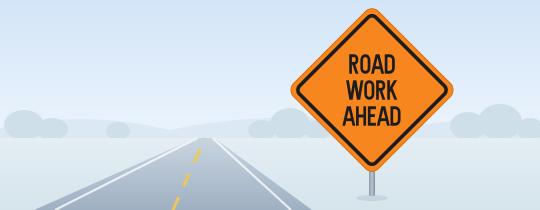
You approach an orange, diamond-shaped sign that reads ROAD WORK AHEAD. Which statement about the zone ahead is true?
Show answer
Correct answer: Traffic fines are doubled there while workers are present
Why
Orange signs mark temporary traffic control areas such as construction and maintenance zones. California doubles traffic fines there whenever workers are present, so a routine ticket can cost far more than usual. Slow down, leave extra following room and obey any flagger's directions.
32Right-of-way
Which rule applies when you enter a roundabout?
Show answer
Correct answer: Yield to traffic already in the circle and travel counterclockwise
Why
Vehicles already circling have priority, so slow down and merge in only when there is a safe gap. Traffic moves counterclockwise, keeping the center island on your left. If you miss your exit, go around again instead of stopping or backing up.
33Speed limits
You are approaching an intersection with no stop signs, yield signs or signals. During the last 100 feet, buildings block your view, so you cannot see 100 feet along the cross street in either direction. What is the speed limit?
Show answer
Correct answer: 15 mph
Why
An intersection with no traffic controls and a blocked view is a blind intersection, and the limit there is 15 mph. At that speed you can stop quickly if a car, bike or pedestrian appears from behind the obstruction. The same 15 mph limit applies in alleys and at railroad crossings where you cannot see 400 feet down the tracks both ways.
34Parking & curb colors
If there is no curb extension, how far back from a crosswalk must you park on the side where traffic approaches it?
Show answer
Correct answer: At least 20 feet
Why
California's daylighting law prohibits parking within 20 feet of the approach side of any crosswalk, marked or unmarked, or within 15 feet where the curb has been extended. Since 2025 you can be ticketed even when the curb is not painted and no sign is posted. The open space lets approaching drivers see pedestrians before they step off the curb.
35Alcohol & phones
You are 30 and rely on your phone for directions. Which setup is legal while you drive?
Show answer
Correct answer: Mounted on the dashboard and operated with a single tap or swipe
Why
Adult drivers may use a phone only in a hands-free, voice-operated way. If you need to touch it, the phone must be mounted on the windshield, dashboard or center console without blocking your view, and you are limited to one tap or swipe. Set your destination before you start driving.
36Safe driving
You are about to pass a bicyclist traveling the same direction in your lane. What is the minimum space the law requires between your car and the rider?
Show answer
Correct answer: 3 feet
Why
California requires at least 3 feet between any part of your vehicle and the bicycle or its rider when you pass. If you cannot give that much room, slow down and wait until it is safe. When another lane heading your way is open, the law requires you to move into it before passing, as long as the change is practical and allowed.
37Permit & provisional license
You got your provisional license four months ago. Which of these trips would break the law?
Show answer
Correct answer: Driving your 18-year-old friend home from school with no adult in the car
Why
During the first 12 months, a provisional driver may not carry passengers under 20 unless a licensed parent or guardian, a licensed driver 25 or older, or a licensed or certified instructor is also in the car. Driving alone outside the 11 p.m. to 5 a.m. window, or with a qualified adult on board, is allowed. The signed-note exceptions cover only late-night driving and giving rides to immediate family members; none of them lets you drive friends under 20 without a qualified adult.
38Right-of-way
You reach an intersection where every traffic light is dark because of a power outage. How should you treat it?
Show answer
Correct answer: As an all-way stop
Why
When a signal is out, the intersection becomes an all-way stop. Stop completely, then take turns: the first vehicle to arrive goes first, and if two arrive together, the driver on the left yields to the one on the right. Some drivers will not notice the outage, so check carefully before you go.
39Safe driving
A fender bender leaves about $1,500 of damage to the two cars, and nobody is hurt. What is the deadline for reporting it to the DMV?
Show answer
Correct answer: Within 10 days
Why
Any crash causing more than $1,000 in property damage, or any injury or death, must be reported to the DMV on form SR-1 within 10 days. This applies no matter who was at fault, and a police report does not file it for you. Failing to report can lead to a suspended license, so file even if the other driver promises to handle everything.
40Road signs
On a highway, signs with a blue background usually give information about what?
Show answer
Correct answer: Nearby gas stations, restaurants, hotels and hospitals
Why
Sign colors follow a national code: blue for motorist services, brown for recreation and cultural sites, green for directions and distances, and fluorescent pink for traffic incidents. Knowing the code lets you understand a sign's purpose from a distance, before you can read its words.
California DMV written test at a glance
The numbers that matter before your DMV visit.
California · Class C knowledge test
80% to pass.
Multiple choice · 3 options
8 of every 10 answers right
3 trieson one application
Day 8earliest retake if you’re under 18
$46application fee, good for 12 months
Onlinefrom home with a webcam, or at any DMV office
35 languagesfor the online test, Spanish included
20/40vision standard
Under 18? Your road to a license
15½Instruction permitBring your driver education certificate and pass the knowledge test.
6 moSupervised practiceLog 50 hours with a licensed adult 25 or older, 10 of them at night, plus 6 hours with a driving instructor.
16Provisional licensePass the drive test and you’re on the road.
Year 1Provisional limitsNo driving 11 p.m.–5 a.m. and no passengers under 20, unless a parent, guardian, licensed driver 25+ or instructor rides along.
18 or older? No driver ed needed: get your permit, then book the drive test.
What’s on the California permit test
Every question comes from the California Driver’s Handbook. Here’s what to know cold in six key areas.
Road signs
The shape speaks first: an octagon is STOP, a point-down triangle is YIELD, and a circle warns of a railroad crossing ahead.
A pennant marks a no-passing zone; a five-sided sign means a school is near.
Orange means a work zone, where fines double while workers are present.
Right-of-way
No signs or signals and you arrive together? The car on the right goes first.
Turning left on a solid green: oncoming traffic goes first.
Siren behind you: pull to the right edge and stop. School bus flashing red: stop and wait.
Speed limits
Basic Speed Law: never faster than is safe for traffic, weather and visibility, whatever the sign says.
65 mph is the usual highway maximum; 55 mph on a two-lane undivided road.
25 mph near a school while kids are around; 15 mph at a blind intersection.
Parking
A red curb means no stopping at all, even with the engine running.
Park at least 15 feet from a fire hydrant and 20 feet back from a crosswalk.
Uphill with a curb, turn the wheels away from it; downhill, turn them toward it.
Alcohol & phones
BAC limit: 0.08% at 21 and over, 0.01% under 21.
An opened bottle rides in the trunk, never in the glove box.
Adults: hands-free only, or one tap or swipe on a mounted phone.
Teen rules
A permit never means driving alone, not even to your drive test.
First 12 months: no driving 11 p.m.–5 a.m., no passengers under 20 without a qualified adult.
Under 18, the phone stays off while you drive, even hands-free.
California curb colors
Five colors, five rules. Learn them once and every curb tells you what you can do.
RedNo stopping, standing or parking
YellowLoading and unloading only
WhiteA brief stop to let riders in or out, or to mail a letter
GreenParking for a limited time
BlueDisabled placard or plate only
Your California course, in your pocket
These 40 questions are just the warm-up. The app gives you 563 California practice questions, 36 short lessons and the why behind every answer.
36 short lessonsFour levels, from fundamentals to expert, then a full practice exam.
563 California questions323 of them with pictures.
Your most-missed questionsA review lesson built from the questions you miss most.
Exam simulatorTake full practice exams and watch your readiness grow.
California permit
Your California path is ready.
36 lessons, 563 questions and full practice exams. In English and Spanish.
What score do I need to pass the California permit test?
80%. The test is multiple choice, every question comes from the California Driver’s Handbook, and each one has a single right answer out of three choices.
How many times can I take the California written test?
You get three tries on one application. If you’re under 18 and don’t pass, you can retake it from the 8th day after the failed test. Your application stays valid for 12 months.
Can I take the California knowledge test online?
Yes. You can take it online on a computer with a webcam, or in person at a DMV office. Up to two of your three tries can be online; the third one happens at the office.
Can I take the test in Spanish?
Yes. The online test comes in 35 languages, Spanish included. If you test in a language other than English, you also take a separate road-sign test. This practice test is in Spanish too, and so is the app.
How old do I have to be to get a permit in California?
15½. Between 15½ and 17½ you need a driver education certificate, or proof that you’re enrolled in a combined driver education and training course. Over 17½ you can skip driver ed, but you can’t take the drive test until 18. At 18 or older, get your permit and then book the drive test.
What are the rules for a provisional license?
For the first 12 months: no driving 11 p.m.–5 a.m., and no passengers under 20 unless someone 25 or older with a license, a parent or guardian, or a licensed instructor rides along. Narrow exceptions, such as medical, school or work needs, require a signed note in the car. And under 18, no phone use at all while driving, even hands-free.
How much does a California permit cost?
The Class C application fee is $46, and it isn’t refundable. Your application and fee stay valid for 12 months, so plan to finish every step within a year.
What’s the best way to study for the California permit test?
Read the California Driver’s Handbook, then practice until 80% feels easy. Start with the 40 questions above, then let the app walk you through 563 California questions and 36 short lessons, with an explanation for every answer.