Get ready for the 25-question Nebraska DMV written test with 40 free questions on road signs, speed limits from gravel roads to the interstate, DUI and phone laws, and the rules for teen permits and the POP. Pick an answer and see right away why it’s correct.
Four rounds of 10 questions on Nebraska signs, right-of-way, speed limits, parking, DUI and phone laws, and permit and POP rules. Each answer comes with a short explanation.
Round 1 · Questions 1–10
1Safe driving
Dusk on a two-lane Nebraska highway: you pass a yellow diamond sign with a leaping deer, and seconds later a deer jumps into your headlights, too close to miss. What does the state’s “Don’t Veer for Deer” advice tell you to do?
Show answer
Correct answer: Brake hard, keep both hands steady on the wheel and come to a controlled stop
Why
Swerving off the road or across the center line usually ends in a worse crash than hitting the animal, so the Nebraska Driver’s Manual says to brake firmly, stay in control and stop safely. Be most watchful from dusk to dawn, in spring and fall, and near rivers and woods; deer travel in groups, so when one crosses, expect another.
2Permit & teen rules
On Nebraska’s Class O written test, how many questions can you get wrong and still pass?
Show answer
Correct answer: 5 out of 25
Why
The car (Class O) knowledge test has 25 questions, and you need at least 20 right, the 80% that every Nebraska written test asks for. There is no separate road sign section, so signs and traffic laws all count toward one score. Practice until 80% feels comfortable, not lucky.
3Road signs
Along Nebraska highways you’ll see small numbered reference post markers spaced one mile apart. Why are they worth noticing?
Show answer
Correct answer: They let you tell 911 or responders exactly where you are
Why
Reference posts stand every mile so that a stranded or injured driver can give a precise location. Get in the habit of noting the last number you passed, especially on long rural stretches with few landmarks. That number, plus the highway and your direction, brings help straight to you.
4Right-of-way
You’re driving a gravel county road in rural Nebraska and reach a paved highway. Nothing controls the junction: no signal and no sign of any kind. Who has the right-of-way?
Show answer
Correct answer: Every vehicle traveling on the paved highway
Why
Nebraska law tells a driver coming off an unpaved road to yield to all traffic on the paved one, even when no sign marks the junction. Stop if you need to, look both ways twice, and pull out only into a gap long enough to get up to speed. Most state highways run at 65 mph, so judge that gap generously.
5Speed limits
No speed limit sign is posted on the residential street you’ve turned onto in a Nebraska town. How fast may you go?
Show answer
Correct answer: 25 mph
Why
Nebraska’s default is 25 mph in a residential district and 20 mph in a business district, unless signs set something else. Both are ceilings, and the basic speed rule still expects you to slow down when kids are playing or the street is icy.
6Parking
You find an open spot on a Lincoln street near a fire hydrant. What is the smallest gap Nebraska law allows between your car and the hydrant?
Show answer
Correct answer: 15 feet
Why
Nebraska law keeps standing and parked cars at least 15 feet from a hydrant, so fire crews can hook up a hose without delay; only a quick stop to pick up or drop off a passenger may be closer. Pair it with two more figures from the same law: a crosswalk at an intersection needs 20 feet, and a stop sign, yield sign or flashing signal needs 30.
7Alcohol & phones
A 19-year-old Nebraska driver is pulled over, and a breath test reads 0.03. What’s the result?
Show answer
Correct answer: A violation, because drivers under 21 may not reach 0.02
Why
Nebraska has zero tolerance for drivers under 21: 0.02 or more breaks the law. A conviction means the court impounds the license for 30 days, and refusing the test brings a 90-day impoundment. At 0.08 or higher, an under-21 driver is charged under the same DUI law as adults.
8Safe driving
The Nebraska Driver’s Manual gives a minimum following distance in seconds and asks for more when conditions turn bad. In steady rain, how much space should you leave?
Show answer
Correct answer: At least 4 seconds: the 3-second minimum plus one for the rain
Why
Start counting when the car ahead passes a fixed point such as a sign; if you reach it before three seconds, you’re too close. Nebraska’s manual treats three seconds as the floor and adds a second for each hazard, such as rain or heavy traffic. Behind a motorcycle, keep three to four seconds.
9Road signs
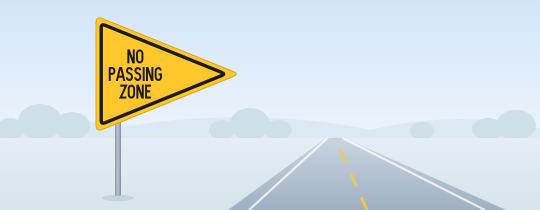
Along a two-lane Nebraska highway, a long sideways yellow triangle stands at the left-hand edge, its point aimed down the road. What message does it carry?
Show answer
Correct answer: Passing is not allowed from here on
Why
The pennant shape is reserved for no-passing zones, and it sits on the left so drivers about to pull out can see it. Nebraska law also rules out a pass when you’re 100 feet or less from an intersection or a railroad crossing, and near hilltops or curves that block your view. Stay behind until the zone ends and the center line lets you pass.
10Crashes & emergencies
After a fender-bender with no injuries, no police officer comes to investigate, but the damage to the other driver’s car is about $2,000. What does Nebraska require of you?
Show answer
Correct answer: A crash report to the Nebraska Department of Transportation within 10 days
Why
When no officer investigates, Nebraska requires a written report within 10 days for any crash that hurts or kills someone or causes $1,500 or more in damage to one person’s property. You must also stop, help anyone injured and trade names, addresses, license, plate and insurance details. On an interstate, if no one is hurt and the cars still run, move them to the shoulder first.
Round 2 · Questions 11–20
11Sharing the road
Harvest season in Nebraska: a farm tractor ahead is crawling along a two-lane road, and an orange triangle edged in red is mounted on its back. What is that triangle telling you?
Show answer
Correct answer: It is built to travel at 25 mph or less, so you will close in fast
Why
That’s the slow-moving vehicle emblem, which Nebraska requires on farm equipment and other vehicles that go 25 mph or less on public roads. At highway speed you can be on top of one within seconds, so ease off as soon as you spot it. Pass only where it’s legal and you can see far ahead, never in a no-passing zone.
12Permit & teen rules
A 16-year-old who skipped the driver safety course wants a Provisional Operator’s Permit (POP). What must a parent, guardian or licensed adult 21+ certify instead?
Show answer
Correct answer: 50 hours of supervised driving, at least 10 between sunset and sunrise
Why
Nebraska gives two routes to a POP: a DMV-approved driver safety course, which also waives the DMV written and drive tests, or a signed log of 50 practice hours with 10 or more after dark. With the 50-hour form you still pass the vision and drive tests at the DMV. Either way, you must have held a permit for six months with fewer than three points.
13Road signs
Traffic is being rerouted on I-80, and the temporary signs are fluorescent pink instead of orange. What does that color tell you?
Show answer
Correct answer: A traffic incident, such as a crash, is being managed
Why
Nebraska’s manual assigns pink to incident management: temporary signs set up around crashes and other unplanned events. Orange marks road work, fluorescent yellow-green warns of schools, pedestrians and bicycles, and brown points to recreation. Slow down, follow the detour and watch for responders on foot.
14Right-of-way
A storm has knocked out power, and the traffic lights at a busy Grand Island intersection are completely dark. No officer is directing traffic. What does Nebraska law tell you to do?
Show answer
Correct answer: Treat it as an all-way stop: stop, then go when it’s your turn
Why
When a signal is dark and nobody is directing traffic, Nebraska treats the intersection as if stop signs stood on every approach. Stop completely, then take turns: the first to stop goes first, and on a tie, yield to the driver on your right. A dark pedestrian hybrid beacon at a mid-block crossing is the exception; it requires no stop.
15Speed limits
With no sign in sight, what is the speed limit on a Nebraska gravel road?
Show answer
Correct answer: 50 mph
Why
State law sets 50 mph on gravel and other roads without a dust-free surface, 55 mph on paved roads off the state highway system and 65 mph on most state highways. Treat 50 as a ceiling: loose gravel, blind hilltops and dust call for less, since the basic speed rule always ties your speed to conditions.
16Parking
Only one of these spots keeps you within Nebraska’s parking law. Which one?
Show answer
Correct answer: 40 feet before a roadside stop sign
Why
The law’s minimums: a hydrant needs 15 feet, a crosswalk at an intersection 20, a stop sign, yield sign or flashing signal 30, and a railroad crossing 50, measured from the closest rail. Only the spot 40 feet before the stop sign clears its limit. Near a fire station, keep 20 feet from the driveway, or 75 feet across the street where signs are posted.
17Alcohol & phones
A Nebraska police officer asks a driver to take a chemical breath test, and the driver says no. What does the refusal lead to?
Show answer
Correct answer: A separate crime, punished like a high-level DUI, plus a one-year license revocation
Why
Under Nebraska’s implied consent law, driving here means you have already agreed to a blood, breath or urine test when an officer requests one. Refusing is a crime of its own, with the same criminal penalties as a DUI at 0.15 or above, and it brings a one-year administrative revocation. Drivers who test and fail get a 15-day temporary license before their revocation starts.
18Safe driving
Fog has cut visibility to less than a quarter mile, and your route uses a highway posted at 55 mph. What does the Nebraska Driver’s Manual suggest?
Show answer
Correct answer: Stay off that road until the fog lifts, if you can
Why
In fog, use your low beams, slow down and drive with extreme caution. The Nebraska manual goes further: when visibility drops under a quarter mile, avoid roads posted at 40 mph or more. If fog catches you on the road anyway, keep the low beams on and add a second of following distance for each hazard.
19Right-of-way
You’re behind a school bus on a two-lane Nebraska road. It stops, swings out its stop arm and flashes its red lights. What does the law require of you and of oncoming drivers?
Show answer
Correct answer: Both directions stop and wait until the lights go off, the arm folds in and the bus moves
Why
On an undivided road, traffic both ways stops for a school bus showing red lights and its arm, and stays put until the lights go dark, the arm folds back and the bus pulls away. Only drivers coming the opposite way on a highway divided by a median may keep going. Breaking this rule costs $500 and 3 points.
20Crashes & emergencies
Halfway over the tracks on a Nebraska county road, your engine dies and won’t turn over. No train is in sight yet. What’s your first move?
Show answer
Correct answer: Get everyone out and well away, then call the number on the blue Emergency Notification System sign
Why
Get everyone out at once and move well away from the tracks, toward the direction a train would come from. Then call the number on the blue Emergency Notification System sign, which also shows a DOT number pinpointing the crossing, or dial 911. A long freight train at 60 mph needs about 8,500 feet to stop, so never bet on it braking in time.
Round 3 · Questions 21–30
21Speed limits
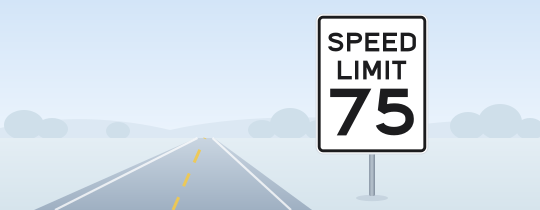
A white SPEED LIMIT 75 sign stands beside the road. On which kind of Nebraska road would you expect to see it?
Show answer
Correct answer: A rural stretch of interstate
Why
75 mph is the highest limit in Nebraska, and it belongs to rural interstate highways. Inside Douglas County, on I-180 in Lancaster County and on I-129 in Dakota County the interstate drops to 65 mph, while paved roads off the state system default to 55 mph. On a freeway, don’t dip below 40 mph unless weather, visibility or traffic makes it necessary.
22Permit & teen rules
Unless they are driving to or from work or a school activity, or riding with a parent, guardian or licensed adult 21+, during which hours may a Nebraska POP holder not drive?
Show answer
Correct answer: Midnight to 6 a.m.
Why
The Provisional Operator’s Permit keeps teens off the road from 12 midnight until 6 a.m. The exceptions are trips between home and a job or school activity, and driving with a parent, guardian or licensed adult who is 21 or older. Police enforce it only after stopping a teen for something else, but a violation still adds a point.
23Road signs
Beneath a white X-shaped railroad crossbuck, a small sign shows the number 3. What is it telling you?
Show answer
Correct answer: Three tracks cross the road here, so more than one train could be coming
Why
A number under the crossbuck counts the tracks. After one train clears, don’t move until you’re sure no second train is coming on another track. Nebraska law has you stop at least 15 but no more than 50 feet short of the closest rail when lights flash, a gate is down or a train is near.
24Right-of-way
In Nebraska, after a full stop, in which situation may a driver turn left while the light is red?
Show answer
Correct answer: When both streets at the corner are one-way, and the cross street flows to your left
Why
Nebraska allows a left on red in a single case: you’re on a one-way street and turning onto a cross street that also runs one way, to your left. Stop fully first and yield to pedestrians and cross traffic. A right turn on red, by contrast, is the general rule after a full stop unless a sign forbids it. A red arrow is different: you may never turn while it’s lit.
25Speed limits
A school bus ahead of you on a Nebraska road switches on its flashing yellow lights. What is the fastest you may drive as you approach it?
Show answer
Correct answer: 25 mph, ready to stop
Why
Yellow (amber) lights mean the bus is getting ready to stop. Nebraska caps your speed at 25 mph whether you’re following the bus or meeting it, and you should be prepared to stop. In town, bus drivers turn the yellow lights on at least 300 feet before a stop; in the country, 500 to 1,000 feet out.
26Parking
You’ve parked nose-down on a steep Omaha street, right against the curb. Which pair of steps does the Nebraska Driver’s Manual call for?
Show answer
Correct answer: Wheels turned toward the curb, parking brake set
Why
Facing downhill, turn the wheels into the curb so the car would roll against it if the brakes let go. Uphill with a curb is the one case where you turn them away from it; with no curb at all, point them toward the edge of the road. Set the parking brake every time, and park within 12 inches of the curb.
27Alcohol & phones
Which of these would break Nebraska law for an adult driver while the car is moving?
Show answer
Correct answer: Reading a text on a phone held in your hand
Why
Nebraska bans every driver from using a handheld device to read, type or send texts, email, instant messages or web content while the vehicle is in motion. Fines climb from $200 to $300 to $500 for repeat offenses, plus 3 points. Hands-free and built-in systems fall outside the ban, but they still pull your mind off the road.
28Safe driving
A Nebraska law that took effect on July 18, 2026, targets a habit on multi-lane highways. What does it ban?
Show answer
Correct answer: Deliberately driving side by side with another vehicle at the same speed, blocking traffic behind
Why
On freeways and other roads with two or more lanes each way, drivers may no longer sit beside another vehicle at a matching speed and hold up everyone behind them; heavy congestion is the exception. Slower traffic belongs in the right lane anyway, except when passing or getting ready to turn left. If you find yourself pacing another car, ease off and open a gap.
29Lane markings
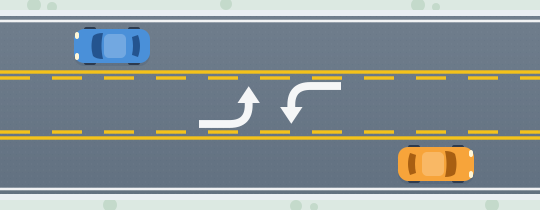
You want to turn left into a store lot from a busy five-lane street in Omaha. The middle lane has yellow paint along both edges, an unbroken stripe on its outer side and a broken one on its inner side. How may you use that lane?
Show answer
Correct answer: Only to turn left, watching for drivers turning from the other direction
Why
That’s a two-way left-turn lane, shared by drivers turning left from both directions. Signal, move into it just before your turn, and wait there for a break in oncoming traffic. Nebraska’s manual says never to use it for passing.
30Safe driving
On a rural Nebraska highway you end up behind a working snowplow with flashing amber lights. Unless you’re passing, how far back must you stay?
Show answer
Correct answer: At least 100 feet
Why
Nebraska law keeps drivers at least 100 feet behind snowplows and other highway maintenance vehicles working with flashing amber or white lights outside town. That gap gives you room to react if the plow slows or turns. A fire truck answering an alarm gets even more room: 500 feet.
Round 4 · Questions 31–40
31Sharing the road
On an interstate with two lanes in your direction, a police car with flashing lights is stopped on the right shoulder. What does Nebraska’s move-over law require?
Show answer
Correct answer: Move to the far lane to leave a lane between you, or slow down if you can’t move over safely
Why
On controlled-access highways, Nebraska wants an empty lane between you and any emergency or roadside-help vehicle parked with its lights flashing, from a patrol car to a tow truck or an NDOT truck. If traffic won’t let you change lanes, slow down and pass with care. A first offense can cost up to $100, and later ones up to $500 and seven days in jail.
32Permit & teen rules
During the first six months with a Nebraska POP, how many passengers under 19 who aren’t immediate family may ride with the teen driver?
Show answer
Correct answer: One
Why
For the first six months, a POP holder may carry no more than one passenger younger than 19 from outside the immediate family, and each violation adds a point. Everyone riding with a POP holder must wear a seat belt or sit in a child safety seat. After six months the passenger limit lifts, but the midnight-to-6 a.m. curfew stays as long as you hold the POP.
33Road signs
On a street with reversible lanes, the signal hanging over your lane changes to a steady yellow X. What should you do?
Show answer
Correct answer: Move out of the lane safely, because it is about to close to you
Why
Lane-use signals hang above lanes whose direction changes during the day. A downward green arrow means you may drive in the lane, a steady yellow X means get out of it, and a red X means never drive under it. Signal and merge into an open lane as soon as it’s safe.
34Right-of-way
At an unsignaled crosswalk on a four-lane street, a pedestrian is crossing in the lane next to yours, where a car has already stopped. What must you do?
Show answer
Correct answer: Stop completely, and do not pass the stopped car
Why
Where no signal is working, Nebraska law has you stop completely for a pedestrian in a crosswalk who is in your lane or the lane beside it. You may never pass a vehicle that has stopped at a crosswalk to let someone cross. Failing to yield to a pedestrian costs 2 points, or 4 if the person is hurt.
35Speed limits
On a Nebraska state highway in a rural area, what maximum speed does state law set for a signed construction or maintenance zone, unless the state engineer approves a higher one?
Show answer
Correct answer: 35 mph
Why
Once signs are up, the standard work-zone maximum is 35 mph in rural areas and 25 mph in urban ones. Speeding fines double in a work zone while workers are present, and in school zones too. Obey a flagger’s STOP and SLOW paddle and give crews and equipment as much room as you can.
36Alcohol & phones
A 16-year-old with a Nebraska POP wants to make a quick phone call while driving. What does state law say?
Show answer
Correct answer: Permit and POP holders may not use a cell phone or similar device while driving
Why
Nebraska’s law for adults targets texting, email and web use on a handheld device, but holders of an LPE, LPD, School Permit or POP may not use a phone or other wireless device at all while driving, calls included. A first offense brings a $200 fine plus a point. Park somewhere safe before you pick it up.
37Permit & teen rules
Nebraska’s School Permit (SCP) is designed for which teens?
Show answer
Correct answer: Students whose home or school is outside any city of 5,000 or more people
Why
The School Permit serves rural students: it can be issued from 14 years 2 months to a teen whose home or school lies beyond any city of at least 5,000 people, once they have held a learner’s permit for two months. It allows driving alone to and from school by the most direct route, or anywhere with a licensed driver 21 or older. On those solo school runs, the only passengers allowed are family members who live with the driver.
38Road signs
Over a mid-block crosswalk hangs a pedestrian hybrid beacon: two red lights side by side above a yellow one. As you approach, every light on it is dark. What do you do?
Show answer
Correct answer: Continue with care, since a dark beacon does not require a stop
Why
Nebraska’s manual says a dark pedestrian hybrid beacon requires no stop, though anyone already in the crosswalk still has the right-of-way. When it is working, flashing and then steady yellow means get ready to stop, two steady reds mean stop and stay stopped, and alternating flashing reds mean stop, then go if no one is crossing in your lane or the next. A regular traffic light that has gone dark is different: treat it as an all-way stop.
39Alcohol & phones
In the back seat as you drive along a Nebraska highway, a 25-year-old friend pops open a can of beer. Is that allowed?
Show answer
Correct answer: No: open containers are banned for everyone in the passenger area
Why
Nebraska’s open container law applies to the driver and every passenger while the vehicle is on a highway or in a public parking area, and drinking there is illegal too. The narrow exception covers passengers in a chartered limousine or bus. Keep any alcohol sealed and stowed outside the passenger area, such as in the trunk.
40Safe driving
At night on a rural Nebraska highway you catch up to another car. Once you are following within what distance must you switch from high beams to low beams?
Show answer
Correct answer: 200 feet
Why
Nebraska requires low beams whenever you follow another vehicle within 200 feet, and when you meet oncoming traffic. Headlights must be on from sunset to sunrise and any time you can’t see people or vehicles 500 feet ahead. If an oncoming driver’s brights dazzle you, aim your eyes at the right side of the road until the car goes by.
Nebraska DMV written test at a glance
What to know before you walk into a driver licensing office.
Nebraska · Class O written test
80% to pass.
25 questions · Miss 5 at most
20 of 25 answers right to pass
$13for a learner’s or school permit; no separate test fee
1 daywait before a retake, for tries 1 to 5
Spanishplus English and ASL, with an audio version
In personat a driver licensing office; no at-home test
6 monthsa passed written test stays valid
20/40vision standard with both eyes, glasses allowed
Under 18? Your road to a license
14School permitsRural students can start with a School Learner’s Permit (LPE) at 14, then get a School Permit at 14 years 2 months to drive themselves to school.
15Learner’s PermitPass the vision and written tests and pay $13. Drive only with a licensed adult 21+ beside you; the permit lasts a year.
6 moPracticeHold a permit at least six months, then finish a driver safety course or log 50 hours, 10 of them at night.
16POPProvisional Operator’s Permit: no unsupervised driving midnight–6 a.m. except to and from work or school activities, one non-family passenger under 19 for six months, and no phone.
17Class OAfter 12 months on the POP with fewer than three points, move up to a full license with no more tests, online or at any office.
18 or older? Take the vision, written and drive tests; there’s no required permit period. Moving here with a valid license from another state? Switch within 30 days, and if you surrender it, you’ll typically take just the vision test.
What’s on the Nebraska permit test
Study the Nebraska Driver’s Manual (Class O, January 2025 edition), also offered as an audio version. It covers licensing, signs, rules of the road and special driving conditions. Here’s what to know cold in six key areas.
Road signs
Shape talks first: an octagon means stop, a point-down triangle means yield, a pennant flags a no-passing zone.
Orange marks work zones, fluorescent yellow-green warns of schools, walkers and bikes, and pink means a traffic incident.
An orange-and-red triangle marks a vehicle that goes 25 mph or less; numbered posts every mile tell responders where you are.
Right-of-way
Coming off a gravel road onto pavement with no sign? Yield to everyone on the paved road.
A dark traffic signal works as an all-way stop; on a tie, the driver on the right goes first.
School bus with red lights and arm out: both directions stop unless a median divides the road.
Speed limits
No sign in town? 20 mph in a business district, 25 in a residential one.
50 mph on gravel, 55 on paved county roads, 65 on most state highways.
75 mph on rural interstates (65 inside Douglas County), and no slower than 40 on a freeway unless conditions demand it.
Parking
Give a hydrant 15 feet of space, and a crosswalk at an intersection 20 feet.
Keep 30 feet from a stop sign or flashing signal and 50 feet from the nearest rail.
Park within 12 inches of the curb; uphill with a curb, wheels away from it, otherwise toward it.
Alcohol & phones
BAC limits: 0.08 for adults, 0.04 in a commercial vehicle, 0.02 under 21.
Refusing a chemical test is a crime of its own and costs your license for a year.
Texting or browsing on a handheld phone while moving: $200 and 3 points for a first offense.
Teen rules
Learner’s Permit at 15: a licensed driver 21 or older sits beside you on every drive.
POP: no unsupervised driving midnight–6 a.m. except for work or school trips, and one non-family passenger under 19 for six months.
Permits and the POP rule out phone use behind the wheel, calls included.
Nebraska numbers to know
Six Nebraska figures worth memorizing before test day.
100 ftof signaling before you turn or change lanes
15 ftfrom a fire hydrant when you park
15–50 ftfrom the nearest rail when you stop for a train
25 mphtop speed near a school bus flashing yellow
75 mphmaximum on rural interstates
0.02%BAC limit for drivers under 21
Your Nebraska course, in your pocket
These 40 questions are just the warm-up. The app gives you 458 Nebraska practice questions, 36 short lessons and the why behind every answer.
36 short lessonsFour levels, from fundamentals to expert, then a full practice exam.
458 Nebraska questions321 of them with pictures.
Your most-missed questionsA review lesson built from the questions you miss most.
Exam simulatorTake full practice exams and watch your readiness grow.
Nebraska permit
Your Nebraska path is ready.
36 lessons, 458 questions and full practice exams. In English and Spanish.
How many questions are on the Nebraska permit test, and what’s a passing score?
The Class O written test has 25 questions, and you need at least 20 right, which is 80%. Miss more than five and you’ll have to come back another day. Signs and traffic laws share one test with no separate sign section, and an audio version can read the questions to you.
How many times can I take the Nebraska written test?
Not on the same day you fail. For tries one through five, wait one day between attempts, and five failures in a row bring a sit-down session with an examiner before your sixth try. Fail a sixth time and you’ll need an approved driver training course or a 90-day wait.
Can I take the Nebraska permit test online?
No. Nebraska has no at-home knowledge test: you take it in person at a driver licensing office. Appointments are strongly encouraged in Lincoln, Omaha and Bellevue, where walk-ins are served after booked customers. Teens in a DMV-approved driver safety course are tested by the course instructor instead, which waives the DMV written and drive tests for the School Permit and POP.
Can I take the Nebraska permit test in Spanish?
Yes. The DMV gives the written test, and its audio version, in Spanish as well as English and American Sign Language. If reading either language is hard for you, you can ask for a 24-question non-verbal picture test instead. The DMV also posts a Spanish manual, the Manual del Conductor de Nebraska, and this practice test and the app work in Spanish too.
How old do you have to be to get a permit in Nebraska?
15 for a Learner’s Permit (LPD), or 14 for a School Learner’s Permit if you’re a rural student on track for a School Permit. After six months with a permit and either a driver safety course or 50 logged hours (10 at night), you can get a POP at 16. POP drivers can’t drive unsupervised from midnight to 6 a.m. except to and from work or a school activity, may carry only one non-family passenger under 19 for the first six months, and can’t use a phone. At 17, after a year on the POP with fewer than three points, you move up to a full Class O license.
How much does a Nebraska permit cost?
You pay for the permit or license itself; the DMV’s fee list has no separate charge for the written test. A School Learner’s Permit, Learner’s Permit or School Permit costs $13, the POP is $20, and a five-year Class O license is $29, each including the $5 security fee.
What do I need to bring to get a Nebraska permit?
Proof of U.S. citizenship or lawful status that shows your name, date of birth and identity, two documents with your Nebraska home address, and your Social Security number. Bring originals, not photocopies; under 21, you may use a parent’s or guardian’s address documents. Everyone also takes a vision test: aim for 20/40 with both eyes, wearing glasses or contacts if you need them, since 20/50 or 20/60 brings a daylight-only restriction.
What’s the best way to study for the Nebraska permit test?
Read the Nebraska Driver’s Manual, then practice until 80% comes easily. Start with the 40 questions above, then let the app take you through 458 Nebraska questions and 36 short lessons, with the reason behind every answer.