Get ready for the FLHSMV Class E Knowledge Exam with 40 free practice questions on signs, right-of-way, Florida speed limits and the Move Over law. Pick an answer and see instantly why it’s right.
Four rounds of 10 questions on signs, right-of-way, Florida speed limits, the Move Over law, alcohol and teen rules. Every answer comes with a quick explanation.
Round 1 · Questions 1–10
1Right-of-way
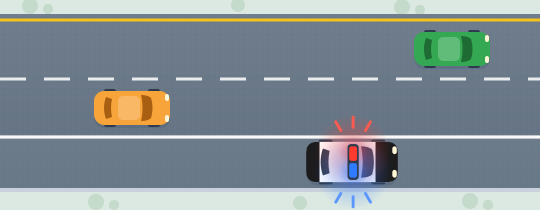
On a highway with two lanes in your direction, a police car is stopped on the right shoulder ahead with its lights flashing. You are in the right lane, and the left lane has room for you. What does Florida's Move Over law require?
Show answer
Correct answer: Signal and move to the left lane, away from the stopped car
Why
Florida’s Move Over law tells you to leave the lane next to a stopped emergency vehicle whenever you can do it safely. It also covers stopped tow trucks, sanitation and utility trucks and road maintenance vehicles, and since January 1, 2024, disabled vehicles showing hazard lights or flares. If you cannot change lanes, slow to 20 mph below the posted limit.
2Road signs
On a Florida interstate, you pass mile marker 250, and the markers are counting up as you go. Your exit is Exit 270. About how far ahead is it?
Show answer
Correct answer: About 20 miles
Why
Florida numbers its interstate exits to match the mile markers, so an exit number tells you roughly where that exit sits along the highway. Subtract the marker you just passed from your exit number to estimate the distance. The markers also pin down your location if you ever need to call for help.
3Speed limits
You turn onto a street lined with homes and small shops in a Florida town, and you have not seen a speed limit sign. Which limit applies?
Show answer
Correct answer: 30 mph
Why
Unless a sign says otherwise, Florida's limit in business and residential districts is 30 mph, and outside them it is 55 mph. Cities and counties can post lower limits, such as 20 or 25 mph, on local streets, so keep an eye out for signs. On a busy street, the safe speed may be lower than either number.
4Parking
You are hunting for street parking near a busy intersection. Which of these spots is legal in Florida?
Show answer
Correct answer: 35 feet before a stop sign
Why
Florida sets three gaps here: 15 feet around a fire hydrant, 20 feet back from an intersection crosswalk, and 30 feet ahead of a stop sign, flashing beacon or traffic light. Those gaps keep hydrants reachable and let drivers and walkers see each other at the corner. A spot 35 feet back from the stop sign clears the 30-foot rule.
5Alcohol & phones
A 19-year-old is pulled over, and a breath test shows 0.03. What does Florida's zero tolerance law mean for this driver?
Show answer
Correct answer: A 6-month license suspension for a first violation
Why
Drivers under 21 in Florida may not drive with a breath or blood alcohol level of 0.02 or more. A first violation brings a 6-month suspension, and a second one a full year. The simple rule: if you are under 21, don't drink at all before you drive.
6Safe driving
In dry daytime traffic, what is the smallest gap behind the car ahead that the Florida handbook recommends?
Show answer
Correct answer: Four seconds
Why
Florida's handbook asks for a cushion of four seconds or more behind the vehicle in front when conditions are good. Pick a fixed point such as a sign; when the car ahead passes it, start counting, and you should not reach it before four. Add more time in rain, at night or when you are towing.
7Permit & teen rules
You are 15 and just got your Florida learner's license. Who may sit with you while you practice?
Show answer
Correct answer: A licensed adult aged 21 or up, riding right beside you
Why
Every time a Florida learner drives, the front passenger seat must hold a licensed driver aged 21 or more. Age matters: a licensed 18- or 20-year-old does not qualify. A learner's license never allows driving alone.
8Lane markings
On a five-lane road, the middle lane is shared by drivers heading in both directions. What may you use it for?
Show answer
Correct answer: Making left turns, and nothing else
Why
On a Florida road with three or five lanes, the center lane is set aside for left turns and must never be used for passing. Drivers from both directions share it, so move into it close to your turn and watch for someone waiting to turn the other way.
9Crashes & emergencies
Which crash does Florida law require you to report right away to the police, the sheriff or the Florida Highway Patrol?
Show answer
Correct answer: Any crash with an injury, a death or $2,000+ in apparent damage
Why
Since October 1, 2026, Florida's threshold for calling police is $2,000 in apparent damage; it used to be $500. An injury or death must always be reported at once. If no police report is required, you file your own written crash report with FLHSMV within 10 days.
10Road signs
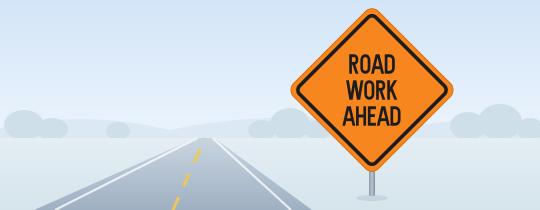
Just past an orange diamond-shaped ROAD WORK AHEAD sign, you enter a posted work zone with a crew working beside your lane. What changes for you in Florida while you drive through it?
Show answer
Correct answer: A speeding ticket here carries a doubled fine
Why
Orange marks work-zone signs in Florida, and a speeding ticket in a posted work zone costs double while workers are present, just as it does in a school zone. Your phone also has to stay hands-free in an active work zone. Ease off early, leave extra room and watch for workers close to the lane.
Round 2 · Questions 11–20
11Speed limits
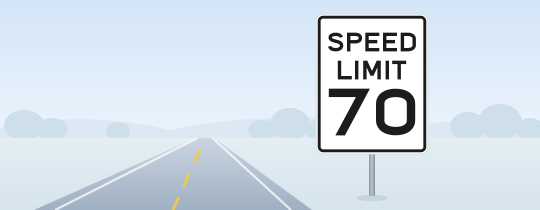
On a Florida interstate with four lanes, signs read SPEED LIMIT 70. In normal conditions, what is the slowest speed you may legally drive there?
Show answer
Correct answer: 50 mph
Why
Where an interstate with four or more lanes is posted at 70 mph, Florida sets a 50 mph minimum; on other interstates with four or more lanes, the minimum is 40 mph. 70 mph is also the highest limit anywhere in the state. If you need to go slower than the flow, stay out of the far-left lane.
12Right-of-way
You are leaving a dirt road and pulling onto a paved county road. There is no stop sign or signal where they meet. Who has the right-of-way?
Show answer
Correct answer: All traffic already on the paved road
Why
Florida law says a driver coming off an unpaved road onto a paved county or city road, with no sign or signal to direct them, must yield to every vehicle on the paved road. The same duty applies when you enter a state highway from any side road. Stop if you need to, and pull out only when the gap is big enough to get up to speed safely.
13Road signs
The signal over your left-turn lane shows a blinking yellow arrow pointing left. What does it allow you to do?
Show answer
Correct answer: Turn left once you yield to oncoming traffic and pedestrians
Why
A flashing yellow arrow means the turn is allowed but not protected, so oncoming cars may still be coming through on a green. Florida's handbook tells you to yield to oncoming traffic and pedestrians before you turn. Wait for a gap you are sure of rather than forcing the turn.
14Parking
Under Florida law, what is the closest you may park to the nearest rail of a railroad crossing?
Show answer
Correct answer: 50 feet
Why
In Florida, a parked car must sit 50 feet or more away from the closest rail at a crossing. Don't mix it up with the 15 to 50 feet where you must stop when a train is coming. Near a fire station driveway, the gap is 20 feet on the same side of the street.
15Alcohol & phones
After a lawful DUI arrest, a driver refuses a breath test for the first time ever. What follows under Florida law today?
Show answer
Correct answer: A 1-year suspension, and the refusal itself is a crime
Why
By driving in Florida you have already agreed to breath, blood or urine testing. A first refusal means a 1-year suspension, 18 months for a second, and since October 1, 2025, even a first refusal of a lawful breath or urine test is a misdemeanor. Saying no only adds to your trouble.
16Safe driving
Light rain starts in the middle of the day and you switch on your windshield wipers. What does the Florida handbook say about your headlights?
Show answer
Correct answer: Turn them on whenever the wipers are on
Why
Florida law requires headlights during any rain, smoke or fog, not only from sunset to sunrise, so the handbook’s easy rule is wipers on, headlights on. Lights make your car much easier to spot on a gray, wet road. Use low beams, since high beams reflect off rain and fog and cut your view.
17Permit & teen rules
You have had your Florida learner's license for two months. When are you allowed to drive?
Show answer
Correct answer: Only in daylight
Why
For the first three months, a Florida learner may drive only during daylight hours. After that, driving is allowed until 10 p.m. Either way, someone 21 or over with a license has to sit next to you.
18Sharing the road
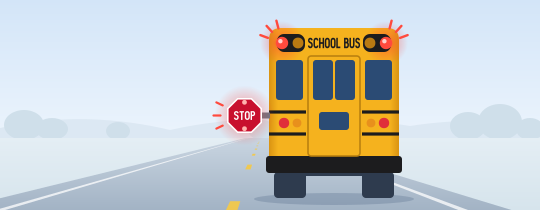
You are following a school bus on a two-lane road. It halts, its red lights begin to blink, and the stop arm swings out. Who must stop?
Show answer
Correct answer: You and the oncoming traffic, until the stop signal is withdrawn
Why
On two-lane roads and undivided multi-lane roads, Florida requires traffic in both directions to stop for a school bus showing its stop signal. Stay stopped until the signal is withdrawn. A ticket from an officer for passing a stopped bus brings 4 points and at least $265 in fines.
19Right-of-way
In the lane next to yours, a car has stopped at a marked crosswalk, and you cannot see why. What should you do?
Show answer
Correct answer: Stop as well, since someone may be crossing in front of it
Why
Florida law forbids passing a vehicle that has stopped at a crosswalk to let a pedestrian cross. The stopped car can hide a person who is about to walk into your lane. Stop and wait until the crosswalk is completely clear.
20Crashes & emergencies
After a hurricane knocks out the power, you reach an intersection where every signal is dark and no officer is directing traffic. What should you do?
Show answer
Correct answer: Treat it as a four-way stop
Why
Florida law says a dark traffic signal with no officer present works like a four-way stop. Stop completely, then go in turn: the first to stop goes first, and if two cars stop together, the driver on the left yields to the one on the right. Expect other drivers to be unsure, and make eye contact before you go.
Round 3 · Questions 21–30
21Road signs
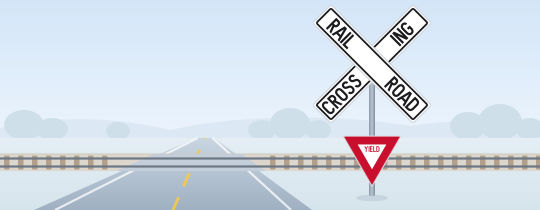
A crossing ahead is marked by a white X-shaped RAILROAD CROSSING sign with a YIELD sign under it, and a train is coming. Where does Florida law tell you to stop?
Show answer
Correct answer: Somewhere 15 to 50 feet short of the closest rail
Why
Florida wants your car stopped in a window 15 to 50 feet short of the closest rail whenever a train is near, crossing lights flash, a gate is down or a flagger signals. The 15-foot minimum keeps your car well clear of the passing train. Once it has gone by, move on only when the tracks are clear and you can cross safely.
22Right-of-way
Your car is first in line at a red light on a one-way street, and your next move is a left. When may you make that turn on red under Florida law?
Show answer
Correct answer: When turning onto a one-way street that flows left, after a full stop
Why
In Florida, turning left against a red light is legal in just one case: you are on a one-way street turning onto a second one-way street whose traffic flows to your left. You still have to stop completely, let pedestrians and cross traffic go first, and skip the turn wherever a sign forbids it. On two-way streets, wait for the green.
23Speed limits
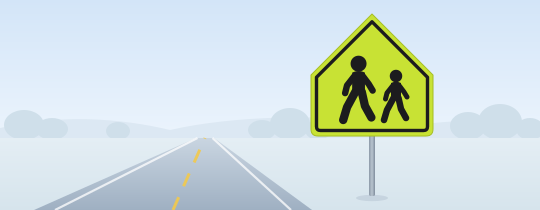
Heading into a school zone in a Florida city at morning drop-off, you pass a five-sided fluorescent yellow-green sign showing two children. What is the highest limit Florida allows in an urban school zone?
Show answer
Correct answer: 20 mph
Why
In urbanized areas, a Florida school zone limit may not be set above 20 mph, and it applies from 30 minutes before to 30 minutes after the times students arrive and leave. Speeding fines are doubled in school zones, and handheld phone use is banned there. Slow down before you reach the zone, not inside it.
24Parking
You park on a steep hill with the nose of your car pointing downhill and a curb on your right. Which way should your front wheels point?
Show answer
Correct answer: Toward the curb
Why
Facing downhill, turn your wheels toward the curb so that if the car starts to roll, the curb stops it. Facing uphill with a curb, turn them away from it; uphill with no curb, turn them to the right. Set the parking brake every time.
25Alcohol & phones
You are 25 and driving on a Florida highway, far from any school or work zone. Which use of your phone is allowed?
Show answer
Correct answer: Asking the phone's voice assistant for directions
Why
Florida’s texting ban forbids typing or reading texts, emails and instant messages on a handheld device while you drive, but voice commands and navigation are allowed. A first ticket is a nonmoving violation, and a second within 5 years becomes a moving violation that adds points. Set your route before you pull out.
26Safe driving
At night on a dark two-lane road, you catch up to a car going your way. With your high beams on, how close may you get before you must switch to low beams?
Show answer
Correct answer: 300 feet
Why
Florida law says to dim your high beams once you are 300 feet or closer behind another car, and 500 feet or closer to one coming toward you. High beams shining into another driver's mirrors can dazzle them. Dim early, and switch back once the road ahead is clear.
27Permit & teen rules
Before a Florida teen can trade a learner's license for a Class E license, what must a parent or guardian certify?
Show answer
Correct answer: 50 hours of practice, at least 10 of them at night
Why
A parent, guardian or responsible adult 21 or older must certify 50 hours of supervised driving, with at least 10 after dark. The teen must also hold the learner's license for 12 months, or until turning 18, with no moving-violation convictions. Log each drive as you go so the form is easy to complete.
28Lane markings
You are cruising in the far-left lane of a three-lane highway when a faster car comes up behind you. You are not passing anyone or turning left soon. What does Florida law require?
Show answer
Correct answer: Move out of the left lane and let the car pass
Why
Where a Florida road has at least two lanes heading your way, the far-left lane is not for cruising once a faster vehicle is overtaking you from behind, unless you are passing or about to turn left. Driving at the limit does not change that. Signal, check your mirror and blind spot, and move right when it is safe.
29Sharing the road
A school bus has stopped with its stop arm out on the far side of a highway. In which setup may you, driving the opposite way, keep going?
Show answer
Correct answer: An unpaved median at least 5 feet wide separates you from the bus
Why
Florida lets oncoming traffic keep moving only when the highway is divided by an unpaved space at least 5 feet wide, a raised median or a physical barrier. Painted lines and pavement markings do not count as a divider. Even when you may go on, slow down and watch for children near the road.
30Crashes & emergencies
You are in a minor fender bender on a busy road. No one is hurt and both cars still run, but they are blocking a lane. What should you do?
Show answer
Correct answer: Move both cars out of the travel lanes to a safe spot nearby
Why
Florida expects drivers in a minor crash to move their vehicles, or have them moved, so they do not block traffic. Leaving the scene is never an option, and when anyone is hurt or killed it is a felony. Once you are safely off the road, check whether the damage reaches the $2,000 level that calls for a police report.
Round 4 · Questions 31–40
31Road signs
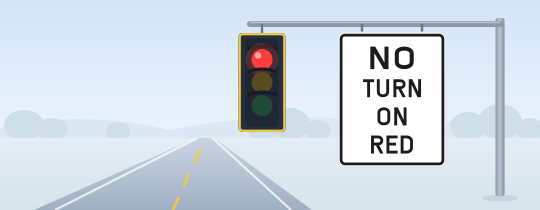
Your light is red, the cross street is empty, and you want to turn right. A white sign next to the signal reads NO TURN ON RED. What should you do?
Show answer
Correct answer: Stay stopped until the light turns green
Why
Florida normally lets you turn right on red after a complete stop, as long as you yield to pedestrians and cross traffic. A NO TURN ON RED sign takes that option away at this corner. Wait for the green, and still check the crosswalk before you go.
32Right-of-way
On a two-lane street, an ambulance with its siren wailing and lights flashing comes up behind you. You are nowhere near an intersection. What should you do?
Show answer
Correct answer: Pull to the nearer edge of the road and stop until it passes
Why
When a police car, fire truck or ambulance comes up with its siren on or lights flashing, Florida law says to get out of its way: head for the nearest edge of the roadway, away from intersections, and stay stopped until it is past. Check your mirrors and signal so your move is easy to predict. If you are already in an intersection, clear it first, then pull over.
33Speed limits
A summer afternoon storm is dumping heavy rain on a road posted at 45 mph, and your wipers can barely keep up. How fast should you drive?
Show answer
Correct answer: As fast as is reasonable for the rain and what you can see
Why
Florida's basic speed rule puts conditions first: the sign shows the most you may drive, and the law also demands a speed that is sensible for the weather, traffic and road. A downpour cuts both your view and your tires' grip, so the safe speed may be well under 45. Keep your headlights on with the wipers and leave extra room ahead.
34Alcohol & phones
Driving through a school zone during its posted hours, you want to call home to say you are running late. What does Florida law allow?
Show answer
Correct answer: A hands-free call only; holding the phone is banned there
Why
In Florida school crossings, school zones and active work zones, you may not drive with a phone or other wireless device in your hand. Hands-free calling is allowed. A violation there costs 3 points, so make the call before the zone or after you are through it.
35Alcohol & phones
You like music in your earbuds on long drives. What does Florida law say about wearing them while you drive?
Show answer
Correct answer: Banned while driving, though hearing aids are allowed
Why
Florida law bars driving while wearing a headset, headphones or other listening device, since you need to hear sirens, horns and trains. Hearing aids are allowed. Play your music through the car speakers instead.
36Safe driving
During a heavy downpour, the steering suddenly feels light and your tires seem to be gliding on water. What should you do first?
Show answer
Correct answer: Ease off the gas and steer where you want to go
Why
That floating feeling is hydroplaning: a layer of water has lifted your tires off the pavement. Lift your foot off the gas, avoid the brakes if you can, and steer gently toward where you want the car's nose to point. Slowing down when water covers the road is the best way to prevent it.
37Permit & teen rules
You are 16 and have a Florida Class E license. It is 11:30 p.m. and you are driving home alone from a friend's house. Are you breaking the law?
Show answer
Correct answer: Yes, at 16 you can't drive 11 p.m.–6 a.m. on a trip like this
Why
Florida limits 16-year-old drivers to 6 a.m.–11 p.m. unless they are going to or from work or a licensed driver 21 or older is with them. At 17 the window widens: no driving 1–5 a.m., with the same exceptions. These time limits end at 18.
38Permit & teen rules
A 15-year-old in Florida who has never held a license wants a learner's license. Which course must come first?
Show answer
Correct answer: The 6-hour Driver Education Traffic Safety (DETS) course
Why
Since August 1, 2025, first-time applicants under 18 must complete the 6-hour DETS course, online or in person; a school driver education course can count instead. The 4-hour TLSAE course is now for first-time applicants 18 and older. If a study guide says every new driver needs TLSAE, it predates the 2025 change.
39Sharing the road
On a two-lane street posted at 20 mph, a garbage truck is stopped ahead with its warning lights flashing, and you cannot change lanes. Under Florida's Move Over law, how fast may you go as you pass it?
Show answer
Correct answer: 5 mph
Why
When you cannot move over, or you are on a two-lane road, Florida tells you to slow to 20 mph below the posted limit. Where the limit is 20 mph or less, the rule is simpler: slow to 5 mph. The rule protects sanitation, utility, tow and road crews as well as police, fire and ambulance.
40Road signs
Near the Intracoastal Waterway, the red lights on a drawbridge start flashing and the gate arm begins to come down. What should you do?
Show answer
Correct answer: Stop at the stop line and wait until the gate goes back up
Why
Florida has many movable bridges, and their signals work like a traffic light: on red, or when the gate lights flash, stop at the stop line. Never go around a gate that is down or on its way down, because the span may already be starting to lift. Stay stopped until the gate is fully up and the signal lets you go.
Florida DMV written test at a glance
The numbers that matter before your Class E Knowledge Exam.
Florida · Class E Knowledge Exam
40 of 50 to pass.
50 questions · Multiple choice
40 of 50 answers right to pass
$48for your first learner’s license
$10for each knowledge retest
Onlineunder 18 only, with a parent as proctor
Englishthe only test language since February 2026
1 examsigns and rules together, no separate sign test
20/40in each eye to pass the vision screening
Under 18? Your road to a license
15Learner’s licenseFinish the 6-hour DETS course, pass the vision, hearing and knowledge tests, and bring a parent’s signed consent.
3 moDaylight onlyDrive with a licensed adult 21 or older beside you, in daylight only for 3 months, then until 10 p.m.
12 moLearner yearKeep the learner’s license 12 months with no moving-violation convictions and log 50 hours, 10 of them at night.
16Class E licensePass the Driving Skills Test, then trade in your learner’s license for your Class E license.
16–17Night limitsAt 16, no driving 11 p.m.–6 a.m.; at 17, none 1–5 a.m., unless it’s for work or a licensed driver 21+ rides along.
18 or older? Take the 4-hour TLSAE course, then pass the vision, knowledge and driving tests in person. No learner year required.
What’s on the Florida permit test
Study the Official Florida Driver License Handbook: the 50-question exam covers traffic laws, safe driving, and signs, signals and markings. Here’s what matters most in six key areas.
Road signs
Color tells the story: orange means a work zone, fluorescent yellow-green warns of kids, walkers and bikes, brown points to recreation.
On Florida interstates the exit number matches the mile marker, so Exit 100 sits near mile 100.
Drawbridge lights flashing or the gate coming down? Stop at the line and never go around the gate.
Right-of-way
Four-way stop: first to stop goes first; arrive together and the driver on the left yields to the right.
Move Over: leave the lane next to a stopped police car, tow truck or disabled car with hazards on; if you can’t, slow to 20 mph under the limit.
School bus stop arm out: traffic stops both ways, unless a raised median or a 5-foot unpaved strip divides the road.
Speed limits
No sign? 30 mph in business and residential areas, 55 mph elsewhere.
70 mph is the top limit anywhere in Florida, and interstates posted at 70 have a 50 mph minimum.
Urban school zones max out at 20 mph. Speeding fines double in school zones and in work zones with crews present.
Parking
Parking gaps: 15 feet from a hydrant, 20 from an intersection crosswalk, 30 before a stop sign or signal.
Railroad crossing? Leave 50 feet or more between your car and the closest rail.
Downhill, wheels toward the curb. Uphill, away from it, or to the right when there’s no curb.
Alcohol & phones
BAC limit: 0.08% at 21 and over, 0.02% under 21.
Refuse a breath test after a DUI arrest and lose your license for a year; since October 2025 even a first refusal is a crime.
No texting while you drive, at any age. In school zones and active work zones, hands-free only.
Teen rules
Learner’s license: a licensed driver 21+ beside you every time; daylight only for 3 months, then until 10 p.m.
At 16, no driving 11 p.m.–6 a.m.; at 17, none 1–5 a.m., unless it’s for work or a licensed driver 21+ is with you.
Six points in 12 months restricts a teen driver to a Business Purposes Only license.
Florida numbers to know
Six figures to lock in before test day.
70 mphthe highest speed limit anywhere in Florida
20 mphtop limit in an urban school zone
4 secminimum gap behind the car ahead
100 ftof signaling before every turn
15 ftfrom a fire hydrant when you park
0.02%alcohol limit for drivers under 21
Your Florida course, in your pocket
These 40 questions are just the warm-up. The app gives you 499 Florida practice questions, 36 short lessons and the why behind every answer.
36 short lessonsFour levels, from fundamentals to expert, then a full practice exam.
499 Florida questions347 of them with pictures.
Your most-missed questionsA review lesson built from the questions you miss most.
Exam simulatorTake full practice exams and watch your readiness grow.
Florida permit
Your Florida path is ready.
36 lessons, 499 questions and full practice exams. In English and Spanish.
What score do I need to pass the Florida permit test?
40 out of 50, which is 80%. The Class E Knowledge Exam is one multiple-choice test on traffic laws, safe driving, and signs, signals and markings. There’s no separate road-sign section.
What happens if I fail the Florida knowledge test?
You can take it again, and each knowledge retest costs $10. Some offices take walk-ins while others work by appointment only, so check your local service center before you go back. Use the time in between to review what you missed.
Can I take the Florida permit test online?
Only if you’re under 18. Teens can test online through an FLHSMV-approved third-party administrator, with a Parent Proctoring Form (HSMV 71144) that is notarized or signed in front of a driver license examiner. Adults take the exam in person at a driver license service center or with an approved provider.
Can I take the Florida DMV test in Spanish?
No. Since February 6, 2026, Florida gives every driver license knowledge exam and driving test in English only, with no translation help. FLHSMV still publishes the driver handbook in Spanish, and this practice test and the app work in Spanish too. Learn the rules in the language you know best, then practice the questions in English before test day.
How old do you have to be to get a learner’s license in Florida?
15. First finish the 6-hour Driver Education Traffic Safety (DETS) course, then pass the vision and hearing test and the Class E Knowledge Exam, and bring a parent’s signed consent form. After 12 months with your learner’s license and 50 logged hours, 10 of them at night, you can go for your Class E license at 16.
What are the driving rules for 16- and 17-year-olds in Florida?
At 16 you can’t drive from 11 p.m. to 6 a.m., and at 17 from 1 a.m. to 5 a.m., unless you’re driving to or from work or a licensed driver 21 or older is with you. Florida sets no teen passenger limit, but 6 points in 12 months brings a Business Purposes Only restriction. The time limits end at 18.
How much does a Florida learner’s license cost?
Your first learner’s license costs $48, the same fee as an original Class E license. Offices run by a county tax collector may add a $6.25 service fee, and each knowledge retest is $10.
What’s the best way to study for the Florida permit test?
Read the Official Florida Driver License Handbook, then practice until 40 out of 50 feels easy. Start with the 40 questions above, then let the app walk you through 499 Florida questions and 36 short lessons, with an explanation for every answer.