Washington's DMV written test is the DOL knowledge test. Practice for it with 40 free questions on road signs, speed limits, HOV lanes and intermediate license rules, and see why each answer is right the moment you pick it.
Ten questions a round, four rounds: Washington road signs, who goes first, speed limits, parking distances, DUI and phone laws, and intermediate license rules. You'll see the reason after every answer.
Round 1 · Questions 1–10
1Lane markings
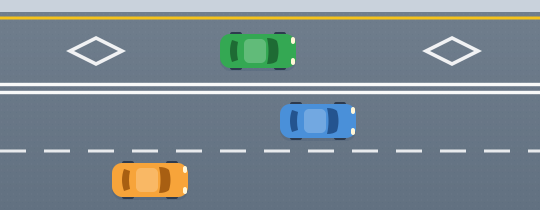
On a freeway near Seattle, the far-left lane is marked with a white diamond and set apart from your lane by two solid white lines. What does Washington's driver guide say about those lines?
Show answer
Correct answer: They act as a barrier, so you may not cross them
Why
The diamond marks an HOV lane, for vehicles with at least the posted number of people, plus buses, vanpools and motorcycles, and it isn't meant for passing. Double solid white lines between lanes work as a barrier. Wait for a stretch where the line turns dashed before you move in or out.
2Right-of-way
You're stopped at a red light on a two-way street in Spokane. You want to turn left onto a one-way street whose traffic flows to your left, and no sign forbids it. What does Washington law allow?
Show answer
Correct answer: A left turn after a complete stop, once you've yielded to pedestrians and cross traffic
Why
Washington allows it: after a full stop at a red light, you may turn left onto a one-way street flowing left, and it doesn't matter whether the street you're leaving carries traffic in one direction or both. Yield to people in the crosswalk and to traffic first, and don't turn where a sign prohibits it. Right turns on red follow the same stop-and-yield rule.
3Speed limits
You're driving on a street inside a small Washington town and haven't passed a single speed limit sign. What is the most state law allows?
Show answer
Correct answer: 25 mph
Why
When nothing is posted, Washington caps city and town streets at 25 mph. The default rises to 50 mph on county roads and 60 mph on state highways. A posted sign always replaces these numbers.
4Alcohol & phones
A 19-year-old used cannabis earlier in the day and gets pulled over. For a driver under 21, what level of THC in the blood breaks Washington law?
Show answer
Correct answer: Any amount above 0.00
Why
Under 21, Washington allows no THC at all, and the alcohol limit is 0.02. Drivers 21 and older are over the line at 0.08 alcohol or 5.00 ng/mL of THC. Being old enough to buy cannabis never makes it legal to drive after using it.
5Road signs
Driving north on I-5 into Canada, you may come across a traffic light flashing green. What does the Washington Driver Guide say about flashing green signals?
Show answer
Correct answer: Washington doesn't use them; you'd meet them in British Columbia
Why
Washington's signals never flash green, but British Columbia's do, so you may meet one after you cross the border. At home, treat a flashing red like a STOP sign (stop fully, then go when it's clear) and a flashing yellow like a YIELD sign.
6Permit & teen rules
You're 15 and signed up for an approved driver training course. When can you get your Washington learner permit?
Show answer
Correct answer: Now, applying no more than 10 days before the course starts
Why
Enrolled students can get a permit from age 15, applying up to 10 days before class begins, with a parent or guardian giving permission online. Without a course you wait until 15½, pass the knowledge test, and can't be licensed until 18. The permit costs $35 and is good for a year.
7Parking
The only open curb space on a Seattle street is near a fire hydrant. What is the closest Washington law lets you park to it?
Show answer
Correct answer: 15 feet
Why
State law keeps parked cars at least 15 feet from a fire hydrant, so crews can hook up a hose fast. The same law adds 20 feet from a crosswalk and 30 feet on the approach to any roadside STOP, YIELD or signal light. If the space looks tight, keep looking.
8Crashes & emergencies
Your car stalls on a railroad crossing and won't restart. Once everyone is out, what does the Washington Driver Guide tell you to do?
Show answer
Correct answer: Call the number on the blue-and-white Emergency Notification System sign, or 911
Why
Get everyone out and away from the tracks, then call the number on the blue-and-white Emergency Notification System sign and give the dispatcher the crossing ID; with no sign, dial 911. A train may need up to a mile to stop, so never count on it seeing you in time.
9Safe driving
In normal conditions, how much room does the Washington Driver Guide tell you to keep behind the vehicle ahead?
Show answer
Correct answer: At least two vehicle lengths
Why
Washington's guide asks for a minimum of two vehicle lengths, and more at night, on snow and behind motorcycles or large trucks. That cushion is your time to react if the driver ahead brakes hard. If someone cuts into the gap, drop back and rebuild it.
10Sharing the road
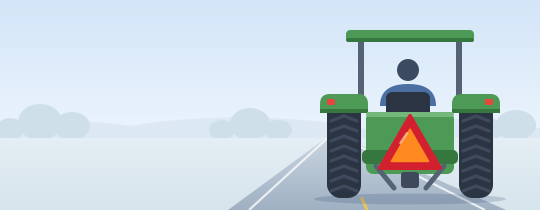
On a two-lane road in the Palouse, you come up behind a tractor with an orange triangle edged in red on its back. What does that emblem tell you?
Show answer
Correct answer: Its top speed is 25 mph or less
Why
Washington's guide says farm vehicles that can't go faster than 25 mph carry that triangle, so you'll close the gap fast. Slow down early and pass only where it's legal and safe. Leave at least 3 feet as you go around.
Round 2 · Questions 11–20
11Road signs
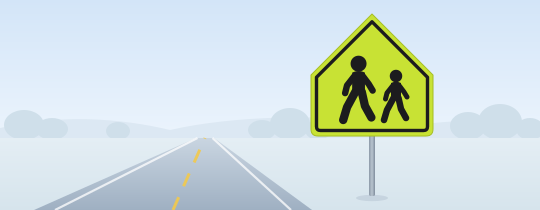
Outside an elementary school in Tacoma, a five-sided, fluorescent yellow-green sign showing two children on foot tells you a school zone is ahead. What is the speed limit in a Washington school zone?
Show answer
Correct answer: 20 mph
Why
Washington school zones are 20 mph, and a posted school or playground crosswalk zone stretches 300 feet each way from the crosswalk. Speeding fines there are doubled and can't be reduced, and cameras may record you. That pentagon shape and bright yellow-green color are your cue to ease off early.
12Right-of-way
You and an oncoming car reach a four-way stop at the same moment. You plan to turn left; the other driver is going straight. Who should go first?
Show answer
Correct answer: The other driver, because a left-turning driver yields to straight-through traffic
Why
At a Washington four-way stop, the first to arrive goes first, and if two arrive together the driver on the right has priority. When you face each other, though, the driver turning left waits for anyone going straight or turning right. Watch the other car's signal and wheels before you commit.
13Alcohol & phones
A Washington driver with a clean record is arrested for DUI and refuses a breath test for the first time. What happens to the license?
Show answer
Correct answer: Revocation for one year
Why
By driving in Washington you've already agreed to alcohol and drug testing when an officer has reason to suspect impairment. A first refusal means a one-year revocation, longer than the 90-day suspension for a first test at or over the limit. Refuse again within seven years and it's two years, or until 21 if that's later.
14Speed limits
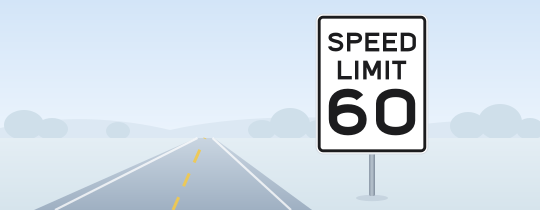
With no speed signs posted, on which kind of Washington road is 60 mph, the number on this sign, the legal maximum?
Show answer
Correct answer: State highways
Why
Unposted, Washington's maximums are 25 mph on city streets, 50 mph on county roads and 60 mph on state highways. The state can raise a highway's limit after an engineering study, but never above 75 mph, while trucks over 10,000 pounds and vehicles towing are capped at 60. Always go by the signs you actually see.
15Permit & teen rules
You have a Washington learner permit. Who may sit beside you as your supervising driver?
Show answer
Correct answer: A licensed driver with at least 5 years of driving experience
Why
Washington requires a licensed driver with 5 or more years of experience, or a driver training instructor, in the seat next to you, and you must carry the permit. Other passengers of any age may ride along. For the 50 practice hours you log, your supervisor must also be at least 21.
16Road signs
You reach a STOP sign at a rural corner with no painted stop line and no marked crosswalk. Under Washington law, where should your car come to a halt?
Show answer
Correct answer: At the point nearest the crossing road where you can see traffic approaching
Why
Washington sets an order: stop at the marked stop line; with no line, before a marked crosswalk; with neither, at the spot closest to the crossing road where you can see traffic coming. Look both ways for vehicles and people, then yield before you pull out. A slow roll past the sign is not a stop.
17Lane markings
A two-way left-turn lane runs down the middle of a busy street in Vancouver, Washington. What is the farthest state law lets you drive in it?
Show answer
Correct answer: 300 feet
Why
Washington caps your trip in a shared center turn lane at 300 feet, and passing in it is never allowed. Signal at least 100 feet before the turn, move in close to your turning point and wait there for a gap. Drivers coming the other way share the same lane.
18Safe driving
How far ahead of a turn or lane change does Washington law require your turn signal to be blinking without a break?
Show answer
Correct answer: For at least the last 100 feet
Why
RCW 46.61.305 requires a continuous signal over the final 100 feet or more before you turn or move left or right. Drivers behind you need that time to slow, and people waiting to cross need to know your plan. Cancel the blinker once you've finished the move.
19Sharing the road
You're on a four-lane highway split by a concrete median. On the far side, a school bus stops with red lights flashing and its stop arm out. What should you do?
Show answer
Correct answer: Keep going with care; oncoming drivers across a median don't have to stop
Why
Across a median, or where the road has at least three marked lanes, drivers headed the other way may proceed with caution. Traffic behind the bus always stops, and on an ordinary two-lane road both directions stop. Passing a stopped school bus illegally costs a doubled fine.
20Crashes & emergencies
After a crash with more than $1,000 in property damage and no police report, how long do Washington drivers have to file a written collision report?
Show answer
Correct answer: 4 days
Why
Washington drivers must file their own written report within 4 days when nobody from law enforcement does, if someone was hurt or killed or the damage to property reaches $1,000. Keep proof of insurance in the car as well, since you must be ready to show it. Snap photos at the scene so the details are fresh when you fill out the form.
Round 3 · Questions 21–30
21Sharing the road
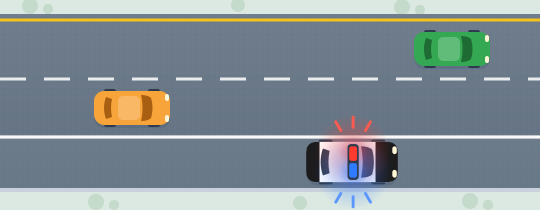
On a four-lane divided highway posted at 55 mph, a patrol car with flashing lights is stopped on the right shoulder ahead. You're in the right lane, and the lane to your left is open. What does Washington law tell you to do?
Show answer
Correct answer: Slow down and move to the left lane if it's safe; if you can't, go 45 mph or slower
Why
Washington treats the lanes beside a stopped emergency vehicle, tow truck or roadside-help vehicle with flashing lights, from 200 feet before it to 200 feet after, as an emergency zone. Ease off and change lanes away from it when you safely can; if you can't, drive at least 10 mph under the limit, and no faster than 50 where the limit is over 60. Penalties in the zone are doubled.
22Right-of-way
At a neighborhood corner with no painted lines at all, a woman steps off the curb to cross in front of you. What does Washington law require?
Show answer
Correct answer: You must stop, because every intersection is a crosswalk, marked or not
Why
In Washington each intersection is a legal crosswalk even without stripes. Stop and stay stopped while a pedestrian is in your half of the road or within one lane of it. And never pass a car that has stopped at a crosswalk, because it may be hiding someone crossing.
23Road signs
Orange diamond signs and cones line a stretch of I-90, and a roller with flashing yellow lights is working next to your lane. Whom does the Washington Driver Guide tell you to yield to here?
Show answer
Correct answer: The workers and any vehicle or equipment showing flashing yellow lights
Why
In a Washington highway work zone, construction workers and equipment with flashing yellow lights get the right-of-way. Traffic fines are doubled while workers are present, so slow down before the first cone and give crews space. Orange is the color of construction and maintenance warnings.
24Alcohol & phones
Your passenger wants to take a half-finished bottle of wine home from a dinner party. Where can it legally ride in your car in Washington?
Show answer
Correct answer: In the trunk
Why
Washington's open container law covers the whole passenger area, and the glove box counts as part of it. Stow the bottle in the trunk instead. The driver guide applies the same rule to opened cannabis products.
25Speed limits
Thick fog rolls in on a highway posted at 60 mph, and you keep driving at exactly 60. Could a Washington officer still ticket you?
Show answer
Correct answer: Yes, because your speed must be reasonable and safe for current conditions
Why
Washington's basic speed law requires a speed that is sensible for the weather, traffic and hazards in front of you, no matter what the sign says. Fog, rain, snow, heavy traffic and darkness can all make the posted number too fast. At night, slow enough that you could stop within the reach of your headlights.
26Permit & teen rules
During your first six months with a Washington intermediate license, who may ride with you as a passenger?
Show answer
Correct answer: Your 14-year-old sister, since immediate family is allowed
Why
For the first 6 months, an intermediate driver can't carry passengers under 20 unless they're immediate family. In months 7 through 12, up to three under-20 passengers from outside the family may ride. Go a full year without a crash or ticket and those limits fall away.
27Parking
You're parking on the approach to a STOP sign at the side of the road. How far back must your car be in Washington?
Show answer
Correct answer: At least 30 feet
Why
Washington keeps the last 30 feet before a roadside STOP or YIELD sign, flashing beacon or traffic light clear of parked cars, so approaching drivers can see it. Crosswalks need 20 feet of clearance, as does a fire station driveway on its own side of the street. A car parked too close hides both the sign and anyone stepping out.
28Safe driving
You're on a dark county road with your high beams on when headlights appear coming toward you. By what distance must you switch to low beams?
Show answer
Correct answer: 500 feet
Why
Washington requires low beams within 500 feet of an oncoming vehicle and within 300 feet of one you're following. Brights at closer range can blind the other driver. Your headlights must be on from 30 minutes past sunset until 30 minutes before sunrise, and any time people and vehicles 1,000 feet away are hard to make out.
29Right-of-way
In farm country outside Yakima, you're about to leave a gravel road and pull onto a paved one. The intersection has no signs or signals. Who has to give way?
Show answer
Correct answer: You do, because you're coming off an unpaved road
Why
With no signs or signals, the Washington Driver Guide has you yield when you move from an unpaved road onto a paved one, and also when you enter a state highway from a secondary road. You also give way to anyone already in the intersection and, when turning left, to oncoming traffic. Stop if needed and wait for a real gap.
30Crashes & emergencies
A storm brings a power line down across the hood of your car. Nothing is burning. What should you do?
Show answer
Correct answer: Stay inside the car and call 911
Why
The ground around the car may be energized, so stay put, call 911 and wait until responders tell you it's safe to get out. Only if the car catches fire should you jump clear without touching it, then shuffle at least 35 feet away. Wave bystanders back at least 35 feet too.
Round 4 · Questions 31–40
31Parking
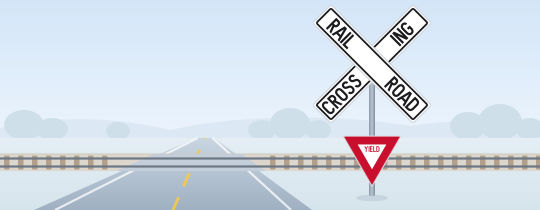
You want to park along a road near a railroad crossing marked with a white X-shaped crossbuck and a YIELD sign. How far from the nearest rail must your vehicle be in Washington?
Show answer
Correct answer: At least 50 feet
Why
Washington keeps parked vehicles 50 feet or more from the closest rail, and stopping on the tracks is never allowed. When you're driving and a train or flashing signals make you stop, the stopping point is 15 to 50 feet from that rail. A train may need up to a mile to stop, so give crossings room.
32Alcohol & phones
You're 30, stopped at a red light in Bellevue, when a text buzzes on the phone in your cup holder. Under Washington law, what should you do?
Show answer
Correct answer: Leave it until you've pulled safely off the roadway
Why
Washington's electronic device law still applies while you're briefly stopped in traffic or at a light. Adults may use hands-free features and a single touch to start or stop a function, but can't hold the device, text or watch video. Drivers with a permit or intermediate license can't use one at all, even hands-free, unless they're reporting an emergency.
33Road signs
Seconds after turning onto a freeway ramp, you spot a red rectangular sign that reads WRONG WAY. What should you do?
Show answer
Correct answer: Stop, then turn around as soon as you safely can
Why
WRONG WAY means you're driving against traffic, and Washington's guide tells you to stop and turn around immediately. You'll often see it near a red DO NOT ENTER sign, which marks a road you can't enter from your direction. Spotting either one is your signal to undo the turn.
34Right-of-way
You're approaching a roundabout in Olympia. Which plan matches the Washington Driver Guide?
Show answer
Correct answer: Choose your lane before entering, yield to traffic already circling and travel counterclockwise
Why
Washington roundabouts are built for about 15 to 25 mph, so slow down well before the entry. Pick your lane early, let vehicles already in the circle pass, then travel counterclockwise to your exit. Wait for a gap instead of forcing your way in.
35Permit & teen rules
At 17 with a Washington intermediate license, during which hours may you not drive unless a licensed driver aged 25 or older is with you?
Show answer
Correct answer: 1 a.m. to 5 a.m.
Why
Washington keeps intermediate drivers off the road from 1 to 5 a.m. unless a licensed driver 25 or older rides along. The night limit lifts after a year with no crash or traffic ticket. Every intermediate restriction ends automatically at 18.
36Speed limits
Some ocean beaches in Grays Harbor and Pacific counties are open to cars. What speed limit applies on the sand?
Show answer
Correct answer: 25 mph
Why
Those beaches are legally state highways, with a 25 mph limit, and people walking or riding bikes always have the right-of-way. Grays Harbor and Pacific are the only Washington counties that allow driving on ocean beaches. Give everyone on foot a wide berth.
37Safe driving
You plan to run studded tires this winter. Unless WSDOT extends the season, during which dates does Washington allow them?
Show answer
Correct answer: November 1 through March 31
Why
Studded tires are illegal in Washington from April 1 to November 1, which leaves November 1 through March 31 as the legal window. Only WSDOT can stretch it by setting extra dates. Plan your tire swaps around that window.
38Lane markings
You're first in line at a red light, and just ahead of your white stop line is a painted bicycle box. You want to turn right. What does the Washington Driver Guide say?
Show answer
Correct answer: Don't turn right on red; wait behind the white line
Why
A bicycle box gives cyclists a place in front of cars at a red light, where drivers can see them. Right turns on red aren't allowed at these intersections, so stay behind the white stop line. When the light turns green, riders in the box go first; let them clear it and check for bikes on your right before you turn.
39Road signs
On a winding road near Lake Chelan, a yellow sign with a curved arrow has a small yellow plate beneath it reading 35 MPH. What is that 35 telling you?
Show answer
Correct answer: A recommended lower speed for getting through the curve
Why
The guide calls these speed warning signs: the plate suggests a safer, lower speed for the curve or turn ahead. Brake before the bend instead of in the middle of it. On rain-slick or icy pavement, Washington's basic speed law expects you to go slower still.
40Permit & teen rules
Before a Washington teen can get an intermediate license, how much supervised driving must a parent or guardian confirm?
Show answer
Correct answer: 50 hours, 10 of them at night
Why
Washington asks for 50 hours of supervised practice: 40 in daylight and 10 after dark. A parent or guardian vouches for them when you apply, along with at least 6 months on the permit and a finished driver training course. Start logging from your first drive.
Washington DOL knowledge test at a glance
What to know before you book your knowledge test.
Washington · DOL knowledge test
80% to pass.
40 questions · Multiple choice
32 of 40 answers right to pass
In personat a DOL-approved driving school or a DOL office; no online test
Spanishone of 12 test languages; confirm with your school
$35learner permit, valid for one year
2 yearsthat a passing knowledge score stays good
Variestest fee, set by each testing location
20/40vision standard; worse means an eye exam
Under 18? Your road to a license
15Learner permitEnroll in approved driver training and apply up to 10 days before it starts, with a parent's OK online. No course? Wait until 15½ and pass the knowledge test.
6 moDriver ed and practiceHold the permit at least six months, finish 30 hours of class plus 6 behind the wheel, and log 50 supervised hours, 10 after dark.
16Intermediate licensePass the knowledge and drive tests (80 of 100 on the drive), stay ticket-free for 6 months and have a parent or guardian sign off. From November 1, 2026, also finish the free online work zone course.
Year 1Intermediate limitsNo passengers under 20 outside the family for 6 months, then three at most; no driving 1–5 a.m. without a licensed driver 25+; no phone, even hands-free, except to report an emergency.
18Limits liftedPassenger and night limits lift after a year with no crashes or tickets, and everything ends at 18, with no new card needed.
18 or older? For now, passing the knowledge and drive tests is enough, with no permit or driver ed required. From November 1, 2026, first-time drivers under 25 also take a free online work zone course, and driver ed is scheduled to become required at 18 from January 1, 2027.
What's on the Washington permit test
Study the Washington Driver Guide (DOL form 520-400, 2025 edition), free online in 17 languages, Spanish included. The test checks that you know Washington's signs and traffic laws, and these six areas deserve most of your time.
Road signs
Orange means a work zone; fluorescent yellow-green flags schools, people on foot and bikes.
A five-sided yellow-green sign means a school is near; eight sides always mean STOP.
A flashing red signal works like a STOP sign, a flashing yellow like a YIELD sign.
Right-of-way
Every intersection is a crosswalk, painted or not; stop for anyone in your half of the road or one lane from it.
Left on red is legal onto a one-way street flowing left, after a full stop, unless a sign says no.
Red lights flashing on a stopped school bus? On a two-lane road, both directions wait.
Speed limits
No sign? 25 mph on city streets, 50 on county roads, 60 on state highways.
School zones are 20 mph, and speeding fines there double.
75 mph is the legal ceiling on any Washington highway.
Parking
15 feet from a hydrant, 20 from a crosswalk, 30 from a stop sign or signal.
Leave 50 feet between your parked car and the closest rail at a train crossing; never stop on the tracks.
On a two-way street, park with your right wheels within 12 inches of the curb.
Alcohol & phones
Alcohol limits: 0.08 at 21 and over, 0.02 under 21, 0.04 in a commercial vehicle.
Under 21, any THC above zero is illegal; at 21 and up, 5.00 ng/mL or more is a DUI by itself.
No phone in your hand while driving, even at a red light; one touch to start or stop a function is fine.
Teen rules
Permit at 15 with driver training, 15½ without; your supervisor needs 5+ years of driving.
First 6 months of an intermediate license: no passengers under 20 except family.
No driving 1–5 a.m. without a licensed driver 25+; phones only to report an emergency.
Washington numbers to know
Six figures from Washington law and the driver guide to have down cold.
100 ftof steady signaling before a turn or lane change
15 ftbetween your parked car and a fire hydrant
2 lengthsminimum gap behind the vehicle ahead
500 ftto dim high beams for oncoming cars (300 ft when following)
200 fteach side of a stopped emergency vehicle: move over or slow down
0.02%alcohol limit for drivers under 21
Your Washington course, in your pocket
These 40 questions are just the warm-up. The app gives you 429 Washington practice questions, 36 short lessons and the why behind every answer.
36 short lessonsFour levels, from fundamentals to expert, then a full practice exam.
429 Washington questions294 of them with pictures.
Your most-missed questionsA review lesson built from the questions you miss most.
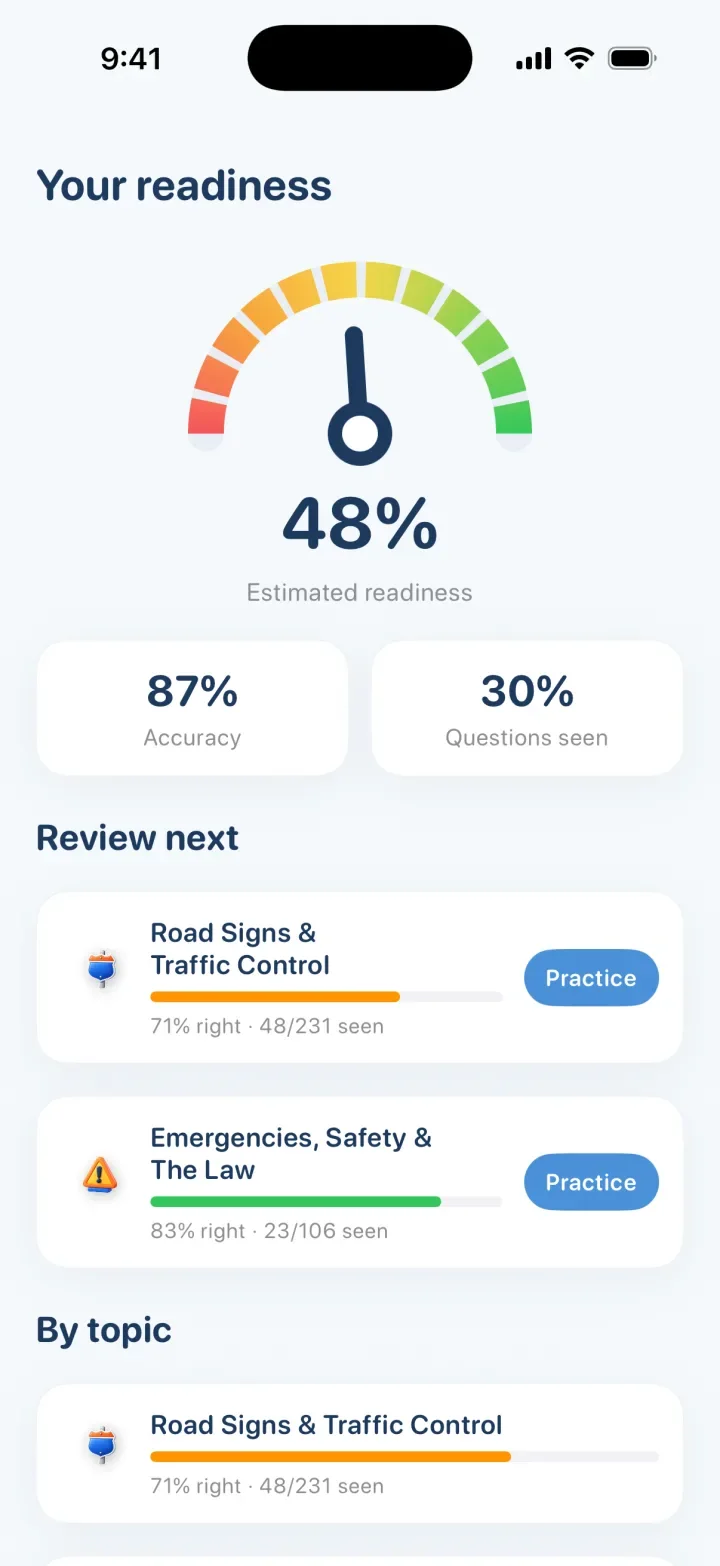
Exam simulatorTake full practice exams and watch your readiness grow.
Washington permit
Your Washington path is ready.
36 lessons, 429 questions and full practice exams. In English and Spanish.
How many questions are on the Washington permit test, and what score do I need?
Washington's DOL knowledge test asks 40 multiple-choice questions covering road signs and state traffic laws. You need 32 right, or 80%, to pass, and a passing score stays valid for 2 years. You'll also take a vision screening at a driver licensing office.
Can I take the Washington knowledge test online?
No, it's taken in person. You book it with a DOL-approved driver training school that gives the test, or make an appointment at a DOL driver licensing office through License Express. Steps like the permit application can be done online.
What happens if I fail the Washington permit test?
You can test again, but there may be a waiting period first. Each testing school sets its own retest policy and fee and has to explain them before you test, so ask when you book. Use the wait to drill the topics you missed.
Can I take the Washington permit test in Spanish?
Yes. DOL gives the knowledge test in 12 languages, Spanish among them, but check that your testing school offers it in Spanish before you book. DOL also posts the driver guide in Spanish (Guía del Conductor de Washington) and a free online practice test in Spanish, and this page and the app work in Spanish too.
How old do you have to be to get a permit in Washington?
15 if you're enrolled in approved driver training, 15½ if you're not, and without a course there's no license until 18. With driver ed (30 class hours plus 6 behind the wheel), six months on the permit and a 50-hour practice log that includes 10 night hours, the intermediate license opens up at 16. It comes with passenger limits, no driving 1–5 a.m. without a licensed driver 25 or older, and no phone use. From January 1, 2027, driver training is also scheduled to become required for new drivers aged 18.
How much does a Washington learner permit cost?
$35, and it's valid for one year. A first driver license costs $111 for six years or $131 for eight. The knowledge and drive test fees are separate and set by each testing location.
What do I need for the Washington drive test?
Bring a vehicle with valid registration, tabs and plates (a rental is fine) and proof of liability insurance for it. You need 80 or more out of 100 to pass, and a passing drive score is good for one year. From November 1, 2026, first-time drivers under 25 must also pass a free online work zone and first responder course before they're licensed.
What's the best way to study for the Washington permit test?
Read the Washington Driver Guide, then practice until 32 of 40 feels easy. Start with the 40 questions above, then let the app take you through 429 Washington questions and 36 short lessons, with every answer explained.