Prep for the MVC knowledge test, New Jersey’s take on the DMV written exam, with 40 free questions on road signs, school buses, crosswalks, speed limits and the GDL decal and curfew rules. Tap an answer and the reason pops up right away.
Four rounds of 10 questions on New Jersey road signs, right-of-way, speed limits, parking distances, DUI and phone laws, and GDL rules. Each answer comes with a short reason, so you learn as you go.
Round 1 · Questions 1–10
1Speed limits
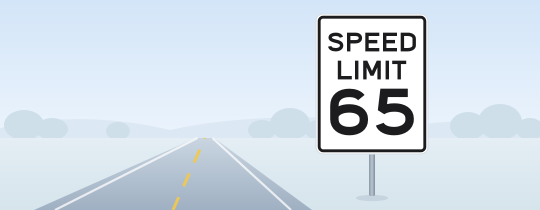
A white SPEED LIMIT 65 sign marks your stretch of New Jersey highway. If you’re clocked at 75 mph there, what’s different about the ticket?
Show answer
Correct answer: The fine is doubled, because you were 10 mph or more over in a 65 zone
Why
65 mph is New Jersey’s top limit, posted only on certain high-speed highways. In a 65 zone, going 10 mph or more over doubles the fine, and most other moving violations there cost double too. Plenty of highways stay at 55, so read every sign.
2Right-of-way
You pull up to a STOP sign where a white stop line is painted across your lane. Where does New Jersey law say to stop?
Show answer
Correct answer: Behind the line and within 5 feet of it
Why
New Jersey wants your full stop no more than five feet before the painted line, or before the nearest crosswalk if there’s no line. Stopping far back hides you from cross traffic; creeping past the line puts you in the path of pedestrians. Once stopped, let pedestrians cross and wait for any traffic close enough to be a danger.
3Alcohol & phones
A 19-year-old had one drink at a party and plans to drive home. In New Jersey, what blood alcohol concentration (BAC) makes driving illegal for someone that age?
Show answer
Correct answer: 0.01% or more
Why
New Jersey sets the line for drivers under 21 at 0.01%, so a single drink can put you over. Drivers 21 and older are held to 0.08%, and commercial drivers to 0.04%. If you’re under 21, the only safe amount before driving is zero.
4Permit & probationary license
You’re 17 with a New Jersey probationary license. Without a signed work or religious letter, during which hours are you barred from driving?
Show answer
Correct answer: 11:01 p.m. to 5:00 a.m.
Why
GDL drivers under 21, whether on a permit or a probationary license, must be off the road from 11:01 p.m. to 5:00 a.m. The only way around it is a letter on your employer’s or religious institution’s letterhead, signed and carried with you. Plan to be parked by 11.
5Road signs
Driving toward the Jersey Shore, you spot a brown rectangular sign by the road. What kind of information do brown signs carry?
Show answer
Correct answer: Parks, recreation areas and scenic places
Why
Color is a shortcut: brown signs lead to recreation and scenic areas, blue ones to motorist services, green ones give directions, and orange ones warn of road work. Spot the color first and you know what kind of message is coming before you can read it.
6Safe driving
It’s 2 p.m., a light drizzle is falling and your windshield wipers are on. What does New Jersey law say about your headlights?
Show answer
Correct answer: They must be on whenever you’re using your wipers
Why
New Jersey links headlights to wipers: if rain, snow or ice has your wipers going, your headlights must be on too. They also have to be on through the night, from 30 minutes after the sun goes down until 30 minutes before it comes up, and any time visibility drops to 500 feet or less. Parking lights never take the place of headlights.
7Parking
You’re hunting for a curbside spot in a New Jersey town near a set of train tracks. What’s the shortest legal distance between your parked car and the crossing?
Show answer
Correct answer: 50 feet
Why
New Jersey keeps parked cars at least 50 feet from a railroad crossing. Don’t confuse it with two other railroad numbers: when signals are active, stop 15 feet or more short of the crossing, and never pass another vehicle within 100 feet of one.
8Sharing the road
On a summer evening, an ice cream truck stops on your street with red lights flashing and a stop arm out. What does New Jersey law require?
Show answer
Correct answer: Stop, yield to anyone crossing, then pass at 15 mph or less
Why
New Jersey has a law just for frozen dessert trucks: yield to people walking to or from the truck, stop, and then pass at no more than 15 mph. Children with ice cream on their minds rarely look for cars. You don’t have to stop if you’re across a raised median or safety island on a dual highway.
9Speed limits
You turn onto a street in a New Jersey residential district, and there’s no speed limit sign in sight. How fast may you go?
Show answer
Correct answer: 25 mph
Why
Where no sign says otherwise, New Jersey sets 25 mph for residential and business districts; in suburban ones, it’s 35. Even 25 can be too fast on a narrow street lined with parked cars, and the law expects you to slow down when conditions call for it.
10Road signs
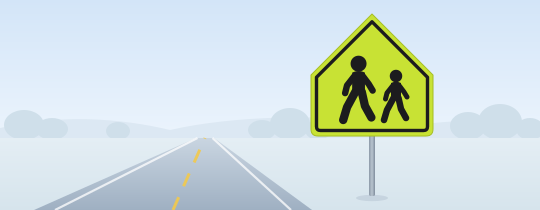
A five-sided sign showing two children walking stands at the edge of a New Jersey street. No other limit is posted, and students are arriving for class. What’s your top speed?
Show answer
Correct answer: 25 mph
Why
New Jersey’s sign chart lists the five-sided shape for school signs. Unless a different limit is posted, the state caps school zones at 25 mph during recess, while children are in view, and as they come and go. Keep an eye out for crossing guards and kids darting between parked cars.
Round 2 · Questions 11–20
11Road signs
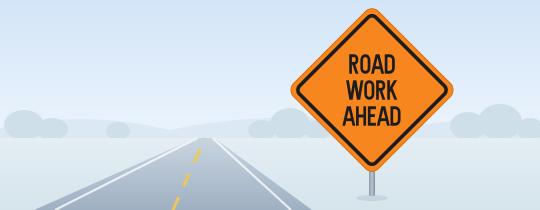
An orange diamond-shaped ROAD WORK AHEAD sign marks the start of a highway project in New Jersey. How are traffic tickets handled inside the work zone?
Show answer
Correct answer: Fines are doubled
Why
Orange diamonds announce construction and maintenance work, and New Jersey doubles traffic fines in these zones, whether for speeding, tailgating or an illegal pass. Ease off early and expect shifting lanes and flaggers. The same doubling applies on highways the state designates as Safe Corridors.
12Right-of-way
New Jersey still has many traffic circles. You’re entering one, and no sign tells you who goes first. What does the New Jersey Driver Manual say?
Show answer
Correct answer: No set rule: signs and the circle’s usual flow decide; if unsure, yield to the car on your right
Why
The manual says plainly that New Jersey has no set rules for traffic circles. Most of the time the circle’s long-standing traffic pattern decides, along with any STOP or YIELD signs posted where you enter. If you’re still unsure, use the basic rule for uncontrolled intersections: yield to the vehicle coming from your right.
13Alcohol & phones
Arrested for drunk driving in New Jersey, a driver refuses to take the breath test. What can follow?
Show answer
Correct answer: A $1,000 surcharge each year for three years and, on a first offense, no driving until an ignition interlock is installed
Why
New Jersey’s implied consent law means that by driving on its roads, you’ve already agreed to a breath test after an arrest for impaired driving. Refusing is an offense of its own, with a yearly $1,000 surcharge for three years and an ignition interlock requirement on a first offense. The simplest plan: if you’ve been drinking, let a sober driver take the wheel.
14Permit & probationary license
Where must the two red reflective GDL decals go on a car driven by a New Jersey permit holder under 21?
Show answer
Correct answer: One in the upper left corner of each license plate, front and back
Why
Every permit or probationary driver under 21 must display the decals on any car they drive: one in the upper left corner of each plate, front and rear. The pair comes with your permit for $4, and replacements are $4 a pair at any Licensing Center.
15Safe driving
Snow covers the road on your morning commute. What following distance does the New Jersey Driver Manual recommend?
Show answer
Correct answer: 6 seconds or more
Why
The manual’s three-seconds-plus rule is the baseline on dry pavement, stretched to four seconds or more in bad weather. On snow-covered roads, plan on six seconds or more, since stopping takes far longer. Count from the moment the car ahead passes a fixed point, like a sign or a tree.
16Parking
You find four open parking spaces on a New Jersey street. Which one would earn you a ticket?
Show answer
Correct answer: 35 feet from a stop sign
Why
New Jersey requires 50 feet between a parked car and a stop sign, so 35 feet is too close. The other spaces clear their limits: 10 feet from a hydrant, 25 feet from an intersection crosswalk and 20 feet from a fire station driveway. Across the street from a fire station entrance, the gap grows to 75 feet.
17Speed limits
What’s the speed limit on a rural New Jersey road where no limit is posted?
Show answer
Correct answer: 50 mph
Why
Unposted rural roads in New Jersey top out at 50 mph. You’ll see 55 on certain state highways and interstates, and 65 only on some high-speed highways where signs allow it. Curves, farm vehicles and darkness can all make 50 too fast.
18Lane markings
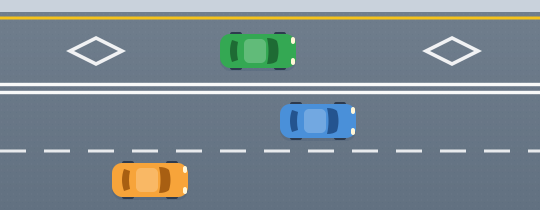
White diamond shapes are painted down the middle of the far-left lane of a New Jersey highway. What kind of lane is it?
Show answer
Correct answer: A high-occupancy vehicle (HOV) lane
Why
White diamonds mark a high-occupancy vehicle lane, kept for buses, carpools or other vehicles named on nearby signs. Read those signs for who may use it and when. If you don’t qualify, stay in the regular lanes.
19Road signs
On a two-lane highway, a yellow sign shaped like a pennant, a long triangle lying on its side, appears on the left shoulder. What is it telling you?
Show answer
Correct answer: A no-passing zone begins here
Why
New Jersey’s sign chart saves the yellow pennant for no-passing warnings. Any pass you’ve already started has to be finished before the center lines turn solid. Wherever the line on your side is solid, don’t start one.
20Sharing the road
You’re about to pass a cyclist on a narrow New Jersey road and can’t switch lanes. What does the Safe Passing Law require?
Show answer
Correct answer: Give at least 4 feet; if that’s impossible, slow to 25 mph and pass only when it’s safe
Why
New Jersey’s Safe Passing Law protects pedestrians, cyclists and other vulnerable road users. Move into another lane to pass when you can; when you can’t, leave at least 4 feet, and if even that won’t fit, slow to 25 mph and wait for a safe moment.
Round 3 · Questions 21–30
21Right-of-way
You’re behind a school bus on a two-lane road when it stops, flashes its red lights and swings out its stop arm. How close are you allowed to get?
Show answer
Correct answer: No closer than 25 feet
Why
When a stopped school bus turns on its red lights, New Jersey drivers must stop 25 feet or more away, whether they’re behind it or coming toward it, on two-lane roads, roads divided only by painted lines, and private roads. Wait until the red lights are off, then move on slowly while watching for children.
22Right-of-way
A woman steps into a marked crosswalk ahead of you on a New Jersey street. What does state law require you to do?
Show answer
Correct answer: Stop and stay stopped until she’s out of your lane and the lane next to it
Why
In New Jersey, yielding isn’t enough: your car has to stop completely and stay put until the pedestrian is clear of your lane and the adjacent one. Never pass a car that has stopped at a crosswalk. Failing to stop can cost up to $500, two points and a license suspension as long as six months.
23Alcohol & phones
An adult driver in New Jersey is stopped for texting with the phone in hand. What can a first offense cost?
Show answer
Correct answer: $200 to $400
Why
Holding a phone or texting behind the wheel is a primary offense in New Jersey, so police can pull you over for that alone. A second offense runs $400 to $600, and a third costs $600 to $800 plus 3 points and a possible 90-day suspension. Hands-free calls are legal for adults but discouraged.
24Permit & probationary license
Your 20-year-old cousin has driven with a New Jersey license for three years. Can they be the supervising driver for your examination permit?
Show answer
Correct answer: No, the supervisor has to be 21 or older
Why
In New Jersey, the supervising driver rides in the front seat and must be 21 or older, hold a current New Jersey license and have at least three years of driving experience. Your cousin clears two of those three rules but misses the age requirement. Once they turn 21, they can ride with you.
25Safe driving
After an overnight snowfall, you clear the windshield but leave a thick layer of snow on your roof. Can you be fined in New Jersey even if none of it blows off?
Show answer
Correct answer: Yes, $25 to $75 just for not clearing it
Why
Before you drive, New Jersey law has you clear all snow and ice off the car, including the roof. The fine of $25 to $75 applies whether or not anything comes loose. Clear the hood, trunk and windshield as well, so nothing slides down and blocks your view.
26Parking
You parallel park on a New Jersey street. What’s the farthest your wheels may be from the curb?
Show answer
Correct answer: 6 inches
Why
New Jersey law says your wheels can’t sit over six inches away from the curb. A car sticking out narrows the lane for traffic and cyclists. When you get out, check your mirror for bikes before opening the door.
27Road signs
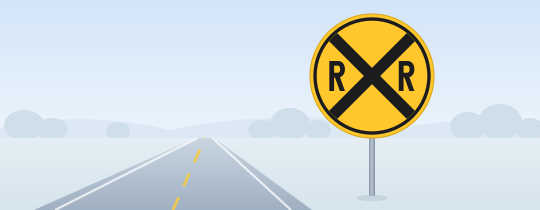
You pass a round yellow sign with a black X and two R’s. Moments later, red lights at the crossing ahead begin flashing and bells ring. Where do you stop?
Show answer
Correct answer: At least 15 feet from the crossing
Why
The round sign is only the early warning; the tracks come later. New Jersey wants your car 15 feet or more short of the crossing whenever lights flash, bells ring, gates come down or a flagger signals. Stay stopped until the gates rise, the bells go quiet and the lights go dark.
28Safe driving
A driver who knows they’ve barely slept for two days gets behind the wheel anyway and causes a fatal crash. How does New Jersey’s Maggie’s Law treat that?
Show answer
Correct answer: As recklessness for a vehicular homicide charge
Why
Maggie’s Law treats knowingly driving when you’re impaired from too little sleep as recklessness under New Jersey’s vehicular homicide statute. Fatigue slows your reactions, and you can drift off without warning. If your eyelids feel heavy, pull over somewhere safe and rest.
29Speed limits
A New Jersey driver is ticketed for going 20 mph over the limit. How many points go on their driving record?
Show answer
Correct answer: 4 points
Why
New Jersey assigns 2 points for 1 to 14 mph over, 4 points for 15 to 29 over, and 5 points for 30 or more. Reach 12 points and the MVC sends a Notice of Scheduled Suspension. Just a few speeding tickets can get you there.
30Crashes & emergencies
At highway speed, your right wheels drift off the pavement onto the shoulder. What’s the safest way back?
Show answer
Correct answer: Ease off the gas, slow to 25 mph or less, then steer back with about a quarter turn
Why
Yanking the wheel at speed can fling the car across the road into oncoming traffic. Stay on the shoulder, ease off the gas until you’re at 25 mph or less, then turn the wheel about a quarter turn toward the road so the tires climb the edge smoothly.
Round 4 · Questions 31–40
31Sharing the road
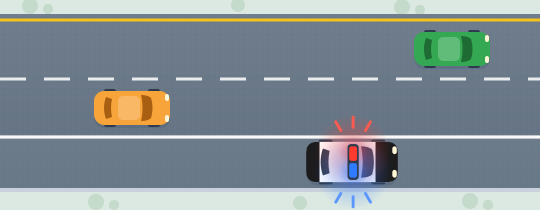
On a highway with two lanes in your direction, a police car sits on the right shoulder with its lights flashing. What does New Jersey’s Move Over law tell you to do?
Show answer
Correct answer: Shift to the left lane when it’s safe; if you can’t, slow below the limit and be ready to stop
Why
The law covers stopped emergency vehicles, tow trucks and highway maintenance vehicles with flashing lights, plus any disabled car using hazard lights, flares or triangles. Move to a lane that isn’t next to it when traffic allows; otherwise, drop below the posted limit and be ready to stop. Violations cost $100 to $500.
32Right-of-way
An ambulance with its siren wailing comes up behind you. You pull to the far right, stop, and it goes by. When you pull back into traffic, how far back should you stay?
Show answer
Correct answer: At least 300 feet
Why
New Jersey asks you to steer to the far right, stop, and let an emergency vehicle using its siren or lights go by. Afterward, stay 300 feet or more behind it so its sudden stops and turns don’t catch you. And when fire crews are working, park no closer than 200 feet to their truck.
33Alcohol & phones
You’re 17 and driving on a New Jersey probationary license. Which phone use is allowed while you drive?
Show answer
Correct answer: None of these: GDL drivers can’t use a phone, even hands-free
Why
Permit and probationary drivers in New Jersey may not use any phone or electronic device while driving, hand-held or hands-free. Breaking a GDL restriction can mean a $100 fine or a suspension. Set your music and directions before you shift into drive.
34Permit & probationary license
Before the road test, how much supervised practice must a New Jersey permit holder under 21 complete?
Show answer
Correct answer: At least 6 months, with 50 hours logged, 10 of them in darkness
Why
Drivers under 21 practice for six months or more and log at least 50 hours, including 10 after dark. Your parent, guardian or supervisor signs MVC form BA-CSD to certify the hours. Applicants 21 and older need only three months of supervised driving.
35Safe driving
You’re planning a right turn at the next corner. Under New Jersey law, how far before the turn should you be in the proper lane with your signal on?
Show answer
Correct answer: At least 100 feet
Why
New Jersey wants you in the correct lane, blinker on, for the last 100 feet or more before any turn, so drivers behind you have time to react. You’re also expected to know the hand signals: arm straight out for left, bent up for right, bent down to slow or stop.
36Road signs
At a quiet rural railroad crossing, the only warning is a white X-shaped sign reading RAILROAD CROSSING. There are no lights and no gate. How should you treat it?
Show answer
Correct answer: As a yield sign: slow down, look both ways and let any train go first
Why
New Jersey’s manual gives the crossbuck the same meaning as a YIELD sign. A train can’t swerve and needs a long distance to stop, so it always has the right-of-way. Look and listen in both directions, and cross only when you’re sure the tracks are clear.
37Alcohol & phones
Your friend leaves an opened bottle of wine on the back seat of your car, and you’re pulled over in New Jersey. What can a first offense cost you?
Show answer
Correct answer: A $200 fine
Why
New Jersey fines drivers who carry an open or unsealed alcohol container, or an unsealed cannabis item, in the passenger area: $200 the first time, then a $250 fine or community service of 10 days for each repeat. Put anything that’s been opened in the trunk before you drive.
38Right-of-way
You’re driving on a dual highway with a raised median. Across the median, a school bus has pulled over with its red lights blinking. What does New Jersey require of you?
Show answer
Correct answer: Keep going, but slow to 10 mph or less
Why
With a raised median or safety island between you and the bus, New Jersey doesn’t make you stop, but you must slow to 10 mph. Keep scanning for children near the road as you pass. If the lanes are separated only by painted lines, every driver stops 25 feet back.
39Safe driving
You’re giving your 6-year-old nephew a ride. He’s 50 inches tall. How must he ride under New Jersey’s child passenger law?
Show answer
Correct answer: In a rear seat, in a booster seat or a harnessed child seat
Why
New Jersey requires children under 8 who are shorter than 57 inches to ride in a rear seat, in either a child seat with a harness or a booster seat. Breaking the rule can mean a $50 to $75 fine, plus court costs. Babies under 2 who weigh under 30 pounds ride rear-facing.
40Permit & probationary license
You’re 17 and hold a New Jersey probationary license, and no parent or guardian is in the car. Who may ride with you?
Show answer
Correct answer: Your dependents plus one other passenger
Why
Without a parent or guardian along, New Jersey limits probationary drivers to their dependents and one more passenger. Your own child counts as a dependent, but a brother or sister doesn’t. Everyone in the car, front and back, must wear a seat belt.
New Jersey MVC knowledge test at a glance
What to know before your MVC appointment.
New Jersey · MVC knowledge test
80% to pass.
50 questions · Multiple choice
40 of 50 answers right to pass
Spanishwritten or oral, plus 11 more languages
$10examination permit, valid for 2 years
7 dayswait before a retest if you fail
In personby appointment or at school; no at-home test
20/50vision standard; glasses or contacts OK
$4for the pair of red GDL decals
Under 18? Your road to a license
16–17Learner permitAt 16, sign up for state-approved driver training at your high school or a driving school: the instructor buys your permit, you pass the MVC knowledge test and an eye check, and you finish 6 hours behind the wheel. At 17, skip the course and get a $10 examination permit.
6 moSupervised practiceDrive with a supervisor who is 21 or older, holds a current New Jersey license and has 3+ years of experience. Log 50 hours, 10 of them after dark.
17Probationary licensePass the MVC road test and drive on your own, with red decals on both plates and only your dependents plus one passenger unless a parent or guardian rides along.
Year 1Probationary limitsNo driving 11:01 p.m.–5 a.m. without a work or religious letter, and no phone at all, not even hands-free.
18Basic licenseAfter 12 probationary months, and once you’re 18, upgrade online or at a Licensing Center. Until you do, the GDL limits still apply.
21 or older? Get an examination permit, practice with a supervisor for at least three months and pass the road test. The curfew, passenger and decal limits don’t apply to you, but the GDL phone ban does. New drivers aged 18 to 20 follow the same rules as teens.
What’s on the New Jersey permit test
Your study guide is the New Jersey Driver Manual (2026 edition), free on the MVC website in English, Spanish and seven more languages. Start with these six areas.
Road signs
Only STOP signs are red octagons; a red-and-white triangle pointing down means YIELD.
A yellow pennant warns of a no-passing zone, a pentagon means school, an orange diamond means road work.
Blue leads to services, brown to parks and scenic spots, green gives directions.
Right-of-way
Multi-way stop, same arrival? The driver on the right goes first.
Pedestrian in a crosswalk: stop fully and stay stopped until they clear your lane and the next one.
School bus flashing red: stop 25+ feet back from either direction; across a raised median, slow to 10 mph.
Speed limits
25 mph in school zones and in business or residential districts, unless posted.
35 in suburban districts, 50 on unposted rural roads, 55 on many highways.
65 mph is the state’s top limit, and 10+ over in a 65 zone doubles the fine.
Parking
Keep 10 feet from a hydrant and 25 feet from any intersection crosswalk.
50 feet from a stop sign, and 50 feet from a railroad crossing.
Wheels within 6 inches of the curb; facing downhill, turn them toward it.
Alcohol & phones
BAC limits: 0.08% at 21 and up, 0.04% in a commercial vehicle, just 0.01% under 21.
Refusing the breath test means a $1,000 surcharge every year for three years.
No hand-held phone or texting for anyone; a first ticket costs $200–$400.
Teen rules
Under 21 on a permit or probationary license: off the road 11:01 p.m.–5 a.m.
Two red reflective decals, one on each license plate, whenever you drive.
Dependents plus one passenger unless a parent rides along, and no phones, even hands-free.
New Jersey numbers to know
Six figures from New Jersey law that are easy to mix up on test day.
100 ftin the proper lane, signal on, before any turn
25 ftminimum gap from a stopped school bus with red lights
15 ftclosest stop to a crossing when train signals are on
300 ftbehind an emergency vehicle once it has passed
4 ftgap when passing a cyclist if you can’t change lanes
0.01%BAC limit for drivers under 21
Your New Jersey course, in your pocket
These 40 questions are just the warm-up. The app gives you 586 New Jersey practice questions, 36 short lessons and the why behind every answer.
36 short lessonsFour levels, from fundamentals to expert, then a full practice exam.
586 New Jersey questions342 of them with pictures.
Your most-missed questionsA review lesson built from the questions you miss most.
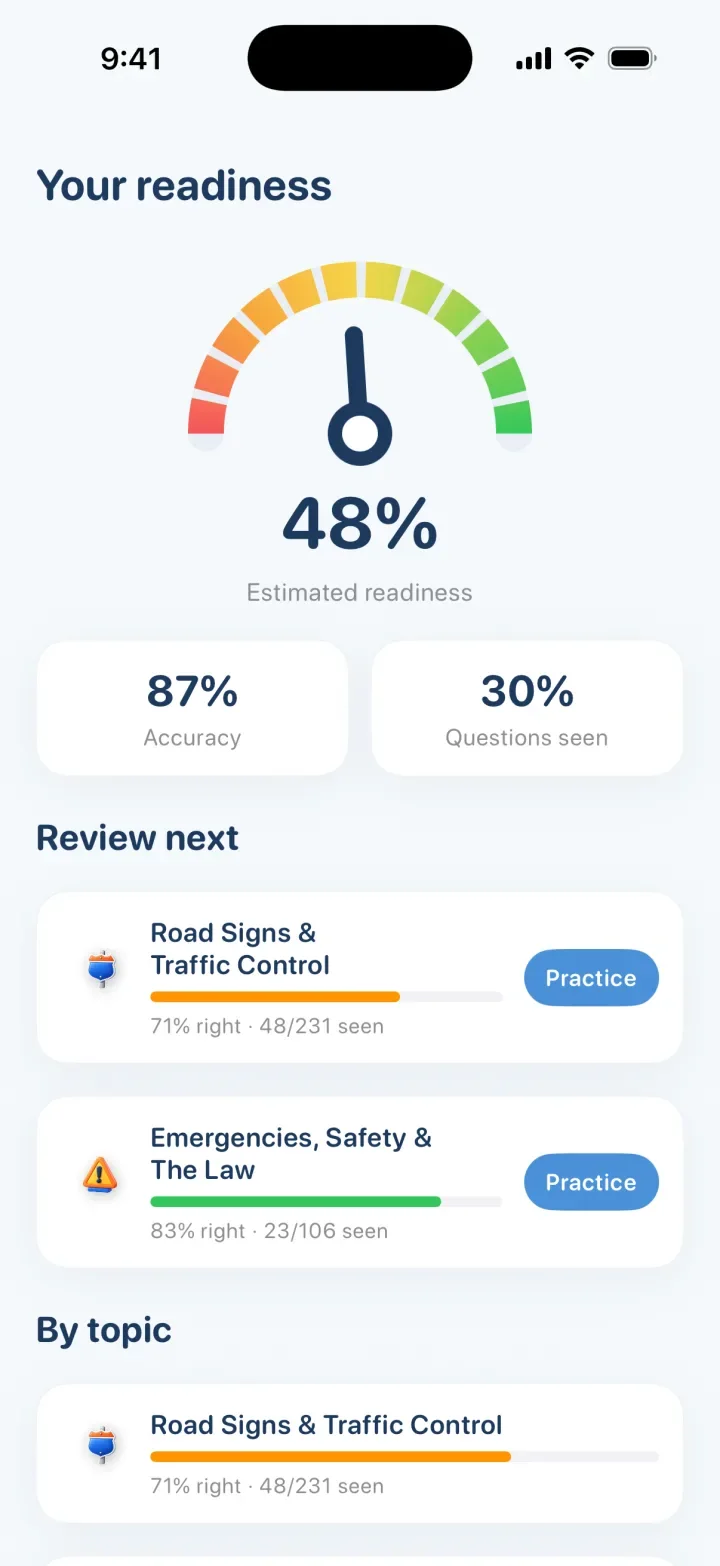
Exam simulatorTake full practice exams and watch your readiness grow.
New Jersey permit
Your New Jersey path is ready.
36 lessons, 586 questions and full practice exams. In English and Spanish.
How many questions are on the NJ permit test, and what’s a passing score?
The knowledge test from the New Jersey Motor Vehicle Commission (MVC), the state’s version of the DMV, has 50 multiple-choice questions, plus one survey question about organ donation that isn’t scored. You pass with 40 correct answers, or 80%. You’ll also need 20/50 vision on the screening, with glasses or contacts if you wear them.
What happens if I fail the New Jersey knowledge test?
You can take it again after seven days. Your $10 permit gives you two years to pass the knowledge test, practice and pass the road test; once that window closes, you need a new permit.
Can I take the NJ permit test online?
No, there’s no at-home version. You always test in person with a proctor: at an MVC Licensing Center by appointment, or through a high school or licensed driving school that gives the test. For your permit, bring documents worth 6 Points of ID, plus proof of your New Jersey address and your Social Security number.
Can I take the New Jersey permit test in Spanish?
Yes. The MVC gives the knowledge test in Spanish, either written or as an oral version you hear through headphones, and Spanish is one of 12 languages available besides English. The New Jersey Driver Manual has a Spanish edition too, and this practice test and the app both work in Spanish.
How old do you have to be to get a permit in New Jersey?
16, if you’re enrolled in state-approved driver training at school or a driving school: your instructor buys a special learner permit, you pass the MVC knowledge test and an eye check, and you finish 6 hours behind the wheel. Without a course, the examination permit starts at 17. Under 21, you then practice at least six months and log 50 hours (10 at night). The probationary license comes at 17 at the earliest and keeps the 11:01 p.m.–5 a.m. curfew, the dependents-plus-one passenger limit, the phone ban and the red decals.
How much does a New Jersey permit cost?
An examination permit costs $10 and stays valid for two years. Drivers under 21 also pay $4 for the pair of red GDL decals. When you pass the road test, the probationary license is $6.
What’s on the New Jersey road test?
An MVC examiner rides with you for about 10 to 15 minutes. Expect to back up in a straight line, parallel park, make a three-point (K) turn, and handle stop signs and yielding. You need an appointment, and if you don’t pass, you wait at least 14 days for another try.
What’s the best way to study for the NJ permit test?
Read the New Jersey Driver Manual, then practice until 80% comes easily. Start with the 40 questions above, then let the app take you through 586 New Jersey questions and 36 short lessons, with the reason behind every answer.