Forty free questions built around the Minnesota DVS written test: road signs, speed limits, school bus stops, hands-free and DWI laws, and teen driving rules. Choose an answer and see the reason in a second.
Four rounds of 10 questions that move between Minnesota road signs, right-of-way, speed limits, parking, DWI and phone laws, winter driving and teen rules. Pick an answer and the reason appears right away.
Round 1 · Questions 1–10
1Road signs
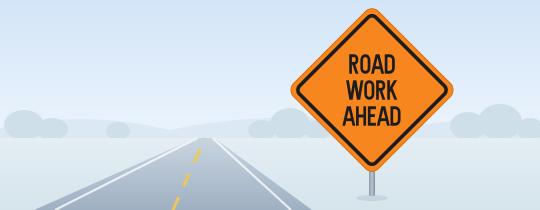
An orange diamond-shaped ROAD WORK AHEAD sign comes up on a Minnesota highway. What does it tell you, and what does speeding in the work zone cost?
Show answer
Correct answer: Road work lies ahead; a $300 fine on top of the ticket
Why
Orange is the color of construction and maintenance zones, where lanes shift and workers stand just feet from traffic. Minnesota hits work zone speeders with a $300 fine on top of the regular ticket. Ease off before the first cone, follow any flagger and stick to any lower limit posted for the zone.
2Right-of-way
You and another driver arrive together where two streets cross with no sign or light. The other car, coming from your right, is going well over the speed limit. What does Minnesota law say about its right-of-way?
Show answer
Correct answer: It loses the right-of-way it would otherwise have
Why
Normally, when two vehicles reach an uncontrolled intersection together, the driver on the left yields to the driver on the right. Minnesota adds that a driver going faster than the legal speed forfeits any right-of-way. Even so, never assume a speeder will yield: slow down and be ready to stop.
3Speed limits
You’re driving through a small Minnesota town on a street lined with houses and stores, and you haven’t seen a speed limit sign. What’s the limit?
Show answer
Correct answer: 30 mph
Why
Minnesota’s default is 30 mph on urban and town roads, 10 mph in alleys and 55 mph on other roads, unless a sign says otherwise. Some cities set 25 mph on residential streets, but that lower limit applies only where it’s posted. Without a sign, 30 is the number.
4Parking
How much space must you leave between your parked car and a fire hydrant in Minnesota?
Show answer
Correct answer: 10 feet
Why
Minnesota’s parking law keeps cars at least 10 feet from a fire hydrant so fire crews can reach it quickly. The same law asks for 20 feet from an intersection crosswalk and 30 feet before a stop sign, flashing beacon or traffic signal. When a spot is borderline, find another one.
5Alcohol & phones
You’re 19 and had one glass of wine at a family wedding. Under Minnesota law, can you drive home?
Show answer
Correct answer: No: under 21, driving after drinking any amount of alcohol is illegal
Why
Minnesota’s Not a Drop law makes it illegal for anyone under 21 to drive after drinking any amount of alcohol. The penalty is a 30-day license suspension, or 180 days for a repeat, and at 0.08 or above the full DWI law takes over instead. Hand the keys to a sober driver or call a ride.
6Permit & teen rules
What must a 15-year-old in Minnesota complete before applying for an instruction permit?
Show answer
Correct answer: 30 hours of classroom driver ed, plus enrollment in behind-the-wheel training
Why
Minnesota teens can get an instruction permit at 15 once they’ve finished 30 hours of classroom driver ed and enrolled in behind-the-wheel lessons. In a concurrent course, the first 15 classroom hours are enough to start. Bring the Blue Card, or the Pink Card for a concurrent course, to the written test.
7Safe driving
What following distance does the Minnesota Driver’s Manual recommend, and when should you add more?
Show answer
Correct answer: Three seconds, stretched to four or five in poor conditions
Why
Use a fixed marker such as a sign: when the vehicle ahead passes it, count off the seconds until you reach it. Fewer than three means you’re too close. In rain, snow or a longer vehicle, stretch the gap to four or five seconds.
8Right-of-way
You’re following a school bus on a two-lane road when it stops, flashes its red lights and swings out its stop arm. How close may you stop to the bus in Minnesota?
Show answer
Correct answer: No closer than 20 feet
Why
In Minnesota, a school bus showing flashing red lights means you halt 20 feet or more away from it and wait there until the lights go dark. Since a 2026 change in the law, the flashing reds alone mean stop, even if the stop arm never comes out. Fines start at $500, and flashing amber lights are your warning that the bus is about to stop.
9Sharing the road
You’re behind a bicyclist on a two-lane road marked as a no-passing zone. Oncoming traffic is clear. What does Minnesota law allow?
Show answer
Correct answer: Crossing the center line to pass, leaving at least 3 feet of space
Why
Minnesota lets you cross the center line, even in a no-passing zone, to pass a bicyclist when it’s safe. Leave at least 3 feet, or half your vehicle’s width if that’s more. Wait for a clear stretch with good visibility rather than squeezing by.
10Road signs
On a two-lane highway, a yellow sign shaped like a sideways pennant reads NO PASSING ZONE. Where is it placed, and what does it mark?
Show answer
Correct answer: On the left side of the road; the start of a no-passing zone
Why
The pennant stands on the left edge of the road, right where your eyes go when you’re thinking about passing. It marks where a no-passing zone begins. The pavement often repeats the warning when the line on your half of the road turns solid yellow, so finish any pass before you get there.
Round 2 · Questions 11–20
11Road signs
On a two-lane county road you catch up to a tractor. On its back is an orange triangle with a red border. What does that emblem mean in Minnesota?
Show answer
Correct answer: The vehicle travels at 30 mph or less
Why
That’s the slow-moving vehicle emblem. Minnesota requires it on farm equipment, animal-drawn vehicles and anything else that travels 30 mph or less on public roads, so you’ll close in faster than you expect. Ease off early and pass only where it’s legal and you can see well ahead.
12Right-of-way
Your side road ends at a T intersection with no signs, and you need to turn onto the through road. A pickup is coming along that road from your left. Who has the right-of-way?
Show answer
Correct answer: The pickup; at a T, the driver who has to turn yields
Why
At an uncontrolled T intersection, Minnesota law has the driver who must turn yield to traffic on the through road, from either side. The left-yields-to-right rule doesn’t help you here, because your road is the one that ends. Wait for a gap you can use without making anyone brake.
13Speed limits
What speed limit does Minnesota law set on an interstate running through open country, far from any city?
Show answer
Correct answer: 70 mph
Why
Interstates outside urbanized areas of more than 50,000 people get 70 mph; inside those areas, the statutory limit is 65 mph. Other expressways and freeways are also 65 mph. Signs can set a lower limit, and snow or ice can make even that too fast.
14Parking
Which of these curbside spots would break Minnesota’s parking law?
Show answer
Correct answer: 40 feet from a train crossing’s closest rail
Why
Railroad crossings need the widest berth: no parking within 50 feet of the nearest rail, so 40 feet is too close. The other spots clear their minimums of 10 feet for a hydrant, 20 for an intersection crosswalk and 30 before a stop sign. Fire station driveways need 20 feet of clearance as well.
15Alcohol & phones
Stopped on suspicion of DWI, a Minnesota driver refuses to take a breath test. What follows?
Show answer
Correct answer: The refusal is itself a crime, and a first refusal revokes the license for at least one year
Why
In Minnesota, refusing a breath test, or a blood or urine test under a search warrant, is a crime of its own. A first refusal brings at least a year of license revocation, compared with at least 90 days for a first failed test at 0.08 or more. Saying no doesn’t make the problem go away; it adds a second one.
16Permit & teen rules
Before a provisional license, how much supervised driving must a Minnesota teen log if no parent has taken the approved parent class?
Show answer
Correct answer: 50 hours, 15 at night
Why
The standard is 50 hours behind the wheel, at least 15 of them after dark. If a parent finishes the supplemental parent class offered by a Minnesota-approved driver ed program, it drops to 40 hours, still with 15 at night. Bring the completed log to the road test.
17Safe driving
It’s early afternoon and a light snow has started. Does Minnesota law require your headlights?
Show answer
Correct answer: Yes, any time it’s raining, snowing, sleeting or hailing
Why
Minnesota requires headlights from sunset to sunrise, whenever rain, snow, sleet or hail is falling, and any time you can’t clearly see people and vehicles 500 feet ahead. Parking lights never count as a substitute. Lights on also help other drivers spot you in gray weather.
18Lane markings
A busy street has a center lane edged on both sides by paired yellow lines, solid on the outside and broken on the inside. What is that lane for?
Show answer
Correct answer: Left turns, by drivers coming from either direction
Why
That marking means a two-way left-turn lane, shared by drivers heading both ways who are about to turn left. Signal, move in shortly before your turn and wait there for a gap. The lane is only for turning left, so don’t pass in it.
19Road signs
The left-turn signal ahead of you shows a flashing yellow arrow. What may you do?
Show answer
Correct answer: Turn left once you have yielded to oncoming traffic
Why
A flashing yellow arrow means you may turn with caution, but oncoming traffic may still be coming, and you must yield to it. A flashing red light is the one that works like a stop sign. While you wait for a gap, keep your wheels pointed straight so a rear-end bump can’t push you into oncoming lanes.
20Crashes & emergencies
A blizzard leaves your car stuck on a rural Minnesota road. What does the Driver’s Manual recommend?
Show answer
Correct answer: Stay with the car, keep the tailpipe clear and run the engine about 10 minutes an hour
Why
Staying with your vehicle keeps you sheltered from wind and cold. Running the engine about 10 minutes each hour gives you heat, while a clear tailpipe and a slightly open window keep carbon monoxide from building up inside. Check the tailpipe again whenever snow keeps falling.
Round 3 · Questions 21–30
21Sharing the road
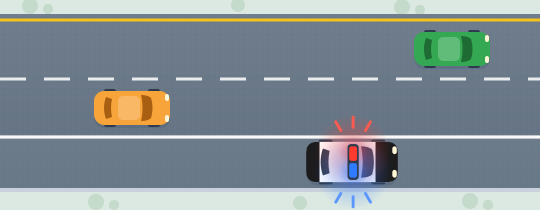
On a highway with two lanes in your direction, a police car is stopped on the right shoulder with lights flashing. What does Minnesota’s move-over law tell you to do?
Show answer
Correct answer: Shift to the lane farthest from it, or slow down if you can’t change lanes safely
Why
With two lanes going your way, Minnesota wants you in the lane farthest from a stopped emergency vehicle with its lights on; on wider roads, leave a full empty lane between you and it. If you can’t move over, slow down. The rule also covers tow trucks, road crews, utility and postal vehicles, and garbage and recycling trucks.
22Right-of-way
You’re on a four-lane highway split by a raised concrete median. Across that median, a school bus has halted with red lights blinking. What do you do?
Show answer
Correct answer: Continue with care; traffic across a median doesn’t have to stop
Why
When a physical barrier or a raised or depressed median separates the two roadways, Minnesota doesn’t require traffic on the other roadway to stop for the bus. On an undivided road, even one with four lanes, drivers going both ways must stop. A painted line isn’t a physical divider, so it doesn’t count.
23Speed limits
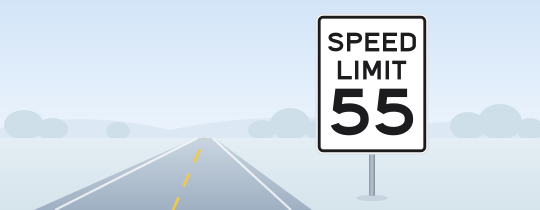
On a two-lane highway with a SPEED LIMIT 55 sign, you pull out to legally pass a slow car going your way. How fast does Minnesota let you go while you pass?
Show answer
Correct answer: Up to 65 mph
Why
On two-lane highways posted 55 mph or more, Minnesota raises the limit by 10 mph while you’re lawfully passing a vehicle traveling the same direction. Back in your lane, the posted limit applies again. If a pass would need more than that extra 10, it isn’t worth starting.
24Parking
Parallel parking on a two-way street, you finish with your right wheels near the curb. How much gap does Minnesota law allow at most?
Show answer
Correct answer: 12 inches
Why
Minnesota sets 12 inches as the maximum gap between your right-side wheels and the curb. Then set the parking brake before you leave the car. Parking farther out squeezes the lane for passing cars and cyclists.
25Alcohol & phones
You’re taking home a partly finished bottle of wine from a restaurant. Where can it legally ride in your car in Minnesota?
Show answer
Correct answer: In the trunk
Why
Minnesota bans opened alcohol containers anywhere in the passenger area, and the law counts the glove compartment as part of it. The trunk is the legal place. Opened cannabis packages fall under the same trunk-only rule.
26Permit & teen rules
During the first six months with a Minnesota provisional license, which hours are off-limits for driving unless an exception applies?
Show answer
Correct answer: Midnight to 5 a.m.
Why
For the first six months, provisional drivers stay off the road from midnight to 5 a.m. The exceptions: a licensed driver 25 or older rides along, or you’re driving between home and work, between home and a school event without school transport, or for your job. After six months, the nighttime rule ends.
27Safe driving
Driving with your high beams on a dark rural road, you see headlights coming toward you. Within what distance must you switch to low beams?
Show answer
Correct answer: 1,000 feet
Why
Minnesota wants your low beams on once an oncoming vehicle is 1,000 feet away or closer, and once you’re 200 feet or less behind another car. For most vehicles, high beams reach only about 350 feet, so keep your night speed low enough to stop within what you can see.
28Road signs
A sign beside a city street has five sides and is colored fluorescent yellow-green. What is it telling you?
Show answer
Correct answer: You’re nearing a school zone or school crossing
Why
The five-sided shape is used for school zone and school crossing signs, in yellow or fluorescent yellow-green. Minnesota school speed limits are set locally and apply while children are present, so watch for the posted number. Expect kids to appear from between parked cars.
29Alcohol & phones
Can you drive in Minnesota with an earbud in each ear, listening to a podcast?
Show answer
Correct answer: No, earphones in both ears at once aren’t allowed
Why
Minnesota law bars drivers from wearing headphones or earphones in both ears at the same time to listen to audio. You need to hear sirens, horns and train warnings. Play it through the car’s speakers instead.
30Crashes & emergencies
Carbon monoxide is one of the subjects Minnesota law requires on the written test. What makes this gas so dangerous?
Show answer
Correct answer: You can’t see or smell it, and its first signs feel like ordinary tiredness
Why
Carbon monoxide has no color and no smell, and its early symptoms, sudden tiredness, headache, dizziness and nausea, are easy to brush off. Get fresh air at once if you notice them, and have a leaking exhaust fixed. Never warm up your car inside a closed garage.
Round 4 · Questions 31–40
31Safe driving
At dusk on a wooded Minnesota highway, you pass a yellow diamond sign showing a leaping deer. Moments later, eyes shine back at you in your headlights. What should you do?
Show answer
Correct answer: Slow down, sound your horn and be ready to stop, expecting more than one deer
Why
Deer are most active from dusk to dawn, and where there’s one, others are often close behind. The Minnesota Driver’s Manual says to slow down, use your horn and be prepared to stop. Keep scanning both shoulders until you’re well past the spot.
32Right-of-way
On a four-lane city street with no traffic signal, the car in the lane beside you stops at a marked crosswalk, and it blocks your view of whoever it stopped for. What does Minnesota law require of you?
Show answer
Correct answer: Stop as well; you may not pass a vehicle stopped for a pedestrian
Why
A stopped car can hide someone in the crosswalk from your view, which is why Minnesota bans passing a vehicle that has stopped for a pedestrian. Where no signal is working, you must stop for anyone in a marked crosswalk, or at an intersection without one, and stay stopped until they’ve passed your lane. A second violation within a year is a gross misdemeanor.
33Speed limits
Snow is coming down, the pavement is slick and the posted limit is 55 mph. What does Minnesota’s basic speed law expect?
Show answer
Correct answer: Drive no faster than is reasonable for the conditions, even if that’s far below 55
Why
Minnesota law requires a speed that is reasonable and prudent under the conditions you’re facing, and slowing down whenever that’s needed to avoid a crash. Posted limits assume ideal conditions. On snow and ice the safe speed may be well under the sign, so leave extra room ahead too.
34Parking
Which of these hill-parking setups matches the Minnesota Driver’s Manual?
Show answer
Correct answer: Nose downhill against a curb, front wheels angled into the curb
Why
Facing downhill, angle the front wheels toward the curb so it catches the car if it ever rolls. Facing uphill against a curb, angle them away from it, and uphill with no curb, toward the shoulder. The parking brake goes on every time.
35Alcohol & phones
You’re 30, creeping along in stop-and-go traffic on I-94. Which phone use is legal in Minnesota?
Show answer
Correct answer: Starting a call with a single tap on a mounted phone
Why
Minnesota’s hands-free law bans holding a phone with one or both hands while driving, and that includes sitting in traffic. Calls, voice texts, navigation and music are allowed by voice or a single touch, but video, games and reading messages are off-limits even when the phone is mounted. A first ticket costs $100 or more with court fees, a repeat $300 or more.
36Permit & teen rules
You’re seven months into your Minnesota provisional license and no parent or guardian is with you. How many passengers under 20, not counting immediate family, may ride along?
Show answer
Correct answer: Up to three
Why
Minnesota allows one passenger under 20 in the first six months of a provisional license and up to three in months seven through twelve, unless a parent or guardian rides along. Immediate family members don’t count against either limit. Every extra teen aboard adds distraction, which is why the limit loosens only gradually.
37Permit & teen rules
Minnesota’s phone rule for drivers under 18 is stricter than the adult hands-free law. What does it allow while driving?
Show answer
Correct answer: Only a call to 911 in an emergency
Why
Minnesota bans any cell phone use behind the wheel by permit and provisional drivers under 18, whether handheld or hands-free. The single exception is calling 911 for help in an emergency. Put the phone away before you start the car.
38Safe driving
Traffic is backing up because the right lane closes a half mile ahead. What does the Minnesota Driver’s Manual say to do?
Show answer
Correct answer: Stay in your lane until the merge point, then take turns merging
Why
This is the zipper merge: when a lane is closing and traffic is backed up, use both lanes all the way to the merge point, then alternate one car from each lane. The manual says it can cut backups by as much as 40 percent. Taking your turn at the merge point isn’t cutting in line; it’s how the system is meant to work.
39Road signs
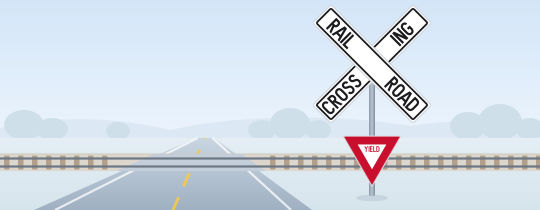
A railroad crossing is marked only by a white X-shaped crossbuck, with no lights or gate. A train is plainly approaching. What does Minnesota law say about where your car comes to rest?
Show answer
Correct answer: 10 feet or more from the nearest track
Why
When a train is plainly near, or when signals flash, a gate is down or a flagger signals, Minnesota law keeps you 10 feet or more back from the closest track. Go only when you can clear the far track by 10 feet without stopping. The 50-foot figure belongs to the parking law, not to stopping for trains.
40Speed limits
What happens to a Minnesota driver caught going faster than 100 mph?
Show answer
Correct answer: License revoked for at least six months
Why
Minnesota revokes the license of anyone driving faster than 100 mph for at least six months. At 20 mph or more over the limit, a surcharge equal to the fine already doubles the ticket. Speed is one of the quickest ways to lose a brand-new license.
Minnesota DVS written test at a glance
What to know before you book your DVS exam station appointment.
Minnesota · Class D written test
80% to pass.
40 questions · Multiple choice & true/false
32 of 40 answers right to pass
2 freetries at a DVS exam station, then $10
1 a daywritten test, at a station or a proctor
Spanishplus Hmong, Somali, Karen and more
By appt.at DVS exam stations, booked online
$29.50instruction permit, valid 2 years
20/40vision, with or without glasses
Under 18? Your road to a license
15Instruction permitFinish 30 hours of classroom driver ed (or the first 15 of a concurrent course), enroll in behind-the-wheel lessons, then pass the vision screening and the written test.
6 moSupervised practiceHold the permit at least six months, always with a licensed driver 21+ beside you, and log 50 hours, 15 of them at night (40 if a parent takes the parent class).
16Provisional licenseComplete behind-the-wheel training, keep a clean permit record and pass the road test, with a parent or guardian approving your application.
1–6 moFirst six monthsNo driving from midnight to 5 a.m. unless you’re driving for work or to a school event, or a licensed driver 25+ is along. Only one passenger under 20 (family doesn’t count) unless a parent or guardian rides along.
12 moFull licenseUp to three passengers under 20 in months 7–12. After 12 months with no alcohol, drug or crash-related convictions and no more than one other moving violation, plus 10 more supervised hours, move up to an under-21 license.
18 or older? Skip driver ed: hold the permit 180 days at 18, or just 90 days at 19 and up, practicing with a licensed driver 18+ beside you, then take the road test.
What’s on the Minnesota permit test
Study the Minnesota Driver’s Manual (June 2026 edition) from Driver and Vehicle Services. State law spells out what the test covers: signs, traffic laws, DWI, railroad crossings, school buses, bicycles and carbon monoxide. Start with these six areas.
Road signs
Colors carry meaning: yellow warns, orange flags construction, and fluorescent yellow-green marks school, pedestrian and bike crossings.
Five sides mean a school zone or crossing; a yellow pennant on the left edge marks where a no-passing zone starts.
The slow-moving vehicle triangle marks farm equipment and animal-drawn vehicles that go 30 mph or less.
Right-of-way
Two cars at an all-way stop or an unmarked intersection at once? The driver on the left yields to the one on the right.
Speeding forfeits your right-of-way, and at a T intersection the driver who has to turn yields.
School bus with flashing reds: stop 20 feet back, stop arm or not, unless a raised median or barrier separates you.
Speed limits
No sign? 10 mph in alleys, 30 in urban districts and towns, 55 on other roads.
Rural interstates reach 70 mph; interstates inside urban areas of 50,000+ people top out at 65.
Passing on a two-lane road posted 55 or more earns you 10 extra mph; speeding in a work zone adds a $300 fine.
Parking
Park at least 10 feet from a hydrant and 20 feet from an intersection crosswalk.
Stay 30 feet back from a stop sign or signal, and keep 50 feet between you and a crossing’s closest rail.
Right wheels within 12 inches of the curb; facing downhill, turn the front wheels toward it.
Alcohol & phones
DWI starts at 0.08 (0.04 in a commercial vehicle), and under 21 any alcohol at all breaks the Not a Drop law.
Refusing a breath test is a crime; a first refusal costs your license for at least a year.
Hands-free only: no phone in your hand while driving, even when you’re stopped in traffic.
Teen rules
Under 18 with a permit or provisional license: no phone at all, hands-free included, except to call 911.
First six months provisional: no driving midnight–5 a.m. and just one passenger under 20, family excepted.
When a teen with a permit or provisional license drives, every rider buckles up.
Minnesota numbers to know
Commit these six to memory; each one comes from Minnesota law or the Driver’s Manual.
100 ftof steady signaling before every turn
10 ftminimum gap to a fire hydrant when parking
20 ftback from a school bus with flashing reds
3 secfollowing distance; 4–5 in bad weather
1,000 ftdim your high beams for oncoming cars
3 ftminimum room when passing a bicycle
Your Minnesota course, in your pocket
These 40 questions are just the warm-up. The app gives you 499 Minnesota practice questions, 36 short lessons and the why behind every answer.
36 short lessonsFour levels, from fundamentals to expert, then a full practice exam.
499 Minnesota questions317 of them with pictures.
Your most-missed questionsA review lesson built from the questions you miss most.
Exam simulatorTake full practice exams and watch your readiness grow.
Minnesota permit
Your Minnesota path is ready.
36 lessons, 499 questions and full practice exams. In English and Spanish.
How many questions are on the Minnesota permit test, and what’s a passing score?
The Class D written test has 40 questions, a mix of multiple choice and true-or-false, on Minnesota traffic laws and road signs. You need 80% to pass, so 32 correct answers. It’s given on paper or on a computer by Driver and Vehicle Services (DVS), the Department of Public Safety division that serves as Minnesota’s DMV.
What happens if I fail the Minnesota written test?
You can try again, but only one written test per day. At a DVS exam station your first two attempts are free, as long as you haven’t already tested with a third-party proctor; after two fails in a row, each retest costs $10. There’s no time limit at the exam station, so take each question slowly.
Can I take the Minnesota permit test online?
Not from home. You can take a computer-based test at a DVS-approved third-party site, such as a driver education program, with a proctor present in person; it may charge up to $10 and allows no interpreters or other help. Otherwise, book an appointment for the test at a DVS exam station.
Can I take the Minnesota permit test in Spanish?
Yes. DVS gives the written test in Spanish, as well as Somali, Hmong, Russian, Vietnamese, Karen and American Sign Language, with audio at most locations. There’s a Spanish edition of the manual, the Manual del (de la) conductor(a) de Minnesota, and since October 2023 the Driver’s License for All law lets you get a standard license regardless of immigration status. This practice test and the app come in Spanish too.
How old do you have to be to get a permit in Minnesota?
15, after 30 hours of classroom driver ed and enrollment in behind-the-wheel training. Hold the permit six months and log 50 supervised hours, 15 at night, before a provisional license at 16. For the first six months, no driving midnight to 5 a.m. (with a few exceptions) and only one passenger under 20 without a parent; until 18, no phone use at all, hands-free included, except to call 911.
How much does a Minnesota instruction permit cost?
$29.50, and the permit is good for two years; renewing it costs $24.50. The written test itself is free for your first two tries at a DVS exam station. When you move up, a provisional license is $32.50 and a regular Class D license $46.
What do I need for the Minnesota road test?
Bring your own safe vehicle with current proof of insurance and a licensed driver to go with you. Teens also bring the completed supervised driving log and the White Card showing driver ed is done. Expect to parallel park (parking-assist must stay off), park on a hill and back into a space in a 90-degree maneuver. The first two road tests are free; after that each costs $20, and a no-show costs $40.
What’s the best way to study for the Minnesota permit test?
Work through the Minnesota Driver’s Manual (June 2026) chapter by chapter, with extra care on signs, traffic laws and impaired driving. Then test yourself: the 40 questions above are a start, and the app adds 499 Minnesota questions and 36 short lessons that explain every answer. Aim for 80% or better every time before you book your test.