Get ready for the Colorado DMV written test with 40 free questions on road signs, mountain-road rules, DUI and DWAI, and teen driving limits. Pick an answer and see the reason instantly.
Four rounds of 10 questions covering signs, mountain-road right-of-way, Colorado speed limits, parking, DUI, DWAI and phone laws, and teen rules, each explained the moment you answer.
Round 1 · Questions 1–10
1Road signs
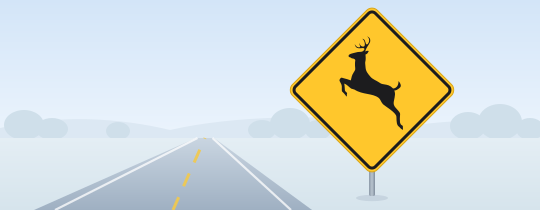
Heading into the foothills at dusk, you pass a yellow diamond sign with a leaping deer on it. According to the Colorado Driver Handbook, when do roughly 9 out of 10 deer and elk collisions happen?
Show answer
Correct answer: Between dusk and dawn
Why
Deer and elk move most when the light is low, and Colorado’s handbook puts about 90% of these crashes between dusk and dawn. Where this sign stands, ease off the gas and sweep the shoulders for eyes glowing in your headlights. If an animal jumps out, focus on keeping control instead of swerving hard, which can end in a worse crash than the impact itself.
2Right-of-way
You’re heading down a steep, narrow Colorado mountain road when a car appears coming up. There isn’t room for both of you to pass. Which driver has the right-of-way?
Show answer
Correct answer: The driver coming uphill
Why
On narrow mountain roads with steep grades, Colorado law gives the uphill vehicle the right-of-way. The downhill driver usually backs up to a turnout or a wider spot, unless it’s easier for the uphill driver to do so. Tap your horn before a blind curve so traffic you can’t see knows you’re there.
3Speed limits
No speed limit sign is posted on the residential street you’ve just turned onto in a Colorado town. What’s the legal limit?
Show answer
Correct answer: 30 mph
Why
Unless signs say otherwise, Colorado law sets 30 mph in a residence district and 25 mph in a business district. Cities can post lower limits, so obey any sign you see. And the basic speed rule never switches off: drive no faster than conditions safely allow.
4Parking
In Colorado, what’s the minimum distance between your parked car and a crosswalk at an intersection?
Show answer
Correct answer: 20 feet
Why
Leave 20 feet or more between your car and any intersection crosswalk in Colorado, so drivers can spot people stepping off the curb. Two more distances to remember: 15 feet from a hydrant and 30 feet on the approach to a stop or yield sign or a traffic signal. Never park in the crosswalk itself.
5Alcohol & phones
Besides DUI, Colorado has a second, lower impaired-driving offense. What is DWAI?
Show answer
Correct answer: Driving while ability impaired: alcohol or drugs affect you even to the slightest degree
Why
DWAI means alcohol, drugs or both have made you even slightly less able to drive safely, and a BAC above 0.05% can support the charge. At 0.08% or more, it’s DUI per se. A first DWAI still puts 8 points on your record.
6Safe driving
In normal conditions, how much space does the Colorado Driver Handbook want between you and the vehicle ahead?
Show answer
Correct answer: At least three seconds
Why
Pick a fixed point, like a sign; when the vehicle ahead passes it, start counting. If you reach the point before three seconds are up, drop back. Add more time at night, in bad weather and on snow or ice.
7Permit & teen rules
You’re 15 years and 2 months old and want a Colorado instruction permit. What do you have to finish first?
Show answer
Correct answer: A 30-hour driver education course
Why
At 15, Colorado requires a completed 30-hour driver education course before it issues a permit. For permits issued before 2027, 15½-year-olds may take a 4-hour driver awareness program instead, but from January 1, 2027, everyone aged 15 to 17 needs the 30-hour course. A course completion is good for 6 months, so time it with your permit appointment.
8Right-of-way
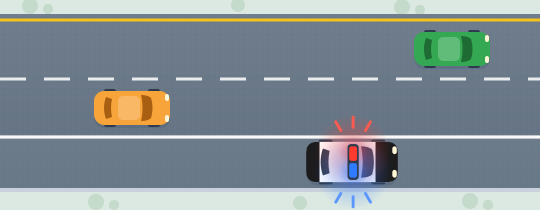
On a Colorado highway posted at 65 mph, a patrol car sits on the right shoulder with its lights flashing. A car in the next lane keeps you from moving over. What does the Move Over law require?
Show answer
Correct answer: Slow to 45 mph or less as you pass
Why
Colorado’s Move Over law asks you to change lanes away from the stopped vehicle when you safely can. If you can’t, slow to a safe speed: the law presumes 20 mph under the limit is safe where the limit is 45 mph or more (45 mph here), and 25 mph or less where it’s lower. The rule also covers tow trucks, utility trucks and any stopped vehicle with its hazard lights flashing.
9Sharing the road
On a two-lane Colorado road, you’re about to pass a bicyclist. What does state law require?
Show answer
Correct answer: Leave at least 3 feet between the rider and your car, mirrors included
Why
Colorado requires at least 3 feet between the rider and every part of your vehicle, mirrors and trailer included, even where no sign says so. When the oncoming lane is clear, you’re allowed to cross a solid or double yellow line briefly to give that room. If you can’t, stay behind until you can.
10Road signs
A country road crosses railroad tracks marked only by a white X-shaped crossbuck: no flashing lights, no gate. How should you treat that crossbuck?
Show answer
Correct answer: Like a YIELD sign: slow down, look both ways and stop if a train is coming
Why
Colorado’s handbook says the crossbuck works like a YIELD sign, so be ready to stop for any train you see or hear. If you must stop and no stop line is painted, Colorado law has you wait 15 to 50 feet back from the closest rail. A freight train at 55 mph needs about a mile to stop, so it can’t stop for you.
Round 2 · Questions 11–20
11Speed limits
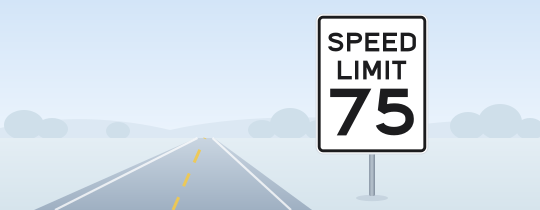
You pass this SPEED LIMIT 75 sign on a Colorado highway. What makes 75 mph special in Colorado?
Show answer
Correct answer: No road in the state may be posted any higher
Why
75 mph is Colorado’s ceiling: no state or local authority may post a higher limit on any highway. Where no sign is posted, surfaced four-lane interstates, freeways and expressways default to 65 mph, and other open highways to 55 mph. Even at 75, slow down whenever weather or traffic makes that speed unsafe.
12Right-of-way
At a rural Colorado intersection with no signs or signals, you and a pickup arrive at almost the same moment. The pickup is on your left. Who should give way?
Show answer
Correct answer: The pickup driver, because you’re on the right
Why
If you and another driver roll up to an intersection with no signs or signals at nearly the same instant, Colorado law makes the driver on the left give way to the one on the right. The same tiebreaker settles things at a four-way stop when two cars stop together. Still, never force it: if the other driver keeps coming, let them go.
13Alcohol & phones
A 19-year-old Colorado driver is stopped on the way home from a party, and a breath test reads 0.03% BAC. What’s the result?
Show answer
Correct answer: A violation, because for drivers under 21 the line is 0.02%
Why
Colorado holds drivers under 21 to a near-zero standard. A BAC from 0.02% to 0.05% is underage drinking and driving (UDD), which carries 4 points, and anything over 0.02% leads to license revocation, 3 months for a first offense. If you’re under 21, the only safe amount is none.
14Parking
Four open curb spaces are left on a busy Colorado street. Which one can you legally take?
Show answer
Correct answer: One that keeps 8 feet clear of a private driveway
Why
Colorado’s rule for driveways is 5 feet, so 8 feet is fine. The others all fall short: hydrants need 15 feet, stop signs 30 feet on the approach, and fire station driveways 20 feet (75 feet across the street where signs say so). When in doubt, find another space.
15Safe driving
You plan to turn off a Colorado highway where the speed limit is above 40 mph. How far ahead must your turn signal be on?
Show answer
Correct answer: At least 200 feet
Why
Colorado wants a steady signal for at least 200 feet on four-lane highways and roads posted over 40 mph, and at least 100 feet in town. The extra distance gives faster traffic behind you time to react. Cancel the signal once the turn is done.
16Permit & teen rules
Before a Colorado driver under 18 can trade the permit for a license, what must the signed driving log show?
Show answer
Correct answer: 50 hours, 10 of them at night
Why
Colorado wants at least 50 hours of supervised driving, 10 of them after dark, recorded on the DR 2324 Drive Time Log or in the RoadReady app. You also have to hold the permit at least 12 months, or until you turn 18 if that comes first. Spread the hours across the seasons, snow included.
17Road signs
A power outage has left every traffic light at a busy Colorado intersection completely dark. How do you get through?
Show answer
Correct answer: Treat it as a four-way stop
Why
Colorado’s handbook says to handle a signal that’s out or malfunctioning as a four-way stop. Come to a complete stop; the first driver to stop goes first, and when two stop together, the one on the left yields to the one on the right. Make eye contact and move only when it’s clearly your turn.
18Sharing the road
Traffic on a Colorado street is stopped at a red light, and a motorcyclist eases forward between your car and the car in the next lane. Is that legal?
Show answer
Correct answer: Yes, if the rider goes 15 mph or slower and the traffic alongside is stopped
Why
Colorado allows lane filtering: a rider on a two-wheeled motorcycle may move past stopped vehicles at 15 mph or less when the traffic in neighboring lanes is stopped too. Riding on the shoulder or into oncoming lanes is still off-limits. When you’re stopped in traffic, check your mirrors before you open a door or change lanes.
19Speed limits
You’re on a narrow, winding Colorado mountain road full of blind curves, and no speed limit is posted. What speed does state law allow?
Show answer
Correct answer: 20 mph
Why
Colorado sets 20 mph on tight, twisting mountain roads and around blind curves, and 40 mph where a mountain highway opens up, whenever no other limit is posted. Sound your horn as you approach a blind curve so drivers you can’t see know you’re coming.
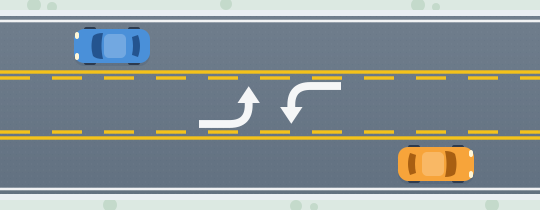
20Lane markings
Down the middle of a Colorado road runs a lane bordered by solid and broken yellow lines, with left-turn arrows pointing both ways. How may you use it?
Show answer
Correct answer: Only to make a left turn, from either direction
Why
Those markings set aside a center lane for left turns in both directions. Drivers from either side may pull in to make a left turn, but never to pass or to cruise along in it. Move in shortly before your turn, and watch for a driver coming the other way into the same space.
Round 3 · Questions 21–30
21Right-of-way
You’re following a school bus on a two-lane Colorado road. It stops, its red lights flash and the stop arm swings out. Where do you stop?
Show answer
Correct answer: At least 20 feet from the bus, and stay until the red lights go off
Why
Colorado law has drivers coming from either direction stop no closer than 20 feet from a bus showing flashing red lights. Only oncoming traffic on a highway split by a median may keep going; behind the bus, you always stop. Flashing yellow lights mean the bus is about to stop, and illegally passing a stopped bus costs 6 points.
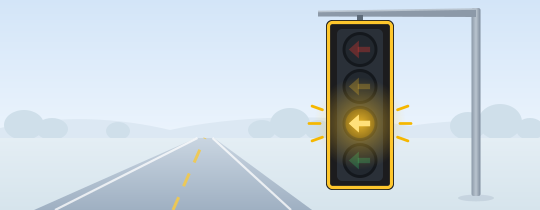
22Road signs
You’re waiting in a left-turn lane, and the signal above it shows a flashing yellow arrow. What does that let you do?
Show answer
Correct answer: Turn left once you’ve yielded to oncoming traffic and pedestrians
Why
A flashing yellow arrow permits the turn but doesn’t protect it: cars coming the other way may have a green light. Wait for a real gap and check the crosswalk you’ll cross before you go. Only a green arrow gives you the right-of-way over oncoming traffic.
23Speed limits
Colorado highways posted at 65 mph and up have a special rule for the far-left lane. When may you drive in it?
Show answer
Correct answer: To pass or turn left, or when traffic is too heavy to move right
Why
Colorado treats the far-left lane of a 65+ mph highway as a passing lane: use it to pass or to turn left, then move back right. Cruising there is allowed only when traffic is too heavy to merge over. On I-70’s steep climbs, the left lane also has a floor of 10 mph under the limit, unless a lower minimum is posted.
24Parking
Your car is parked on a sloping Colorado mountain road with no curb, only a dirt shoulder. Which way should you turn the front wheels?
Show answer
Correct answer: To the right, toward the edge of the road
Why
With no curb to catch a tire, wheels turned toward the road’s edge send a rolling car off the pavement instead of into traffic. Where there is a curb, point the wheels toward it facing downhill and away from it facing uphill. Set the parking brake every time as well.
25Alcohol & phones
A Colorado driver suspected of impaired driving refuses a breath or blood test for the first time. What happens to the license?
Show answer
Correct answer: It’s revoked for one year
Why
Under Colorado’s Express Consent law, driving means you’ve already agreed to a chemical test if an officer suspects impairment. A first refusal brings a one-year revocation, a second two years and a third three years. Saying no doesn’t make the problem go away; it usually makes it bigger.
26Safe driving
Driving at night with your high beams on, you come up behind another car going the same way. Under Colorado law, by what distance must you switch to low beams?
Show answer
Correct answer: 200 feet
Why
Colorado requires low beams within 200 feet of a vehicle you’re following and within 500 feet of one coming toward you. High beams in someone’s mirror can blind them just as badly as from the front. Failing to dim can cost you 2 points.
27Permit & teen rules
A Colorado driver under 18 got a license four months ago. With no parent or other qualifying adult along, how many passengers under 21 who aren’t family may ride with them?
Show answer
Correct answer: None
Why
For the first six months the answer is none, and from month 7 to month 12 it’s one at most. The limits lift when a parent or guardian rides along, or an adult 21+ whose license is 12 months old or more; in a medical emergency; or when the young passengers are immediate family wearing seat belts. They end after a year of licensed driving or at 18.
28Road signs
On a rural Colorado road you come up behind farm equipment with an orange reflective triangle mounted on its back. What does that triangle tell you?
Show answer
Correct answer: It’s built to go slower than 25 mph
Why
That’s the slow-moving vehicle emblem, and Colorado’s handbook says it marks vehicles built for speeds under 25 mph. At highway speed you’ll close the gap within seconds, so ease off the moment you spot it. Pass only where passing is legal and you can see far enough ahead.
29Sharing the road
During a snowstorm on a Colorado highway, several snowplows are clearing the road side by side in a staggered line. What should you do?
Show answer
Correct answer: Stay behind them; passing plows working in this formation is illegal
Why
When plows work together in an echelon, they clear the whole road at once, and Colorado’s handbook says passing them is illegal. Hang back, give them room and be patient; the road behind them is in better shape anyway. Plows and sanding trucks run flashing yellow and blue lights, so treat those lights as your cue to slow down.
30Alcohol & phones
Adults can buy marijuana legally in Colorado. At what blood level of THC may a court infer that a driver was under the influence?
Show answer
Correct answer: 5 nanograms per milliliter
Why
At 5 nanograms of THC per milliliter of blood or more, a court can infer DUI. Below that level, impairment alone can still bring a DUI or DWAI charge, and a medical card is no defense. Colorado law also bans an open marijuana container in the passenger area, just as it does for alcohol.
Round 4 · Questions 31–40
31Right-of-way
A yellow diamond sign with three arrows chasing each other in a circle warns of a roundabout. When you get there, a 40-foot motor home is entering at the same moment. What does Colorado law say?
Show answer
Correct answer: You must yield to the motor home
Why
Colorado requires drivers in a roundabout to yield to large vehicles, meaning trucks, buses, emergency vehicles and RVs over about 35 feet long or 10 feet wide. Otherwise, traffic coming in yields to vehicles already circling and to people in the crosswalks. Travel counterclockwise and stay out of a big vehicle’s path.
32Road signs
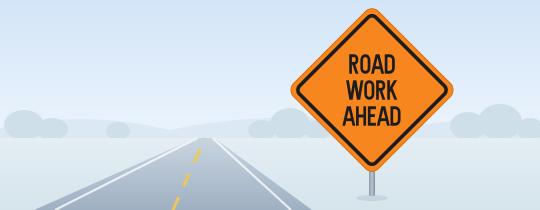
An orange diamond-shaped ROAD WORK AHEAD sign marks the start of a highway work zone in Colorado. If you’re ticketed for speeding inside the zone, what happens to the fine?
Show answer
Correct answer: It’s doubled
Why
Orange is reserved for work zones, and Colorado doubles speeding fines inside a designated highway work zone; signed school zones double fines too. Lanes can shift without warning and crews may be working inches from traffic, so slow down early and leave extra room. Obey every flagger, even when the crew seems far off.
33Speed limits
An open two-lane state highway crosses Colorado’s eastern plains with no speed limit posted. What limit applies?
Show answer
Correct answer: 55 mph
Why
Colorado sets 55 mph on open highways that aren’t four-lane interstates, freeways or expressways, unless signs show a different number. Surfaced four-lane interstates and freeways default to 65 mph, and posted limits can go as high as 75. Out on the plains, watch for slow farm equipment ahead.
34Parking
Colorado law sets a maximum gap between your wheels and the curb when you parallel park. What is it?
Show answer
Correct answer: Within 12 inches
Why
Colorado allows a gap of 12 inches at most between the curb and your wheels on that side; where there’s no curb, get as close as practical to the edge of the shoulder. Parking farther out squeezes the lane for passing traffic. Check your mirror for bikes and cars before you open your door.
35Alcohol & phones
Under the Colorado phone law in force since January 1, 2025, which of these may an adult driver do while driving?
Show answer
Correct answer: Take a call through the car’s speakers without picking up the phone
Why
Since 2025, no Colorado driver may hold a phone to talk, text, read messages or watch video; hands-free use is fine, and calling for help in an emergency is always allowed. A first ticket carries a $75 fine and 2 points, and if it’s your first, proof that you own a hands-free accessory can get it dismissed.
36Safe driving
CDOT has put the Passenger Vehicle Traction Law into effect on I-70. Your all-wheel-drive SUV has winter tires and no chains. How much tread must those tires have, at a minimum?
Show answer
Correct answer: 3/16 inch
Why
With all-wheel or four-wheel drive, snow-rated tires (winter, mud-and-snow or all-weather) need at least 3/16 inch of tread to meet the Traction Law. Chains or an approved traction device are the other way to comply, and getting caught unprepared starts at a $100 fine plus a surcharge. Check your tread before any winter trip into the mountains.
37Safe driving
Rounding a shaded curve, you hit ice and the car starts to slide. What does the Colorado Driver Handbook tell you to do?
Show answer
Correct answer: Lift both feet off the pedals and steer toward where you want to go
Why
Lifting off the pedals lets the tires roll and find grip, and steering toward your intended path brings the car back in line. Bridges, overpasses and shady spots freeze before the rest of the road, so slow down before you reach them. Small, smooth steering moves work better than big ones.
38Permit & teen rules
In the first year with a license, during which hours may a Colorado driver under 18 not drive, apart from a few exceptions?
Show answer
Correct answer: Midnight to 5 a.m.
Why
Colorado’s curfew for new drivers under 18 runs from midnight to 5 a.m. during the first year. It lifts with a parent or guardian in the car, or an adult 21+ whose license is 12 months old or more; for trips to school, school events or a job when you carry a signed note from the school or employer; in a medical emergency; and for emancipated minors. Plan rides home from late events ahead of time.
39Permit & teen rules
A Colorado teen wants a license before turning 16½. On top of the 50-hour log, what extra training does the law require?
Show answer
Correct answer: 6 hours of driving with an approved driving school instructor
Why
Getting licensed before 16½ means 6 hours behind the wheel with an approved driving school instructor. If no approved school within 30 miles of home teaches at least 20 hours a week, 12 more hours with your parent or permit supervisor can take its place. Wait until 16½ and this requirement drops away.
40Crashes & emergencies
You have a minor fender bender on a divided Colorado highway. No one is hurt, no one has been drinking and both cars still drive. What does Colorado’s Move It law require?
Show answer
Correct answer: Move both cars off the highway, then exchange information
Why
Under the Move It law, drivable cars in a minor crash with no injuries, alcohol or drugs must be moved off the highway, to a frontage road, cross street or another safe spot, before you trade information. Police and insurers won’t hold the move against you. Lingering in a live lane invites a second crash.
Colorado DMV written test at a glance
The numbers that matter before test day, whether you test at home or at a DMV office.
Colorado · Class R knowledge test
80% to pass.
Multiple choice · Online or in person
At least 80% of your answers right
Online@Home test with a webcam, $6.50 a try
2 a daytest attempts, with no lifetime limit
Spanishor English, online or at the office
$20instruction permit fee
$11.50state fee for each written retest
20/40vision standard
Under 18? Your road to a license
15Instruction permitFinish a 30-hour driver ed course, have a parent or guardian sign the DR 2460 affidavit, then pass the knowledge test.
12 moSupervised practiceHold the permit a full year and log 50 hours with a licensed driver 21+, 10 of them at night.
16Minor driver’s licensePass the drive test, usually with an approved driving school. Getting licensed before 16½? Add 6 hours with an instructor.
Year 1First-year limitsNo driving midnight–5 a.m. No passengers under 21 for six months, then one at most, unless they’re family or a qualifying adult rides along.
18 or older? There’s no minimum permit period: get your permit, practice with a licensed driver 21+ and take the drive test when you’re ready. From January 1, 2027, applicants aged 18 to 20 also need a 4-hour driver awareness program or the 30-hour course.
What’s on the Colorado permit test
Study the Colorado Driver Handbook (DR 2337, January 2025 edition), also published in Spanish as the Manual del Conductor de Colorado. The test draws on road signs, DUI, rules of the road, safety and legal topics. Below are the six areas worth mastering first.
Road signs
Round means railroad: no other sign is a circle. At the tracks, treat the white crossbuck like a YIELD sign.
Orange marks a work zone, where Colorado doubles fines, just as it does in signed school zones.
Brown points to recreation and cultural sites, blue to services, green to directions.
Right-of-way
Narrow mountain road on a steep grade? The uphill car goes first.
In a roundabout, yield to traffic already circling, and to any big truck, bus or RV entering or circling with you.
School bus flashing red: stop at least 20 feet away, from either direction. Only traffic on the far side of a median may keep going.
Speed limits
No sign? 25 mph in a business district, 30 in a residential one.
20 mph on twisting mountain roads and blind curves, 40 on open mountain highways.
75 mph is the most any Colorado road can post, and at 65 and up the left lane is for passing.
Parking
Keep 15 feet from a hydrant and 20 feet from an intersection’s crosswalk.
Stay 30 feet back from a stop sign or signal, and 5 feet clear of any driveway.
Downhill, wheels to the curb; uphill with a curb, wheels away; no curb, turn them right.
Alcohol & phones
0.08% is DUI per se, DWAI starts when you’re even slightly impaired, and under 21 the line is 0.02%.
Refuse a chemical test and lose your license for a year. For marijuana, 5 ng of THC lets a court infer DUI.
Since 2025, no driver may hold a phone to talk, text or watch video. Go hands-free.
Teen rules
Every permit drive needs a licensed adult 21+ in the front passenger seat.
First 6 months licensed: no passengers under 21 except family. Months 7–12: one at most.
No driving midnight–5 a.m. in year one, and every rider buckles up.
Colorado numbers to know
Six figures from Colorado law and the handbook that are worth knowing by heart.
200 ftof signaling on roads over 40 mph (100 ft in town)
15 ftfrom a fire hydrant when you park
20 ftfrom a school bus with red lights flashing
3 secminimum following distance in good conditions
0.02%BAC limit for drivers under 21
25/50/15minimum liability insurance, in thousands of dollars
Your Colorado course, in your pocket
These 40 questions are just the warm-up. The app gives you 501 Colorado practice questions, 36 short lessons and the why behind every answer.
36 short lessonsFour levels, from fundamentals to expert, then a full practice exam.
501 Colorado questions331 of them with pictures.
Your most-missed questionsA review lesson built from the questions you miss most.
Exam simulatorTake full practice exams and watch your readiness grow.
Colorado permit
Your Colorado path is ready.
36 lessons, 501 questions and full practice exams. In English and Spanish.
What score do I need to pass the Colorado permit test?
80%: get at least 8 of every 10 answers right on the Class R (car) knowledge test. It’s multiple choice and built on the Colorado Driver Handbook, from road signs and DUI to driving rules, safety and legal topics. You can take it online with @Home, at a state driver license office or at an approved driving school.
How many times can I take the Colorado written test?
As many times as you need, but no more than twice in one day. Every retest carries an $11.50 state fee, which you can pay online through myDMV or at your office appointment.
Can I take the Colorado permit test online?
Yes. The DMV’s @Home Driving Knowledge Test runs on a desktop or laptop with a webcam once you pre-register at myDMV.Colorado.gov. You get 60 minutes, each attempt costs $6.50, and you can test from 14 years and 11 months; under 19, a parent or guardian registers as your proxy. After you pass, book an office appointment for the vision screening and your permit.
Can I take the Colorado permit test in Spanish?
Yes. State driver license offices give the written test in English or Spanish, and the @Home online test comes in both languages, with an option to have each question read aloud. The DMV also publishes the handbook in Spanish as the Manual del Conductor de Colorado. This practice test is in Spanish too, and so is the app.
How old do I have to be to get a permit in Colorado?
15. For permits issued before 2027, you need a 30-hour driver education course at 15, a 4-hour driver awareness program also works at 15½, and from 16 no course is required. From January 1, 2027, every applicant aged 15 to 17 needs the 30-hour course. Under 18, a parent or guardian signs the DR 2460 affidavit, and you hold the permit 12 months and log 50 hours, 10 at night, before a license at 16 or later.
What are the rules for new teen drivers in Colorado?
For the first year with a license, or until you turn 18, no driving midnight–5 a.m. unless a parent, guardian or licensed adult 21+ rides along, you carry a signed statement for school or work, or there’s a medical emergency. During the first six months, no riders under 21 unless they’re family or a qualifying adult is along; in months 7–12, one at most. Everyone in the car buckles up, and like every Colorado driver you can’t hold a phone while driving; the smartest move is to leave it alone.
How much does a Colorado permit cost?
$20 for a REAL ID-compliant instruction permit, or $23 for a Standard (CO-RCSA) one. The permit stays valid for three years, or until you turn 21 if that comes sooner. A first license, minor driver’s license included, costs $34 ($36 Standard). Each written retest adds $11.50.
What’s the best way to study for the Colorado permit test?
Work through the Colorado Driver Handbook (DR 2337), then drill questions until you clear 80% every time. The 40 questions above are a good start; the app picks up from there with 501 Colorado questions and 36 short lessons, every answer explained.