Get ready for Alaska's 20-question DMV knowledge test with 40 free practice questions on road signs, right-of-way, speed limits, moose and winter driving, and teen license rules, each with an instant explanation.
Four rounds of 10 questions on Alaska road signs, right-of-way, speed limits, parking, DUI and texting laws, winter driving and provisional license rules. Each answer explains the rule behind it.
Round 1 · Questions 1–10
1Safe driving
It's dusk on a two-lane Alaska highway. You've just passed a yellow diamond sign showing a leaping deer when a moose steps onto the road ahead. What does the Alaska Driver Manual advise?
Show answer
Correct answer: Brake firmly and keep the car straight in your lane
Why
The manual says to brake hard and not swerve: a swerve can put you into another vehicle, a pedestrian, or a tree or utility pole. Moose crashes peak around dawn and dusk, and animals often travel in pairs, so when one crosses, look for another. If you hit a moose or other big game animal, notify the State Troopers or a Fish and Wildlife officer as soon as you can.
2Right-of-way
A windstorm has cut the power in Anchorage, and every light at a busy intersection is dark. No officer is directing traffic. How does the Alaska Driver Manual tell you to handle it?
Show answer
Correct answer: Treat it as uncontrolled: stop, yield to traffic on your right, and go when it's safe
Why
With the signals out and nobody directing traffic, the manual says to treat the crossing as uncontrolled. Come to a stop, and if you and another car get there together, the car on the right goes first. Even when it's your turn, ease in slowly and don't assume others will wait.
3Speed limits
You're driving through downtown Fairbanks, a business district, and haven't seen any speed limit sign. What's the highest speed Alaska's default limits allow?
Show answer
Correct answer: 20 mph
Why
Where nothing else is posted, Alaska sets 20 mph in a business district, 15 in an alley, 25 in a residential district and 55 on other roads. Those defaults are lower than many drivers expect, so read every sign as you come into town. A posted limit always replaces the default.
4Permit & provisional license
You're 16, it's your first month with a provisional license, and no adult is in the car. Which passenger may ride with you?
Show answer
Correct answer: Your 14-year-old brother
Why
Alaska's provisional rule allows passengers only if every one of them is a parent, guardian, sibling or someone 21 or older, unless a parent, guardian or 21-plus person is riding along. A younger brother counts as a sibling; friends and cousins under 21 don't. The limit lasts until 18, or until six clean months on the provisional license earn you a regular one.
5Parking
There's an open spot along the curb right next to a fire hydrant. How close to the hydrant does Alaska regulation let you park?
Show answer
Correct answer: No closer than 15 feet
Why
Alaska requires at least 15 feet between your vehicle and a fire hydrant so fire crews can reach it fast. Other gaps to know: 20 feet from an intersection crosswalk or a fire station driveway, and 50 feet between your car and the closest rail at a train crossing. When in doubt, find another spot.
6Alcohol & phones
You're 19 and drank one beer at a friend's house an hour ago. You feel fine. Under Alaska law, may you drive home?
Show answer
Correct answer: No, because under 21 driving after drinking any amount is an offense
Why
Alaska has zero tolerance for drivers aged 14 to 20: any alcohol at all, then driving, is an offense. The citation alone means no driving of any kind for 24 hours and a 30-day DMV revocation on a first offense, and a first conviction adds a $500 fine and 20 to 40 hours of community work. Hand over the keys or call for a ride.
7Right-of-way
On a two-lane road in Wasilla, the school bus in front of you stops, flashes its red lights and swings out its stop arm. How close may you get before stopping?
Show answer
Correct answer: No closer than 30 feet
Why
Alaska law makes traffic from both directions stop at least 30 feet from a bus showing flashing red lights, and wait until it moves on and the lights go off. Only drivers on a separate roadway of a divided highway may continue. An illegal pass is a misdemeanor that adds 6 points to your record.
8Permit & provisional license
What's the youngest age at which you can get an Alaska instruction permit?
Show answer
Correct answer: 14
Why
Alaska lets you apply at 14. You pass the written knowledge test and a vision test, bring your ID documents and a parent's signed consent, and pay $15. The permit lasts two years and can be renewed once.
9Safe driving
On dry pavement, how much following distance does the Alaska Driver Manual recommend behind the vehicle ahead?
Show answer
Correct answer: 4 seconds
Why
The manual teaches a four-second gap, while Alaska regulation sets two seconds as the bare legal minimum. On wet, icy or snowy roads, or when towing, stretch it to six seconds or more. Count from when the vehicle ahead passes a fixed object, like a sign, until you reach it.
10Sharing the road
On a two-lane highway outside town, you're driving below the limit and notice five vehicles stacked up behind you. What does Alaska law require?
Show answer
Correct answer: Pull off at the first safe spot, such as a turnout, and let them by
Why
Alaska requires a driver with five or more vehicles lined up behind on a two-lane road outside an urban area to pull over where it's safe and let them pass, and the fine starts at $100. Highway turnouts are there for exactly this. On roads with more lanes, slower drivers keep right except to pass.
Round 2 · Questions 11–20
11Road signs
Heading out of Palmer, you come up behind a farm tractor with an orange triangle edged in red fixed to its back. What does that emblem tell you about the vehicle?
Show answer
Correct answer: It's built to travel at 25 mph or less
Why
The Alaska Driver Manual calls it the slow-moving-vehicle emblem, and it’s required on vehicles that go 25 mph or slower. By day its orange center shows from more than a fifth of a mile away, and at night the red border glows in your headlights, so ease off the gas as soon as you spot it. Pass only where the road ahead is clear and passing is legal.
12Right-of-way
You're about to enter a single-lane roundabout, and a car already circling is coming toward your entry from the left. Who has the right-of-way?
Show answer
Correct answer: The car already in the roundabout
Why
Alaska regulation has entering drivers yield to traffic already circulating. Inside, you travel counterclockwise and may not pass on the right, and the design speed is only about 15 to 20 mph. Wait for a gap, then merge in at that slower pace.
13Speed limits
A five-sided yellow-green sign with two walking children marks a school crosswalk near an elementary school in Anchorage. What limit does Alaska set as you pass that crosswalk?
Show answer
Correct answer: 20 mph, from 300 feet before it to 300 feet past it
Why
Alaska regulation caps your speed at 20 mph when you pass a marked, signed school or playground crosswalk, and that zone reaches 300 feet out on each side. Speeding there costs 6 points, as much as going 20 mph over elsewhere. Watch for children stepping out from between parked cars.
14Parking
You want to park on the right side of a street, just before a corner with a stop sign. What's the minimum gap Alaska regulation requires between your car and that sign?
Show answer
Correct answer: 30 feet
Why
Coming up to a STOP or YIELD sign, a flashing beacon or a traffic light at the roadside, leave 30 feet clear before you park. A car parked closer than that can hide the sign from drivers coming up behind you. Keep at least 15 feet from a hydrant and 20 feet from a crosswalk as well.
15Alcohol & phones
For a driver 21 or older in an ordinary car, what blood or breath alcohol level makes it DUI in Alaska no matter how sober the driver feels?
Show answer
Correct answer: 0.08%
Why
At 0.08% or higher it's DUI in Alaska, and you can still be convicted below that if alcohol or drugs impair you. Commercial drivers face action at 0.04%. A first DUI means at least 72 hours in jail, a fine of $1,500 or more, license revocation and an ignition interlock for at least six months.
16Permit & provisional license
You've just gotten your instruction permit. Which of these people may sit beside you as your supervising driver?
Show answer
Correct answer: Your 23-year-old cousin, licensed for three years
Why
Alaska requires the supervisor to be at least 21, to have been licensed to drive that kind of vehicle for a year or more, and to sit in the seat next to you. Each of the other choices misses one of those three conditions. Check all three before every practice drive.
17Safe driving
When does Alaska law require your headlights to be on?
Show answer
Correct answer: From 30 minutes past sunset until sunrise is 30 minutes away, plus any time you can’t see clearly for 1,000 feet
Why
Alaska’s rule has two parts: the clock, which starts 30 minutes past sunset and runs until sunrise is 30 minutes off, and visibility, any time people and vehicles 1,000 feet away are hard to make out. In a snowstorm or ice fog that can be midday. Switch to low beams within 500 feet of an oncoming vehicle and within 300 feet of one you’re following.
18Road signs
Orange signs, cones and barrels mark a highway project, and crews are out on the road. What does Alaska law do to traffic fines inside a highway work zone?
Show answer
Correct answer: It doubles them
Why
Alaska doubles traffic fines in highway work zones and in designated Traffic Safety Corridors. A signed work zone counts even when no one is working at that moment. Slow down early, leave extra room around crews and equipment, and follow any flagger’s directions.
19Right-of-way
On a street with two lanes each way, the car in the lane to your left stops at a marked crosswalk. Your own lane looks open. What should you do?
Show answer
Correct answer: Stop too, since passing a car stopped at a crosswalk isn't allowed
Why
Alaska regulation forbids passing a vehicle that has stopped at a crosswalk to let someone cross, because the stopped car can hide a pedestrian stepping into your path. Pedestrians crossing on your side of the road, or coming close from the far side, go first. Anyone walking with a guide dog or white cane gets the right-of-way every time.
20Crashes & emergencies
Two cars bump at a city intersection. Nobody is hurt, but the damage looks like about $3,000. What does Alaska law require?
Show answer
Correct answer: Report it to the police right away, and file a written report with the DMV within 10 days unless an officer investigated
Why
Any crash with injury, death or apparent damage of $2,000 or more must be reported at once: to the local police inside a municipality, or to the State Troopers outside one. Every driver must also send the DMV proof of insurance within 15 days when damage tops $501, even if not at fault. Stop, exchange names, addresses and plate numbers, and help anyone who’s hurt.
Round 3 · Questions 21–30
21Road signs
The driver of the car ahead sticks a left arm out the window and bends it upward at the elbow, hand pointing at the sky. What is that driver telling you?
Show answer
Correct answer: I'm turning right
Why
Alaska’s hand signals all come from the driver’s window: an arm held straight out means a left turn, bent up means a right turn, and bent down means slowing or stopping. The manual suggests them when bright sun washes out turn signal lights or a line of cars behind you blocks the view of them. Treat an arm signal from the car ahead just like a blinker.
22Right-of-way
You've come to a full stop at a steady red light in downtown Juneau and want to turn left. When does Alaska allow a left turn on red?
Show answer
Correct answer: Only onto a one-way street, after yielding, where no sign forbids it
Why
Alaska regulation permits a left on a steady red only if the street you're turning into carries one-way traffic; a left on red into two-way traffic is not allowed. Right turns on red are legal after a full stop unless a sign prohibits them. Either way, pedestrians and cross traffic go first.
23Speed limits
A trooper clocks you at 12 mph over the posted limit. How many points does that add to an Alaska driving record?
Show answer
Correct answer: 4 points
Why
Alaska scores speeding by how far over you were: 3 to 9 mph over is 2 points, 10 to 19 is 4, and 20 or more is 6, the same as any speeding in a school zone. Reach 12 points within 12 months, or 18 within 24, and your license is suspended. Provisional drivers with 6 or more points in 12 months, or 9 in 24, must complete a defensive driving course.
24Parking
You've parked on a steep Juneau street, nose pointing downhill, with a curb on your right. If the brakes slipped, which wheel position would let the curb stop the car?
Show answer
Correct answer: Toward the curb
Why
Turned toward the curb, the front tire catches on it if the car starts to roll. Uphill against a curb, you turn the wheels away from it so the car rolls back into the curb. Alaska's rule is the same in both cases: any roll should end at the curb or road edge, away from traffic.
25Alcohol & phones
After a lawful DUI arrest in Alaska, a driver refuses to take the breath test. What follows?
Show answer
Correct answer: A separate criminal charge, punished like DUI, plus license revocation
Why
By driving in Alaska you're treated as having agreed to a breath test if lawfully arrested for DUI. Refusing is a crime of its own, with the same minimum jail time, fines and ignition interlock as a DUI, and the DMV revokes the license as well, for 90 days on a first offense. Many drivers end up facing two charges: DUI and refusal.
26Permit & provisional license
Before a 16-year-old in Alaska can get a provisional license, a parent, guardian or employer must certify how much supervised driving?
Show answer
Correct answer: At least 40 hours, 10 of them in tougher conditions like darkness or bad weather
Why
Alaska's provisional license law asks for 40 certified practice hours, including at least 10 in progressively harder conditions, plus six months on the permit and no traffic convictions in the last half year before you apply. Driver education is optional in Alaska and doesn't stand in for the hours. Mix in winter roads and darkness while an experienced driver is beside you.
27Safe driving
You live in Fairbanks, north of 60° latitude. During which dates are studded tires banned on paved roads there?
Show answer
Correct answer: May 1 through September 15
Why
Alaska sets the stud-free season by latitude: north of 60° it runs May 1 to September 15, and south of 60°, in places like Juneau, April 15 to September 30. On the Sterling Highway, the May 1 to September 15 dates apply along its whole length. Tire chains fall under the same dates.
28Road signs
A roadside sign tells you you're entering a Traffic Safety Corridor. It's a bright summer afternoon. What does Alaska law require of you along this stretch?
Show answer
Correct answer: Headlights on, whatever the time of day
Why
Alaska law requires headlights on a designated Traffic Safety Corridor at any hour, not just after dark. Traffic fines are doubled inside a corridor too. The state transportation department picks these stretches and puts up signs to mark them.
29Right-of-way
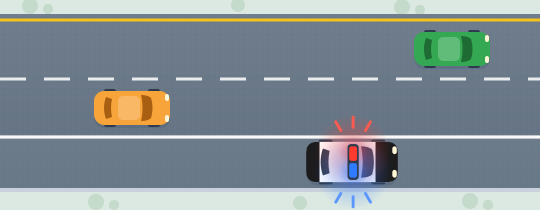
A car coming up fast behind you is flashing a blue light, with no siren. What does Alaska require you to do?
Show answer
Correct answer: Pull to the right edge, clear of any intersection, and stop until it goes by
Why
In Alaska a flashing blue light marks an authorized emergency responder's vehicle, and you yield to it as you would to an ambulance. Slow down, steer over to the right-hand edge outside any intersection and stay stopped until it has passed. The same goes for any emergency vehicle using lights and siren, or a police car using either one.
30Crashes & emergencies
On a four-lane divided highway, you're in the right lane when you spot a trooper's car stopped on the right shoulder with its lights flashing. The left lane is open. What does Alaska's move-over law require?
Show answer
Correct answer: Move into the left lane, away from the trooper, if it's safe
Why
Alaska's move-over law tells you to leave the lane next to a stopped emergency, police, fire, tow, road-maintenance or animal-control vehicle with flashing lights when you have two or more lanes your way. If changing lanes isn't safe, or there's only one lane, slow to a safe speed instead. Injuring someone while ignoring the law is a misdemeanor.
Round 4 · Questions 31–40
31Speed limits
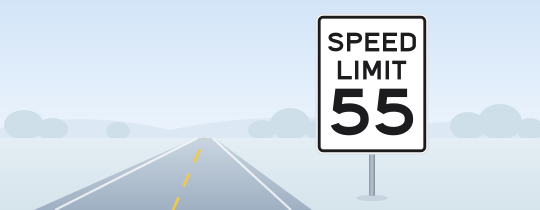
Thick fog has settled over a highway posted SPEED LIMIT 55, and you can see only a few car lengths ahead. Under Alaska's basic speed rule, how fast may you drive?
Show answer
Correct answer: No faster than is reasonable for the fog, even if that's far below 55
Why
Alaska's basic speed rule says you must never go faster than is reasonable and prudent for traffic, the road and the weather, whatever the sign says. The manual adds a simple test: if you couldn't stop inside the stretch of road you can see is clear, you're too fast. In fog, snow or ice, that often means driving well under the limit.
32Road signs
A round yellow sign with a black X and two letter R's warns of a railroad crossing. As you get close, the crossing's red lights start to flash. Under Alaska regulation, where do you stop?
Show answer
Correct answer: No nearer than 15 feet to the closest rail, and no more than 50 feet back
Why
The round sign is only the early warning. Once lights flash, a gate drops, a flagger signals or a train is near, stop so that 15 to 50 feet separate your car from the closest rail, and never weave around or under a lowered or moving gate. If your car ever stalls on the tracks, get out at once and move away at an angle toward the direction the train is coming from.
33Parking
On a frigid winter morning, you dash into a store and are tempted to leave the car idling to stay warm. What does Alaska regulation require before you walk away from a parked vehicle?
Show answer
Correct answer: Engine off and key out, with the parking brake set unless it might freeze
Why
Alaska regulation says to stop the engine, put the vehicle in park or gear, lock the ignition and take the key before leaving it. The one cold-weather allowance is the parking brake: you can skip it if it could freeze. The manual says outright that leaving an unattended car running is illegal.
34Alcohol & phones
A friend riding with you has an opened, half-full bottle of wine. Where can it legally ride in your sedan?
Show answer
Correct answer: In the trunk
Why
Alaska bans open alcohol containers anywhere in the passenger area, and that includes the glove box. In a sedan, an open bottle goes in the trunk; in a vehicle with no trunk, it goes behind the last upright seat inside another container. Drinking while driving is illegal too.
35Permit & provisional license
You're 16 with an Alaska provisional license, driving home alone from a friend's house at 2 a.m. Is that legal?
Show answer
Correct answer: No, provisional drivers stay off the road from 1 to 5 a.m. unless an exception applies
Why
Provisional drivers may not drive between 1 and 5 a.m. The exceptions: a parent, guardian or licensed driver 21 or older rides along, or you're driving to or from work, or for your job, by the most direct route. Breaking a provisional restriction is an infraction with a $200 fine and 2 points.
36Road signs
Approaching a highway exit, you see a rectangular sign with white symbols and lettering on a blue background. What kind of information is it giving you?
Show answer
Correct answer: Services such as fuel, food, lodging or a rest area
Why
In the Alaska Driver Manual's color code, blue signs point to services. Green signs guide you with directions and distances, yellow ones warn, orange ones mark road work, and white ones state regulations. Knowing the colors lets you read a sign before you can make out its words.
37Alcohol & phones
Which of these does Alaska's distracted-driving law ban for every driver, whatever their age?
Show answer
Correct answer: Reading or typing texts while you're behind the wheel
Why
Alaska law bans reading or writing texts and other non-voice messages behind the wheel, and having a TV or video screen on where you can see it. Voice calls, caller ID and navigation are exempt. Texting that causes an injury or death becomes a felony, so keep the phone down until you've stopped.
38Permit & provisional license
You got your first Alaska license at 17. What happens to it around your 21st birthday?
Show answer
Correct answer: It expires 90 days after you turn 21, and renewing it takes an alcohol and drug awareness test
Why
Any Alaska license issued before 21 expires 90 days after the 21st birthday. To renew it, you pass the Alcohol & Drug Awareness Test, which you can take online. After that, a regular license lasts about eight years and expires on your birthday.
39Speed limits
Up ahead, a school bus switches on its flashing yellow lights but is still rolling. Alaska caps your speed as you go past it. What is the cap?
Show answer
Correct answer: 20 mph
Why
Under Alaska regulation you may not pass a school bus showing flashing yellow lights at more than 20 mph. Buses turn on the yellows 100 to 500 feet before they stop, then switch to flashing red once stopped. Ease off and be ready to halt at least 30 feet back when the reds come on.
40Lane markings
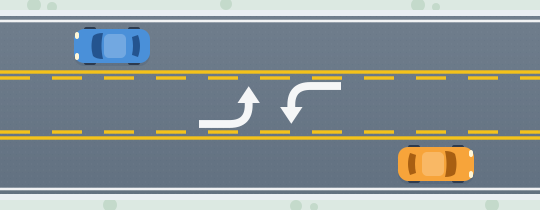
The street in the picture has a middle lane edged by a solid and a dashed yellow line on each side, with left-turn arrows pointing both ways. How does the Alaska Driver Manual say you may use it?
Show answer
Correct answer: Only for left turns, by drivers from either direction
Why
The manual reserves this center lane for left turns, and traffic heading both ways shares it. Driving along it, speeding up in it or passing in it is not allowed. Enter it with care, since a driver coming the other way may be using the same stretch, and give way to oncoming cars and people on foot as you turn.
Alaska DMV knowledge test at a glance
The numbers that matter before test day, online or at a DMV office.
Alaska · Class D knowledge test
16 of 20 to pass.
20 questions · 25 minutes
16 of 20 answers right to pass
Onlineat home for $11.50, or free at a DMV office
Next dayearliest retake, one try a day, no cap
Any officetell staff you’re there for the knowledge test
Translatorbring your own to translate and read the questions aloud at an office
$15for your instruction permit
20/40vision in each eye or both together
Under 18? Your road to a license
14Instruction permitPass the knowledge and vision tests, bring a parent’s signed consent and pay $15.
6 moSupervised practiceDrive only with an adult 21+ who has held a license a year or more beside you, and log 40 hours, 10 of them in darkness, bad weather or other tougher conditions.
16Provisional licensePass the road test with no traffic convictions in the past six months.
16–17Provisional limitsNo driving 1–5 a.m. except for work or with a parent, guardian or licensed adult 21+. No passengers under 21 except siblings, unless a parent, guardian or adult 21+ rides along.
18Limits liftedThey end at 18, or sooner after six months on the provisional license with no traffic convictions and a fresh parental consent.
18 or older? There’s no minimum permit period: pass the knowledge and vision tests, practice on your permit, then take the road test.
What’s on the Alaska permit test
The DMV test draws only on the Alaska Driver Manual: traffic laws, safe driving and highway signs, plus the state’s DUI and insurance rules. Master these six areas first.
Road signs
Read the color first: yellow warns, orange means road work, green gives directions, blue points to services.
An orange triangle on a vehicle’s back marks something that travels 25 mph or slower.
Traffic Safety Corridors: headlights on all day, and fines double, just as in work zones.
Right-of-way
Arrive together at an uncontrolled intersection? Yield to the right. Signals dark? Stop first.
Siren, or a flashing red or blue light: pull to the right edge and stop.
School bus flashing red: traffic from both directions stops at least 30 feet away, unless the bus is across a divided highway.
Speed limits
No sign? 15 mph in an alley, 20 in a business district, 25 in a residential area, 55 elsewhere.
20 mph past a marked school crosswalk, and no more than 20 past a bus flashing yellow.
Five vehicles stuck behind you on a two-lane road outside town? Use the next safe turnout.
Parking
Keep 15 feet from a hydrant, 20 from a crosswalk and 30 from a stop sign.
Park no closer than 50 feet to a railroad crossing’s nearest rail, or 20 feet to a fire station driveway.
Engine off and key out before you walk away; skip the parking brake only if it could freeze.
Alcohol & phones
BAC limits: 0.08% at 21+, 0.04% in a commercial vehicle, and no alcohol at all under 21.
Refusing a breath test after a DUI arrest is a crime of its own.
Texting and video screens are off-limits for every driver; voice calls and navigation are allowed.
Teen rules
Your supervisor: 21 or older, licensed a year or more, in the seat beside you.
Provisional, 1–5 a.m.: stay off the road unless a parent, guardian or licensed adult 21+ is with you or you’re driving for work.
Provisional passengers under 21: siblings only, unless a parent, guardian or adult 21+ is also in the car.
Alaska numbers to know
Distances and limits to have down cold before test day.
100 ftof steady signaling before you turn
30 ftback from a school bus flashing red
15–50 ftfrom the nearest rail when a crossing makes you stop
500 ftfrom an oncoming car, switch to low beams
4 secfollowing gap the Alaska manual teaches
50/100/25minimum liability insurance, in thousands of dollars
Your Alaska course, in your pocket
These 40 questions are just the warm-up. The app gives you 488 Alaska practice questions, 36 short lessons and the why behind every answer.
36 short lessonsFour levels, from fundamentals to expert, then a full practice exam.
488 Alaska questions347 of them with pictures.
Your most-missed questionsA review lesson built from the questions you miss most.
Exam simulatorTake full practice exams and watch your readiness grow.
Alaska permit
Your Alaska path is ready.
36 lessons, 488 questions and full practice exams. In English and Spanish.
How many questions are on the Alaska permit test, and what’s a passing score?
The Alaska DMV knowledge test has 20 questions, and you need at least 16 right (80%), so you can miss four. You get 25 minutes. There’s no separate road-sign section: signs, traffic laws and safe driving are mixed into one test, along with Alaska’s DUI and insurance laws.
How many times can I take the Alaska knowledge test?
As many times as you need, one try a day: fail today and you can test again tomorrow. Getting help from a phone, notes or another person during the test bars you from testing for seven days. Once you pass, the result stays good for one year.
Can I take the Alaska permit test online?
Yes. Through the DMV’s KnowTo Drive Online system you can test from home for $11.50 per attempt, on a desktop or laptop with a webcam (phones and tablets won’t work). At a DMV office the test is free, and you just tell staff you’re there for it. In communities with no DMV office, approved proctors such as schools, troopers and Village Public Safety Officers give the test.
Can I take the Alaska permit test in Spanish?
The online test is English only, and the Alaska Driver Manual has no Spanish edition. At a DMV office, if you don’t understand English, you may bring someone to translate the questions and read them to you, though that person can’t help you choose answers; for other language needs, contact your local office. This practice test is in Spanish too, and so is the app.
How old do you have to be to get a permit in Alaska?
14. Under 18, the parent or guardian who signs your application becomes legally liable for your driving. After six months on the permit, 40 logged hours (10 in tougher conditions) and a road test, you can get a provisional license at 16. Until 18, or until six clean months earn you a regular license, two limits apply: no driving 1–5 a.m. except for work or with a parent, guardian or licensed adult 21+, and no passengers under 21 but siblings unless a parent, guardian or adult 21+ rides along.
How much does an Alaska permit cost?
The instruction permit is $15, and the knowledge test is free at a DMV office ($11.50 if you take it online). The road test costs $15, and a Class D license is $20, or $40 for the REAL ID version. A permit is good for two years and can be renewed once, for $5.
What’s on the Alaska road test?
Bring a registered, insured vehicle in good working order with about a quarter tank of fuel; nobody else rides along. The examiner scores tasks such as starting and stopping, parallel parking or a three-point turn, a quick stop, backing, turns, lane changes and following distance. Book it online with the DMV or through a business partner or driving school, and reschedule for free up to 24 hours ahead.
What’s the best way to study for the Alaska permit test?
Read the Alaska Driver Manual, since every test question comes from it, then practice until 16 of 20 feels easy. Start with the 40 questions above, then let the app take you through 488 Alaska questions and 36 short lessons, with every answer explained.