Get ready for the Ohio BMV knowledge test, what other states call the DMV written test, with 40 free questions on road signs, Ohio speed limits, OVI laws and teen driving rules. Tap an answer and see right away why it’s correct.
Four rounds of 10 questions on Ohio road signs, right-of-way, speed limits, parking, OVI and phone laws, and teen rules. Every answer comes with a quick explanation.
Round 1 · Questions 1–10
1Sharing the road
On a two-lane country road in Ohio you come up behind a tractor. Fixed to its rear is an orange triangle with a red reflective border. What does that emblem tell you?
Show answer
Correct answer: The vehicle travels slower than 25 mph
Why
That triangle is the slow-moving vehicle emblem. In Ohio it marks farm machinery, construction equipment and horse-drawn buggies that move at under 25 mph, so you will close the gap quickly. Ease off early; you may cross a solid yellow line to get around one only if it's going under half the posted limit, the oncoming lane is clear and you stay within the limit yourself.
2Right-of-way
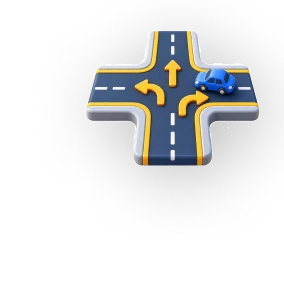
You're stopped at a red light in downtown Columbus and want to turn left. When does Ohio allow a left turn on red after a full stop?
Show answer
Correct answer: Only when the street you're on and the street you're turning onto both carry one-way traffic, with no sign against it
Why
Ohio lets you turn left on red in just one case: you're in the far-left lane of a one-way street, turning onto a street where traffic also runs one way, after a complete stop and with no sign prohibiting it. Right turns on red are allowed more widely, also after a full stop and while yielding to crossing traffic and pedestrians. Check for a NO TURN ON RED sign before either turn.
3Speed limits
Ohio's basic speed law sets a limit you must follow whatever number is posted. What is it?
Show answer
Correct answer: Keep your speed low enough to halt inside the stretch of open road you can see in front of you
Why
Ohio law calls it the assured clear distance ahead: your speed must let you stop within the stretch of road you can see is clear, and it must suit traffic and road conditions. In fog, snow or on a dark curve, that can mean driving well under the sign. If you couldn't stop in the space you see, you're going too fast.
4Parking
You spot an open curb space near a fire hydrant. How close to the hydrant does Ohio law let you park?
Show answer
Correct answer: No closer than 10 feet
Why
Ohio bans standing or parking within 10 feet of a fire hydrant. Fire crews need clear access to hook up a hose fast, so give more room when you can. Pair this number with two others: 20 feet from an intersection crosswalk and 30 feet from a stop sign.
5Alcohol & phones
A 20-year-old had one beer at a cookout and is stopped on the drive home. A breath test reads 0.03%. Under Ohio law, what's the situation?
Show answer
Correct answer: A violation, because the limit for drivers under 21 is 0.02%
Why
Ohio sets a 0.02% limit for drivers under 21; the offense is called OVUAC, operating a vehicle after underage alcohol consumption. At 0.08% the adult OVI law applies, and commercial drivers are held to 0.04%. An underage conviction can bring a suspension of 3 months to 2 years.
6Safe driving
How much following distance does the Ohio Driver Manual recommend behind the car ahead?
Show answer
Correct answer: At least four seconds
Why
Pick a fixed point such as a sign; when the car ahead passes it, start counting. If you reach the point before four seconds, back off. Ohio's manual also gives a rule of thumb of one car length for every 10 mph, and asks for more room at night, in bad weather, on slick roads and behind large vehicles.
7Permit & teen rules
What's the earliest age at which you can take the Ohio knowledge test and get a temporary instruction permit (TIPIC)?
Show answer
Correct answer: 15 years and 6 months
Why
Ohio lets you take the vision screening and knowledge test at 15 years and 6 months. After you pass, you have 60 days to buy the TIPIC at a Deputy Registrar License Agency, and a parent or guardian co-signs if you're under 18. The permit is good for one year.
8Road signs
A yellow diamond sign reads ONE LANE BRIDGE, and a pickup is heading toward the same bridge from the far side. According to the Ohio Driver Manual, which vehicle may cross first?
Show answer
Correct answer: The one nearest the bridge
Why
Only one vehicle fits on the bridge at a time, and Ohio gives the right-of-way to whoever is closer to it. If the pickup will reach it before you, slow down, stop short of the entrance and wait until it has cleared. Speeding up to claim the bridge only sets up a head-on standoff.
9Right-of-way
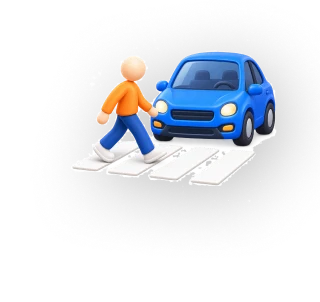
A school bus stops on a two-lane road to let children off. Its red lights flash and the stop arm swings out. Under Ohio law, who has to stop?
Show answer
Correct answer: Drivers from both directions, staying at least 10 feet back
Why
On a road with fewer than four lanes, traffic from both directions must halt 10 or more feet away and wait until the bus moves or its driver waves them on. Only on highways with four or more lanes may drivers coming the other way keep going; drivers behind the bus always stop. Flashing amber lights mean the bus is about to stop, and passing it illegally can cost up to $500 and a license suspension.
10Crashes & emergencies
Your car breaks down on a rural Ohio highway after dark. You've steered onto the shoulder and turned on your flashers. If you carry flares, where should they go?
Show answer
Correct answer: About 200 to 300 feet behind the car
Why
Flares set 200 to 300 feet back give approaching drivers time to spot trouble and change lanes before they reach you. Get the car as far off the road as you can and keep the hazard flashers on. Stay clear of passing traffic while you place them.
Round 2 · Questions 11–20
11Speed limits
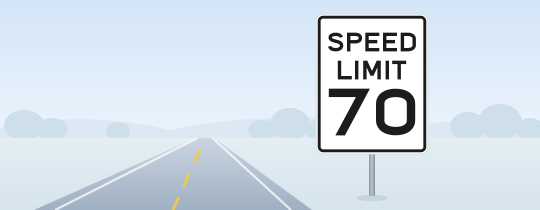
In Ohio, which kind of road can carry a SPEED LIMIT 70 sign like this one?
Show answer
Correct answer: A rural freeway, such as an interstate through open country
Why
70 mph is the top speed limit anywhere in Ohio, and only rural freeways get it. Rural expressways without signals top out at 65 mph, and freeways in urban areas usually run 55 or 65. Whatever the sign says, slow down when traffic or weather calls for it.
12Road signs
Orange signs, cones and barrels mark a work zone on an Ohio highway, but you don't see anyone working. What does the Ohio Driver Manual expect from you?
Show answer
Correct answer: Slow down anyway, since speeding there can double your fine and even lead to jail
Why
Orange is the color of work zones, and the hazards stay even when the crew is out of sight: lane shifts, rough pavement, equipment parked close to traffic. Speeding in an Ohio work zone can cost double the normal fine, and jail time is possible. Obey any flagger, keep extra space and watch for workers stepping out.
13Right-of-way
You and another driver pull up to a four-way stop at the same moment. The other car is on the street to your right. Who goes first?
Show answer
Correct answer: The driver on your right
Why
When two vehicles arrive together, Ohio has you yield to the one on your right; otherwise, the first to arrive is the first to go. Make eye contact and wait for a clear sign the other driver is moving before you pull out. A wave is a courtesy, not a promise.
14Parking
On the approach to a stop sign, how far back must your parked car be in Ohio?
Show answer
Correct answer: At least 30 feet
Why
Ohio keeps parked cars at least 30 feet back from a stop sign, a yield sign or a traffic signal on the approach side. A car parked closer would hide the sign and cross traffic from other drivers. Railroad crossings need even more room: 50 feet from the nearest rail.
15Alcohol & phones
Arrested for OVI for the first time, a driver refuses to take a breath, blood or urine test. What happens to the license?
Show answer
Correct answer: An immediate administrative suspension of one year
Why
Driving in Ohio means you've already agreed to chemical testing if you're arrested for OVI. A first refusal brings an on-the-spot administrative suspension of one year, and it stands even if you're later found not guilty. Testing over the limit on a first offense, by comparison, brings a 90-day administrative suspension.
16Safe driving
It's midday, a steady rain is falling and your windshield wipers are running. What does Ohio law say about your headlights?
Show answer
Correct answer: They must be on whenever rain or snow has your wipers going
Why
Ohio ties headlights to wipers: if precipitation has your wipers on, your headlights must be on too. They're also required from sunset to sunrise and whenever you can't see people and vehicles 1,000 feet ahead. Parking lights alone don't count at any of those times.
17Permit & teen rules
You're 16 and a half with a TIPIC. Who may sit beside you as your supervising driver?
Show answer
Correct answer: Any licensed driver who is 21 or older
Why
From age 16, Ohio lets a permit holder practice with any licensed driver aged 21+ sitting next to them. Before 16, the list narrows to a parent, guardian or custodian, a licensed driving instructor, or an adult 21+ acting in place of a parent. Your supervisor must be sober, and everyone in the car buckles up.
18Lane markings
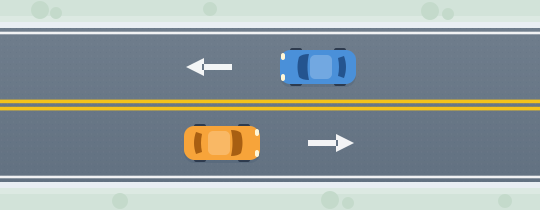
A double solid yellow line runs down the middle of your two-lane road. When does Ohio allow you to cross it?
Show answer
Correct answer: To turn left into a driveway, or to pass a slow-moving vehicle such as a bicycle when it's safe
Why
A double solid yellow line bans passing from both directions. Ohio still lets you cross it to turn left into a driveway, or to get around a slow-moving vehicle, such as a bicycle or one with the orange triangle, when the oncoming lane is clear. A car that's simply a little slow doesn't qualify.
19Speed limits
You turn onto a residential street inside an Ohio city and haven't passed a speed limit sign. What limit applies?
Show answer
Correct answer: 25 mph
Why
Unless signs say otherwise, Ohio sets 25 mph on streets inside a city or village. Alleys drop to 15 mph, while state routes running through town outside business districts rise to 35 mph. On a neighborhood street with no sign in sight, 25 is the number to remember.
20Permit & teen rules
Before the driving test, how much supervised practice must an Ohio driver under 21 log on top of driver education?
Show answer
Correct answer: 50 hours, at least 10 of them at night
Why
Ohio requires 50 hours behind the wheel with a supervising driver, including at least 10 after dark. You record them on the notarized BMV 5791 Fifty-Hour Affidavit and bring it to your driving test. The RoadReady Ohio app can track the hours for you.
Round 3 · Questions 21–30
21Road signs
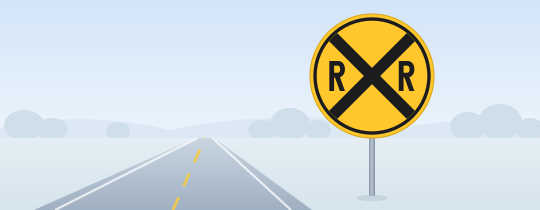
Past a round yellow sign marked with an X and the letters RR, you reach a crossing where the red lights are flashing. Under Ohio law, where should your car come to a stop?
Show answer
Correct answer: No closer than 15 feet and no farther than 50 feet from the nearest rail
Why
The round yellow sign is your early warning; the white X-shaped crossbuck marks the tracks themselves. When signals flash, a gate is lowered or a train is near, Ohio requires you to stop within 50 feet of the nearest rail but not closer than 15 feet. Never drive around or under a gate that is down or moving.
22Road signs
The side street you're on meets a busier road, and a red-and-white triangle pointing downward stands at the corner. In which situation does it require a full stop?
Show answer
Correct answer: Only when other traffic is close enough that you'd get in its way
Why
That's a YIELD sign. Slow down and check both ways; if the road is clear you may keep rolling, but anyone near enough to be affected goes first. The Ohio Driver Manual adds that you yield to all oncoming traffic, so be ready to stop rather than squeeze in.
23Right-of-way
On a divided highway with a grass median, an ambulance with lights and siren is racing along the opposite side. What should you do?
Show answer
Correct answer: Keep driving with care, since you don't have to pull over for it
Why
Ohio’s pull-right-and-stop rule covers emergency vehicles coming from either direction, with one exception: a vehicle traveling the opposite way on a divided highway. An ambulance across the median can’t reach your lanes, so stopping would only create a new hazard. If one comes up behind you, though, move right, stop and wait until it passes.
24Parking
Which of these parking spots is legal in Ohio?
Show answer
Correct answer: 25 feet from a fire station driveway, on the same side of the street
Why
Near a fire station, Ohio's rule is 20 feet from the driveway, or 75 feet across the street where signs are posted, so 25 feet on the same side is fine. The other spots all break the law: hydrants need 10 feet, intersection crosswalks 20 feet and railroad crossings 50 feet, measured from the closest rail.
25Alcohol & phones
Under Ohio's hands-free law, which of these may an adult driver do while driving?
Show answer
Correct answer: Answer a call with one tap on a mounted phone and talk hands-free
Why
Ohio law bars holding, supporting or using a phone while you drive, with a few exceptions. Adults may talk hands-free, start a call with a single tap or swipe, or hold the phone to an ear during a call, but they can’t type. Calling emergency services is always allowed, and a first offense can cost up to $150 and 2 points.
26Safe driving
Even where no sign prohibits it, when is a U-turn against Ohio law?
Show answer
Correct answer: On a curve or near a hilltop where other drivers couldn't see you from 500 feet away
Why
A U-turn leaves you crosswise in the road, so Ohio bans it on a curve, or close to a hilltop or on the climb toward one, whenever drivers coming from either direction couldn't see you within 500 feet. Choose a spot with a long clear view both ways, or go around the block. Where a sign shows a U-turn arrow in a red circle with a slash, don't turn at all.
27Permit & teen rules
You're 16 with a TIPIC. Unless a licensed parent, guardian or custodian rides with you, during which hours can't you drive?
Show answer
Correct answer: Midnight to 6 a.m.
Why
Permit holders under 18 may not drive between midnight and 6 a.m. unless a parent, guardian or custodian with a valid Ohio license sits beside them. The 1 to 5 a.m. window comes later, for probationary drivers past their first year. Plan practice drives so you're home before midnight.
28Sharing the road
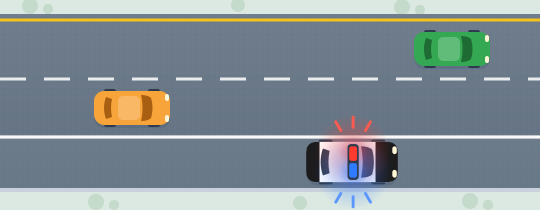
On a highway with two lanes in your direction, you're approaching a police car stopped on the right shoulder with its lights flashing. What does Ohio's Move Over law tell you to do?
Show answer
Correct answer: Move to the lane away from the police car if you safely can; if not, slow down and pass with caution
Why
Ohio's Move Over law covers stopped police and emergency vehicles, tow trucks, highway maintenance and waste collection trucks with flashing lights. Shift over a lane when traffic allows; if you can't, slow down and stay alert as you pass. Breaking this law costs twice the usual fine.
29Speed limits
When does Ohio's 20 mph school zone limit apply?
Show answer
Correct answer: During school recess and while children are arriving or leaving, where 20 mph school signs are posted
Why
Ohio's school zone limit is 20 mph during recess and while children are going to or leaving school, wherever the 20 mph school signs are up. State law doesn't require flashing lights to mark those times, so don't wait for a beacon to slow down. Watch for kids stepping out between parked cars.
30Permit & teen rules
During the first 12 months with an Ohio probationary license, how many passengers who aren't family members may you carry without a parent, guardian or custodian in the car?
Show answer
Correct answer: One
Why
For the first year, Ohio limits a probationary driver to one non-family passenger unless a parent, guardian or custodian is along. Every rider also needs a seat belt of their own, and everyone buckles up. Fewer friends in the car means fewer distractions while you build experience.
Round 4 · Questions 31–40
31Right-of-way
A yellow diamond sign with three arrows chasing each other in a circle warns that a roundabout is ahead. When you reach it, who has the right-of-way?
Show answer
Correct answer: Vehicles already circling inside the roundabout
Why
Traffic in a roundabout flows counterclockwise, and drivers coming in yield to vehicles already circulating. Wait for a gap, enter to the right and keep moving. Once you're inside, don't stop or switch lanes until you're about to exit.
32Road signs
Where are you most likely to find a red circle crossed by a white horizontal bar with the words DO NOT ENTER?
Show answer
Correct answer: Where a one-way road meets another street, and at freeway exit ramps
Why
DO NOT ENTER guards roads where all traffic comes toward you: the wrong end of a one-way street and the bottom of a freeway exit ramp. If you realize you've passed one, pull over where it's safe and turn around. At highway speed, a wrong turn onto a ramp can mean a head-on crash.
33Road signs
Any Ohio sign that shows a black symbol inside a red circle with a red diagonal slash across it is telling you what?
Show answer
Correct answer: The action shown is not allowed
Why
The Ohio Driver Manual calls these prohibitory signs: the red circle and slash simply mean NO. The symbol inside tells you what's banned, such as a U-turn or a left turn. Read the symbol first and the meaning follows.
34Parking
When you parallel park on an Ohio street, what is the farthest your wheels may be from the curb?
Show answer
Correct answer: 12 inches
Why
Ohio's manual has you park parallel to the curb, facing the same way as traffic, with your wheels no more than 12 inches away. On a one-way street you may use either curb. Park too far out and you squeeze the lane for everyone passing.
35Alcohol & phones
You're 17 and drive with a probationary license. Which use of your phone is allowed while you're driving?
Show answer
Correct answer: Calling 911 to report an emergency
Why
Ohio bars drivers under 18 from using a phone or other wireless device in any way, even hands-free and even while stopped in traffic. The exceptions are emergencies, being parked out of the travel lane, and navigation used hands-free. A first violation means a $150 fine and a 60-day suspension.
36Alcohol & phones
Your friend in the passenger seat wants to open a can of beer while you drive on an Ohio highway. What does state law say?
Show answer
Correct answer: It's banned, because the law covers the driver and every passenger
Why
Ohio's open container law applies to everyone riding in a motor vehicle on a public road or in a parking area, not only the driver. The exceptions are narrow, such as a passenger in a hired limousine. If you're carrying alcohol, keep it sealed and out of reach, ideally in the trunk.
37Safe driving
At night, an oncoming car's bright headlights are making it hard for you to see. Where should you look?
Show answer
Correct answer: Toward the right edge of the road
Why
Glancing toward the right edge of the road keeps you on course without taking the full glare. Don't answer with your own high beams; Ohio has you dim them for oncoming traffic. Tinted lenses at night only make things darker.
38Safe driving
You plan to turn right into a parking lot ahead. Under Ohio law, when should your turn signal be on?
Show answer
Correct answer: Steadily through the final 100 feet, or more, leading up to the turn
Why
Ohio wants your signal blinking without a break over the final 100 feet or more before you turn or shift right or left, and the same goes for lane changes. You also signal before stopping or slowing suddenly. Hand signals are legal too, which helps if a bulb burns out.
39Permit & teen rules
You're 19 and applying for your first Ohio license. Since September 30, 2025, what do you need before the driving test?
Show answer
Correct answer: Driver education and 50 hours of supervised practice, but no six-month permit wait
Why
Ohio now requires drivers aged 18, 19 and 20 to finish driver training, 24 hours of class plus 8 hours with an instructor, and to log 50 supervised hours. Unlike younger teens, they don’t have to hold the permit for six months first. Most first-time drivers 21 and older need training only if they fail their first driving test.
40Lane markings
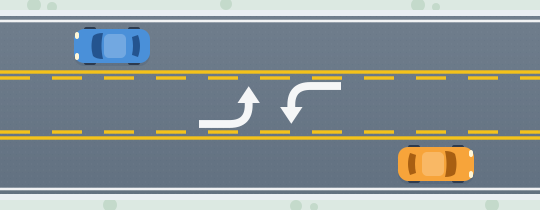
The middle lane of a busy road has a pair of yellow lines along each edge, one solid and one dashed, and white turn arrows inside it point opposite ways. How may you use it?
Show answer
Correct answer: Only to make a left turn, from either direction
Why
You’re looking at a lane shared by left-turning drivers from both directions. Signal, move into it just before your turn, and wait there for a gap. Ohio’s manual says never to use it for passing or as a lane to drive along.
Ohio BMV knowledge test at a glance
The numbers that matter before test day, online or in person.
Ohio · BMV knowledge test
75% to pass.
40 questions · Multiple choice
30 of 40 answers right to pass
Onlinefrom home with a webcam, or at a Driver Exam Station
2 triesonline in any 6 months, 24 hours apart
24 hourswait after a fail; in person, no cap on tries
Spanishtext and audio, one of 9 test languages
$26.50for your permit (TIPIC)
20/40vision needed for day and night driving
Under 18? Your road to a license
15½Temporary permitPass the vision screening and the 40-question test, then buy your TIPIC within 60 days, with a parent or guardian co-signing.
6 moPractice and driver edHold the permit at least six months, finish driver ed (24 hours of class, 8 behind the wheel) and log 50 hours, 10 of them at night.
16Probationary licensePass the maneuverability and on-road driving tests, and you’re licensed.
Year 1First-year limitsNo driving midnight–6 a.m. (work, school and religious trips with papers excepted) and one non-family passenger at most, unless a parent or guardian rides along.
Year 2Until you turn 18No driving 1–5 a.m., with the same exceptions, and no phone use at all, not even hands-free.
18 to 20? Since September 30, 2025, you need driver ed and 50 practice hours too, but no six-month wait. At 21 or older, most new drivers just get a permit and pass the driving test.
What’s on the Ohio permit test
Study the Ohio Driver Manual, also called the Digest of Ohio Motor Vehicle Laws (HSY 7607, edition 10/25). Sections 2 through 10 cover the signs and Ohio laws the test asks about. Here’s what to know cold in six key areas.
Road signs
Shape and color speak first: yellow diamonds warn, orange means a work zone, and a red circle with a slash means NO.
A round yellow sign with an X and RR warns of a railroad crossing; the white X-shaped crossbuck marks the tracks.
At a ONE LANE BRIDGE sign, the vehicle closest to the bridge crosses first.
Right-of-way
Two cars, one four-way stop, same arrival? The driver on the right goes first.
Turning left on a green with no arrow: wait for a safe gap in oncoming traffic.
School bus flashing red: stop at least 10 feet away. On roads with four or more lanes, only traffic behind it has to stop.
Speed limits
Assured clear distance: never so fast that you can’t stop within the road you can see ahead.
25 mph on city streets, 20 mph in posted school zones at school times, 15 mph in alleys.
70 mph is Ohio’s top limit, on rural freeways; highways outside cities default to 55.
Parking
Stay 10 feet from a fire hydrant and 20 feet from any crosswalk at an intersection.
Keep 30 feet back from a stop sign or signal, and 50 feet back from the closest rail at a train crossing.
Park pointing the way traffic moves, with your tires at most 12 inches off the curb.
Alcohol & phones
OVI limits: 0.08% for adults, 0.04% in a commercial vehicle, 0.02% under 21.
Refuse the chemical test once and lose your license for a year on the spot, conviction or not.
Adults may not text, type or scroll with a phone in hand. Under 18, no phone use even hands-free, except emergencies and hands-free GPS.
Teen rules
Permit holders under 18 stay off the road midnight–6 a.m. unless a licensed parent, guardian or custodian rides along.
First probationary year: one non-family passenger at most without a parent, guardian or custodian.
A teen driver’s first phone offense means a $150 fine and a 60-day suspension.
Ohio numbers to know
Six Ohio figures worth knowing by heart before test day.
100 ftof signaling before a turn or lane change
10 ftfrom a fire hydrant when you park
30 ftfrom a stop sign, yield sign or signal
15–50 ftfrom the nearest rail when you stop for a train
4 secfollowing distance the Ohio manual recommends
0.02%BAC limit for drivers under 21
Your Ohio course, in your pocket
These 40 questions are just the warm-up. The app gives you 486 Ohio practice questions, 36 short lessons and the why behind every answer.
36 short lessonsFour levels, from fundamentals to expert, then a full practice exam.
486 Ohio questions325 of them with pictures.
Your most-missed questionsA review lesson built from the questions you miss most.
Exam simulatorTake full practice exams and watch your readiness grow.
Ohio permit
Your Ohio path is ready.
36 lessons, 486 questions and full practice exams. In English and Spanish.
How many questions are on the Ohio BMV permit test, and what’s a passing score?
40 multiple-choice questions on traffic signs and Ohio motor vehicle laws, given by the Bureau of Motor Vehicles (BMV), Ohio’s version of the DMV. You need 75% to pass, which means at least 30 right. You’ll also need to pass a vision screening before your permit is issued.
How many times can I take the Ohio knowledge test?
In person there’s no limit: after a fail, wait 24 hours and try again, at most once a day. Online you get two attempts in any six-month period, at least 24 hours apart, and after that you test in person.
Can I take the Ohio permit test online?
Yes. Through BMV Online Services you can test on a computer or laptop with a working webcam (not a phone or tablet), and anyone under 19 needs a supervising adult who passes an identity check. You can also test at a Driver Exam Station or a select Deputy Registrar License Agency. After an online pass, the Deputy Registrar does your vision screening when you buy the permit.
Can I take the Ohio permit test in Spanish?
Yes. The BMV gives the knowledge test in Spanish as both text and audio, alongside Arabic, Chinese, French, Haitian Creole, Japanese, Russian, Somali and English, plus American Sign Language. The Ohio Driver Manual has no Spanish edition, so this practice test and the app, both in Spanish, make studying easier.
How old do you have to be to get a permit in Ohio?
15½. Under 18, you hold the TIPIC at least six months, finish driver ed and log 50 supervised hours, 10 at night, before a probationary license at 16. In the first year, no driving midnight–6 a.m. (unless a parent or guardian rides along or you carry papers for work, school or a religious event) and no more than one non-family passenger without a parent or guardian; after that and until 18, no driving 1–5 a.m. Phones are off-limits the whole time, even hands-free, except for emergencies and hands-free navigation.
How much does an Ohio permit cost?
The TIPIC costs $26.50, Deputy Registrar fee included. Buy it within 60 days of passing the knowledge test and vision screening, or you’ll have to start over. If you get your first license at 16, it costs $28.75.
What’s on the Ohio driving test?
Two parts: a maneuverability test, where you steer forward through a 9-by-20-foot box of markers and then back out, and an on-road drive with an examiner. Knocking down or running over a marker fails you on the spot. You book it through BMV Online Services. If you’re under 21, bring your Fifty-Hour Affidavit, and if you don’t pass, you can retest after two days.
What’s the best way to study for the Ohio permit test?
Read Sections 2 through 10 of the Ohio Driver Manual, then practice until 75% feels easy. Start with the 40 questions above, then let the app walk you through 486 Ohio questions and 36 short lessons, with an explanation for every answer.