Get ready for the Iowa DOT knowledge test with 40 free questions on road signs, the new 60 mph limit, OWI and hands-free laws, and teen license rules. Every answer comes with an instant explanation.
Four rounds of ten: Iowa road signs, who goes first, speed limits, parking, OWI and hands-free rules, and the teen license steps. Every answer is explained the moment you pick it.
Round 1 · Questions 1–10
1Speed limits
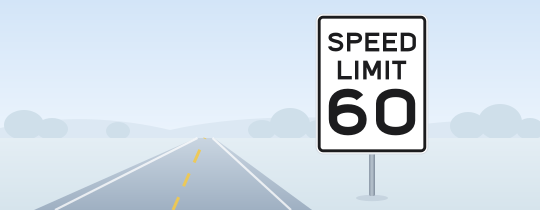
Since July 1, 2026, Iowa’s general speed limit has been 60 mph, the number on this sign. Where does it apply when no other limit is posted?
Show answer
Correct answer: On primary highways and paved secondary roads
Why
Senate File 378 moved Iowa’s unposted limit from 55 to 60 mph for primary roads and paved secondary roads. Unpaved roads keep their own rules, including 50 mph after sunset, and towns run much lower, so keep reading the signs as you go.
2Right-of-way
Driving a gravel road in rural Iowa, you reach a crossroads with no stop or yield signs. A pickup is coming from the road on your right and will get there when you do. Who goes first?
Show answer
Correct answer: The pickup on your right
Why
When two vehicles arrive from different roads at about the same time, Iowa law has the driver on the left yield to the one on the right. Crossroads with no signs at all are common on Iowa’s gravel roads, so ease off before each one and be ready to stop.
3Permit & teen rules
In Iowa, how old must you be to get an instruction permit?
Show answer
Correct answer: 14
Why
The permit opens at 14, once you pass the vision and knowledge tests and a parent or guardian gives written consent. 14½ is a different milestone: the earliest age for the optional special minor’s license, which needs driver ed and six clean months on a permit.
4Alcohol & phones
Iowa’s hands-free law is in force. When may you hold your phone to read a text?
Show answer
Correct answer: Only after you’ve stopped off the traveled part of the road
Why
Since July 1, 2025, no Iowa driver may hold, view or work a phone while driving unless fully stopped off the traveled roadway, and sitting at a red light in your lane doesn’t qualify. Voice commands and single-touch controls are the legal way to call on the move. Getting caught is a moving violation with a $100 fine.
5Parking
What is the closest Iowa law lets you park to a fire hydrant?
Show answer
Correct answer: 5 feet
Why
Iowa draws the line at 5 feet from a hydrant. Treat that as a bare minimum and leave more when you can, since fire crews need room to connect a hose. Two more Iowa numbers pair well with it: a stop sign or signal needs 10 feet, and a train crossing needs 50, counted from the closest rail.
6Road signs
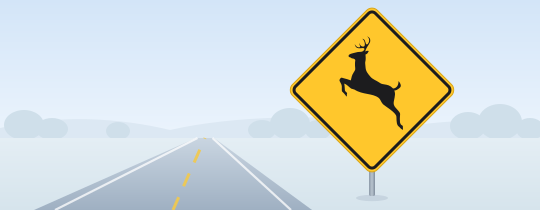
You pass a yellow diamond warning sign with a leaping deer on it. According to Iowa’s driver manual, in which months do deer crashes peak?
Show answer
Correct answer: October, November and May
Why
Iowa’s manual flags October, November and May as the high-risk months. Where this sign is posted, slow down and watch both ditches, since deer travel in groups. If you can’t avoid hitting one, don’t swerve: veering away usually ends in a worse crash than the hit itself.
7Safe driving
You’re on a 55 mph Iowa highway and plan to turn right onto a county road. For at least how many feet before the turn must your signal be blinking?
Show answer
Correct answer: 300 feet
Why
Iowa uses two distances: a steady signal for at least the last 100 feet where the limit is 45 mph or less, and at least 300 feet where it’s higher. At 55 mph you cover 300 feet in under four seconds, so the drivers behind you need that early warning.
8Right-of-way
An oncoming school bus switches on its flashing amber lights. What is the fastest Iowa law lets you go as you meet it?
Show answer
Correct answer: 20 mph
Why
Amber lights warn that the bus is about to stop. From that moment Iowa caps you at 20 mph, and you must be ready to halt once the red lights flash and the stop arm swings out. On roads posted 45 mph or more, buses switch on the ambers 300 to 500 feet before the stop, so react right away.
9Sharing the road
On a snowy Iowa highway you come up behind a snowplow. What does the Iowa manual tell you?
Show answer
Correct answer: Plows usually move at 25 to 35 mph, and you should never pass one on the shoulder side
Why
Plows work slowly, often 25 to 35 mph, and many crashes happen when drivers come up on them too fast. They push snow toward the shoulder, so never pass on that side. Hang back, since a plow kicks up snow clouds and its blade can stick out past the truck, and pass only when you can clearly see the road ahead.
10Alcohol & phones
Suspected of OWI, an Iowa driver refuses the breath test. On a first offense, how does the license penalty compare with failing the test?
Show answer
Correct answer: It’s heavier: one year instead of 180 days
Why
Driving in Iowa means you’ve already agreed to a blood, breath or urine test when an officer has reasonable grounds to suspect OWI. A first refusal brings a one-year revocation, twice as long as the 180 days for testing at 0.08% or higher. Saying no only makes things worse.
Round 2 · Questions 11–20
11Sharing the road
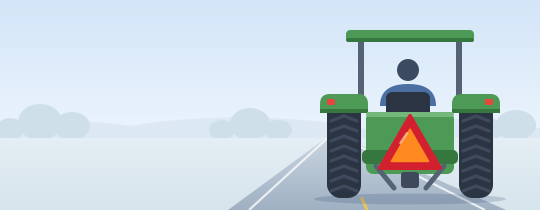
It’s harvest season, and the farm tractor ahead has an orange triangle edged in red on its back. What does Iowa’s manual say that emblem tells you?
Show answer
Correct answer: It moves at 35 mph or slower
Why
That’s the slow-moving vehicle emblem, used on farm machinery, road equipment and horse-drawn wagons that go 35 mph or less. At highway speed you close the gap within seconds, so lift off the gas as soon as you spot it. Pass only where it’s legal and you can see far enough ahead.
12Road signs
Orange signs mark a road work zone on Interstate 80 in Iowa, and you’re cited there for following too closely. What happens to the scheduled fine?
Show answer
Correct answer: It’s doubled
Why
Iowa doubles the scheduled fine for moving violations inside a signed road work zone, and speeding there has its own, steeper scale that starts at $195. The zone runs from the first work-zone sign to the one that ends it, crews or no crews. Slow down early, merge when told and leave extra space.
13Speed limits
You drive into the business district of a small Iowa town, and no speed limit sign is in sight. What limit applies?
Show answer
Correct answer: 20 mph
Why
Iowa law sets 20 mph in business districts unless signs say otherwise, while residence and school districts default to 25 mph. Storefront streets mean parked cars, opening doors and people stepping out between them, so the low number makes sense.
14Permit & teen rules
You have an Iowa intermediate license and no qualified adult is riding with you. During which hours are you not allowed to drive?
Show answer
Correct answer: 12:30 a.m. to 5 a.m.
Why
On an intermediate license you may drive on your own from 5 a.m. until 12:30 a.m.; in between, a qualified adult has to ride along. A parent can sign a waiver (form 431170) for trips to and from school activities or work, and it must stay in the car.
15Alcohol & phones
What’s the lowest blood alcohol level at which a 20-year-old driver breaks Iowa law, and what does a first offense bring?
Show answer
Correct answer: 0.02%, with a 60-day revocation
Why
Iowa holds drivers under 21 to 0.02%. Between 0.02% and 0.08%, a first offense means a 60-day revocation (90 days after an earlier one); at 0.08% or above, the adult OWI rules apply, starting at 180 days. Under 21, the only safe amount before driving is zero.
16Right-of-way
Downtown Des Moines: you’re stopped at a red light in the leftmost lane, and traffic on your street flows only one direction. The cross street is one-way too, heading to your left, and no sign forbids turning. What may you do?
Show answer
Correct answer: Turn left after your full stop, yielding to pedestrians and cross traffic
Why
Iowa allows a left on red in just this setup: one-way traffic on your street and on the street you’re entering, a full stop first, and the turn made from the left lane. If either street carries two-way traffic, wait for green, and a sign banning turns on red overrides the option.
17Parking
When you park parallel to a curb in Iowa, how far from it may your right-hand wheels be, at most?
Show answer
Correct answer: 18 inches
Why
Iowa law calls for right wheels parallel to the curb and within 18 inches of it. Park farther out and your car sticks into the lane, forcing passing drivers and cyclists to swing around you. Before opening your door, check the mirror for bikes.
18Safe driving
At night you catch up to a slower car on an Iowa highway. Once you’re within what distance of it must you switch to low beams, unless you’re passing?
Show answer
Correct answer: 400 feet
Why
Iowa wants low beams within 400 feet of a vehicle you’re following, so your lights don’t glare at its driver through the mirrors. Oncoming traffic gets a longer buffer: dim when an approaching vehicle is within 1,000 feet.
19Road signs
You stop at a red light in Cedar Rapids, planning to turn right. A white sign next to the signal reads NO TURN ON RED. What should you do?
Show answer
Correct answer: Wait for the green light
Why
Iowa normally allows a right turn on red after a full stop, as long as you yield to all traffic, but this sign cancels that permission. Stay put until the light changes. When it turns green, still check for people in the crosswalk before you go.
20Crashes & emergencies
You’re in a minor fender bender on a busy Iowa street. No one is hurt and both cars still run fine. What does Iowa’s Steer It-Clear It law call for?
Show answer
Correct answer: Move both cars out of the traffic lanes, then stop
Why
When a crash damages only vehicles and yours can still be driven safely, Iowa wants it moved to the shoulder, median or emergency lane first, which helps prevent a second collision. Then stop, check on each other and exchange information. If anyone is hurt, call police right away.
Round 3 · Questions 21–30
21Right-of-way
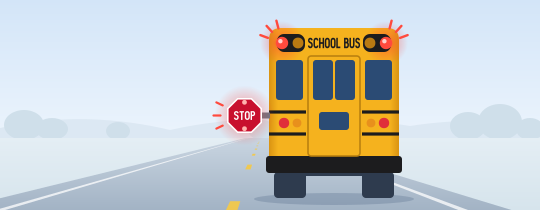
You’re following a school bus on a two-lane road when it stops, flashes its red lights and swings out the stop arm, as shown. Under Iowa law, where do you stop and for how long?
Show answer
Correct answer: At least 15 feet behind it, until the arm is pulled back and the bus moves on
Why
Iowa wants you at least 15 feet back, and you remain there until the driver folds the arm back in and the bus pulls away. On a road with two or three lanes, oncoming drivers stop too; only where there are two or more lanes in each direction may oncoming traffic keep going. A first offense for passing illegally costs $345 to $930.
22Speed limits
Thick fog rolls over an Iowa highway posted at 65 mph. What does Iowa’s basic speed rule require?
Show answer
Correct answer: A pace at which you could stop before reaching the edge of what you can see
Why
The posted number is a ceiling, not a target. Iowa ties your speed to the assured clear distance ahead: if fog lets you see only a few car lengths, you must be able to stop within those few car lengths. Turn on your headlights too, since Iowa requires them whenever you can’t see clearly 500 feet ahead.
23Permit & teen rules
You’re 15 with an Iowa instruction permit. Which of these people may sit beside you as your supervising driver?
Show answer
Correct answer: Your licensed 22-year-old brother
Why
Iowa lists who qualifies: a parent, guardian or custodian, an immediate family member 21 or older, a driver education instructor, or anyone 25 or older with your parent’s written permission. Whoever it is needs a valid license for the vehicle and must sit in the seat next to you.
24Alcohol & phones
Your phone is in a dashboard mount with hands-free mode on. Which of these is still against Iowa law while you drive?
Show answer
Correct answer: Watching a video clip on the mounted screen
Why
Hands-free means voice commands and one-touch actions, not screen time. Even with the phone mounted, Iowa bans watching video, video calls, streaming, gaming and reading messages while you drive. Type your destination in before you shift out of park.
25Parking
You leave your car parked on a steep street in Dubuque. What does Iowa law require on a slope?
Show answer
Correct answer: Set the brake and angle the front tires toward the curb or roadside
Why
Iowa law asks for two things on any grade: a firmly set brake and front tires angled toward the curb or roadside. If the brake ever lets go, the tires catch the curb or steer off the road instead of rolling into traffic.
26Road signs
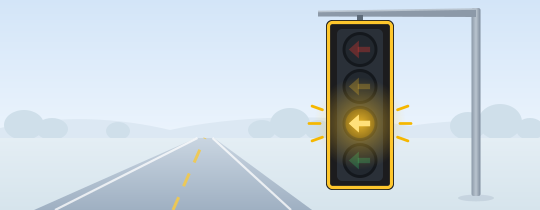
The left-turn signal ahead shows the flashing yellow arrow pictured. What does it allow you to do?
Show answer
Correct answer: Turn left only after yielding to oncoming traffic and pedestrians
Why
A flashing yellow arrow means oncoming traffic has a green at the same moment, so your turn is allowed but not protected. Wait for a safe gap, let people in the crosswalk finish, and then complete the turn.
27Safe driving
You’re on a side road at a reduced-conflict intersection, or J-turn, on a four-lane Iowa highway, and you want to head left. How is it done?
Show answer
Correct answer: Turn right, move to the left lane, then make a U-turn at the marked median opening
Why
J-turns replace dangerous crossings of fast four-lane traffic. You enter with a simple right turn, work over to the left lane, then U-turn at the marked opening in the median, so you only ever merge with one direction of traffic at a time.
28Right-of-way
A teenager on a skateboard starts across an unmarked crosswalk at a corner in Iowa City. What does Iowa law require of you?
Show answer
Correct answer: Yield, just as you would to someone walking
Why
Since a 2024 change, Iowa gives people using human-powered devices, such as wheelchairs, strollers, skateboards and scooters, the same crosswalk right-of-way as walkers. That covers unmarked crosswalks at intersections, where no lines are painted. Stop and let the rider cross completely.
29Speed limits
In a suburban district at the edge of an Iowa city, no speed limit is posted. What is the legal limit?
Show answer
Correct answer: 45 mph
Why
Iowa law sets 45 mph in suburban districts unless signs say otherwise. Closer in, the defaults drop to 25 mph in residence and school districts and 20 mph in business districts. Watch for the signs where one district turns into the next.
30Road signs
Your car stalls on a railroad crossing in rural Iowa. Once everyone is out and far from the tracks, which sign should you look for?
Show answer
Correct answer: The blue-and-white Emergency Notification System sign with a phone number and crossing ID
Why
Getting everyone out and away comes first, because a train can’t stop quickly. Then find the blue-and-white ENS sign at the crossing and call the number on it, giving the crossing ID so the railroad can warn oncoming trains.
Round 4 · Questions 31–40
31Crashes & emergencies
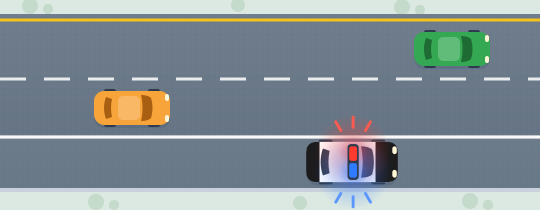
You’re driving the right-hand lane of a divided Iowa highway, two lanes each way, when you see a patrol car stopped on the shoulder with its lights flashing, as pictured. You can safely change lanes. What does Iowa’s Move Over or Slow Down law require?
Show answer
Correct answer: Move into the lane farther from the patrol car
Why
If you can do it safely, shift to a lane that isn’t next to the stopped vehicle; if you can’t, slow below the posted limit and be ready to stop. Iowa applies the rule to police, tow, utility, road crew and garbage trucks, and even to an ordinary car with its hazard lights on. A violation costs $135.
32Road signs
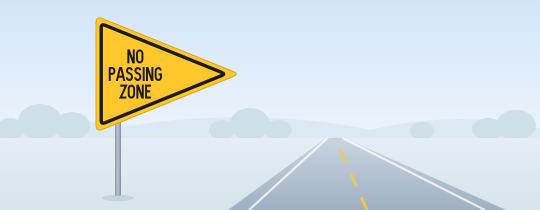
On a two-lane Iowa highway, a yellow sign shaped like a sideways pennant and lettered NO PASSING ZONE stands beside the road on the driver’s side. What does it tell you?
Show answer
Correct answer: From here on, you may not pass on the left
Why
The pennant goes on the left, where a driver thinking about passing will see it, at the point where the no-passing zone begins. Iowa also forbids passing in the last 100 feet before an intersection, railroad crossing or signed narrow bridge, and wherever a hillcrest or curve hides oncoming traffic.
33Permit & teen rules
Before an Iowa teen trades the permit for an intermediate license, how much supervised driving must a parent certify?
Show answer
Correct answer: 20 hours, 2 of them at night
Why
Iowa asks for 20 hours on streets and highways, at least two between sunset and sunrise, on top of 12 months with the permit and six months free of crashes and violations. The 10-hour figure belongs to the next step: you log 10 more (2 at night) on the intermediate license before the full one.
34Alcohol & phones
You’re driving friends home in Iowa, and one of them has an opened bottle of wine. Where may it legally ride?
Show answer
Correct answer: In the trunk
Why
Iowa bans open alcohol, and open THC beverages, anywhere in the passenger area, and the glove box counts as part of it. Put it in the trunk; in a vehicle without a trunk, behind the last upright seat. Sealed is always safest.
35Parking
Which of these parking spots breaks Iowa law?
Show answer
Correct answer: 35 feet short of a train crossing’s closest rail
Why
At train crossings, Iowa’s parking gap is 50 feet, counted from the closest rail, so 35 is too close. The other spots clear Iowa’s minimums: 5 feet from a hydrant, 10 feet from a stop sign or signal, and 20 feet from a fire station driveway on the same side.
36Safe driving
It’s mid-afternoon, and blowing snow keeps you from clearly seeing cars 500 feet ahead on an Iowa road. What does state law say about headlights?
Show answer
Correct answer: They’re required right now
Why
Iowa requires headlights from sunset to sunrise and any time fog, snow, sleet or rain keeps you from clearly seeing people and vehicles 500 feet away. The manual adds an easy habit: if the wipers are on, the headlights should be on too.
37Speed limits
On a rural Iowa interstate, what is the speed limit, and which vehicles aren’t allowed on the road at all?
Show answer
Correct answer: 70 mph; vehicles that can’t reach and hold 40 mph
Why
Iowa’s rural interstates are posted at 70 mph, though the DOT sets lower limits on some stretches, such as through cities. Anything that can’t reach and keep up 40 mph is kept off entirely, since a vehicle that slow is a hazard among 70 mph traffic.
38Permit & teen rules
You got your Iowa intermediate license last month, and your parent didn’t waive the passenger limit. With no adult in the car, how many unrelated passengers under 18 may ride with you?
Show answer
Correct answer: One
Why
For the first six months, Iowa lets an intermediate driver carry only one unrelated passenger under 18 without an adult, unless a parent waived the rule at the counter when the license was issued; it can’t be waived later. A brother or sister doesn’t count toward that one. Whatever the limit, never carry more riders than seat belts.
39Right-of-way
A fire truck answering an alarm passes you with its siren on, and you’re heading the same way. How closely may you follow it under Iowa law?
Show answer
Correct answer: No closer than 500 feet
Why
Iowa bars following a fire truck on an alarm run any closer than 500 feet, and the manual asks for the same gap behind any emergency vehicle using lights and siren. When one comes toward you or up behind you, pull to the right edge, clear of any intersection, and stop until it passes.
40Safe driving
Iowa’s manual has new drivers keep at least three seconds behind the car ahead on dry roads. How much gap does it call for on a slippery road?
Show answer
Correct answer: 6 seconds or more
Why
Ice and slush stretch your stopping distance, so the manual asks for six seconds or more, the same as when the vehicle in front blocks your view. To measure it, pick a fixed point like a sign and count from when the car ahead passes it until you do.
Iowa DOT knowledge test at a glance
Key numbers to know before test day.
Iowa · DOT knowledge test
Aim for 80% or better.
Signs + traffic laws · One test
80% is the passing line on Iowa DOT’s own practice test
$6instruction permit, good for up to 4 years
At homeonline permit test for teens under 18, with a parent as proctor
Spanishone of 20 test languages, written and audio
180 dayshow long a passing score stays valid
20/40vision for a license with no restriction
Any officetest at any DOT center or county treasurer, not just the closest
Under 18? Your road to a license
14Instruction permitPass the vision and knowledge tests, bring ID plus residency and Social Security proof, and get a parent’s written consent.
14½School license (optional)With driver ed done and six clean months on the permit, a special minor’s license lets you drive alone, within limits, to school, activities and work.
16Intermediate licenseAfter 12 months on the permit, approved driver ed, 20 supervised hours (2 at night) and six months with no crash or violation.
Year 1Intermediate limitsNo solo driving 12:30–5 a.m. without a signed school or work waiver. For the first six months, one unrelated passenger under 18, unless a parent waived that limit at issue.
17Full licenseHold the intermediate license 12 months, log 10 more supervised hours (2 at night) and keep a clean record for that year.
18 or older? You can skip driver ed and the permit wait: pass the vision screening, the knowledge test and a driving test.
What’s on the Iowa permit test
Study the Iowa Driver’s License Manual (form M1170, July 2026 edition). A single test covers Iowa traffic laws and highway signs, so start with these six areas.
Road signs
Look left for the yellow pennant: past it, passing is off-limits.
A reflective orange triangle on a tractor, road machine or wagon means 35 mph or less.
Flashing red: stop, then go when clear. Flashing yellow arrow: turn left only after yielding.
Right-of-way
Two cars, no signs, same moment? The driver on the left yields to the one on the right.
Walkers, wheelchairs, strollers, skateboards and scooters all get the right-of-way in crosswalks, marked or not.
Meeting a bus with flashing ambers: 20 mph max. Behind a stopped bus with its arm out: stop 15+ feet back.
Speed limits
Whatever the sign says, your speed must let you stop inside the clear road you can see.
Unposted limits: 20 mph in business districts, 25 in residence and school districts, 45 in suburban ones.
Since July 1, 2026, primary and paved secondary roads default to 60 mph; rural interstates reach 70.
Parking
Keep 5 feet from a hydrant, 10 feet from a stop sign or signal, 50 feet from a crossing’s closest rail.
Right wheels parallel to the curb and no more than 18 inches from it.
On any slope: brake set, front tires angled toward the curb or roadside.
Alcohol & phones
BAC limits: 0.08% for adults, 0.04% in a commercial vehicle, 0.02% under 21.
Refusing a chemical test costs a year of driving, longer than failing it.
Hands-free only, for every driver: no holding, typing, watching or reading while you drive.
Teen rules
Permit drivers always have a qualified, licensed supervisor in the front passenger seat.
Intermediate drivers need an adult along from 12:30 to 5 a.m., unless a signed school or work waiver is in the car.
Violations push your next step back: 6 months on a permit, 12 months on an intermediate license.
Iowa numbers to know
Short, specific and easy to mix up: six Iowa figures to lock in before test day.
100 ftof steady signal before a turn at 45 mph or less; 300 ft above that
5 ftminimum gap between a parked car and a hydrant
15–50 ftyour stop zone back from the tracks when a train is coming
1,000 ftdim your high beams for oncoming traffic
3 secminimum following gap for new drivers
60 mphunposted limit on primary and paved roads since July 2026
Your Iowa course, in your pocket
These 40 questions are just the warm-up. The app gives you 474 Iowa practice questions, 36 short lessons and the why behind every answer.
36 short lessonsFour levels, from fundamentals to expert, then a full practice exam.
474 Iowa questions331 of them with pictures.
Your most-missed questionsA review lesson built from the questions you miss most.
Exam simulatorTake full practice exams and watch your readiness grow.
Iowa permit
Your Iowa path is ready.
36 lessons, 474 questions and full practice exams. In English and Spanish.
What score do I need to pass the Iowa permit test?
Aim for 80% or better. That’s the passing line on Iowa DOT’s free online practice test, which draws on questions from the real knowledge test. The exam covers Iowa traffic laws and highway signs, and you also pass a vision screening before the permit is issued.
Can I take the Iowa permit test online at home?
Yes, if you’re a teen. From age 14 until you turn 18, you can take the web-based test at home on a computer (not a phone or tablet) with a parent who holds a valid Iowa license as proctor, or at a participating school through Skip the Trip. The parent’s application takes 7 to 14 days, and after you pass you still visit an office to get the permit. Otherwise, test at a DOT service center (by appointment) or a county treasurer’s office.
Can I take the Iowa knowledge test in Spanish?
Yes. Iowa DOT gives the test with written and audio translation in 20 languages, Spanish among them, and can arrange an interpreter by appointment for other languages. You may also ask for an oral test. The newest manual is English-only (the Spanish edition online is an older, archived one), so this practice test and the app, both in Spanish, help fill the gap.
How many times can I retake the Iowa permit test?
Iowa publishes no fixed limit and no waiting period: a retake is up to the examiner. Once you pass, the result stays valid for 180 days. Between tries, the DOT’s free online practice test serves up 25 random questions per attempt, as often as you like.
How old do you have to be to get a permit in Iowa?
14. With driver ed and six clean months on the permit, you can add a special minor’s license at 14½ for solo trips to school and work. At 16, after 12 months on the permit and 20 supervised hours (2 at night), you can move up to an intermediate license, with no solo driving from 12:30 to 5 a.m. A full license follows at 17, after 12 months on the intermediate license and 10 more supervised hours.
How much does an Iowa permit cost?
$6 for a Class C instruction permit, which stays valid for up to four years. The DOT’s fee list shows no separate charge for the knowledge test. A regular license later costs $4 for each year it’s valid.
Do I need driver’s ed in Iowa, and is there a driving test?
Under 18, yes: an approved course with at least 30 classroom hours and 6 hours behind the wheel, 3 or more of them on streets or highways. Over 93% of teens who finish one skip the DOT driving test, though a parent, instructor or licensing staff can still ask for it, and parent-taught students must take it. Adults getting a first license take the driving test, which in Iowa leaves out parallel parking.
What’s the best way to study for the Iowa permit test?
Read the July 2026 Iowa Driver’s License Manual and make sure you know the newest rules, such as the 60 mph default limit and the hands-free law. Work through the 40 questions above until 80% comes easily, then keep going in the app: 474 Iowa questions and 36 short lessons, each answer explained.