Arizona’s MVD permit test is the state’s version of the DMV written test. Prepare with 40 free questions on road signs, speed limits, DUI laws, dust storms and Class G teen rules, each with an instant explanation.
Four rounds of 10 questions on Arizona road signs, right-of-way, speed limits, parking, DUI and phone laws, teen limits and desert hazards like dust storms and flooded washes, each with a quick explanation.
Round 1 · Questions 1–10
1Road signs
Near an elementary school in Mesa, you pass a five-sided, fluorescent yellow-green sign showing two children walking. Classes are starting, and portable school signs stand in the road ahead. What is your top speed until you’re past the crossing?
Show answer
Correct answer: 15 mph
Why
From the first portable school sign until you’re past the crossing, Arizona’s limit is 15 mph; when those signs aren’t out, the area’s normal limit applies. The five-sided shape warns that children may be crossing, so don’t pass other vehicles in the zone and stop for anyone in the crosswalk. Going over 35 mph there is criminal speeding, not just a ticket.
2Right-of-way
You and a pickup reach a rural intersection in Pinal County with no signs or signals, arriving almost together. The pickup is coming from the road on your left. Who should go first?
Show answer
Correct answer: You, because the driver on the left yields
Why
Arizona’s manual says to treat an intersection with no signs or signals like a 4-way stop: both of you stop, and when two vehicles arrive together, the driver on the left yields to the one on the right. Here the pickup should wait for you, but make sure it’s actually stopping before you roll on.
3Speed limits
You turn onto a residential street in Chandler and see no speed limit sign. What limit applies under Arizona law?
Show answer
Correct answer: 25 mph
Why
Unless signs say otherwise, Arizona caps residential and business districts at 25 mph. Treat it as a ceiling, not a target: with kids, parked cars or low sun in your eyes, the basic speed rule may call for less.
4Parking
You find an open curb space next to a fire hydrant in Tempe. How close to the hydrant may you park?
Show answer
Correct answer: No closer than 15 feet
Why
Arizona keeps parked cars 15 feet or more from a fire hydrant, so fire crews can reach it and hook up quickly. Learn two more distances with it: 20 feet from an intersection crosswalk and 30 feet before a stop sign.
5Alcohol & phones
A 19-year-old has one beer at a lake party, then drives home. A breath test shows 0.02. What’s true in Arizona?
Show answer
Correct answer: It’s illegal: drivers under 21 may have no alcohol at all
Why
Arizona has zero tolerance for drivers under 21: any alcohol in the body while driving breaks the law. The 0.08 limit is for adults 21 and older, and a driver under 18 convicted of drinking and driving loses the license for two years.
6Safe driving
On a dry Phoenix freeway, how much following distance does the Arizona Driver License Manual recommend, and what changes on slick pavement?
Show answer
Correct answer: At least 3 seconds; 6 or more on slippery roads
Why
Pick a fixed point such as an overpass shadow; when the car ahead passes it, start counting. Reaching it in under three seconds means you’re following too closely. When the road is slippery, double that cushion to six seconds or more.
7Permit & teen rules
What’s the earliest age at which you can get a Class G graduated instruction permit in Arizona?
Show answer
Correct answer: 15 years and 6 months
Why
Arizona issues the graduated instruction permit at 15 and a half, and it’s valid for 12 months. Pass the written test first, at home through a parent’s AZ MVD Now account or at an MVD office, then finish the paperwork with a parent or guardian’s signature.
8Lane markings
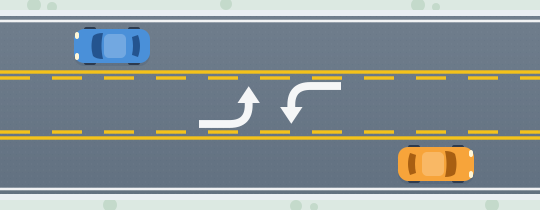
The middle lane of a busy Mesa road has yellow edge lines, solid on the outer side and dashed on the inner side, plus left-turn arrows facing both directions. What does Arizona law allow in this lane?
Show answer
Correct answer: Left turns and legal U-turns only
Why
In Arizona this shared center lane serves only drivers turning left or making an allowed U-turn: slow down in it before a left off the road, or pull into it when turning left out of a driveway. Passing, cruising along it or using it to build speed before merging all break the rule.
9Crashes & emergencies
A wall of blowing dust sweeps across I-10 between Phoenix and Tucson, and you can barely see past your hood. What does Arizona’s “Pull Aside, Stay Alive” advice tell you to do?
Show answer
Correct answer: Pull completely off the road, lights off, foot off the brake
Why
Drivers behind you may steer toward any lights they can see and run into your parked car. Slow down, pull completely off the pavement, never stopping in a travel lane or on the shoulder, then turn off every light, including flashers, set the parking brake and take your foot off the brake pedal. Stay buckled in until the dust passes.
10Road signs
Your car overheats on a lonely stretch of an Arizona state highway, and you call 911. What should you look for so you can tell responders exactly where you are?
Show answer
Correct answer: The number on the closest mile post
Why
Arizona is one of the few states with mile posts along every state highway, spaced about a mile apart. Give the dispatcher the highway and the nearest marker number; a town you drove through could be many miles behind you. On long desert drives, make a habit of noticing them.
Round 2 · Questions 11–20
11Speed limits
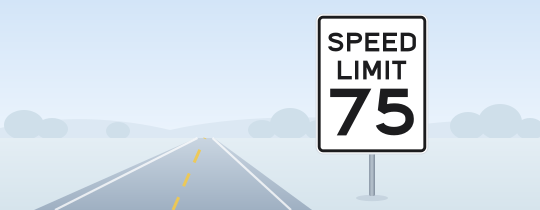
Where in Arizona would you expect to see a SPEED LIMIT 75 sign like this one?
Show answer
Correct answer: On a rural interstate where ADOT has posted it
Why
75 mph is Arizona’s highest limit. Where no other limit applies, state law sets 65 mph, and ADOT may raise rural interstates to 75 by posting signs. Even there, slow down when wind, dust or heavy traffic make that speed unsafe.
12Right-of-way
Your street ends where it meets a through road, forming a T, and neither road has signs. Which driver has the right-of-way?
Show answer
Correct answer: Drivers on the through road
Why
At an uncontrolled T intersection, Arizona has the driver on the road that ends yield to traffic on the road that continues. Stop if you need to, check both directions and wait for a gap that lets you turn without forcing anyone to brake.
13Parking
Looking for street parking in Yuma, you spot four open spaces. Which one is legal?
Show answer
Correct answer: 25 feet from a fire station driveway, same side
Why
Arizona asks for 20 feet from a fire station driveway on the same side (75 feet across the street where posted), so 25 feet works. The other spaces are too close: stop signs need 30 feet, intersection crosswalks 20 feet and railroad crossings 50 feet from the nearest rail.
14Alcohol & phones
Arrested for DUI for the first time, a driver refuses the breath and blood tests. What happens to the driver’s license?
Show answer
Correct answer: It’s suspended for 12 months
Why
Driving in Arizona means you’ve already agreed to a breath, blood or urine test after a DUI arrest. A refusal costs 12 months of suspension, and a second refusal within 84 months costs two years. Testing over the limit brings a 90-day suspension from MVD, even before any court case.
15Safe driving
You’re about to turn right into a shopping center. Under Arizona law, how long must your turn signal be on beforehand?
Show answer
Correct answer: Without a break for at least the last 100 feet
Why
Arizona requires an unbroken signal over at least the final 100 feet before a turn, roughly four seconds of warning. Signal early enough that drivers behind can react, and make sure the blinker shuts off once you’ve straightened out.
16Permit & teen rules
You’re 16 with an Arizona instruction permit. Who may sit beside you as your supervising driver?
Show answer
Correct answer: A licensed driver aged 21 or over
Why
Arizona requires a licensed driver age 21 or older, holding a class A, B, C or D license, in the seat beside a permit driver, and you must have your permit with you. A 19-year-old sibling with a license doesn’t qualify, however experienced.
17Sharing the road
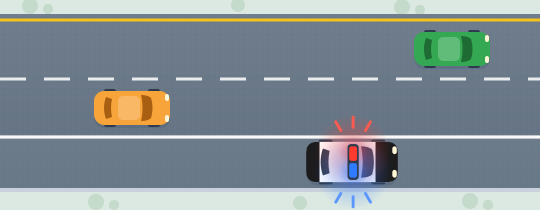
A police car sits on the right shoulder with its lights flashing, and you’re in the lane next to it on a highway with two lanes in your direction. What does Arizona’s Move Over law tell you to do?
Show answer
Correct answer: Move to the far lane if you safely can, otherwise slow down
Why
Arizona’s Move Over law covers any vehicle stopped with flashing or warning lights, from patrol cars and tow trucks to a family car with its hazards on. Shift to a lane that isn’t next to it when you safely can, or slow down if you can’t. A first violation costs $275, rising to $500 and then $1,000 for repeats within five years.
18Road signs
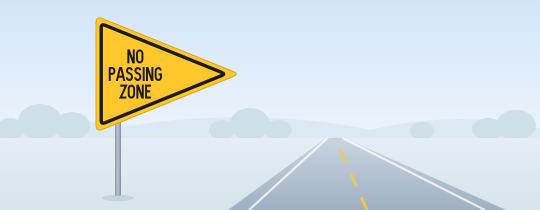
On a two-lane highway outside Flagstaff, a sideways yellow triangle shaped like a pennant is posted along the left shoulder. What message is it giving you?
Show answer
Correct answer: A no-passing zone begins here
Why
The pennant marks where a no-passing zone starts, and it sits on the left so it faces anyone thinking about pulling out to pass. Arizona also keeps you on your side of the center line near hilltops or curves that hide oncoming cars, and whenever an intersection or a railroad crossing is 100 feet away or closer.
19Speed limits
It’s a dark, rainy night on a winding road posted at 55 mph. What does Arizona’s basic speed law require of you?
Show answer
Correct answer: Choose a speed that’s reasonable and prudent for conditions
Why
Arizona’s basic speed rule sits underneath every posted number: drive no faster than conditions allow, and slow enough to avoid hitting anything ahead. Rain, darkness and curves can make the posted number too fast, so ease off until you feel in control.
20Crashes & emergencies
After a summer storm, muddy water is flowing through a dip where the road crosses a wash, and a barricade blocks the way. What happens if you drive around it and have to be rescued?
Show answer
Correct answer: You may have to pay for the rescue, up to $2,000
Why
Under Arizona’s so-called Stupid Motorist Law, a driver who goes around flood barricades and needs rescuing can be billed for the emergency response, up to $2,000. Flash floods rise fast and water in a wash is often deeper than it looks, so turn around and find another route.
Round 3 · Questions 21–30
21Right-of-way
You’re behind a school bus on a two-lane road when it stops, flashes its red lights and swings out its stop arm. Which drivers must stop?
Show answer
Correct answer: Traffic in both directions
Why
On a road that isn’t physically divided, Arizona stops traffic from both directions until the bus moves on or its signals go off. Passing a stopped bus costs at least $250 the first time; a second offense within three years brings at least $750 and up to six months of suspension.
22Road signs
In Gilbert, a yellow diamond sign with three curved arrows forming a loop warns that a roundabout is coming up. How should you enter it?
Show answer
Correct answer: Slow to 15–20 mph and yield to traffic already circling
Why
Arizona roundabouts are designed to be driven at 15 to 20 mph. Vehicles already in the circle have the right-of-way, so wait for a gap and enter keeping to the right of the center island. Once you’re in, keep moving until your exit.
23Right-of-way
A monsoon storm knocks out power in Tucson, and the traffic lights at a busy intersection go dark. How should you get through?
Show answer
Correct answer: Come to a full stop and take turns, as at an all-way stop
Why
Arizona law treats a dead signal like an all-way stop. Every driver stops completely and goes only when it’s safe; if two cars pull up together, the one on the left lets the right-hand car go first. Expect other drivers to be unsure, so ease through slowly.
24Speed limits
On a Scottsdale road posted at 45 mph, a driver is clocked at 68 mph. How does Arizona treat this?
Show answer
Correct answer: As criminal speeding, because it’s more than 20 mph over
Why
Going more than 20 mph over a posted limit is criminal speeding in Arizona, a class 3 misdemeanor rather than a simple ticket. The same applies above 35 mph near a school crossing, or above 45 mph in a business or residential district with no posted limit. Speeding also puts 3 points on your record.
25Parking
Which of these hill-parking setups follows the Arizona Driver License Manual?
Show answer
Correct answer: Facing uphill beside a curb, wheels angled away, tire touching it
Why
Nose-up next to a curb, turn the wheels left and let the car roll back gently until the front tire meets the curb, so the curb holds the car if the brakes ever let go. Nose-down, angle them toward the curb, and on a hill with no curb, angle them to the right. Set the parking brake every time.
26Alcohol & phones
Under Arizona’s hands-free law, which of these may an adult driver do while driving?
Show answer
Correct answer: Follow spoken directions from a mounted phone set up by voice
Why
Arizona bans holding or supporting a phone with any part of your body, and reading, writing or sending texts, while you drive. Voice commands, an earpiece and a mounted phone used hands-free are fine, and you can always call to report an emergency. A first ticket costs $75 to $149; later ones cost $400.
27Safe driving
On a dark desert highway with your high beams on, you see headlights coming toward you. By what distance must you switch to low beams?
Show answer
Correct answer: 500 feet
Why
Arizona law has you dim within 500 feet of an oncoming vehicle and within 200 feet when you’re behind one. Headlights are required from sunset to sunrise, and anytime people and vehicles aren’t clearly visible 500 feet ahead.
28Permit & teen rules
A teen skips driver education and every defensive driving course. How much supervised practice must a parent certify before the teen can get a Class G license?
Show answer
Correct answer: 30 hours, 10 at night
Why
Without a course, a parent or guardian signs off on at least 30 hours behind the wheel, 10 of them after dark. Finishing an MVD-approved driver ed program replaces that log and waives the road test, while a course from a traffic survival school or a Supreme Court-approved defensive driving school lowers it to 20 hours, 6 at night.
29Lane markings
It’s 7:30 on a Tuesday morning on a Phoenix-area freeway, and you’re driving alone in a car with standard plates. May you use the lane marked with white diamonds?
Show answer
Correct answer: No, at this hour it’s for vehicles carrying 2 or more people
Why
Arizona’s HOV lanes require at least two occupants, driver included, on weekdays from 6 to 9 a.m. and 3 to 7 p.m., and motorcycles may use them too. A solo driver there during those hours faces a $200 civil penalty. Arizona has no marked entry or exit points, so you may move in or out wherever it’s safe.
30Road signs
As you near a railroad crossing, its red lights begin to flash and a train is on the way. Where does Arizona law tell you to stop?
Show answer
Correct answer: 15 to 50 feet short of the closest rail
Why
Your stopping point must leave at least 15 feet, but no more than 50, between your car and the closest rail whenever crossing lights flash, a gate comes down, a flagger signals or a train is close. Wait there until it’s safe. Never slip around a gate that’s lowered or still moving, and don’t turn around on the tracks.
Round 4 · Questions 31–40
31Road signs
Orange barrels and a diamond-shaped orange ROAD WORK AHEAD sign mark a construction project on I-17. What changes for a driver caught speeding inside this posted work zone?
Show answer
Correct answer: The speeding fine can double
Why
Arizona doubles speeding fines in posted work zones. Lanes shift, the pavement can be rough and crews work a few feet from moving traffic, so ease off early, leave extra space and follow any flagger’s directions.
32Right-of-way
You’re waiting at a red light in downtown Phoenix. Your street is one-way, and so is the cross street, whose traffic moves to your left. What does Arizona law allow if you want to go left?
Show answer
Correct answer: Turning after a full stop and yielding, unless a sign forbids it
Why
Arizona allows a red-light left in just one setup: both streets carry one-way traffic and the new street flows to the left. Even then you stop completely and yield to pedestrians and cross traffic first. Right on red follows the same steps at most lights. Look for a NO TURN ON RED sign before either one.
33Permit & teen rules
You’ve had your Class G license for three months and want to drive home from a friend’s house at 12:30 at night, with no parent in the car. Is that legal in Arizona?
Show answer
Correct answer: No, it falls inside the midnight-to-5 a.m. curfew
Why
During your first six months on a Class G license, Arizona keeps you off the road from midnight to 5 a.m. unless a licensed parent or guardian sits beside you or you’re going straight to or from a school event, a job, a religious event or a family emergency. Police can’t stop you for this alone, but they can cite it once they’ve pulled you over for something else.
34Speed limits
You’re towing a trailer slowly up a two-lane mountain road near Payson, and passing isn’t safe. When does Arizona law require you to pull into the next turnout?
Show answer
Correct answer: When 5 or more vehicles are lined up behind you
Why
A slow driver with five or more vehicles stacked up behind must use the nearest safe turnout and let them by whenever the road doesn’t allow a safe pass. Signal, pull over, let the line clear and merge back when it’s safe. It keeps impatient drivers from risky passes on blind curves.
35Alcohol & phones
A driver’s breath test reads 0.06, but the officer watched the car drift across lanes for a mile. Can the driver still be convicted of DUI in Arizona?
Show answer
Correct answer: Yes, if alcohol or drugs impaired the driver to the slightest degree
Why
Arizona doesn’t rely on 0.08 alone: a driver can also be convicted when alcohol, drugs or both cause impairment to the slightest degree. A BAC of 0.08 or more within two hours of driving is a separate violation, and extreme DUI starts at 0.15, with tougher penalties.
36Safe driving
Passing a slow truck on a two-lane highway, you see a car coming the other way. Arizona law requires you to be back in your own lane before you come within how many feet of that car?
Show answer
Correct answer: 100 feet
Why
Be fully back on your side while more than 100 feet still separates you from the oncoming car. Two cars close that gap in a blink, so start a pass only with a long clear view ahead, and drop back if there’s any doubt.
37Right-of-way
You’re heading south on a road with two lanes each way and a center two-way left-turn lane. On the northbound side, a school bus halts with its red lights blinking and its stop arm out. What’s required of you?
Show answer
Correct answer: Stop, because a painted turn lane doesn’t count as a divider
Why
Oncoming drivers may continue past a stopped school bus only when a physical barrier or separation splits the road. Painted stripes and a center turn lane don’t qualify in Arizona, so traffic on both sides waits for the bus to move or its lights to go off.
38Alcohol & phones
You’re 15½ and practicing on your instruction permit, with your mom in the passenger seat. A friend calls. May you answer through the car’s hands-free system?
Show answer
Correct answer: No, a permit holder can’t use any phone, even hands-free
Why
Arizona bars permit holders from using any wireless device while driving, hands-free included, except in an emergency when stopping isn’t possible or safe. The ban carries into the first six months of a Class G license, where the only extra allowance is spoken navigation set before the trip. Let the call go to voicemail.
39Sharing the road
On a Tucson street you’re overtaking a cyclist riding the same direction near the curb. How much room does Arizona law require between your car and the bike?
Show answer
Correct answer: At least 3 feet, until you’re safely past
Why
Arizona sets a minimum of three feet between your vehicle and a bicycle you’re passing, and that space has to last until you’re clear of the rider. If the lane is too narrow to give three feet, wait behind the bike until you can.
40Permit & teen rules
In the first six months with an Arizona Class G license, how many passengers under 18 may you carry, not counting brothers and sisters, if no licensed parent or guardian is in the front seat?
Show answer
Correct answer: One
Why
Arizona allows one passenger under 18 during that stretch, siblings excepted, and lifts the limit when a licensed parent or guardian rides up front. A first violation can bring a fine of up to $75 and 30 more days of restrictions.
Arizona MVD permit test at a glance
Everything to know before test day, at home or at an MVD office.
Arizona · MVD written test
80% to pass.
30 questions · Multiple choice
24 of 30 answers right to pass
$7permit application fee
At homeonline test for teens under 18, with a parent watching
Walk-inno appointment for the test at an MVD office
Spanishone of 11 test languages, with audio available
20/40vision needed in at least one eye
Under 18? Your road to a license
15½Instruction permitPass the 30-question test, online at home or at an MVD office, and get your Class G permit with a parent or guardian’s signature. It’s valid for 12 months.
6 moSupervised practiceHold the permit at least six months, driving only with a licensed driver 21 or older beside you. Log 30 hours, 10 at night, or finish approved driver ed instead.
16Class G licensePass the road test unless approved driver ed waived it. For six months: no driving 12–5 a.m., at most one passenger under 18 besides siblings unless a licensed parent or guardian sits beside you, and phones off except emergencies or preset spoken directions.
18Limits liftedThe Class G limits end after six months or at 18, whichever comes first. At 18 you can keep Class G or switch to a Class D license.
18 or older? Pass the same written test at an MVD office and you can book the road test, with no six-month wait; a Class D operator permit lets you practice with a licensed driver 21 or older beside you.
What’s on the Arizona permit test
Study the Arizona Driver License Manual and Customer Service Guide (form 99-0117, March 2026 edition); ADOT draws the test questions from it. Start with these six areas.
Road signs
A five-sided sign, often fluorescent yellow-green in Arizona, warns of a school crossing; with portable school signs out, the limit is 15 mph.
A yellow pennant on the left shoulder shows where a no-passing zone begins.
Mile posts line every Arizona state highway; note the nearest one if you ever need help.
Right-of-way
Two cars reach an uncontrolled intersection together: the driver on the left lets the one on the right go first.
A traffic signal gone dark works like an all-way stop.
A school bus showing red flashers stops traffic both ways; only oncoming drivers past a physical divider may keep going, and a painted turn lane isn’t one.
Speed limits
Posted limits are a ceiling: in rain, dust or heavy traffic, slow to a reasonable and prudent speed.
Unless posted otherwise: 25 mph in business and residential districts, and 15 mph in a school crossing zone while portable school signs are out.
75 mph is the top limit, found on posted rural interstates; going more than 20 mph over a posted limit is criminal speeding.
Parking
15 feet from a fire hydrant, 20 feet from an intersection crosswalk, 30 feet before a stop sign.
Near train tracks, park at least 50 feet back from the closest rail.
Parked along a curb, keep your right wheels within 18 inches of it.
Alcohol & phones
BAC limits: 0.08 for adults, 0.04 for commercial and ride-share drivers, and zero alcohol under 21.
Refusing a chemical test after a DUI arrest costs you your license for 12 months.
Arizona is hands-free: no holding a phone and no texting while you drive.
Teen rules
Permit drivers need a licensed driver 21 or older in the seat beside them.
First six months on a Class G license: no driving 12–5 a.m. and one passenger under 18 at most besides siblings, unless a licensed parent sits beside you.
Permit holders can’t use a phone at all, hands-free included, unless there’s an emergency.
Arizona numbers to know
Memorize these six and you’ll spot them right away on test day.
100 ftof steady signaling before you turn
15 ftbetween your parked car and a hydrant
15 mphin a school crossing zone while portable school signs are out
3 secfollowing gap, doubled when roads are slick
500 ftto dim high beams for oncoming traffic
75 mphtop limit, on posted rural interstates
Your Arizona course, in your pocket
These 40 questions are just the warm-up. The app gives you 521 Arizona practice questions, 36 short lessons and the why behind every answer.
36 short lessonsFour levels, from fundamentals to expert, then a full practice exam.
521 Arizona questions348 of them with pictures.
Your most-missed questionsA review lesson built from the questions you miss most.
Exam simulatorTake full practice exams and watch your readiness grow.
Arizona permit
Your Arizona path is ready.
36 lessons, 521 questions and full practice exams. In English and Spanish.
How many questions are on the Arizona MVD permit test, and how many do I need right?
The test has 30 multiple-choice questions on Arizona traffic laws, road signs and safe driving, all drawn from the Arizona Driver License Manual. You need 80% to pass, so at least 24 correct answers; miss seven and you’ll have to retake it. It’s given by the Motor Vehicle Division of the Arizona Department of Transportation (ADOT MVD), Arizona’s answer to the DMV.
What if I fail the Arizona written test?
Study the weak spots and try again: ADOT requires a wait of at least seven days after a failed test. If reading is the hurdle, or a second or third attempt doesn’t go well, MVD may offer a verbal test by appointment.
Can I take the Arizona permit test online?
Yes, if you’re under 18. With Permit Test @ Home, a parent or guardian signs in to their own AZ MVD Now account (not yours), pays the $7 fee and supervises while you test; some professional driving schools offer it too. Adults test at an MVD office on a touch-screen computer, with no appointment needed. Either way, you then visit an office for your vision test and photo.
Can I take the Arizona permit test in Spanish?
Yes. Besides English, the written test comes in 10 languages, Spanish included, and MVD offices also offer an audio version. ADOT posts a Spanish translation of the Driver License Manual, and this practice test and the app are in Spanish too.
How old do you have to be to get a permit in Arizona?
15 and a half. Teens hold the Class G permit at least six months (counted from the day an office issues it) and either log 30 supervised hours, 10 at night, or finish approved driver ed, then can be licensed at 16. For the first six months on the license: no driving from midnight to 5 a.m. except to or from school events, work, religious events or family emergencies; no more than one passenger under 18 besides siblings; and phones off except in emergencies or for spoken directions set before the trip. A licensed parent or guardian in the front seat lifts the curfew and passenger limits.
How much does an Arizona permit cost?
The instruction permit application fee is $7, whether you test online or at an office. The license itself is $25 for ages 16 to 39, less for older drivers, and a Travel ID (REAL ID) license is $25.
What’s on the Arizona road test?
First you show you know the signs and can follow spoken directions in English; then you drive with an examiner, and 21 or more penalty points means a fail. Book it on AZMVDNow.gov and bring your own car with working brakes, lights, signals and horn, plus current registration and insurance; driver-assist features like self-parking aren’t allowed. From June 1 to September 22, a car without air conditioning can’t be used for an afternoon test.
What’s the best way to study for the Arizona permit test?
Work through the Arizona Driver License Manual (March 2026 edition), since the test questions come from it, and practice until 80% comes easily. Start with the 40 questions above, then let the app guide you through 521 Arizona questions and 36 short lessons, with every answer explained.