Warm up for the 25-question Kansas written test with 40 free practice questions on road signs, right-of-way, Kansas speed limits, parking and teen driving rules. Tap an answer and the explanation appears instantly.
Four rounds of 10 questions that mix Kansas road signs with the state’s rules on right-of-way, speed, parking, alcohol, phones and teen driving. Each answer comes with a short explanation.
Round 1 · Questions 1–10
1Speed limits
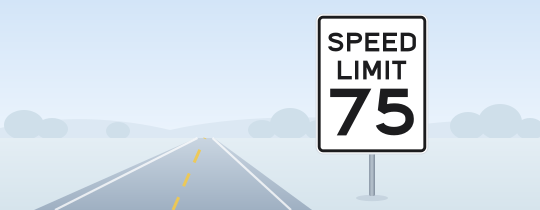
Cruising across Kansas, you pass a white sign that reads SPEED LIMIT 75. Where is a 75 mph limit allowed in this state?
Show answer
Correct answer: Only on divided multilane highways that KDOT designates for it
Why
75 mph is the highest limit in Kansas, and only separated multilane highways picked and posted by KDOT get it. Other state and federal highways default to 65 mph, county and township roads to 55. Even at 75, ease off when wind, rain or heavy traffic makes that speed unsafe.
2Right-of-way
You and a pickup roll to a stop at a four-way stop at the very same moment. The pickup is on the street to your right. Who goes first?
Show answer
Correct answer: The pickup, because it's on your right
Why
At an all-way stop, the first vehicle to stop is the first to go. When two arrive together, the car to your right gets to go ahead. Make sure the other driver is really moving, or really waiting, before you pull out; a wave alone isn't enough to go on.
3Alcohol & phones
A 19-year-old Kansas driver is pulled over after a party, and a breath test reads 0.03. What's the situation?
Show answer
Correct answer: A violation, because the under-21 limit is 0.02
Why
Kansas holds drivers under 21 to 0.02, far below the adult 0.08. A first offense brings a 30-day suspension followed by 180 days of restricted driving, and a repeat means a one-year suspension. For a young driver, no alcohol at all is the only safe plan.
4Permit & teen rules
What's the youngest age at which a Kansas teen can get an instruction permit?
Show answer
Correct answer: 14, with a parent or guardian applying in writing
Why
Kansas issues instruction permits from age 14; under 16, a parent or guardian applies in writing and signs an affidavit at the office. Expect an eye check plus the written exam; a driver education completion form can stand in for the exam. The permit lasts one year.
5Parking
You find an open curbside space near a fire hydrant in Topeka. How close to the hydrant may you park under Kansas law?
Show answer
Correct answer: No closer than 15 feet
Why
Kansas keeps parked cars at least 15 feet from a fire hydrant so firefighters can hook up fast. Learn two more distances with it: 20 feet back from an intersection crosswalk, and 30 feet back from any STOP or YIELD sign, flashing beacon or signal light.
6Safe driving
You plan to turn right into a store parking lot. Under Kansas law, when must your turn signal be on?
Show answer
Correct answer: Without a break for the final 100 feet or more
Why
Kansas wants the blinker going nonstop across the final 100 feet ahead of any turn or lane change. On faster roads, start even earlier so drivers behind you can react. If the lights fail, use your arm: straight out for left, bent up for right, bent down to slow or stop.
7Road signs
Your side street ends at a busier road, and a red-and-white triangle with its point aimed at the ground stands on the corner. What does it ask of you?
Show answer
Correct answer: Slow down, give way to traffic that has priority, and stop if needed
Why
That's a YIELD sign. If nobody is near, you may roll on without stopping, but any car, cyclist or pedestrian close enough to be affected goes ahead of you. Start braking early so a stop, when you need one, is smooth.
8Sharing the road
You come up behind a bicyclist on a two-lane Kansas road marked as a no-passing zone. Oncoming traffic is clear for a long way. What does state law allow?
Show answer
Correct answer: Passing once it's safe, even in the zone, with 3 feet or more of room
Why
Kansas requires at least 3 feet between your car and a bicycle when you pass, and it specifically lets you pass a cyclist in a no-passing zone when it's safe. Wait for a long clear stretch, give a wide berth and move back right only when you're well past the bike.
9Speed limits
You're driving through a small Kansas town and haven't seen a speed limit sign since you came in. What limit applies on its streets?
Show answer
Correct answer: 30 mph
Why
Kansas sets 30 mph in any urban district unless signs say otherwise. Since July 1, 2026, cities may post 25 mph on residential streets without an engineering study first, so keep an eye out for those signs. A posted number always beats the default.
10Crashes & emergencies
You bump another car at a Kansas intersection. Nobody is hurt, no officer is there, and the damage looks like about $1,500. What must you do?
Show answer
Correct answer: Exchange information and report the crash to police right away
Why
Kansas requires an immediate report to police whenever someone is hurt or killed or the damage appears to be $1,000 or more. After a crash like this, stop, share your name, address, registration and insurance, and help anyone who is injured. If nobody is hurt and your car still runs, move it out of the travel lanes on interstates and multilane roads.
Round 2 · Questions 11–20
11Road signs
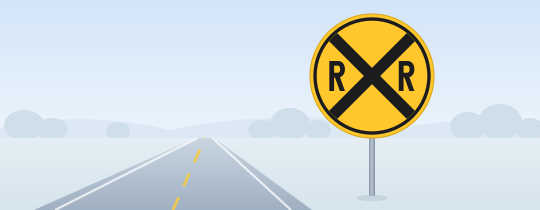
A round yellow sign with a black X and the letters RR comes into view, and just past it the crossing lights start to flash. Where does Kansas law want your car to stop?
Show answer
Correct answer: Somewhere 15 to 50 feet short of the closest rail
Why
The round sign is only the early warning; the stop happens at the crossing itself. When lights flash, a gate comes down, a flagger signals or a train is close, Kansas wants your front bumper at least 15 feet back from the closest rail, and no more than 50 feet back. A gate that is down or moving is never something to drive around.
12Right-of-way
Stopped at a red light in downtown Wichita, you want to turn left. When does Kansas law allow a left turn on a steady red after a full stop?
Show answer
Correct answer: Only when both streets are one-way and the cross street runs to your left
Why
Kansas allows a left on red in one setup only: the street you're on is one-way, the street you're entering is one-way too, and its traffic moves to the left. You still need a complete stop and no sign forbidding it. If you're on a two-way road, a left on red is not legal in Kansas, even where the cross street is one-way, though some states allow it.
13Alcohol & phones
Pulled over on suspicion of DUI, a Kansas driver refuses a breath test for the first time. What happens to the license?
Show answer
Correct answer: A one-year suspension, then two years with an ignition interlock
Why
Under Kansas' implied consent law, driving means you've already agreed to alcohol and drug testing. A first refusal brings a one-year suspension, then two years of driving only with an interlock device. A first DUI conviction, for comparison, means a minimum of 48 hours behind bars, which a judge may swap for 100 hours of community service, plus a $750 to $1,000 fine.
14Permit & teen rules
You're 15 with a Kansas instruction permit. Your 19-year-old brother, licensed for three years, offers to ride along so you can practice. Can he supervise you?
Show answer
Correct answer: No, he's too young; Kansas supervisors have to be 21 or older
Why
A Kansas permit driver needs a licensed supervisor who is at least 21, has a year or more of driving experience and sits right beside them. Nobody else may ride in the front seat. A parent or any other licensed adult who meets those terms can do it.
15Parking
You're circling the block for a legal place to park. Which of these spots does Kansas law allow?
Show answer
Correct answer: 25 feet from a fire station driveway, same side as the station
Why
Kansas asks for 20 feet of clearance from a fire station driveway on the station's own side, so 25 feet works; across the street, posted signs can push that to 75 feet. The other two spots break the law: a train crossing needs 50 feet to the closest rail, and a stop sign needs 30 feet.
16Safe driving
It's midafternoon and steady rain has your wipers running nonstop. What does Kansas law say about your headlights?
Show answer
Correct answer: They must be on while the rain keeps your wipers going
Why
Kansas ties headlights to wipers: if rain, sleet or snow keeps the wipers moving, the headlights go on too. They're also required from sunset to sunrise and whenever you can't clearly make out people and vehicles 1,000 feet ahead. Officers enforce the wiper rule with warning citations.
17Road signs
On a two-lane Kansas road, you notice a yellow sign shaped like a sideways pennant posted on the left shoulder. What is it marking?
Show answer
Correct answer: A no-passing zone starts here
Why
The pennant shape is used only for no-passing zones, and it sits on the driver's side, right where you look before pulling out. Kansas also bans passing within 100 feet of a railroad crossing, or of a bridge, viaduct or tunnel where your view is blocked. Stay in your lane until the zone ends.
18Speed limits
You turn off a state highway onto a county road in rural Kansas. No speed sign is in sight. What's the most you may drive?
Show answer
Correct answer: 55 mph
Why
County and township roads in Kansas default to 55 mph. Other state and U.S. highways default to 65, and only designated divided highways reach 75. On loose gravel or in blowing dust, the basic speed law can call for much less.
19Sharing the road
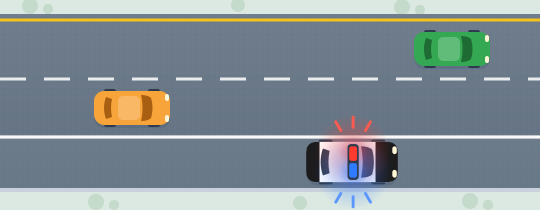
On a four-lane Kansas highway, a police car sits on the right shoulder with its lights flashing, and there's room in the lane to your left. What does the move-over law require?
Show answer
Correct answer: Move over a lane if it's safe; if not, slow down as you pass
Why
When the road gives you two or more lanes heading your way, Kansas wants you to leave the lane next to a stopped emergency vehicle with flashing lights when you safely can, and to slow down if you can't. The same duty covers tow trucks, highway maintenance trucks and waste collection vehicles. Give them room as if someone were standing at the edge of your lane.
20Lane markings
On a two-lane road, the yellow center stripe on your side is solid, while the one on the other side is broken. What does that tell you?
Show answer
Correct answer: You may not pass, but drivers going the other way may
Why
Yellow center lines divide traffic moving in opposite directions, and the stripe closest to you sets your rule. Solid on your side means no passing for you; broken on the other side lets those drivers pass when it's safe. Two solid yellow lines rule out passing both ways.
Round 3 · Questions 21–30
21Road signs
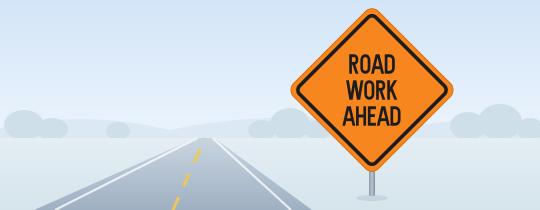
An orange diamond-shaped ROAD WORK AHEAD sign marks a highway project near Salina. Why does it pay to follow the rules extra carefully from here on?
Show answer
Correct answer: Fines for moving violations are doubled in a construction zone
Why
Kansas doubles the fine for moving violations in a road construction zone, so a routine speeding ticket costs twice as much. Since July 1, 2026, your phone also has to stay hands-free in a posted work zone while workers are present. Expect lane shifts, flaggers and equipment pulling onto the road.
22Right-of-way
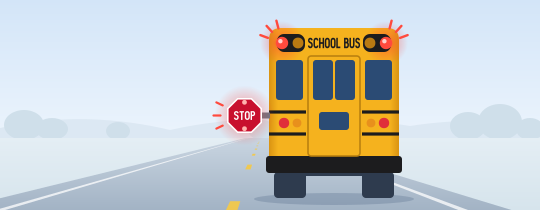
On a two-lane Kansas road, the school bus ahead of you halts, red lights blinking and stop arm swung out. Who has to stop?
Show answer
Correct answer: Drivers from both directions, until the bus moves or its lights go off
Why
On a two-lane road, Kansas makes traffic from both directions halt for a school bus showing flashing red lights and a stop arm. Everyone waits until the bus pulls away or its signals switch off, and church and day care buses get the same treatment. Passing one illegally costs $315 the first time.
23Alcohol & phones
You're 30, cruising an open Kansas highway far from any school or work zone, when your phone lights up. Under state law, which of these may you do?
Show answer
Correct answer: Answer the call and talk
Why
Kansas bans every driver from writing, sending or reading texts, instant messages and email while driving, with a $60 fine, but adults may still make and take calls. Restricted drivers and permit holders under 17 can't use a phone at all. Since July 2026, school zones with the lower limit in effect and work zones with crews present are hands-free only.
24Permit & teen rules
Before a Kansas teen gets a restricted license at 16, how much supervised driving must a parent certify?
Show answer
Correct answer: 50 hours, at least 10 of them at night
Why
Kansas asks for at least 50 hours at the wheel with a licensed adult 21 or older, including 10 or more after dark. A parent or guardian signs an affidavit to confirm it, and the office doesn't ask for a written log. Driver ed time behind the wheel counts if the instructor is 21 or older.
25Parking
You've parallel parked on a steep street in Lawrence, nose up the hill, with a curb beside you. To keep the car out of traffic if the brake slips, how should you leave the front wheels?
Show answer
Correct answer: Turned out, away from the curb
Why
With the wheels turned away from the curb, a car that starts rolling backs into the curb and stops. Facing downhill, turn them toward the curb or the road edge; uphill with no curb, toward the edge. Kansas law also has you set the brake, stop the engine and take the key before you walk away.
26Safe driving
You're on a dark highway with your high beams on when an oncoming car appears. Kansas law requires low beams once that car is within what distance?
Show answer
Correct answer: 500 feet
Why
Dim your lights when an oncoming vehicle comes within 500 feet, and when you're within 300 feet behind another vehicle. High beams can dazzle the other driver, who then can't see you or the road clearly. Switch back up once the car has passed.
27Speed limits
A sudden snow squall hits while you're on a Kansas highway posted at 65 mph. What speed does Kansas law expect from you?
Show answer
Correct answer: Only as fast as is reasonable and safe in the snow
Why
Kansas' basic speed law says your speed must fit the road, the weather and the traffic at that moment. The number on the sign is a ceiling for good conditions, not a target, so driving the limit in a whiteout can still break the law. If you couldn't stop within the distance you can see, slow down.
28Right-of-way
You're on a four-lane Kansas highway split by a wide grass median. On the far side, a school bus heading the opposite way stops with its red lights flashing. What should you do?
Show answer
Correct answer: Keep going with care, since the median separates you
Why
Kansas excuses only drivers going the opposite way on a highway whose roadways are split by a median or other physical barrier. A center turn lane is not a barrier, so on a road with one, both directions stop. Drivers behind the bus must always stop.
29Sharing the road
A pickup with a flat tire is stopped on the shoulder of a Kansas interstate, hazard flashers blinking and a reflective triangle set out behind it. What must you do as you approach?
Show answer
Correct answer: Change to a lane away from it if safe, or slow down if you can't
Why
Since July 1, 2025, Kansas extends move-over-or-slow-down to every stopped vehicle using hazard flashers, flares, cones, warning signs or reflective triangles. Ignoring it can bring a $75 fine. A driver changing a tire on the shoulder is just as exposed as a trooper.
30Safe driving
Outside city limits, you're on a Kansas highway with two lanes in each direction. When should you be in the left lane?
Show answer
Correct answer: To pass or to get ready for a left turn
Why
On rural highways with two lanes each way, Kansas law says keep right except when passing or preparing to turn left, or when signs or another law, like move-over, send you left. On rural stretches with at least three lanes heading your way, the far-left one is kept for passing and left turns. Once you've finished a pass, move back to the right.
Round 4 · Questions 31–40
31Road signs
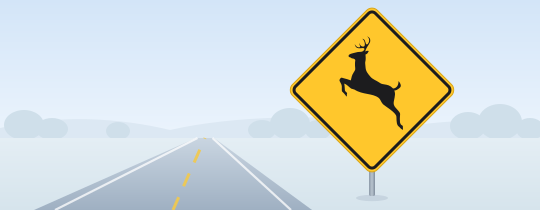
At dusk in November, you pass a yellow diamond sign with a leaping deer on a rural Kansas highway. Seconds later a deer steps into your lane and a hit can't be avoided. What does the Kansas Driving Handbook advise?
Show answer
Correct answer: Brake firmly and stay in your lane
Why
A sudden swerve can send you off the road or into oncoming traffic, often a worse crash than hitting the animal. Deer move most at dawn and dusk and from October through December, so slow down near these signs at those times. Keep scanning both shoulders as you drive.
32Road signs
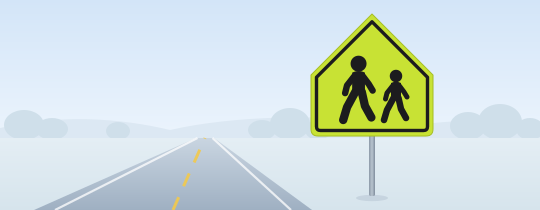
A five-sided, fluorescent yellow-green sign showing two children walking stands at the edge of a Kansas town. What should you know about the school zone it announces?
Show answer
Correct answer: The limit there can be as low as 20 mph, and speeding fines are doubled
Why
You’ll find this five-sided shape near schools, where kids may be walking to class or crossing the street. Kansas cities may cut the limit to 20 mph in a properly marked school zone while kids are heading to or from school, and a speeding ticket there costs double. If the sign says the school limit applies when flashing, the lower number counts only while the lights blink.
33Right-of-way
A fire truck with its siren wailing comes up behind you on a city street. You pull over, and it races past toward an alarm. When you drive on, how far back from it must you stay?
Show answer
Correct answer: At least 500 feet
Why
First, pull over close to the right-hand curb, away from any intersection, and wait there while the fire truck goes by. Once you're moving again, Kansas law keeps you at least 500 feet behind a fire truck answering an alarm. You also may not stop your car within 500 feet of one that has pulled up to answer an alarm.
34Alcohol & phones
You're driving through a Kansas school zone while its lower speed limit is in effect, and your phone buzzes. What does the law that took effect July 1, 2026, say?
Show answer
Correct answer: Hands-free only; just holding the phone is presumed a violation
Why
Kansas now bans handheld phone use in school zones while the reduced limit applies and in posted work zones with workers present. Hands-free calls are fine, but simply holding the phone is presumed to be a violation. Officers hand out warnings until July 1, 2027, and after that it's a $60 fine.
35Alcohol & phones
After a family gathering, you're driving home with an opened bottle of wine. Where may it ride under Kansas law?
Show answer
Correct answer: In a locked trunk, or behind the last upright seat if there's no trunk
Why
Kansas allows an opened container of alcohol only in a locked trunk, or behind the rearmost upright seat when the vehicle has no trunk. Anywhere the people inside can reach is off-limits. It's a misdemeanor, and a second conviction costs you your license for a year.
36Permit & teen rules
You're 16 with a new Kansas restricted license. During which hours may you not drive, unless you're going to or from work, school or religious activities or a licensed adult rides along?
Show answer
Correct answer: 9 p.m. to 5 a.m.
Why
Restricted drivers at 16 may go anywhere between 5 a.m. and 9 p.m. Outside that window, they need a trip tied to work, school activities or religious activities, or a licensed adult in the seat beside them. After six months of driving by the rules, the age-based limits fall away automatically.
37Permit & teen rules
During your first six months of restricted driving at 16, how many passengers under 18 who aren't immediate family may ride with you?
Show answer
Correct answer: One
Why
Kansas allows one passenger under 18 from outside your immediate family during that first six-month stretch. At 15 the rule is tighter: no minors at all except brothers and sisters. Keep the car calm while you're still building experience.
38Safe driving
You're passing a slow truck on a two-lane Kansas highway when an oncoming car appears in the distance. By what point must you be back in your own lane?
Show answer
Correct answer: Before you come within 200 feet of the oncoming car
Why
Kansas law says a pass on a two-lane road must be finished before you get within 200 feet of oncoming traffic. Pull back right only when the whole front of the truck shows in your rearview mirror. If the gap looks tight, drop back and wait for a longer one.
39Safe driving
You're driving your 6-year-old nephew, who weighs 50 pounds and stands 3 feet 10 inches tall. What does Kansas law require for him?
Show answer
Correct answer: A child safety seat or a booster seat
Why
Kansas requires a child seat or booster for ages 4 through 7 unless the child weighs more than 80 pounds or is taller than 4 feet 9 inches. Under 4, it's a child safety seat; from 8 through 13, a seat belt. The fine is $60, and the handbook suggests kids 12 and under ride in back.
40Crashes & emergencies
A tornado is heading your way while you're driving through open Kansas countryside. Which move does the Kansas Driving Handbook warn against?
Show answer
Correct answer: Waiting it out under a highway overpass
Why
The handbook is clear that a bridge or overpass is no shelter from a tornado. Your better choices are a solid building or, when the road lets you, driving away from the storm's path. On long rural drives in storm season, check the forecast before you leave.
Kansas DMV written test at a glance
What to know before you test, at a driver’s license office or online at home.
Kansas · Class C knowledge test
80% to pass.
25 questions · Multiple choice
20 of 25 answers right to pass
Onlineat home through KnowTo Drive, $6.50 per try
Next dayto retest after a fail, for $1.50
4 triesthen a six-month wait
Spanishor English for the online test
$10instruction permit, photo fee included
20/40eyesight bar for your better eye; glasses or contacts OK
Under 18? Your road to a license
14Instruction permitPass a vision screening and the written exam (or turn in a driver ed completion form), with a parent or guardian signing for you. Practice only with a licensed driver 21+ beside you.
15Restricted licenseAfter approved driver ed, a full year on your Kansas permit and 25 supervised hours, you may drive alone to work, school or religious activities.
16Wider limitsWith a year on your permit and a parent’s affidavit for 50 hours (10 at night), pass your tests and drive anywhere from 5 a.m. to 9 p.m., with one non-family passenger under 18 at most.
6 moLimits liftedDrive six months by the rules on your restricted license at 16, and the age limits come off on their own. No office visit needed.
18 or older? No driver ed, no parent signature, no 50-hour affidavit and no minimum time on your permit: just pass the vision, written and driving tests.
What’s on the Kansas permit test
The test draws on the Kansas Driving Handbook (KDOR, revised February 2022): road signs, pavement markings, Kansas traffic laws and safe driving habits. Lock in these six areas first.
Road signs
An eight-sided red sign always means a full stop; a red-and-white triangle pointing down means slow and give way.
Round and yellow with an X and RR? Railroad tracks ahead: slow down, look and listen.
A yellow pennant on the left shoulder marks where a no-passing zone begins.
Right-of-way
Four-way stop: first to stop, first to go. A tie? Yield to the car on your right.
Left on red? Only when the street you’re on and the street you’re turning into both run one-way, after a full stop.
Flashing red on a school bus: everyone stops, except oncoming traffic on the far side of a median or barrier.
Speed limits
No sign? 30 mph in town, 55 on county and township roads, 65 on other highways.
75 mph is the Kansas top limit, and only on divided multilane highways that KDOT posts for it.
A marked school zone can drop to 20 mph, and speeding fines there double.
Parking
Keep 15 feet from a hydrant, 20 feet from an intersection crosswalk and 30 feet from a stop sign.
Leave 50 feet between your car and the closest rail at a train crossing, and park within 12 inches of the curb.
Uphill with a curb, turn the wheels away from it; downhill, turn them toward the curb or edge.
Alcohol & phones
BAC limits: 0.08 at 21 and over, 0.04 in a commercial vehicle, 0.02 under 21.
Refuse a breath or blood test the first time: a one-year suspension, then two years with an ignition interlock.
No texting at the wheel for anyone. Since July 2026, no handheld phone in active school zones or work zones with crews.
Teen rules
Permit drivers need a licensed adult 21+ in the seat beside them, and nobody else up front.
Restricted at 16: no driving 9 p.m. to 5 a.m. except for work, school or religious activities, or with a licensed adult.
Restricted drivers and permit holders under 17 can’t use a phone at all, except to report a crime or call for emergency help.
Kansas numbers to know
Straight from Kansas law and the state handbook. Learn them once and they stick.
100 ftof steady signaling before a turn or lane change
15 ftbetween your parked car and a fire hydrant
15–50 ftfrom the nearest rail when a crossing makes you stop
500 ftdim your high beams when an oncoming car is this close
75 mphtop limit, on designated divided highways
0.02BAC limit for drivers under 21
Your Kansas course, in your pocket
These 40 questions are just the warm-up. The app gives you 475 Kansas practice questions, 36 short lessons and the why behind every answer.
36 short lessonsFour levels, from fundamentals to expert, then a full practice exam.
475 Kansas questions331 of them with pictures.
Your most-missed questionsA review lesson built from the questions you miss most.
Exam simulatorTake full practice exams and watch your readiness grow.
Kansas permit
Your Kansas path is ready.
36 lessons, 475 questions and full practice exams. In English and Spanish.
How many questions are on the Kansas permit test, and what’s a passing score?
25 multiple-choice questions on road signs, pavement markings, Kansas traffic laws and safe driving, all based on the Kansas Driving Handbook. You need 80%, which means at least 20 right. At the office the test isn’t timed, and most people finish in 15 to 20 minutes.
How many times can I retake the Kansas written test?
If you fail, you can test again the next business day for a $1.50 retest fee. Kansas gives you four tries; a fourth failure within six months means a six-month wait from that attempt. Your application and $3 test fee stay good for six months.
Can I take the Kansas permit test online?
Yes. KnowTo Drive, the online platform KDOR uses, lets Kansas residents 14 and older test at home on a desktop or laptop with a webcam, for $6.50 per attempt with a 60-minute limit. If you’re under 18, a parent or guardian registers with you. Bring your passing result to a driver’s license office, where the regular fees are paid.
Can I take the Kansas permit test in Spanish?
Yes. The online test on KnowTo Drive comes in English or Spanish, with optional read-aloud audio, and KDOR publishes a Spanish handbook, the Manual de conducción de Kansas. This practice test and the app are in Spanish too.
How old do you have to be to get a permit in Kansas?
You can get an instruction permit at 14; under 16, a parent or guardian applies with you and signs at the office. A restricted license at 15 takes approved driver ed, a full year on your permit and 25 supervised hours. At 16 you need that year on your permit plus 50 hours, 10 of them at night, and then you stay off the road from 9 p.m. to 5 a.m. unless you’re driving for work, school activities or religious activities or have a licensed adult beside you. Those limits end after six months.
How much does a Kansas permit cost?
A Kansas instruction permit costs $10: a $2 permit fee plus the $8 photo fee. The first knowledge test costs $3 (no test fee with a driver ed completion form), and a retest is $1.50. Under 21, a first license is $20 plus the photo fee; adults 21 to 64 pay $29 with testing.
What’s on the Kansas driving test?
Three parts: a pre-trip check where you point out and explain your car’s safety equipment, a basic vehicle-control exercise, and a drive on public roads. You bring the car, with working signals, brake lights and horn, safe tires and a valid tag. Appointments are recommended, and customers who book are served first.
What’s the best way to study for the Kansas permit test?
Read the Kansas Driving Handbook, then practice until 80% comes easily. Start with the 40 questions on this page, then let the app take you through 475 Kansas questions and 36 short lessons, each answer explained.