In Montana, the Motor Vehicle Division (MVD) gives the written test on road signs and traffic laws. Warm up with 40 free questions on 80 mph interstates, school buses, wildlife and teen license rules, and see why each answer is right the moment you tap it.
Ten questions per round, four rounds: Montana signs, right-of-way, interstate and highway speeds, parking, DUI and phone rules, plus the teen license steps. Every pick gets a quick explanation.
Round 1 · Questions 1–10
1Speed limits
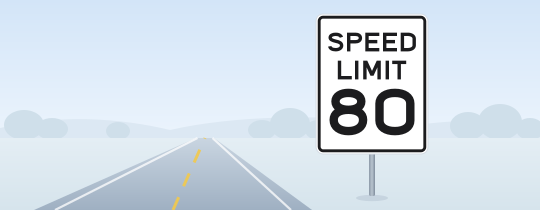
A white SPEED LIMIT 80 sign stands beside the road. Where does Montana law set 80 mph as the limit?
Show answer
Correct answer: On interstates outside urbanized areas of 50,000+ people, day and night
Why
Montana sets 80 mph at all times on interstates away from its larger urbanized areas; inside them, as around Billings, Great Falls and Missoula, the interstate limit is 65 mph. Four-lane stretches of national highway top out at 75 by day, and other highways at 70. In snow, wind or wildlife country, the safe speed can be far lower.
2Right-of-way
Your road ends at a T-intersection with no signs or signals, and a car is approaching on the through road from your left. Who goes first?
Show answer
Correct answer: The car on the through road; drivers on the road that ends must yield
Why
At most uncontrolled intersections, Montana has the driver on the left yield to a vehicle coming from the right. A T-intersection is the exception: the driver on the road that ends gives way to traffic on the road that continues, from either side. Stop if you need to, and pull out only into a safe gap.
3Alcohol & phones
A 20-year-old has two beers at a friend's barbecue, then drives home. What is the lowest alcohol concentration at which that driver is breaking Montana's DUI law?
Show answer
Correct answer: 0.02 or more
Why
Under 21, Montana's line is 0.02, and any active THC in the body is an offense as well. The 0.08 limit applies to adults and 0.04 to commercial drivers. Under 21, plan on zero before you get behind the wheel.
4Permit & teen rules
You've enrolled in your high school's state-approved driver education course. What's the youngest age at which you can get a Montana learner license?
Show answer
Correct answer: 14½
Why
Montana lets teens who are taking or have finished a state-approved traffic education course get a learner license at 14½. Without driver ed, the minimum is 15. Either way, you first pass the vision screening and the knowledge test.
5Parking
You spot an open curb space in Missoula next to a fire hydrant. How far from the hydrant must your car be?
Show answer
Correct answer: At least 15 feet
Why
Montana keeps parked cars 15 feet or more from a hydrant, so fire crews can hook up a hose without hunting for room. Learn the whole set together: 20 feet back from an intersection's crosswalk, 30 feet before a stop sign or signal, and 50 feet clear of a railroad crossing's closest rail.
6Safe driving
On dry pavement in good weather, what minimum following distance does the Montana Driver Manual recommend?
Show answer
Correct answer: 3 seconds
Why
The manual's three-second rule works at any speed: as the car ahead passes a fixed point, start counting, and if you reach that point before three, drop back. Make it four seconds on slippery roads, at night, behind a motorcycle or large truck, or when you're towing.
7Road signs
Just past a yellow diamond sign showing a leaping deer, a doe trots across the highway ahead of you at dusk and slips into the trees. What should you expect now?
Show answer
Correct answer: More deer or elk close by, so stay slow and keep scanning both shoulders
Why
Deer and elk travel in herds, so the Montana Driver Manual says one animal on the road should send your eyes looking for more, especially near sunrise and sunset. If an animal jumps out and there's no time to stop, don't swerve sharply: losing control or veering into another lane can do more harm than the hit itself.
8Sharing the road
A wide combine is coming toward you on a two-lane county road posted 60 mph. How fast should you be going as you meet it?
Show answer
Correct answer: 30 mph
Why
When an agricultural vehicle approaches from the other direction, Montana law requires you to slow to half the posted limit, here 30 mph. Big machinery can take up part of your lane, so ease right and give it room.
9Road signs
Orange cones and a ROAD WORK AHEAD sign mark a paving project on U.S. 93, and a crew is busy a few hundred feet down the road. What changes if you get a traffic ticket here?
Show answer
Correct answer: The fine is at least doubled, because highway workers are within 1,000 feet
Why
Orange is the basic color of Montana's construction and maintenance signs. When a highway worker is present within 1,000 feet of the violation, traffic fines are at least doubled, and each work zone sets its own speed limit, so look for the posted number. Give the crew space and expect sudden lane shifts.
10Crashes & emergencies
Backing out of a grocery store parking space, you dent a parked car with nobody in it, and you can't find the owner. What should you do?
Show answer
Correct answer: Leave a note with your name, how to reach you and the time of the crash
Why
Anyone involved in a crash has to stop. If you hit an unattended car, Montana law has you find the owner or leave a written note where it will be seen, and the Driver Manual adds how to reach you and when it happened. Keep proof of insurance in the vehicle at all times; you'll need to show it after a crash.
Round 2 · Questions 11–20
11Right-of-way
A yellow diamond sign with three arrows chasing each other in a circle tells you a roundabout is coming. How should you enter and drive it?
Show answer
Correct answer: Yield to vehicles already circling and keep to 15 mph or less
Why
Montana law gives the right-of-way to traffic already going around, and you travel only to the right of the center island. The Montana Driver Manual puts roundabout speeds at 15 mph or less. Look left, find a gap and merge in smoothly.
12Speed limits
It's 10 p.m. on a two-lane state highway in eastern Montana, and you haven't seen a speed limit sign for miles. What's the limit for your car?
Show answer
Correct answer: 65 mph
Why
Away from the interstates and four-lane national routes, Montana's default is 70 mph in the daytime and 65 mph at night. Daytime lasts from half an hour before sunrise until half an hour after sunset, so by 10 p.m. the night limit applies. Darkness also hides deer and elk, so leave yourself extra room.
13Alcohol & phones
An officer stops a Montana driver on suspicion of DUI and asks for a breath test. It's the driver's first refusal. What happens to the license?
Show answer
Correct answer: A six-month suspension, with no probationary license
Why
By driving in Montana you've already agreed to breath, blood or oral fluid testing. A first refusal brings a six-month suspension and a second within five years a full year, with no probationary license and a $300 administrative fee. Saying no doesn't make the stop go away; it adds a penalty of its own.
14Permit & teen rules
A Montana teen finished a traditional driver education course. Before the first-year restricted license, how much supervised driving must a parent certify?
Show answer
Correct answer: At least 50 hours, 10 at night
Why
Parents certify at least 50 hours behind the wheel, 10 of them at night, on top of six months with the learner license. Teens who completed an alternative course approved by the Department of Justice need 75 hours, 15 at night, instead. Log each drive as you go so the paperwork is easy.
15Parking
You want to park along the curb just before a stop sign. What's the shortest distance Montana law allows between your car and the sign?
Show answer
Correct answer: 30 feet
Why
Within 30 feet of a stop sign, flashing beacon or traffic signal on the approach side, a parked car could block other drivers' view of it, so Montana bans parking there. Don't confuse it with the 20-foot gap required at an intersection's crosswalk.
16Safe driving
On a dark two-lane highway with your high beams on, you spot headlights coming toward you. Within what distance of that car must you switch to low beams?
Show answer
Correct answer: 1,000 feet
Why
Montana wants your low beams on once an approaching car is 1,000 feet away, and once you're 500 feet behind a car you're following, so the glare doesn't blind anyone. Headlights are required from 30 minutes past sunset until 30 minutes before sunrise, plus any time you can't make out people or vehicles 500 feet ahead.
17Road signs
On a county road outside Havre, a round yellow sign with a large X and the letters RR comes into view. What does it tell you?
Show answer
Correct answer: A railroad crossing is ahead
Why
Most Montana warning signs are yellow diamonds, but the railroad advance sign is the only round one. Slow down, look and listen both ways, and if lights flash, a gate drops or a train is near, stop no closer than 15 feet to the nearest rail.
18Sharing the road
On a two-lane highway near Great Falls, you come up behind a farm tractor with an orange triangle on its back. What does Montana law tell you to do?
Show answer
Correct answer: Slow to its speed and pass only where passing is allowed
Why
The orange triangle marks vehicles that normally travel 25 mph or less, such as tractors and road machinery. Montana law has you slow to the farm vehicle's speed and pass only in a legal passing zone. A slow vehicle with four or more vehicles lined up behind it must pull off at the next safe turnout, so be patient.
19Lane markings
On a two-lane highway you're stuck behind a slow truck, and the oncoming lane looks empty. A railroad crossing is about 80 feet ahead. May you pass?
Show answer
Correct answer: No, Montana bans passing within 100 feet of a railroad crossing or intersection
Why
Montana bars a left-side pass when an intersection or a railroad grade crossing is 100 feet or less ahead, and near a curve, hill crest, bridge or tunnel that hides what's coming. A train, a turning car or a pedestrian can appear with no room for you to get back. Wait until you're well past the tracks.
20Right-of-way
Your light turns green in Helena, but a funeral procession led by a lead vehicle is still rolling through the intersection. What does Montana law expect?
Show answer
Correct answer: Wait and yield until the procession has passed
Why
Montana requires drivers to yield to vehicles in a funeral procession led by a funeral lead or escort vehicle, and you may not cut between its cars while they're moving. The Montana Driver Manual lists them among the state's unique right-of-way provisions. Hold your position and go once the procession has cleared.
Round 3 · Questions 21–30
21Right-of-way
On a two-lane road, the school bus you're following stops, its red lights start flashing and the stop arm swings out. Where does Montana law want you to stop?
Show answer
Correct answer: About 30 feet or more from the bus, until the red lights go off
Why
Once the red lights blink, Montana has traffic from both directions halt roughly 30 feet or more from the bus and wait there until those lights switch off. Never pass it on the right, and a first offense for driving past can mean a $500 to $1,000 fine. Flashing amber lights come first, so start slowing as soon as you see them.
22Speed limits
Driving through a Kalispell neighborhood in an urban district, you haven't passed any speed sign. What limit does Montana law set by default?
Show answer
Correct answer: 25 mph
Why
In an urban district, Montana's statutory limit is 25 mph unless a sign says otherwise. Near schools, local limits can drop as low as 15 mph, and speeding fines in a posted school zone are at least doubled. Watch for new signs each time you enter a different part of town.
23Alcohol & phones
Your friend climbs into your SUV, which has no trunk, carrying an opened bottle of wine. Where can it legally ride on a Montana highway?
Show answer
Correct answer: Behind the last upright row of seats
Why
Montana bans open alcohol containers in the passenger area of a vehicle on a highway. A locked glove box, a trunk or, in a vehicle without a trunk, the space behind the last upright seat are all allowed. The fine runs up to $100.
24Permit & teen rules
During the first year on a Montana restricted license, between what hours may a teen not drive unless an exception applies?
Show answer
Correct answer: 11 p.m. and 5 a.m.
Why
The teen curfew runs from 11 p.m. to 5 a.m. Exceptions include a licensed driver 18 or older riding along, trips to and from work, school-sponsored or religious events, emergencies, hauling farm or ranch goods within 150 miles of headquarters, and a parent's specific OK for a specific trip. It ends after a year or at 18.
25Parking
Your street has a fire station, and you'd like to park on the same side as its driveway. How close to the driveway entrance may you park?
Show answer
Correct answer: No closer than 20 feet
Why
Montana keeps parked cars at least 20 feet from a fire station's driveway entrance, so engines can roll out fast. On the opposite side of the street, a no-parking stretch of up to 75 feet applies where signs mark it. Blocking any driveway, sidewalk or intersection is off-limits too.
26Safe driving
On a rural highway miles from town, you plan to turn left onto a gravel road. Over how much distance before the turn must your signal be on?
Show answer
Correct answer: At least 300 feet
Why
Outside business, residence and urban districts, Montana requires a continuous signal through at least the last 300 feet before you turn; in town it's 100 feet. At highway speeds, drivers behind you need that extra warning to slow down safely.
27Road signs
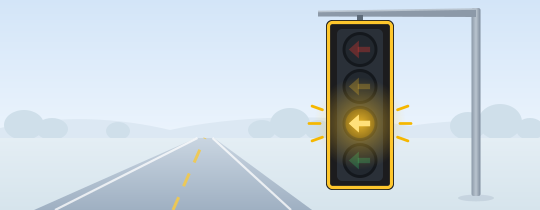
At a Billings intersection, your left-turn signal shows a flashing yellow arrow. What does that let you do?
Show answer
Correct answer: Make the turn after giving way to oncoming cars and people crossing
Why
A flashing yellow arrow permits the left turn but doesn't protect it, so oncoming cars may still be coming through. Wait for a real gap in traffic and for people in the crosswalk to clear, then finish the turn without hurrying.
28Sharing the road
Traffic in Missoula is stopped at a red light. A motorcycle rolls slowly past you in your own lane, between your car and the lane line. Is that legal in Montana?
Show answer
Correct answer: Yes, Montana allows lane filtering past stopped or slow traffic at up to 20 mph
Why
Montana lets motorcyclists filter past vehicles that are stopped or moving 10 mph or less in the same lane, as long as the rider goes no faster than 20 mph. In slow traffic, check your mirrors before drifting toward the lane line, and expect a bike to appear beside you.
29Road signs
After a summer storm knocks out power in Great Falls, the traffic lights at a busy crossing are completely dark. How do you handle the intersection?
Show answer
Correct answer: Like an all-way stop: stop fully, then take turns
Why
The Montana Driver Manual treats a signal that has gone dark as an all-way stop, the same full stop a flashing red light calls for. Stop at the line, let the driver who got there first go first, and move only when the way is clear.
30Crashes & emergencies
A blizzard leaves your car stuck on a remote stretch of Montana highway. What does the Montana Driver Manual advise?
Show answer
Correct answer: Stay in your car, where rescuers are more likely to find you
Why
A stranded car is much easier for searchers to spot than a person on foot, and it keeps you out of the wind. Stay with it and wait for help. To avoid getting stuck in the first place, slow down in winter: the manual says to halve your speed on packed snow.
Round 4 · Questions 31–40
31Speed limits
On I-94, posted 80 mph, a highway patrol car sits on the right shoulder with its emergency lights flashing. No temporary limit is posted, and the left lane is open. What does Montana law require?
Show answer
Correct answer: Move into the left lane and slow to 60 mph
Why
When you can change lanes on an interstate, Montana wants you out of the lane next to the stopped vehicle and 20 mph under the posted limit. If traffic boxes you in, slow to half the limit, 40 mph here. On state highways and county roads the cut is 30 mph below the limit, or half if you can't move over.
32Speed limits
On a two-lane highway posted 70 mph, you pull out in a marked passing zone to get around a slow pickup. How fast does Montana law let you go to finish the pass?
Show answer
Correct answer: Up to 80 mph
Why
Montana allows up to 10 mph over the limit, but only on a two-lane road, only in a designated passing zone and only to overtake and safely return to the right lane. At 55 mph a pass takes about 10 seconds and over 1,600 feet of open road, so if the gap looks tight, stay put.
33Alcohol & phones
Montana's DUI law has one THC limit that covers drivers of every age. What is that level in the blood?
Show answer
Correct answer: 5 ng/ml or more
Why
Montana treats 5 ng/ml or more of THC in the blood as DUI for any driver, and under 21 any amount of active THC breaks the law. If you've used cannabis, hand the keys to someone else.
34Alcohol & phones
You're 25 and driving across Montana. Which statement about using a handheld phone behind the wheel is accurate?
Show answer
Correct answer: There's no statewide ban, but most Montana cities have their own laws against it
Why
Montana has no statewide phone ban, not even for teen drivers, yet the Montana Driver Manual notes that most of its cities prohibit texting and talking while driving. The rules can change at each city limit, so silence the phone before you set off and pull over if a call can't wait.
35Permit & teen rules
Three months after getting her restricted license, a 16-year-old wants to drive three friends, all 16 and none of them family, to a basketball game with no adult along. Can she?
Show answer
Correct answer: No, for the first six months she may carry just one non-family rider under 18
Why
For months one through six, Montana allows just one passenger under 18 who isn't family, unless a licensed driver 18 or older is supervising. From month seven to twelve, the limit rises to three. Everyone must buckle up, and riders can't outnumber seat belts.
36Permit & teen rules
A 15-year-old with a Montana learner license wants to practice driving. Who may sit beside her as the supervising driver?
Show answer
Correct answer: A licensed parent or guardian, or a licensed driver 18 or older they approve
Why
For a learner under 18, Montana requires a licensed parent or legal guardian, or with their permission a licensed driver at least 18, seated next to the learner. Everyone in the car must wear a seat belt or ride in the proper child seat.
37Safe driving
Your car wears studded snow tires. When does Montana allow them on the road?
Show answer
Correct answer: October 1 through May 31
Why
Studded tires are legal in Montana from October 1 through May 31 and banned from June 1 through September 30. Whatever tires you run, the manual says to cut your speed in half on packed snow and by about 10 mph on wet pavement.
38Lane markings
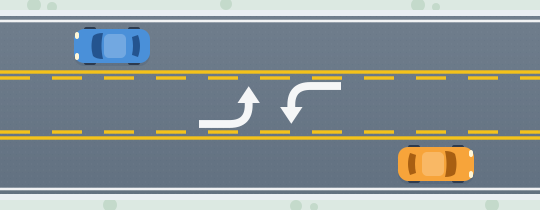
Down the middle of a busy Bozeman street runs a lane bordered by solid and dashed yellow lines, with left-turn arrows painted in both directions. How may you use it?
Show answer
Correct answer: For left turns, and U-turns where allowed, by drivers from both directions
Why
This shared center lane is reserved for turning left, or for U-turns where they're permitted, by traffic from either side. Move into it just before your turn, never to cover distance or to pass. Watch for a driver coming the other way who wants the same space.
39Road signs
In a highway work zone, an orange-and-white striped barricade blocks part of the road. Its stripes slope down toward the right. Which way should you go?
Show answer
Correct answer: To the right of it
Why
Barricade stripes point you around the hazard: when they slope down to the right, bear right. Orange is the basic color of work zone signs and devices, so ease off, merge early and keep an eye out for workers and equipment.
40Right-of-way
You're on a four-lane divided highway with a wide grassy median. Across the median, on the roadway for the opposite direction, a school bus stops with red lights flashing. What do you do?
Show answer
Correct answer: Keep going carefully; you don't have to stop for a bus on a separate roadway
Why
Montana law excuses drivers on a highway with separate roadways from stopping for a school bus on the other roadway. Where no median splits the road, traffic from both directions stops. Even when you may go on, ease off and watch for children near the highway.
Montana MVD written test at a glance
What to know before your appointment at an MVD exam station.
Montana · MVD knowledge test
Road signs and road rules.
Vision check first · MVD exam station
20/40or better in one eye, glasses allowed
3 triesto pass every test on one receipt, good for a year
Next dayearliest written retake: one test a day
In personat an MVD exam station, no online test
In classteens can test in high school driver ed
$5/yearof license time, plus admin fees
Under 18? Your road to a license
14½Learner licenseIn state-approved driver ed? Pass the vision screening and knowledge test for your learner license at 14½; without driver ed, wait until 15.
6 moSupervised practiceDrive with a licensed parent or guardian, or a licensed adult 18+ they approve, and log at least 50 hours, 10 of them at night.
15+Restricted licenseStay violation-free for six months, pass the road test, and bring your driving log and parent form 21-1600.
Year 1First-year limitsNo driving 11 p.m.–5 a.m. without an exception, everyone belted, and one non-family passenger under 18 for six months, then three, unless a licensed adult 18+ rides along.
Year 2Full privilegesThe limits end one year after your license is issued or at 18, whichever comes first.
18 or older? No graduated steps and no six-month wait: bring your documents, pass the vision and written tests, then take the road test in a registered, insured car.
What’s on the Montana permit test
Study from the Montana Driver Manual (MVD form 25-0100M), the guide MVD points you to for the written test, and use its chapter quizzes to check yourself as you go. Start with these six areas.
Road signs
Eight sides always means STOP, and a red sign always calls for stop, yield, do not enter or wrong way.
A round yellow sign means a railroad crossing is ahead; with lights flashing or a train close, halt 15 feet or more back from the rail.
Orange marks a work zone, and fines at least double with a highway worker within 1,000 feet.
Right-of-way
No signs or signals? Yield to the car on your right; at a T, the road that ends gives way.
Roundabouts: yield to traffic already circling and keep it at 15 mph or less.
School bus flashing red: stop about 30 feet away, from either direction, until the lights go off.
Speed limits
80 mph on rural interstates, day and night; 65 on the interstates around Billings, Great Falls and Missoula.
Two-lane highways: 70 mph by day, 65 at night. Urban districts: 25 mph.
Any posted number is a ceiling: slow down for traffic, weather, visibility and road conditions.
Parking
Give a fire hydrant 15 feet of space and an intersection’s crosswalk 20 feet.
Keep 30 feet back from a stop sign or signal, and 50 feet clear of a crossing’s closest rail.
Downhill, wheels toward the curb; uphill, away from it. Right wheels within 18 inches.
Alcohol & phones
Limits: 0.08 for adults, 0.04 in a commercial vehicle, 0.02 under 21.
Refuse a breath or blood test once and your license is suspended for six months.
No statewide phone ban for drivers of any age, but most Montana cities outlaw texting and calls at the wheel.
Teen rules
Learners under 18 drive with a licensed parent, or a licensed adult 18+ the parent approves.
First-year restricted license: off the road 11 p.m.–5 a.m. unless an exception applies.
One non-family passenger under 18 for six months, then three, unless a licensed adult 18+ rides along.
Montana numbers to know
Six figures from Montana law and the Driver Manual worth memorizing before test day.
300 ftof signaling before a rural turn (100 ft in town)
15 ftclosest you may stop to the rail at an active crossing
80 mphon rural interstates, day and night
3 secfollowing distance, 4 in poor conditions
1,000 ftto dim your high beams for oncoming cars
0.02alcohol limit for drivers under 21
Your Montana course, in your pocket
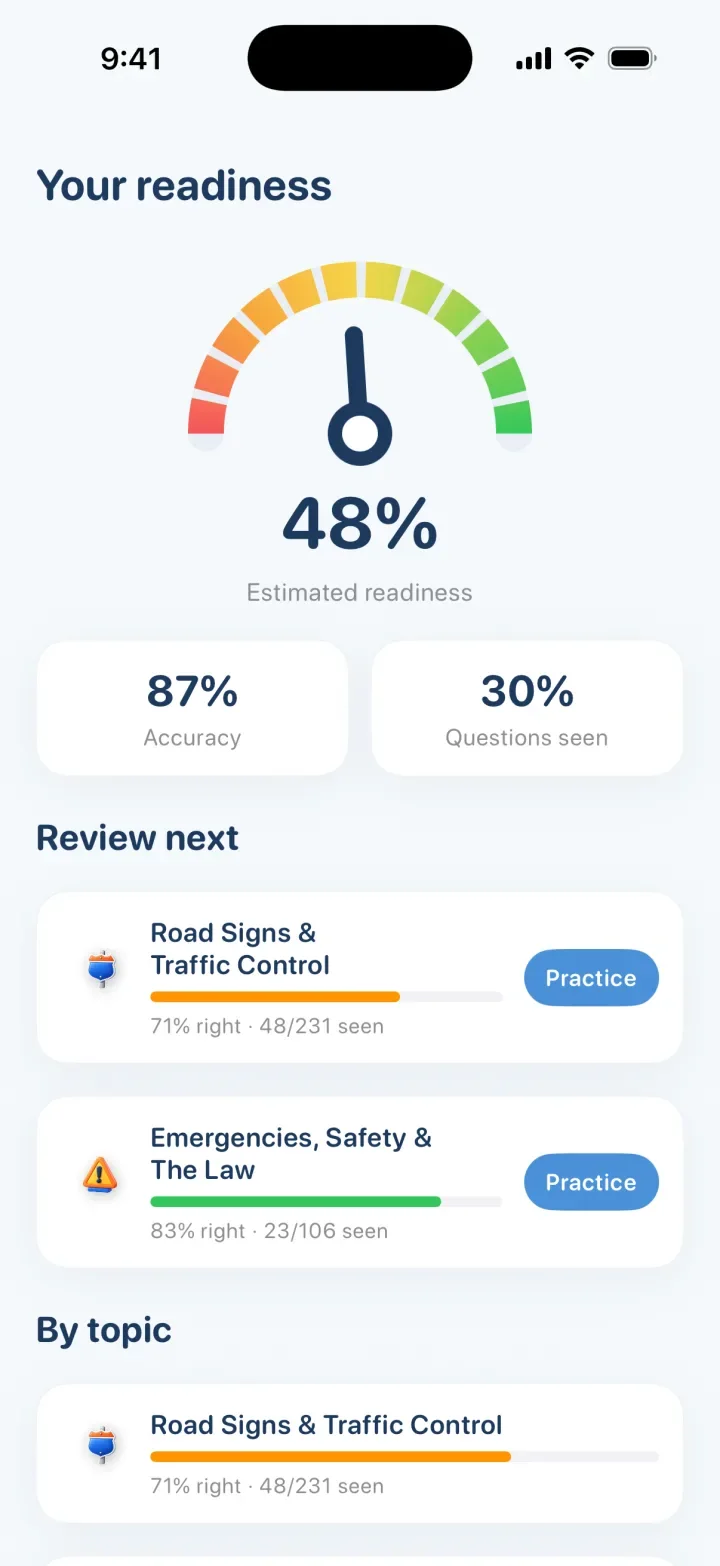
These 40 questions are just the warm-up. The app gives you 470 Montana practice questions, 36 short lessons and the why behind every answer.
36 short lessonsFour levels, from fundamentals to expert, then a full practice exam.
470 Montana questions311 of them with pictures.
Your most-missed questionsA review lesson built from the questions you miss most.
Exam simulatorTake full practice exams and watch your readiness grow.
Montana permit
Your Montana path is ready.
36 lessons, 470 questions and full practice exams. In English and Spanish.
How many questions are on the Montana written test, and what score do I need?
MVD’s manual and website don’t say how many questions the knowledge test has or what percentage you need to pass. By state rule, the test checks two things: what standard warning and regulatory signs mean and what to do at them, and Montana’s traffic laws. The Montana Driver Manual covers both, so practice until you score 80% or better on every round.
How many times can I take the Montana knowledge test?
Your license receipt covers three attempts to pass all the required tests and stays valid for one year; after that, you apply and pay again. If you fail the written test, you can’t retake it the same day, since MVD gives it at most once a day. Road tests are limited to one every seven days.
Can I take the Montana permit test online?
No. Montana has no at-home test: you take it at an MVD driver license exam station, so book an appointment online or at 406-444-1772, and pre-apply online to save time at the counter. Students in a state-approved high school driver education course can take the knowledge and road tests in class through the Cooperative Driver Testing Program.
Can I take the Montana permit test in Spanish?
MVD publishes the manual in Spanish, the Manual de Conducir de Montana (revised February 2025), plus Arabic, Dari and Swahili editions, so you can study in your language. MVD doesn’t list the languages the knowledge test itself comes in, so ask when you book your appointment. An applicant who can’t read can take the test orally. This practice test and the app are both in Spanish too.
How old do you have to be to get a learner license in Montana?
14½ if you’re enrolled in or have finished a state-approved driver education course, or 15 without it. Under 18, you hold the learner license at least six months and log 50 supervised hours, 10 at night, before the road test for a restricted license. For its first year (or until 18): no driving 11 p.m.–5 a.m. without an exception, and only one non-family passenger under 18 for six months, then three.
How much does a Montana learner license cost?
Montana builds the fee from $5 for each year (or part of a year) the license is valid, plus administrative costs. A teen license runs to the 21st birthday, so the total depends on your age: $36.57 at 14½, $31.42 at 15 and $26.27 at 16, and MVD’s table lists the same prices for learner licenses. An adult standard license for ages 21 to 63 is $62.32 for 12 years.
What do I bring to MVD for my written test?
Proof of identity, proof of Montana residency and proof of authorized presence. You don’t have to show your Social Security card, but you do need to know the number. Under 18, a parent or guardian signs your application and accepts financial responsibility for damage you cause while driving. Expect a vision check too: 20/40 in at least one eye, glasses allowed.
What’s the best way to study for the Montana permit test?
Read the Montana Driver Manual and take its chapter quizzes; the answers are in the back. Then work through the 40 questions above until 80% comes easily, and let the app take you through 470 Montana questions and 36 short lessons, with every answer explained.