Warm up for the Oregon DMV knowledge test with 40 free questions on road signs, Oregon speed limits, DUII and phone laws, and provisional license rules. Pick an answer and the reason behind it pops up instantly.
Four rounds of 10 questions on Oregon signs, right-of-way, speed limits, parking distances, DUII and phone laws, and provisional license rules. Each answer is explained the moment you pick it.
Round 1 · Questions 1–10
1Road signs
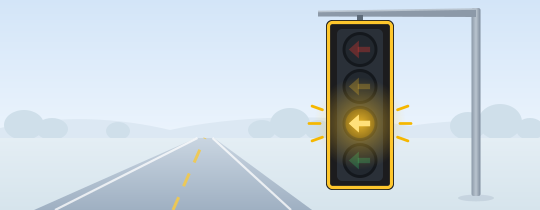
You’re in a left-turn lane at a signal, and the only light showing above you is a flashing yellow arrow. What does it allow?
Show answer
Correct answer: A left turn once you’ve yielded to oncoming traffic and to pedestrians
Why
A flashing yellow arrow means you may turn, but the turn isn’t protected: oncoming drivers have a green light at the same time. Ease forward, let people in the crosswalk finish crossing and wait for a gap you’re sure of. Never rush the turn just because drivers behind you are waiting.
2Right-of-way
Your light is red. You’d like to make a left onto a one-way cross street whose traffic moves to your left, and the road you’re on carries traffic both ways. May you make the turn now?
Show answer
Correct answer: Yes, once you’ve stopped fully and yielded, unless a sign forbids it
Why
Oregon allows a left on red onto a one-way street, whether you’re coming from a one-way street or from a two-way one, as long as you stop first and yield. Turning left on red onto a two-way street is illegal. Right on red follows the same steps: full stop, yield, and check for a NO TURN ON RED sign.
3Speed limits
You’re driving through the downtown business district of a small Oregon town and haven’t seen any speed sign. What limit does state law set there?
Show answer
Correct answer: 20 mph
Why
Oregon law puts business districts at 20 mph whether or not a sign is posted. Residence districts get 25 mph, and alleys and narrow residential roadways 15 mph. A posted sign can set a different speed, so keep an eye out for one.
4Parking
You find an open curb space next to a fire hydrant. What is the closest Oregon lets you park to it?
Show answer
Correct answer: 10 feet
Why
Oregon bans stopping or parking any closer than 10 feet to a hydrant, so firefighters can reach it and hook up fast. Two more distances to remember: 20 feet back from any crosswalk at a corner, and 50 feet from a traffic sign or signal your car would hide. Extra room never hurts.
5Alcohol & phones
A 19-year-old has one beer at a party and drives home. At a traffic stop, a breath test shows a small but measurable amount of alcohol. In Oregon, has the driver failed the test?
Show answer
Correct answer: Yes, because drivers under 21 fail with any measurable alcohol
Why
Oregon has zero tolerance for drivers under 21: even a trace of alcohol means a failed test. Adults are presumed impaired at 0.08%, and commercial drivers face a 0.04% limit. The only safe plan is no alcohol at all before you drive.
6Safe driving
You’re cruising at 45 mph behind another car. How much following time does the Oregon Driver Manual recommend at that speed?
Show answer
Correct answer: Four seconds or more
Why
Oregon’s manual calls 2 to 4 seconds a safe following distance and asks for 4 seconds or more once you’re above 30 mph. Count from the moment the car ahead passes a fixed object, like a pole, until you reach it. Give yourself even more time when the road is wet or icy.
7Permit & provisional license
You’re 15 and just got your Oregon Provisional Instruction Permit. Who may supervise you when you drive?
Show answer
Correct answer: A licensed driver 21 or older, sitting in the seat beside you
Why
An Oregon permit lets you drive only with a licensed driver aged 21 or older right next to you, and any qualified adult can do it, not just a parent. For your practice hours to count, though, that supervisor must have been licensed 3 years or longer. The permit stays valid for two years.
8Lane markings
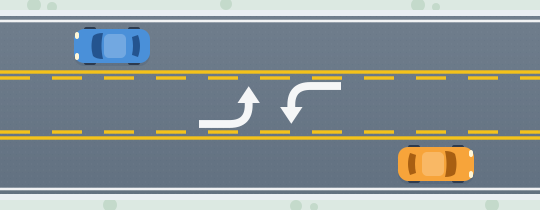
A center lane edged by solid and dashed yellow lines, with left-turn arrows pointing both ways, runs down the middle of the road. Your turn is three blocks ahead. How may you use that lane?
Show answer
Correct answer: Move into it only shortly before you turn
Why
Oregon law forbids driving down a center two-way left-turn lane: enter it just before your turn and wait there for a gap. Where one exists, you must turn left from it, not from a through lane. Drivers coming the other way use the same lane, so watch ahead.
9Sharing the road
On a 45 mph road you come up behind a person riding a bicycle in your lane. Under Oregon law, when may you pass?
Show answer
Correct answer: Only with room enough that a fall wouldn’t put them in your path
Why
Above 35 mph, Oregon lets you pass a bicyclist in your lane only with enough space that a fall wouldn’t put them under your wheels. If you can’t give that room, stay back until you can. Expect riders to swerve around potholes, debris and opening car doors.
10Road signs
Driving across Oregon, you pass a sign marking the start of a SAFETY CORRIDOR. What is the state asking of you on that stretch?
Show answer
Correct answer: Turn your lights on and stay extra alert, since serious crashes there run above average
Why
ODOT names a stretch of highway a Safety Corridor when its rate of deadly and serious-injury crashes is higher than the statewide average. Headlights make you easier to spot there, even by day. Keep a safe speed, leave extra space and give the road your full attention until the corridor ends.
Round 2 · Questions 11–20
11Right-of-way
You’re following a school bus on a two-lane road. It stops ahead of you with its red lights flashing and the stop arm out. When may you drive on?
Show answer
Correct answer: Not until the driver shuts off the bus’s red lights
Why
In Oregon, flashing amber lights on a school bus mean get ready to stop; flashing red means stop before you reach the bus and stay put. You may move again only once the driver turns the red lights off. Watch for a late child running to catch the bus or dashing back across the road.
12Road signs
A winter storm has cut the power, and the traffic lights at the intersection ahead are completely dark. How does Oregon’s manual tell you to handle it?
Show answer
Correct answer: Stop as though a stop sign faced every direction, then take turns
Why
A dead signal turns the crossing into an all-way stop: come to a full stop, then go in turn with the other drivers. A signal flashing red works the same way as a stop sign. Expect some drivers to be confused, and make eye contact before you pull out.
13Speed limits
A five-sided sign showing two children walking marks the start of a school zone. The speed sign after it says the 20 mph school limit applies when children are present. When must you slow to 20?
Show answer
Correct answer: When kids wait at or cross in the crosswalk, or a patrol member is there
Why
Oregon school zones are 20 mph, but when the limit applies depends on the sign: while its yellow light flashes, from 7 a.m. to 5 p.m. on school days, or when children are present, as here. On a school-hours sign, if you can’t tell whether it’s a school day, slow to 20 anyway. The zone lasts until an END SCHOOL ZONE sign or a new speed sign.
14Parking
A fire station sits across the street from the curb where you want to park. How far from its driveway entrance must your car be?
Show answer
Correct answer: 75 feet
Why
Oregon keeps cars 75 feet away when you park across the street from a fire station driveway, and 15 feet when you park on the station’s own side. Engines swing wide as they roll out, so they need the extra space. Never block the driveway itself.
15Alcohol & phones
Arrested for DUII, a driver with a clean record is asked to take a breath test and refuses. What does Oregon’s implied consent law do to the license?
Show answer
Correct answer: Suspends it for one year, apart from the DUII case itself
Why
Driving in Oregon counts as agreeing to chemical testing of your breath, blood or urine whenever police request it. A first refusal brings a one-year implied consent suspension, or three years if you had a DUII conviction, an implied consent suspension or a diversion in the past five years. The refusal can also be used as evidence in court.
16Safe driving
In moving traffic, how far ahead of a turn or lane change does Oregon require your turn signal?
Show answer
Correct answer: At least 100 feet
Why
Oregon wants your blinker going through the final 100 feet, at a minimum, ahead of any turn or lane change, so the drivers around you have time to react. Pulling away from a curb, signal long enough to warn traffic. You also signal before you leave a roundabout.
17Permit & provisional license
Before an Oregon teen can trade the permit for a provisional license, how much supervised driving has to be logged?
Show answer
Correct answer: 100 hours, or 50 hours plus a driver ed course approved by ODOT
Why
Oregon requires 100 hours behind the wheel with a supervisor, cut to 50 if you pass a driver education course approved by ODOT, which also waives the DMV drive test. The permit also has to be at least six months old. Oregon sets no separate night-hours rule, but practice after dark anyway.
18Lane markings
On some Oregon streets, a whole lane is colored red. What does that red lane mean for drivers?
Show answer
Correct answer: It’s for transit; cars may cross it only to turn, park or reach a driveway
Why
Oregon marks transit-only lanes, whether for buses, buses and bikes, or light rail, in red. Don’t drive in them; cross the striped red areas only to turn, reach a parking spot or get into a driveway. Read the signs as well, since some red lanes are shared with bicycles.
19Crashes & emergencies
You’re circling inside a roundabout when you hear a siren and see an ambulance coming. What should you do?
Show answer
Correct answer: Continue to your exit, leave the circle, then pull right and stop
Why
Stopping inside a roundabout blocks the only way through it. Oregon’s manual has you finish your exit first, then pull right and stop; if you haven’t entered yet, stay out and pull over to the right. Once the ambulance passes, keep 500 feet or more between you and it.
20Right-of-way
Your light is green and you’re turning right, but a pedestrian is crossing the street you’re turning onto. At this signalized intersection, when may you finish the turn?
Show answer
Correct answer: When the pedestrian is at least 6 feet beyond the lane you’re turning into
Why
Oregon’s rule at traffic signals: wait until the person on foot is at least 6 feet clear of the lane you’re entering. Where there’s no signal, the bar is higher: they must be clear of your lane and the next one. Someone counts as crossing as soon as any part of them, or their cane, wheelchair or bike, moves onto the road.
Round 3 · Questions 21–30
21Road signs
Late at night you pass an orange diamond ROAD WORK AHEAD sign, then a lowered work-zone speed limit. No crews are anywhere in sight. Which limit applies?
Show answer
Correct answer: The lowered limit, day and night, and traffic fines inside the zone are doubled
Why
In Oregon a posted work-zone speed holds around the clock, even when nobody is working, and it ends only at the END WORK ZONE SPEED LIMIT sign or a new speed sign. Every traffic fine doubles inside a work zone. Lane shifts, rough pavement and parked equipment are still there after the crew goes home.
22Right-of-way
On the far side of a four-lane road, a school bus has stopped with red lights flashing. The only thing between the two directions is a painted center turn lane. What must you do?
Show answer
Correct answer: Stop, since paint or a turn lane doesn’t split the road
Why
Oregon lets traffic going the other way keep moving only when an unpaved median or a barrier separates the directions. Paint and center turn lanes don’t count, so every lane stops. Stay stopped until the red lights go off.
23Speed limits
Some Oregon ocean beaches are open to vehicles. If no other speed is posted, how fast may you drive on the sand?
Show answer
Correct answer: 25 mph
Why
Oregon’s statutory list puts ocean shores open to vehicles at 25 mph, the same as residence districts and public parks. Beachgoers may not hear an engine over the waves, so go slower when the beach is busy. A posted sign can set a different speed.
24Parking
Your car sits nose-up on a steep street, its right side tucked against the curb, with the parking brake on. Which way should the front wheels be turned?
Show answer
Correct answer: Turned away from the curb, out toward the street
Why
If the brakes ever let go, wheels turned out let the tire roll back against the curb and hold the car. Facing downhill against a curb, it’s the reverse: turn toward the curb. With no curb at all, turn toward the edge of the road, and set the parking brake every time.
25Alcohol & phones
You’re 25 and waiting at a long red light when a text arrives. Under Oregon law, may you pick up the phone and read it?
Show answer
Correct answer: No; holding and using it is legal only once you’re safely parked
Why
Oregon’s distracted driving law still applies at a red light, a stop sign or in stop-and-go traffic. Drivers 18 and older may use a phone only hands-free, turning it on or off with a single touch or swipe. A first offense that doesn’t cause a crash counts as a Class B violation, and the fine can reach $1,000.
26Safe driving
On a dark rural road with your high beams on, you’re catching up to a car ahead of you. When must you switch to low beams?
Show answer
Correct answer: Once you’re within 350 feet of it
Why
Oregon requires low beams within 350 feet when you’re following another vehicle, and within 500 feet when one is coming toward you. Fog lights and other extra lamps must be off whenever you’re required to dim. High beams glaring in a mirror can blind the driver ahead as badly as oncoming lights.
27Permit & provisional license
You got your Oregon provisional license two months ago. With no parent or instructor in the car, can you give your 16-year-old friend a ride home?
Show answer
Correct answer: No; for six months, no passengers under 20 outside your immediate family
Why
During the first six months, Oregon’s provisional license bars passengers under 20 unless they’re immediate family. In the second six months you may carry up to three. The limits don’t apply while a certified driver ed instructor, or your parent, stepparent or guardian with valid driving privileges, rides along.
28Sharing the road
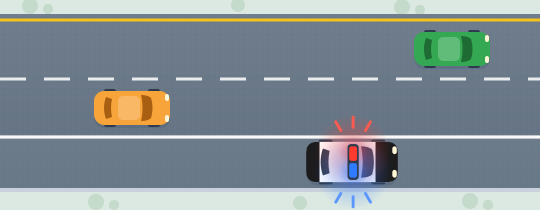
On a highway with two lanes in your direction, a police car is stopped on the right shoulder with its lights flashing, and you’re in the lane right next to it. What does Oregon’s move over rule call for?
Show answer
Correct answer: Move to the lane that isn’t next to the stopped car, if it’s safe
Why
Oregon’s move over law covers any vehicle stopped with its warning or hazard lights flashing, not just police cars. With two or more lanes your way, move to a lane that isn’t next to it; if you can’t, slow to at least 5 mph under the posted limit, which is also the rule on two-lane roads. Either way, give it as much room as you safely can.
29Road signs
A sign along the freeway points you toward gas, food, lodging and an EV charging station. What color is it?
Show answer
Correct answer: Blue
Why
Oregon’s manual sorts these signs by color: blue for motorist services such as fuel, food, lodging, EV charging and hospitals, green for directions and other guide information, and brown for historic, cultural and recreation sites. Knowing the code lets you pick out the sign you need from far away.
30Speed limits
The posted limit is 55 mph, but thick fog has cut your view to a few car lengths. You’re doing 50. Under Oregon’s basic rule, could you be cited?
Show answer
Correct answer: Yes, if 50 is too fast for what you can see
Why
Oregon’s basic rule applies on every road: never drive faster than conditions safely allow, and that can be far below the number on the sign. It never lets you go over the limit, either. In fog, switch to low beams and choose a speed that lets you stop short of anything your headlights reveal.
Round 4 · Questions 31–40
31Speed limits
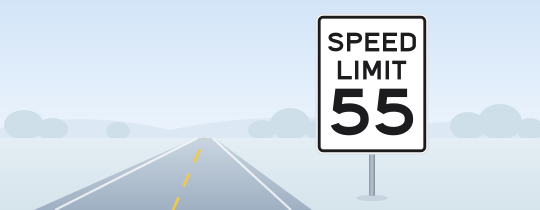
Oregon law sets a default of 55 mph, the number on this white SPEED LIMIT sign. Where does that default apply when no other speed is posted?
Show answer
Correct answer: Roads and highways that fit no other category, like open rural highways
Why
If a road isn’t an alley, a business or residence district, a school zone, a park or a beach, Oregon’s default is 55 mph unless signs say otherwise. Most interstate sections are posted at 65 mph, and some eastern Oregon interstates and highways reach 70 for cars. Slow down for weather, traffic and curves whatever the sign says.
32Road signs
An electronic sign on an Oregon highway shows a black-and-white SPEED LIMIT 45, lower than the road’s usual limit. How should you treat it?
Show answer
Correct answer: As the legal limit, enforced just like any regular speed sign
Why
Oregon’s electronic variable speed signs can change the limit as conditions change, and the black-and-white ones carry the force of law. Yellow versions show an advisory speed instead. Even then, police can cite you under the basic rule if you’re going too fast for the conditions.
33Right-of-way
A city bus at a curbside stop puts on its left signal, and a YIELD sign flashes on its back. You’re coming up behind it in the next lane. What does Oregon law require?
Show answer
Correct answer: Let the bus pull back into traffic ahead of you
Why
Drivers coming from behind must yield when a bus signals to re-enter traffic and shows its flashing YIELD sign. Ease off and leave it room to merge. City buses stop every few blocks, so expect the same thing again soon.
34Parking
When you park near a train or light-rail crossing in Oregon, how close to the closest rail may your car be?
Show answer
Correct answer: No closer than 50 feet
Why
Oregon wants parked cars 50 feet or more back from the closest rail of any railroad or light-rail crossing, so drivers and train crews can see each other. Along the tracks, don’t park within 7½ feet where you could block a train. Stopping for a train is different: with no stop line, you halt 15 feet or more from the rail.
35Alcohol & phones
You’re 17 with a provisional license, and your car has Bluetooth. Can you take a hands-free call while driving?
Show answer
Correct answer: No; under 18, any phone use while driving is banned, hands-free too
Why
Oregon allows hands-free phone use only for drivers 18 and older. Under 18, any use of a mobile device while driving is off-limits, Bluetooth and speakerphone included. Let calls go to voicemail, or pull over and park before you answer.
36Alcohol & phones
After dinner out, your passenger wants to take home a bottle of wine that was opened and then corked again. Where should it ride?
Show answer
Correct answer: In the trunk, because a broken seal makes it an open container
Why
In Oregon a container counts as open the moment its seal is broken, recapped or not. An open container isn’t allowed in a vehicle on a public road, so the bottle goes in the trunk. It doesn’t matter who opened it; the broken seal is what counts.
37Safe driving
You’re outside city limits on a two-lane highway and want to make a U-turn. When is it illegal even without a NO U-TURN sign?
Show answer
Correct answer: If drivers coming from either direction can’t see you from 1,000 feet away
Why
Oregon bans U-turns outside city limits wherever approaching traffic can’t see you within 1,000 feet; inside city limits the distance is 500 feet. U-turns are also off-limits at railroad crossings, at signal-controlled intersections unless a sign allows them, and mid-block in a city. Pick a spot with a long view both ways.
38Permit & provisional license
You’re 16, four months into your provisional license. It’s 12:30 a.m., and you want to drive home alone from a friend’s house. Is that allowed?
Show answer
Correct answer: No; in year one, midnight to 5 a.m. is off-limits with few exceptions
Why
During the first year of an Oregon provisional license, you can’t drive between midnight and 5 a.m. The exceptions: commuting to or from work, driving as part of your job, getting to or from a school activity when no other ride exists, or driving with a licensed adult aged 25 or older in the car. The limit ends when you turn 18 or after one year, whichever comes first.
39Permit & provisional license
A 17-year-old Oregon driver is convicted of speeding and, a few months later, causes a preventable crash. What does DMV do?
Show answer
Correct answer: Restricts the license to work-related driving for 90 days
Why
Under Oregon’s Provisional Driver Improvement Program, two convictions, two preventable crashes, or one of each before 18 bring a 90-day restriction to driving for work. A third brings a six-month suspension, even if the driver has turned 18 by then. A parent who signed for the license can also ask DMV in writing to cancel it any time before 18.
40Crashes & emergencies
Your car stalls on a railroad crossing and won’t restart. Once everyone is out, which way should you move if a train is coming?
Show answer
Correct answer: Away from the tracks at a 45-degree angle, toward the train
Why
When a train hits a car, the wreckage is pushed ahead of it along the tracks, so heading off at an angle toward the oncoming train keeps you out of its path. Get everyone out right away, then use the Emergency Notification System sign posted at the crossing to alert the railroad. Never stay in the car hoping it will start.
Oregon DMV knowledge test at a glance
The numbers that matter before test day, whether you test from home or at a DMV office.
Oregon · Class C knowledge test
80% to pass.
35 questions · Multiple choice
28 of 35 answers right to pass
Onlineon a computer with a webcam through DMV2U, or at a DMV office
Spanishon screen and in audio, among 8 languages
$7per attempt, online or in person
Same dayretest at an office when a testing station is free
$30for the instruction permit, good for 2 years
20/40vision for driving with no restrictions
Under 18? Your road to a license
15Provisional Instruction PermitPass the vision screening and the 35-question test. A parent or guardian signs your application and confirms you’re in school.
6 moPractice behind the wheelHold the permit at least six months, always with a licensed driver 21+ beside you, and log 100 hours, or 50 with an ODOT-approved driver ed course.
16Provisional Driver LicensePass the drive test, or skip it if you passed approved driver ed within the last two years.
Year 1First-year limitsNo driving midnight–5 a.m. outside a few exceptions. No non-family passengers under 20 for six months, then three at most.
18Limits liftedPassenger and night limits end at 18 or after a year, whichever comes first. The phone ban lasts until 18.
18 or older? Oregon sets no permit period and no practice hours: pass the vision, knowledge and drive tests and you’re licensed. Get a permit only if you want to practice first.
What’s on the Oregon permit test
Oregon DMV says the Oregon Driver Manual (2026–2027 edition, Form 735-37) holds everything you need to pass, and it comes in Spanish too. Its “Study for Your Tests” chapter walks through signs, lane travel, turns, sharing the road, railroad crossings, parking and safe driving. Start with these six areas.
Road signs
Read shape and color first: a red octagon means a full stop, yellow warns, orange marks a work zone, and a red circle with a slash means not allowed.
A five-sided school sign marks where a school zone begins; watch for the 20 mph school speed sign.
Signal dark during an outage? Treat it as an all-way stop. A flashing yellow arrow lets you turn once you’ve yielded.
Right-of-way
No signs or signals? Yield to anyone already in the intersection or coming from your right.
Turning left, yield to oncoming traffic. On red, a left is legal only onto a one-way street, after a full stop.
School bus red lights: stop and wait until they go off. Only an unpaved median or a barrier lets the other side keep going.
Speed limits
The basic rule: your speed must suit the conditions, so you can break the law even below the posted limit.
Limits set by law when nothing is posted: 15 mph in alleys, 20 in business districts, 25 in residence districts, 55 elsewhere.
School zones drop to 20 mph. Work-zone limits hold around the clock, and fines there are doubled.
Parking
Keep 10 feet clear of a fire hydrant, and 20 feet clear of any crosswalk at a corner.
Fire station driveway: 15 feet on its side of the street, 75 across. Railroad crossing: keep 50 feet back from the closest rail.
Uphill at a curb, wheels toward the travel lane; downhill, toward the curb. Park within 12 inches of the curb.
Alcohol & phones
Blood alcohol lines: 0.08% for adults, 0.04% in a commercial vehicle, and any measurable amount for drivers under 21.
Refuse a breath test and implied consent suspends your license for a year, or three with a recent DUII history.
18 and older: hands-free only, red lights included. Under 18: no phone use at all, not even hands-free.
Teen rules
Permit drivers need a licensed adult 21+ beside them; hours count only if that adult has held a license for 3+ years.
Provisional license, months 1–6: no passengers under 20 outside your immediate family. Months 7–12: three at most.
First year: no driving midnight–5 a.m. unless it’s for work, a school event with no other ride, or a licensed driver 25+ is along.
Oregon numbers to know
The distances and deadlines Oregon drivers are expected to know by heart.
100 ftof signaling before you turn or change lanes
10 ftbetween your parked car and a fire hydrant
15 ftfrom the nearest rail when you stop at a crossing
2–4 secof following distance, and 4+ above 30 mph
500 ftbehind an emergency vehicle once it has passed
72 hrsto file a DMV crash report if anyone is hurt or your car has over $2,500 in damage
Your Oregon course, in your pocket
These 40 questions are just the warm-up. The app gives you 443 Oregon practice questions, 36 short lessons and the why behind every answer.
36 short lessonsFour levels, from fundamentals to expert, then a full practice exam.
443 Oregon questions310 of them with pictures.
Your most-missed questionsA review lesson built from the questions you miss most.
Exam simulatorTake full practice exams and watch your readiness grow.
Oregon permit
Your Oregon path is ready.
36 lessons, 443 questions and full practice exams. In English and Spanish.
How many questions does the Oregon DMV knowledge test have, and how many do I need right?
It has 35 multiple-choice questions on road signs, Oregon traffic law and safe driving, and you need 28 right to pass. That’s 80%, so you can miss up to 7. Before your first permit, DMV also checks your vision at no charge.
What happens if I fail the Oregon knowledge test?
At a DMV office you can often retest the same day if a testing station is open, with no set limit on attempts, though each one costs $7. Online you get two tries in any 24 hours and four in total, then you test in person. Anyone caught cheating fails on the spot and can’t test again for 90 days.
Can I take the Oregon permit test online?
Yes. Through DMV2U you can test from home on a desktop or laptop with a webcam; phones and tablets won’t work. Under 18, you need an adult proctor aged 21 or older, not necessarily a parent, who registers and watches the whole test, and both of you must have a Social Security number. The fee is the same as at an office.
Can I take the Oregon permit test in Spanish?
Yes. The Class C knowledge test comes in Spanish, on screen and in audio, both online and at DMV offices, alongside English, Arabic, Chinese, Japanese, Korean, Russian and Vietnamese. DMV also publishes the Manual del conductor de Oregon and a free practice test in Spanish, and this page and the app work in Spanish too.
How old do you have to be to get a permit in Oregon?
15. Teens get a Provisional Instruction Permit, hold it at least six months and log 100 supervised hours, or 50 with an ODOT-approved driver ed course, before a provisional license at 16. In that license’s first year, no driving from midnight to 5 a.m. (work and a few other trips excepted), no passengers under 20 outside the family for six months and no more than three for the next six. Until 18, no phone use at all behind the wheel.
How much does an Oregon permit cost?
The instruction permit costs $30 and stays valid for two years, plus $7 for every knowledge test attempt. A first Class C license is $64, and the drive test at DMV is $45. Choosing a REAL ID-compliant card adds $30.
What’s on the Oregon drive test?
You book it by appointment, at DMV or with a certified third-party tester, and bring a registered, insured car. The examiner scores your turns, backing, parking, lane changes, speed, signaling and overall control. If you fail, you can try again the next business day. Teens who pass an ODOT-approved driver ed course have the drive test waived for two years.
What’s the best way to study for the Oregon permit test?
Work through the Oregon Driver Manual 2026–2027, especially the signs, lane use, turning and parking sections, and quiz yourself until you beat 80% every time. Start with the 40 questions above, then let the app take you through 443 Oregon questions and 36 short lessons, every answer explained.