Michigan has no DMV: the Secretary of State (SOS) gives the driver knowledge test. Get ready with 40 free questions on road signs, Michigan lefts, speed limits, hands-free rules and the teen GDL levels, and see why each answer is right the moment you tap it.
Forty questions in four rounds of 10: Michigan signs, right-of-way and Michigan lefts, speed limits, parking, alcohol and phone laws, and the GDL levels. Tap an answer to see why it’s right.
Round 1 · Questions 1–10
1Crashes & emergencies
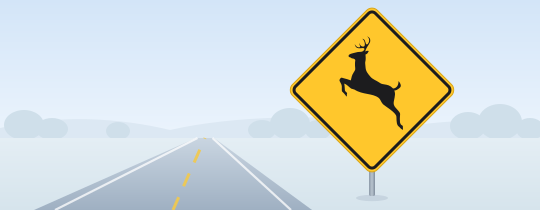
At dusk on a two-lane road near Gaylord, you pass a yellow diamond sign showing a leaping deer. Seconds later a deer bounds into your lane, too close to miss. What does Michigan’s driver handbook tell you to do?
Show answer
Correct answer: Brake firmly, grip the wheel and stay in your lane
Why
Michigan has around 60,000 crashes with deer a year, and the bigger danger is swerving into a tree, a ditch or oncoming traffic. Brake hard, hold the wheel straight and take the hit in your own lane. Where that sign appears, ease off the gas and keep scanning both edges of the road.
2Right-of-way
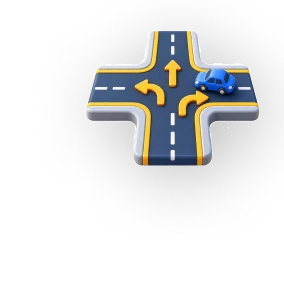
On a divided boulevard in Oakland County, a sign bans left turns at the next intersection and directs you to a Michigan left. You need to go left onto the cross street. How?
Show answer
Correct answer: Go straight through, U-turn at the median crossover, then turn right
Why
Michigan lefts move left turns away from the main intersection. Drive past the cross street, make a U-turn at the median crossover, then turn right when you get back to it. Coming from the side street, you turn right onto the boulevard first and use a crossover the same way.
3Speed limits
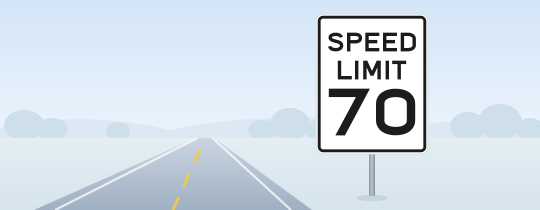
A SPEED LIMIT 70 sign stands beside a Michigan freeway, and no other speed signs are posted. In good conditions, what is the slowest you may legally drive there?
Show answer
Correct answer: 55 mph
Why
Unless signs say otherwise, Michigan freeways have a 70 mph maximum and a 55 mph minimum, since a car creeping along is a hazard too. About 614 miles of freeway are now posted at 75 mph. Trucks and school buses top out at 65 mph on freeways.
4Alcohol & phones
Michigan’s zero-tolerance law sets a lower blood alcohol limit for drivers who aren’t 21 yet. What is it?
Show answer
Correct answer: 0.02%
Why
Drivers under 21 face a 0.02% limit, and a violation puts 4 points on the record. A first offense also brings a 30-day restricted license and a fine of up to $250. The 0.04% figure is for commercial vehicles, and 0.08% is the line for adults.
5Permit & teen rules
What is the youngest age at which a Michigan teen can get a Level 1 Learner’s License?
Show answer
Correct answer: 14 years and 9 months
Why
Level 1 opens at 14 years 9 months, and Segment 1 of driver ed can start a month earlier, at 14 years 8 months. Bring your Segment 1 certificate and a parent or guardian to a Secretary of State office, pass the vision and health checks, and pay $25.
6Parking
You find a curbside space on a Grand Rapids street close to a fire hydrant. What is the nearest you may park to it?
Show answer
Correct answer: 15 feet
Why
Michigan keeps parked vehicles at least 15 feet from a hydrant so fire crews can hook up without delay. Two more gaps to know: 20 feet from a marked crosswalk, and 15 feet from an intersection that has no crosswalk.
7Safe driving
On a dry road in normal daytime traffic, what following distance does Michigan’s handbook call for?
Show answer
Correct answer: 3 to 4 seconds
Why
Watch the car ahead pass a sign or a mailbox, then count: you shouldn’t reach that spot for at least 3 seconds. Stretch the gap to 6 seconds or more at high speed or in rain, snow or fog. The extra room buys you time when the driver ahead brakes hard.
8Road signs
Coming around a curve on I-96, you see a fluorescent pink sign set up on the shoulder. What kind of situation does that color point to?
Show answer
Correct answer: A crash or other emergency ahead
Why
Michigan’s handbook reserves fluorescent pink for incidents and emergencies, so expect stopped traffic, responders or debris ahead and slow down. The other choices match other colors: fluorescent yellow-green for schools, people on foot and bikes, brown for recreation, blue for services. Orange belongs to construction zones.
9Sharing the road
You come up behind a bicyclist on a two-lane road, in a stretch marked as a no-passing zone. What does Michigan allow?
Show answer
Correct answer: Passing with at least 3 feet of space, once it’s safe
Why
Even where cars may not pass each other, Michigan lets you go around a bicyclist once it’s safe, as long as you keep a gap of 3 feet or more. Some cities require 5 feet. If a curve or an oncoming car leaves no room, wait behind the rider.
10Right-of-way
A storm has knocked out power, and the traffic lights at a busy Ann Arbor intersection are completely dark. No officer is directing traffic. How do you get through?
Show answer
Correct answer: Treat it as an all-way stop and take turns
Why
Under Michigan law, a dark or broken signal with no officer present works like an all-way stop. Everyone stops; the driver who stopped first goes first, and when two arrive together, the one on the left lets the one on the right go. Expect confusion and make eye contact before you pull out.
Round 2 · Questions 11–20
11Right-of-way
You’re following a school bus on a two-lane road. It stops, its red overhead lights begin flashing and the stop arm swings out. What is the closest you may stop behind it?
Show answer
Correct answer: 20 feet
Why
Michigan wants 20 feet or more between you and a bus whose red overhead lights are flashing, and you stay put until they go dark or the bus pulls away. Flashing yellow overhead lights come first and mean get ready to stop. Passing a stopped bus costs double the usual fine and 3 points.
12Alcohol & phones
An officer asks a Michigan driver to take a chemical breath test, and the driver refuses. It’s the first refusal. What happens to the license?
Show answer
Correct answer: An automatic one-year suspension
Why
Under implied consent, anyone who applies for or renews a Michigan license has already agreed to chemical testing. Refusing triggers a one-year suspension, and a second refusal inside seven years doubles that to two years. A refusal also puts 6 points on your record.
13Speed limits
Unless a sign says otherwise, how fast may you drive on the streets of a platted subdivision or a condominium complex in Michigan?
Show answer
Correct answer: 25 mph
Why
Michigan sets 25 mph in platted subdivisions and condo complexes, and that limit holds even where no sign is posted. Mobile home parks can be posted as low as 15 mph. Children, parked cars and backing vehicles show up fast on those streets, so keep your foot near the brake.
14Permit & teen rules
A 16-year-old with a Level 2 Intermediate License is driving home alone from a friend’s house at 11 p.m. Which statement is true?
Level 2 drivers stay off the road from 10 p.m. to 5 a.m. unless a parent, guardian or licensed adult 21 or older they designate rides along, or the trip is for work or an authorized activity such as school, sports or a religious event. A visit with a friend doesn’t count. A violation adds 2 points and the parent is notified.
15Road signs
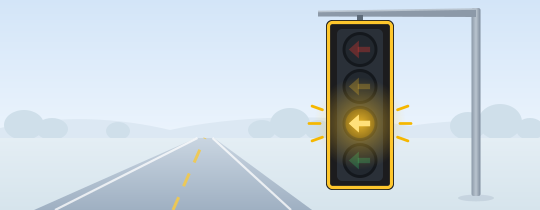
You’re waiting in a left-turn lane, and the only light lit on the signal above it is a flashing yellow arrow pointing left. What may you do?
Show answer
Correct answer: Turn left after yielding to oncoming traffic and pedestrians
Why
A flashing yellow arrow allows the turn but gives you no protection: oncoming drivers have a green light at the same time. Wait for a gap you’re sure of and check the crosswalk you’ll cross. When a turn arrow glows green, the turn is protected.
16Parking
On a rural township road, fire trucks are battling a barn fire, and you’d like to pull over and watch. How close to the fire may you park?
Show answer
Correct answer: No closer than 500 feet
Why
Outside cities and villages, Michigan law bars parking closer than 500 feet to a fire that fire trucks are working, and the handbook gives a fire or crash scene the same 500-foot buffer. That leaves room for crews, hoses and more trucks, and keeps onlookers out of harm’s way. Drive on and let the responders work.
17Safe driving
You’re about to turn right at the next corner on a city street. How far ahead should your turn signal come on, according to Michigan’s road-test study guide?
Show answer
Correct answer: At least 100 feet before the turn
Why
Signal at least 100 feet out, roughly 3 to 4 seconds ahead, yet not so soon that drivers expect you to turn at an earlier driveway. Michigan law also requires a signal for lane changes, not only for turns.
18Sharing the road
Near an Amish settlement you come up behind a horse-drawn buggy. What does Michigan’s handbook ask of you?
Show answer
Correct answer: Slow to 15–20 mph, stay 20+ feet back and skip the horn
Why
A startled horse can lurch into your path, so ease down to 15–20 mph, keep at least 20 feet back and never honk or rev the engine. Buggies and farm machines are slow-moving vehicles that can’t top 25 mph, marked by an orange triangle on the back. Pass only where it’s legal and you can leave them plenty of room.
19Right-of-way
You’re stopped at a red light on a two-way street in Lansing. The street to your left is one-way, with all its traffic flowing left. What does Michigan law allow?
Show answer
Correct answer: A left on red after stopping and yielding, unless a sign says no
Why
Michigan permits a left on red into a one-way street that runs to your left, and the street you’re leaving can be one-way or two-way. Stop completely, check traffic coming from your right, and give way to people in the crosswalk and to oncoming drivers turning right. A NO TURN ON RED sign cancels the option, just as it does for right turns.
20Crashes & emergencies
You bump another car at a Flint intersection. Nobody is hurt, but the damage looks like it will cost more than $1,000 to fix. What does Michigan require?
Show answer
Correct answer: Exchange information with the other driver and notify the police
Why
In Michigan, police must be told about any crash with injuries or more than $1,000 in property damage, and the drivers swap their information. If nobody is seriously hurt and both cars still drive, move them off the main road, to the shoulder for instance, while you wait.
Round 3 · Questions 21–30
21Crashes & emergencies
On I-94, posted at 70 mph, a police car sits on the right shoulder with its lights flashing. What does Michigan’s Move Over law ask of you?
Show answer
Correct answer: Move a lane away if traffic allows and slow to 60 mph or less
Why
For a stopped emergency vehicle with flashing lights, Michigan wants you at least 10 mph under the posted limit and over one lane when traffic allows. If you can’t change lanes, slow down and pass with extra care. The same rule covers stopped tow trucks, road service, construction, utility and waste vehicles.
22Alcohol & phones
You’re a fully licensed adult, stopped at a red light in Kalamazoo, when a text comes in. What does Michigan’s hands-free law let you do?
Show answer
Correct answer: Use voice commands, or leave it until you’re parked
Why
Michigan’s hands-free law bans holding or manually using a phone while driving, and it still applies when you’re stopped at a light or a stop sign. Voice commands and a single tap or swipe to switch something on or off are fine. A first ticket is $100, 16 hours of community service, or both.
23Speed limits
You turn onto an unpaved gravel road in rural Michigan, and there isn’t a speed limit sign anywhere. What is the legal maximum?
Show answer
Correct answer: 55 mph
Why
Michigan’s default on roads that aren’t freeways is 55 mph, and it applies to unposted gravel roads too. The basic speed law still rules: on loose gravel, hills and blind curves, pick a speed that lets you stop for anything in your sightline. 55 is a ceiling, not a target.
24Permit & teen rules
A 16-year-old Level 2 driver keeps her phone in a dashboard mount on speaker. When does Kelsey’s Law let her use it while driving?
Show answer
Correct answer: Only to report an emergency, like a crash or a crime
Why
Kelsey’s Law bars Level 1 and Level 2 drivers from using a phone behind the wheel, and that includes hands-free. The one exception is reporting an emergency, such as a crash, a medical problem, a road hazard or a crime. At Level 3, Kelsey’s Law no longer applies and the adult hands-free rules take over.
25Road signs
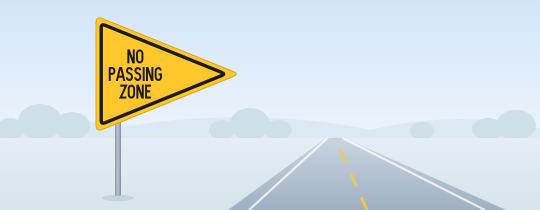
On a two-lane highway up north you spot a yellow sign shaped like a long sideways triangle, reading NO PASSING ZONE. Where does Michigan put this pennant, and what is it telling you?
Show answer
Correct answer: At the left edge of the road, to warn you not to pass from here on
Why
The pennant is the one sign with this shape, and it stands on the left, the side you’d pull into to pass, so you see it right as you think about pulling out. Stay behind the slower vehicle until the zone ends. Also never pass when an intersection or railroad crossing is 100 feet away or less.
26Parking
You parallel park along a curb on a Michigan street. Which position follows the rules?
Show answer
Correct answer: Facing with traffic, wheels 12 inches or closer to the curb
Why
Your wheels may sit 12 inches or less from the curb, and parking against the flow of traffic is not allowed. While you’re choosing a spot, stay 30 feet back from a stop sign or traffic light on the approach side, and 50 feet from the closest rail at a train crossing.
27Safe driving
You’re on high beams on a dark highway, and an oncoming car appears. Within what distance of it are high beams no longer allowed?
Show answer
Correct answer: 500 feet
Why
Using high beams, or even flashing them, is illegal once an oncoming car is 500 feet away or closer, and you should dim them when following someone too. Headlights belong on from 30 minutes past sundown until 30 minutes before sunup, plus any time the light is too poor to make out people and cars 500 feet ahead.
28Road signs
The Michigan handbook teaches nine basic sign shapes. Which one is used to warn that you’re near a school?
Show answer
Correct answer: A five-sided pentagon, shaped like a house
Why
Pentagons are reserved for school zones and school crossings, so slow down and look for children as soon as you spot one. Shapes help when snow or glare hides the words: an octagon means STOP, a downward triangle YIELD, a diamond a warning and a round sign a railroad ahead.
29Right-of-way
A fire truck with flashing lights and a wailing siren goes by, and you ease back into your lane. If you end up heading the same way behind it, how far back must you stay?
Show answer
Correct answer: At least 500 feet
Why
Michigan keeps drivers 500 feet or more behind a moving emergency vehicle that has its lights and siren on, and you may not pass it unless told to. When one is coming toward you or up from behind, pull to the right edge, away from intersections, and stop until it’s gone by.
30Lane markings
You pull into an unmarked median crossover on a Michigan boulevard to make a U-turn, and another car is already waiting in it. What should you do?
Show answer
Correct answer: Wait behind it; unmarked crossovers take one car at a time
Why
Michigan treats a median crossover with no lane lines as a single lane, so vehicles turn one by one. Wait your turn and keep the back of your car out of the through lanes if you can. Crossovers like this are what make Michigan lefts work, so you’ll use them a lot.
Round 4 · Questions 31–40
31Road signs
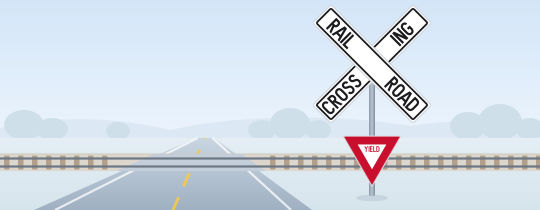
A white X-shaped crossbuck marks a railroad crossing on your route; there are no lights or gates. Cars are backed up just beyond the tracks. When may you start across?
Show answer
Correct answer: Only when your whole car can get 6 feet or more past the tracks
Why
Michigan’s handbook says to wait until your whole vehicle can clear the tracks by 6 feet or more, so a train can’t catch your rear bumper if traffic stalls. If a train is coming, pull up no nearer than 15 feet to the rails and no more than 50 feet back. Stalled on the rails? Get everyone out and well away, then call the railroad’s number on the blue sign there; with a train approaching, call 911.
32Alcohol & phones
Michigan’s high-BAC law brings tougher penalties, such as a longer possible jail term and mandatory alcohol treatment, once a driver’s blood alcohol reaches what level?
Show answer
Correct answer: 0.17%
Why
At 0.17% or more, a first offense can mean fines up to $700, as much as 180 days in jail, a suspension of up to a year and mandatory treatment. Even below that, a first drunk-driving conviction puts 6 points on your record. Police can arrest you at any BAC if you show signs of impairment.
33Speed limits
Orange barrels close one lane of a freeway for road construction, and no other limit is posted for the work zone. What is the most you may drive through it?
Show answer
Correct answer: 45 mph
Why
Michigan law caps speed at 45 mph where a lane, or part of one, is closed for construction, maintenance or surveying, unless the road agency posts a different limit. Some zones drop to 45 only while workers are present, so watch the signs. Moving-violation fines double in work zones, and speeding there adds extra points.
34Permit & teen rules
Before a Michigan teen can take the driving skills test, how much supervised driving has to be logged?
Show answer
Correct answer: 50 hours, 10 of them at night
Why
The total is 50 hours with at least 10 after dark. Thirty of them, 2 at night, must already be in the log before Segment 2 can begin. You also need six months on Level 1 and 90 days with no violations or at-fault crashes.
35Permit & teen rules
You’re 24, brand-new to driving, and just got a Temporary Instruction Permit (TIP) at the Secretary of State. How long must you practice before the driving skills test?
Show answer
Correct answer: At least 30 days
Why
On a TIP, adults must log at least 30 days of practice beside a licensed adult before the road test. The TIP lasts 180 days, so schedule the test in time; let it expire and you start over. Road tests are given by private businesses authorized by the state, and each sets its own price.
36Alcohol & phones
Your SUV has no trunk, and you’re bringing home a half-finished bottle of wine from a friend’s dinner. Where may it ride under Michigan law?
Show answer
Correct answer: In a locked glove box, or behind the last upright seat
Why
Open, uncapped or unsealed alcohol may not be in the passenger area at all. When a vehicle has no trunk, the bottle belongs in a locked glove box, behind the rearmost upright seat or in another area where no one sits. An open container in the vehicle is a 2-point violation.
37Safe driving
You’re passing a slow pickup on a two-lane road when an oncoming car comes into view. When must you be back in your own lane?
Show answer
Correct answer: Before the car is within 200 feet of you
Why
Michigan has you finish the pass and be back in your lane while an oncoming vehicle is still more than 200 feet away. If that doesn’t look possible, ease off and drop back behind the pickup. Skip passing altogether near intersections, railroad crossings and bridges or tunnels that block your view.
38Sharing the road
On a county road, a snowplow working ahead of you has flashing green lights. What are those green lights telling you?
Show answer
Correct answer: Road crews are working, so slow down and take care
Why
Road agencies in Michigan, state and local, may fit their maintenance trucks with flashing green lights so they stand out. Treat green like a caution light: slow down, give the truck room and expect it to stop or turn. When road crews are stopped with lights flashing, the Move Over law covers them too.
39Lane markings
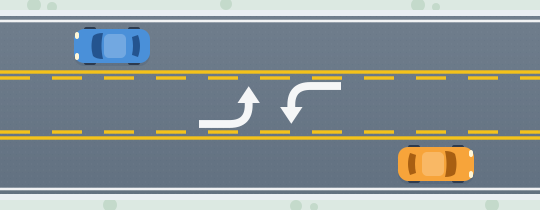
A road has a center lane edged by a solid yellow line on the outside and a broken yellow line on the inside, with left-turn arrows painted for both directions. How may you use it?
Show answer
Correct answer: Only to turn left, whichever direction you’re coming from
Why
Drivers from both directions share this center lane, but only to turn left. Michigan doesn’t allow it to be used for passing or for merging into traffic. Move into it just before your turn and watch for an oncoming driver aiming for the same space.
40Road signs
The signal ahead changes to steady yellow while you’re still far enough back to stop smoothly. What does Michigan expect you to do?
Show answer
Correct answer: Stop, since you can do it safely
Why
Steady yellow warns that red is next, and in Michigan you’re required to stop for it whenever stopping is safe. If you’re already too close to stop without slamming the brakes, go through carefully instead of speeding up. The State Police note that drivers can be ticketed for entering on yellow when they could have stopped.
Michigan SOS knowledge test at a glance
What to know before you test at a Secretary of State office or online.
Michigan · SOS knowledge test
Pass both sections.
Operator + Signs · Multiple choice
Freeat an SOS office, or $6.50 online
Onlineat home if you’re 18 or older
2 triesper day online, paid each time
Spanishand 30 more languages, written or audio
1 yeara passed test stays valid
$25for your permit, teen or adult
Under 18? Your road to a license
14¾Level 1 Learner’s LicenseFinish Segment 1 of driver ed (you can enroll at 14 years 8 months), then visit the SOS with a parent and pay $25.
3 moSegment 2After three months on Level 1 and 30 logged hours, 2 of them at night, take 6 more hours of class and pass its exam.
16Level 2 Intermediate LicenseLog 50 hours, 10 after dark, hold Level 1 for six months and pass the driving skills test.
16–17Level 2 limitsNo driving 10 p.m.–5 a.m. and at most one passenger under 21 from outside the family, unless a parent or designated adult 21+ rides along or the trip is for work or an approved activity such as school. No phone use except to report an emergency.
17Level 3 Full LicenseAfter six months on Level 2 and 12 clean months, it arrives automatically, free of charge.
18 or older? No driver ed needed: pass the test at an SOS office or online, buy your $25 TIP, practice at least 30 days, then take the road test within 180 days.
What’s on the Michigan permit test
The SOS points you to What Every Driver Must Know (SOS-133), especially chapters 4 to 7: traffic laws, signs and signals, sharing the road and emergencies. Start with these six areas.
Road signs
Color first: pink flags an incident ahead, orange a work zone, brown a park or recreation spot.
A yellow pennant posted on the left warns of a no-passing zone; a pentagon means a school.
Red sits on top of Michigan signals. Flashing red: full stop. Flashing yellow arrow: turn left only after yielding.
Right-of-way
Four-way stop: first to stop goes first; arrive together and the driver on the left yields.
At a Michigan left, go straight or turn right, then make your U-turn at the median crossover.
Signal dark and no officer in sight? Everyone stops, just as at a four-way stop.
Speed limits
Freeways: 70 mph max and 55 mph min unless posted, with 75 mph on some stretches.
55 mph on other unposted roads; 25 mph in platted subdivisions and condo complexes.
Lane closed in a work zone? 45 mph unless a sign says otherwise, and fines double.
Parking
Park at least 15 feet from a hydrant and 20 feet from a marked crosswalk.
Leave 30 feet before a stop sign or signal and 50 feet from the closest rail.
Downhill, wheels toward the curb; uphill with a curb, wheels away from it.
Alcohol & phones
BAC limits: 0.08% at 21 and up, 0.02% under 21, 0.04% in a commercial vehicle.
Refuse a breath test and lose your license for a year; refuse again within seven years and it’s two.
Hands-free only for every driver, even at a red light or stop sign.
Teen rules
Level 1: a licensed parent or guardian, or a licensed 21+ adult they designate, must sit up front whenever you drive.
Level 2: no driving 10 p.m.–5 a.m. and one passenger under 21 at most, with exceptions.
Kelsey’s Law: on Level 1 or 2, no phone use while driving except to report an emergency.
Michigan numbers to know
Six figures from Michigan law and the SOS handbook to know by heart.
100 ftof signaling before a turn
3–4 secfollowing distance in normal conditions
20 ftbehind a school bus flashing red
15–50 ftfrom the tracks when a train is coming
3 ftof space when you pass a bicyclist
10 mphunder the limit when you move over
Your Michigan course, in your pocket
These 40 questions are just the warm-up. The app gives you 528 Michigan practice questions, 36 short lessons and the why behind every answer.
36 short lessonsFour levels, from fundamentals to expert, then a full practice exam.
528 Michigan questions318 of them with pictures.
Your most-missed questionsA review lesson built from the questions you miss most.
Exam simulatorTake full practice exams and watch your readiness grow.
Michigan permit
Your Michigan path is ready.
36 lessons, 528 questions and full practice exams. In English and Spanish.
How many questions are on the Michigan SOS test, and how do I pass?
The SOS doesn’t publish a question count or a percentage for the knowledge test. What it does spell out: it’s a multiple-choice test in two sections, Operator (about 45 minutes) and Signs (about 15 minutes), and you must pass both before a permit is issued. Scoring 80% or better on every round here is a strong sign you’re ready for both.
Is the Michigan permit test given by the DMV?
Michigan doesn’t have a DMV. Driver licensing belongs to the Michigan Department of State, and you test and pick up your permit at a Secretary of State (SOS) office. Schedule your visit online, and plan to start testing at least an hour before the office closes.
Can I take the Michigan knowledge test online?
Yes, if you’re 18 or older. Since July 2025, the same test given on SOS office computers can be taken at home for a $6.50 convenience fee. After you pass, you still visit an SOS office for the vision test and your $25 permit.
Can I take the Michigan permit test in Spanish?
Yes. Every SOS office gives the knowledge test in Spanish and 30 other languages, in written or audio form, and the handbook has a Spanish edition, Lo que todo conductor debe saber. This practice test is in Spanish too, and so is the app.
How many times can I retake the Michigan written test?
At an SOS office, a fail ends that visit, so you book a new one and retest on a different day. Online, you get two attempts a day, with the fee charged for each one, and if you pass one section but not the other, you can take the full test at an SOS office at no charge. Once you pass, the result is good for one year.
How old do you have to be to get a permit in Michigan?
14 years 9 months, for a Level 1 Learner’s License. For teens, the knowledge test is the Segment 1 state exam in driver ed: 80 questions, 70% to pass. After six months on Level 1, 50 logged hours (10 at night) and Segment 2, a road test leads to Level 2 at 16, with no driving 10 p.m.–5 a.m., one passenger under 21 at most and, under Kelsey’s Law, no phone. Level 3, the full license, comes at 17 at the earliest.
How much does a Michigan permit cost?
The knowledge test is free at an SOS office, or $6.50 online. Adults pay $25 for the Temporary Instruction Permit (TIP), which lasts 180 days, and if you pass the road test before it expires, the license itself costs nothing extra. Teens pay $25 for the Level 1 Learner’s License. Road test prices are set by the private testing businesses.
What’s the best way to study for the Michigan permit test?
Read chapters 4 to 7 of What Every Driver Must Know, the SOS handbook, along with the Driving Skills Test Study Guide. Then warm up with the 40 questions above and let the app take you through 528 Michigan questions and 36 short lessons, with an explanation for every answer.