In Alabama, the permit test comes from ALEA, the Alabama Law Enforcement Agency, rather than a DMV. Warm up with 40 free questions on road signs, Alabama speed limits, the hands-free law and the teen license stages, with a short explanation after every answer.
Forty questions in four rounds of ten, mixing Alabama signs and right-of-way with speed limits, parking, DUI, the hands-free law and the teen license stages. Tap an answer to see the reasoning.
Round 1 · Questions 1–10
1Road signs
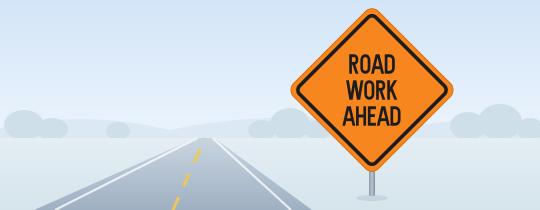
Crews are at work beyond an orange diamond-shaped ROAD WORK AHEAD sign on an Alabama highway. If you’re ticketed for speeding there, what can it cost?
Show answer
Correct answer: $250 or double the normal fine, whichever is greater
Why
Alabama raises the stakes for any moving violation in a construction zone while workers are present: you pay double the normal fine or $250, whichever is higher. Orange signs mark these zones, so ease off as soon as you spot one and watch for lane shifts and flaggers.
2Right-of-way
You and a pickup truck both reach a four-way stop together, and the pickup waits on the cross street to your right. Per the Alabama Driver Manual, which vehicle should go first?
Show answer
Correct answer: The pickup, because it’s farther to the right
Why
At a four-way stop, the manual has vehicles move in the order they arrived. When two arrive together, the one farther to the right gets to go first, so here you wait for the pickup. Watch it clear the intersection before you pull out.
3Speed limits
Inside an Alabama town’s urban district, no speed sign has appeared since you turned onto the street. Which limit does the statute give you?
Show answer
Correct answer: 30 mph
Why
With no sign, the statute’s figure for any urban district is 30 mph. A posted number replaces it, and under the basic speed rule even 30 can be too fast in rain or busy foot traffic.
4Parking
You’re parallel parking on a downtown Birmingham street, and a fire hydrant sits just ahead of the open space. What is the smallest gap Alabama law allows?
Show answer
Correct answer: 15 feet
Why
Under Alabama law, nothing may be parked within 15 feet of a hydrant, so fire crews can reach it and hook up without delay. Pair it with two more distances from the same law: 20 feet back from an intersection’s crosswalk and 30 feet before a stop sign or signal.
5Alcohol & phones
An officer pulls over an 18-year-old college student, and a chemical test shows a blood alcohol concentration of 0.03%. Under Alabama law, where does that leave the driver?
Show answer
Correct answer: Over the limit: under 21 it’s 0.02%, and a first offense means a 30-day suspension
Why
Drivers under 21 in Alabama break the law at 0.02% or more, so 0.03% is over the line. A first offense between 0.02% and 0.08% means a 30-day license suspension. At 0.08% and up, the regular DUI law applies at any age.
6Safe driving
Rain starts in the middle of the afternoon, and you set your windshield wipers to run steadily. In Alabama, what else has to happen?
Show answer
Correct answer: Your headlights must go on as well
Why
Alabama law requires headlights whenever the wipers are in use because of rain, sleet or snow; an occasional swipe for mist doesn’t count. Lights are also a must at night and anytime a person or car 500 feet away is hard to make out. Parking lights alone never qualify.
7Permit & teen rules
How old must you be to get an Alabama learner license, and how is it issued?
Show answer
Correct answer: 15, as a Class D license with a Y restriction
Why
Stage I starts at 15 once you pass the vision and knowledge tests. ALEA issues it as a Class D license marked with a Y restriction, which means you drive only with a qualified supervisor. It’s valid for four years and can be renewed once.
8Right-of-way
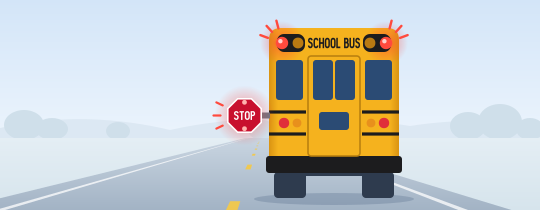
You’re driving behind a school bus that stops on a two-lane road with red lights flashing and its stop arm out. Alabama’s stop-for-the-bus law also covers which other kind of bus when it stops to load or unload?
Show answer
Correct answer: A church bus
Why
Alabama treats a church bus stopped to load or unload with its signals on just like a school bus: traffic from both directions stops and waits until it moves, the driver waves you on or the lights go off. The manual says to stay at least 20 feet back. A first illegal pass costs $150 to $300 and 5 points.
9Safe driving
On an Alabama interstate, how far may you drive in the far-left lane without completely passing another vehicle?
Show answer
Correct answer: 1.5 miles
Why
Since 2019, Alabama limits interstate drivers to 1.5 miles in the left lane without finishing a pass, with exceptions such as heavy traffic, bad weather or a left exit. Whatever the road, if you’re slower than the traffic around you, keep right unless you’re passing or lining up a left turn.
10Crashes & emergencies
On an Alabama highway, a car ahead keeps weaving across lanes and you suspect a drunk driver. Which number from your cell phone connects you to the state troopers?
Show answer
Correct answer: *HP (*47)
Why
Dialing *HP (*47) reaches Alabama State Troopers for highway emergencies and impaired drivers. Hang back from the weaving car, note where you are and what it looks like, and make the call hands-free or after pulling over.
Round 2 · Questions 11–20
11Speed limits
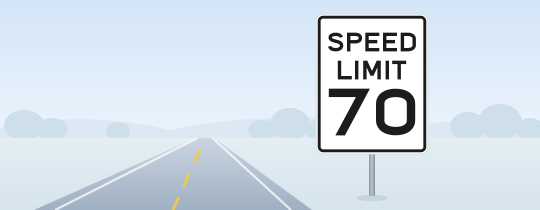
A white SPEED LIMIT 70 sign shows the highest number in Alabama’s speed law. On which kind of road does that law set 70 mph?
Show answer
Correct answer: Interstate highways
Why
Interstates are the only roads where Alabama’s statute itself sets 70 mph. Non-interstate highways with four or more lanes stop at 65, other highways at 55, and paved county roads at 45 unless posted otherwise. Drive slower whenever weather or traffic calls for it.
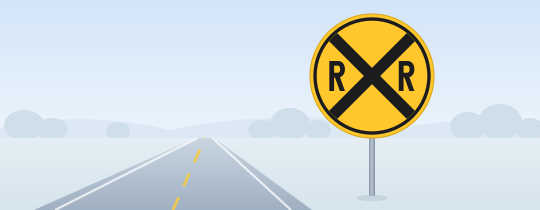
12Road signs
Driving a country road, you spot a round yellow sign marked with a black X and the letters RR. According to the Alabama Driver Manual, roughly how far ahead are the tracks?
Show answer
Correct answer: About 750 feet
Why
This round sign is the early warning for a railroad crossing, and the manual places it about 750 feet before the tracks. That leaves room to slow down, look and listen both ways. Flashing lights or a lowered gate mean you stop 15 to 50 feet short of the closest rail.
13Right-of-way
A highway ahead is split by a grassy median and carries two lanes each way. On the opposite side, a school bus halts with red lights blinking. How should you respond?
Show answer
Correct answer: Keep going with care; you don’t have to stop
Why
Alabama excuses you from stopping when a median separates you from the bus and the highway has two or more lanes each way; drivers behind the bus still must stop. Without a divider, even on a road of four to six lanes, the manual says to stop. Ease off anyway and watch for children near the road.
14Parking
A STOP sign stands at the corner, and there’s an empty stretch of curb before it. What’s the closest to the sign that Alabama lets you park?
Show answer
Correct answer: 30 feet
Why
Leave 30 feet of open curb before any stop sign, yield sign, flashing beacon or traffic light on the roadside. A car parked closer can block other drivers’ view of it. Railroad crossings need more room: 50 feet from the nearest rail.
15Alcohol & phones
Arrested for DUI in Alabama, a first-time offender with a clean record says no to the breath test. What does that refusal cost?
Show answer
Correct answer: A license suspension of at least 90 days
Why
Anyone driving in Alabama has already agreed to a chemical test of blood, breath or oral fluid after a lawful DUI arrest. A refusal brings a suspension of at least 90 days, and up to five years for drivers with prior alcohol or drug offenses. Refusing never wipes the slate clean.
16Safe driving
Night driving with your brights on, you close in on a car traveling ahead of you in your lane. At what distance does Alabama law require you to dim them?
Show answer
Correct answer: 200 feet
Why
Alabama law has you dim within 200 feet of a car you’re following and within 500 feet of an oncoming one. High beams in a mirror can blind the driver ahead just as badly as head-on. Switch back once the road is clear.
17Permit & teen rules
You’re 15 with a Stage I learner license. Which of these people may sit beside you while you practice?
Show answer
Correct answer: Your 24-year-old aunt with a valid license, in the front passenger seat
Why
A 15-year-old learner needs a parent, legal guardian or licensed driver 21 or older in the seat beside them, or a licensed driving instructor. Sitting up front lets the supervisor see the road and step in. Experience doesn’t replace age: under 21, a licensed sibling can’t supervise.
18Speed limits
Out in the countryside, you turn onto a paved road maintained by the county. No speed limit is posted. What is the limit under Alabama law?
Show answer
Correct answer: 45 mph
Why
Alabama sets 45 mph on paved county roads outside towns unless a sign says otherwise. If the county road is unpaved, the limit drops to 35 mph. Gravel and narrow shoulders call for even more care, especially at night.
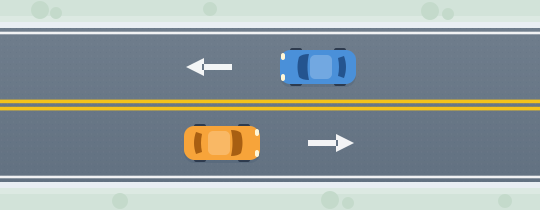
19Lane markings
Two solid yellow lines, side by side, divide your two-lane road. What do they mean?
Show answer
Correct answer: No passing for traffic in either direction
Why
Double solid yellow lines rule out passing for drivers going either way. A single solid yellow line on your side bans passing for you only, while a broken yellow line allows it when it’s safe. White lines, by contrast, separate lanes moving the same way.
20Road signs
A driver rolls past a red-and-white, point-down triangular YIELD sign without slowing and hits a car already crossing the intersection. How does Alabama law treat that crash?
Show answer
Correct answer: As evidence that the driver failed to yield
Why
In Alabama, a collision with a vehicle in the intersection after driving past a YIELD sign without stopping counts as evidence that you didn’t yield the right-of-way. The sign means slow down and be ready to stop for anyone close enough to be a hazard. When in doubt, stop.
Round 3 · Questions 21–30
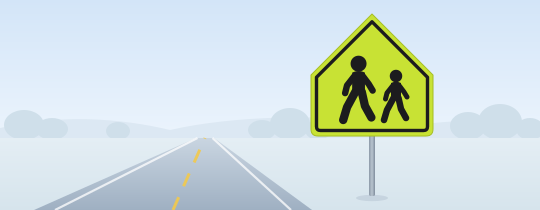
21Road signs
You pass a five-sided, fluorescent yellow-green sign showing two children walking. Under Alabama law, what changes if you speed in the school zone ahead?
Show answer
Correct answer: The speeding fine is doubled
Why
Alabama sets up a reduced-speed zone at every public and private school, with the limit and the hours it applies posted on signs. Speed there while it’s in effect and the fine doubles. Read the posted times, slow down early and watch for children stepping out between parked cars.
22Right-of-way
Alabama permits a left turn against a steady red light in just one situation, after a full stop and with no sign against it. Which one?
Show answer
Correct answer: When both the street you leave and the street you enter run one way
Why
Right on red is allowed after a complete stop unless a sign forbids it. Left on red is much narrower: the street you’re on and the street you turn into must both carry one-way traffic. Either way, pedestrians and cross traffic go first, and a NO TURN ON RED sign overrides both.
23Speed limits
A U.S. highway in Alabama has four lanes but isn’t part of the interstate system. What is the highest speed state law allows on it?
Show answer
Correct answer: 65 mph
Why
Non-interstate highways with four or more lanes have a 65 mph maximum in Alabama. With fewer than four lanes, the default becomes 55 mph, and 70 mph is for interstates only. A lower posted number always wins.
24Parking
You want to park on the same side of the street as a fire station’s driveway. Under Alabama law, how far from the driveway must you stay?
Show answer
Correct answer: At least 20 feet
Why
Alabama keeps the 20 feet nearest a fire station’s driveway clear on its own side of the street, and 75 feet across the street wherever signs say so. Fire engines need room to swing out fast. Blocking any driveway is off-limits too.
25Alcohol & phones
You’re 25, and your phone sits in a dashboard mount. Which of these does Alabama’s hands-free law allow while you drive?
Show answer
Correct answer: One tap or swipe to answer a call or start navigation
Why
Alabama’s hands-free law covers holding a phone, texting, and watching or recording video while you drive. Drivers 18 and older may tap or swipe once on a phone mounted on the windshield, dashboard or console, and hands-free calls, voice-to-text and navigation are fine. Set your route before you shift into drive.
26Safe driving
A gas station is coming up on your right along an Alabama highway. Over what distance, at minimum, must your turn signal blink before you turn in?
Show answer
Correct answer: The final 100 feet
Why
Alabama law wants your blinker going without a break through the final 100 feet or more ahead of the turn. At highway speed, start sooner so drivers behind have time to react. If your lights fail, use hand signals: arm straight out for left, bent up for right, pointed down to slow or stop.
27Permit & teen rules
To move up to a Stage II license at 16 without an approved driver ed course, what must an Alabama teen bring?
Show answer
Correct answer: A signed form certifying at least 50 hours of practice
Why
Alabama asks for a signed form showing 50 or more hours behind the wheel, or proof of passing a State Department of Education driver ed course. There’s no separate night-hours rule. A parent or guardian also signs a consent form, and you pass the road skills test.
28Sharing the road
On a road posted 40 mph with no double yellow line, you come up behind a cyclist riding near the right edge. How much room must you leave when you pass in Alabama?
Show answer
Correct answer: 3 feet
Why
On a road like this, Alabama law requires at least 3 feet between your car and the bicyclist as you pass. Wait for a safe gap in oncoming traffic, give extra room at higher speeds, and check your mirror before moving back. Wind or a pothole can make a rider wobble.
29Road signs
After a storm, every signal light at a busy crossroads has gone dark. How does the Alabama Driver Manual tell you to handle the intersection?
Show answer
Correct answer: As a four-way stop: stop, then take turns
Why
When a signal isn’t working at all, the manual treats the intersection as a four-way stop: come to a full stop and go in the order drivers arrived. A flashing red light gets the same full stop as a STOP sign. Expect others to hesitate, and make eye contact before you move.
30Crashes & emergencies
Your car stalls on a railroad crossing and a train is approaching. Once everyone is out, which way should you go?
Show answer
Correct answer: Off the tracks, moving toward the oncoming train
Why
When a train strikes a car, debris flies forward in the direction the train is traveling. Moving away from the tracks toward the approaching train keeps you out of that path. Once you’re safe, call for help right away.
Round 4 · Questions 31–40
31Sharing the road
A state trooper sits on the right shoulder of an Alabama interstate with lights flashing. You’re in the right lane, and the lane to your left is clear. What does Alabama’s Move Over law expect from you?
Show answer
Correct answer: Move into the left lane as soon as it’s safe
Why
Whenever at least two lanes head your direction, Alabama’s Move Over law has you leave the lane next to a stopped police or emergency vehicle, tow truck, utility or road crew, or working garbage truck. Slowing to at least 15 mph under the limit (55 in a 70 zone) is the fallback only when you can’t move over safely. Fines start at $200.
32Road signs
You come to a STOP sign at a corner with no painted stop line, but a crosswalk is marked across your lane. Where does Alabama law tell you to stop?
Show answer
Correct answer: Before you reach the crosswalk
Why
Alabama ranks the places to stop: a painted stop line first; without one, before the crosswalk; with neither, the point nearest the cross street where you can see traffic coming. Stopping on the crosswalk would block people on foot. After the stop, let cross traffic that is in the intersection or nearly there go first.
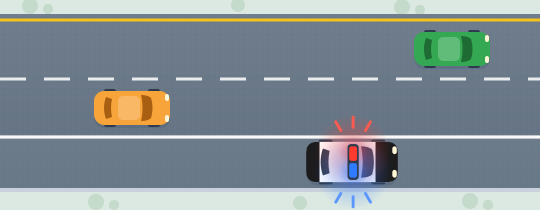
33Right-of-way
Flashing blue lights appear in your mirror on an Alabama highway. What kind of vehicle is it, and what should you do?
Show answer
Correct answer: A police vehicle; pull to the right edge, clear of any intersection, and stop
Why
In Alabama, only police vehicles may use blue lights; fire trucks and ambulances show red. For any emergency vehicle running lights and siren, move to the right edge clear of intersections, stop, and wait until it passes. Once it has gone by, don’t trail within 500 feet of it.
34Parking
A country road has no curb, and you’re leaving your car nose-up on a slope. Which way should you turn the front tires?
Show answer
Correct answer: Toward the edge of the road
Why
With no curb to catch the tire, turning the wheels toward the road edge sends a rolling car off the road instead of into traffic. With a curb, turn them away from it facing uphill and toward it facing downhill. Set the parking brake and leave the car in Park every time.
35Alcohol & phones
After dinner out, your passenger carries a half-finished bottle of wine to the car. Where may it travel on the drive home in Alabama?
Show answer
Correct answer: In the trunk
Why
Alabama bans open alcohol containers in the passenger area of any vehicle on a public road, and a recorked bottle still counts as open because it’s no longer factory-sealed. The trunk or cargo area is exempt, so that’s where it rides. A violation is a misdemeanor with a fine of up to $25.
36Alcohol & phones
What’s the most a first conviction under Alabama’s hands-free law can cost you?
Show answer
Correct answer: Up to $50, plus 1 point
Why
Within 24 months, fines climb from up to $50 to $100 and then $150, with 1, 2 and then 3 points on your record. Tickets come when a driver using a phone is seen swerving or drifting between lanes, and a first charge for holding the phone ends in not guilty if you show the court a hands-free device or a receipt for one. Cheaper still: switch on do-not-disturb before you drive.
37Safe driving
The Alabama Driver Manual teaches a two-second following gap. In heavy rain on a slick road, how much should you allow?
Show answer
Correct answer: Four or five seconds
Why
Two seconds is the minimum on a dry road in good weather. The manual stretches it to four or five seconds in bad road or weather conditions and when you drive a longer vehicle. Count from when the car ahead passes a fixed marker until you reach it.
38Safe driving
Heading down a long hill, a driver shifts into neutral to coast and save gas. What’s the problem in Alabama?
Show answer
Correct answer: Coasting downhill in neutral is against Alabama law
Why
Alabama forbids coasting downhill with the transmission in neutral. Out of gear, you lose engine braking and lean entirely on brakes that can overheat on a long grade. Stay in gear, and pick a lower one on steep hills so the engine helps hold your speed.
39Permit & teen rules
You’re 16 with a Stage II license, and your restaurant shift ends at 1 a.m. May you drive yourself home?
Show answer
Correct answer: Yes, trips to or from work are an exception to the midnight–6 a.m. limit
Why
Stage II drivers stay off the road from midnight to 6 a.m. unless an exception applies: a parent or guardian along, a licensed driver 21+ with parent consent, trips to or from work, school or religious events, hunting or fishing with a license, or an emergency. A late movie wouldn’t count, and breaking a restriction adds six months to your Stage II time.
40Permit & teen rules
With a Stage II license, how many passengers may you carry, not counting parents, guardians, family members riding along or a licensed driver 21 or older?
Show answer
Correct answer: One
Why
Stage II allows one passenger outside that list, down from four before 2010. Every extra friend in the car is one more distraction. Stage III, at 17 after six months on Stage II, lifts the limit.
Alabama ALEA knowledge test at a glance
Know these before your trip to an ALEA Driver License office.
Alabama · ALEA Class D knowledge test
Laws, signs, safe driving.
On a computer · Spanish + 10 more
$5per try at the knowledge test, no checks
Spanishor 10 other languages besides English
Oralan audio version if reading is hard
Walk-inwelcome, or book at AlabamaDL.alea.gov
$36.25for your learner license once you pass
20/60vision needed in at least one eye
Under 18? Your road to a license
15Stage I learner licensePass the vision and knowledge tests, bring your DL-1/93 school form and pay $36.25 for a Class D license with a Y restriction.
6 moSupervised practiceDrive only with a parent, guardian or licensed driver 21 or older beside you, or an instructor, for at least six months.
16Stage II restricted licenseShow 50 practice hours or a passed driver ed course, add a parent’s consent, and pass the road skills test.
16–17Stage II limitsNo driving midnight–6 a.m. without an exception, one passenger at most besides family or a licensed driver 21+, and no handheld devices.
17Stage III unrestricted licenseAfter six months on Stage II with no moving-violation convictions, the limits come off; at 18 they end no matter what.
18 or older? The teen stages don’t apply: pass the vision and knowledge tests, then the road skills test, and go straight to an unrestricted Stage III license. Bring a licensed driver, proof of insurance and a car that passes inspection.
What’s on the Alabama permit test
ALEA builds the knowledge test from the Alabama Driver Manual (November 2024 edition): traffic laws, road signs and safe driving. Start with these six areas.
Road signs
Color tells you the type: yellow warns, orange marks work zones, green guides, blue means services, brown means recreation.
A round yellow RR sign comes about 750 feet before the tracks; if signals flash, stop 15 to 50 feet from the rail.
A flashing red light is a STOP sign; a signal gone dark is a four-way stop.
Right-of-way
Arrival order decides at an all-way stop; a tie goes to the vehicle farther right.
School or church bus loading with signals on: stop from both directions, unless it’s across a divided highway with two lanes each way.
Lights and siren behind you: pull to the right edge and stop. Blue lights always mean police.
Speed limits
Unposted limits: 30 mph in urban districts, 45 on paved county roads, 35 where the county road is dirt or gravel.
55 mph on two-lane highways, 65 on four-lane highways, 70 on interstates.
School zone limits are posted, and speeding there doubles the fine; work zones with crews cost $250 or double.
Parking
Give a hydrant 15 feet and an intersection crosswalk 20.
Stop signs and signals get 30 feet of empty curb; railroad crossings get 50 from the nearest rail.
Park within 18 inches of the curb. On a slope, front wheels turn in to the curb facing down and out from it facing up.
Alcohol & phones
Legal limit 0.08% from age 21; 0.02% below 21; 0.04% behind the wheel of a commercial vehicle.
Saying no to a chemical test after a DUI arrest costs your license for 90 days or more.
Hands-free law: no holding the phone, texting or video; adults may tap a mounted phone once.
Teen rules
Learner license: a parent, guardian, licensed driver 21+ or instructor rides beside you.
Stage II: no driving midnight–6 a.m. unless an exception applies, and one passenger at most beyond family or a licensed driver 21+.
Stage II means no handheld devices, and breaking a limit adds six months of restrictions.
Alabama numbers to know
Distances and limits worth memorizing before your ALEA test.
100 ftof nonstop signaling before a turn
15 ftbetween a parked car and a hydrant
15–50 ftshort of the tracks when a train is near
500 ftto dim your high beams for oncoming cars
1.5 miin the interstate left lane without passing
25/50/25minimum liability insurance, in thousands of dollars
Your Alabama course, in your pocket
These 40 questions are just the warm-up. The app gives you 544 Alabama practice questions, 36 short lessons and the why behind every answer.
36 short lessonsFour levels, from fundamentals to expert, then a full practice exam.
544 Alabama questions335 of them with pictures.
Your most-missed questionsA review lesson built from the questions you miss most.
Exam simulatorTake full practice exams and watch your readiness grow.
Alabama permit
Your Alabama path is ready.
36 lessons, 544 questions and full practice exams. In English and Spanish.
How many questions are on the Alabama permit test, and what score do I need?
ALEA doesn’t publish a question count or a passing score for the Class D knowledge test. What it does tell you: it checks what you know about Alabama’s traffic laws, its road signs and safe driving, all drawn from the Alabama Driver Manual, and every applicant can take it on a computer at an ALEA Driver License office. Practice until you score 80% or better on every round, and you’ll walk in ready.
Is the Alabama permit test given by the DMV?
Not in Alabama. The Alabama Law Enforcement Agency (ALEA), through its Driver License Division, gives the knowledge test and issues learner licenses at its Driver License offices. Walk-ins are welcome at every testing site, or you can book an appointment at AlabamaDL.alea.gov to cut the wait.
Can I take the Alabama permit test online?
No. ALEA gives the knowledge test in person, on computers at its Driver License offices, and its online services don’t include a test. One exception: a student in a high school driver education class can take the written, vision and driving tests from a certified driver ed instructor trained as an ALEA third-party tester, then bring the passing certificate to an ALEA office.
Can I take the Alabama permit test in Spanish?
Yes. ALEA offers the written test in Spanish and 10 more languages: Arabic, Chinese, Farsi, French, German, Japanese, Korean, Russian, Thai and Vietnamese. An oral version is available if reading is hard for you. The Alabama Driver Manual comes only in English, so this practice test and the app give you a way to study in Spanish.
How old do you have to be to get a learner’s permit in Alabama?
15. Stage I is a learner license you drive on with a parent, guardian, licensed driver 21+ or instructor beside you. After six months, and with 50 practice hours or a driver ed course, you can take the road test for a Stage II license at 16: no driving midnight–6 a.m. without an exception, one passenger at most besides family or a licensed driver 21+, and no handheld devices. Stage III, the unrestricted license, comes at 17 after six months on Stage II.
How much does the Alabama permit test cost?
Each try at the knowledge test costs $5, so a retake is another $5. Once you pass, the learner license costs $36.25. ALEA takes cash or money orders but no checks, and cards with a 4% convenience fee. In some counties, local law allows a slightly higher fee.
What do I need to bring to get an Alabama learner license?
At 15, a certified U.S. birth certificate (no photocopies), your Social Security card and two proofs of Alabama residence, such as a recent utility bill or a lease. Anyone under 19 also brings a current Student Enrollment/Exclusion Form (DL-1/93) from school, or proof of graduation. From age 16, two IDs from ALEA’s lists (one with a photo) or three without photos can stand in for the birth certificate, with at least one from the primary list.
What’s the best way to study for the Alabama permit test?
Read the Alabama Driver Manual, November 2024 edition, since the test draws everything from it. Use the 40 questions on this page as a first check, then move to the app: 544 Alabama questions and 36 short lessons, each answer explained.