South Dakota’s written permit test is given by the Department of Public Safety, though many people call it the DMV test. Practice with 40 free questions on the 80 mph interstate limit, school bus stops, winter driving and teen permit rules, and see the reason behind every answer the moment you tap it.
Four rounds of 10, built around South Dakota rules: signs, right-of-way, speed limits, parking, alcohol and phones, and teen permits. Each answer opens a short explanation.
Round 1 · Questions 1–10
1Road signs
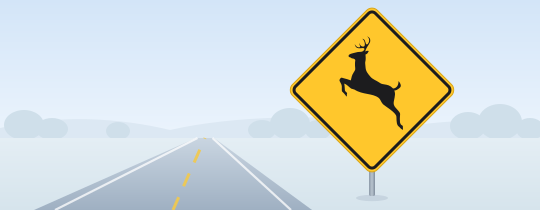
On a rural South Dakota highway at dusk in late October, you pass a yellow diamond sign showing a leaping deer. What does the South Dakota manual tell you about deer at this hour and season?
Show answer
Correct answer: Deer crashes peak in October and November, and dusk is a prime time for them
Why
Deer rank second among the things South Dakota drivers hit, and October and November bring the most collisions. They move most at dusk and dawn, so ease off the gas, watch the ditches for eyes glowing in your headlights, and expect another deer to follow the first.
2Speed limits
Main Street in a small South Dakota town has no speed limit sign anywhere along it. What is the legal maximum?
Show answer
Correct answer: 25 mph
Why
In an urban area with no posted or zoned limit, South Dakota's maximum is 25 mph. A posted sign can set a different limit, so keep reading them as you roll into and out of town. Drive slower still whenever traffic, weather or people on foot call for it.
3Right-of-way
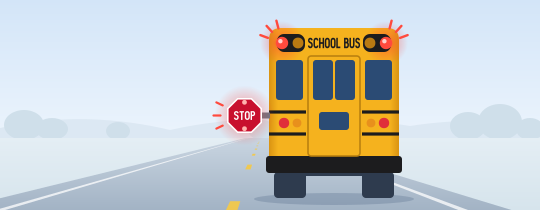
The school bus in front of you pulls up at a farm driveway, red lights blinking and stop arm out. What is the closest you may stop behind it?
Show answer
Correct answer: 15 feet
Why
South Dakota requires a full stop at least 15 feet from a school bus showing flashing red lights, and you stay put until those lights go off. When they do and the stop arm folds in, pull away slowly and watch for children. Passing a stopped bus is a Class 1 misdemeanor.
4Permit & teen rules
The South Dakota knowledge test has 25 questions. How many must you get right to pass?
Show answer
Correct answer: At least 20 (80%)
Why
You need 80% or better, which is 20 of 25, so you can miss up to five. The drive test is scored the same way, 80% or higher. Practice until you clear 80% every time, not just once.
5Alcohol & phones
Driving home from a wedding reception, your 18-year-old cousin blows 0.03% on a breath test. What is true under South Dakota law?
Show answer
Correct answer: It's illegal: South Dakota's cutoff under 21 is 0.02%
Why
Under 21, South Dakota draws the line at 0.02%, or at any trace of marijuana or illegal drugs. A first offense means a 30-day suspension, a second 180 days and a third a full year. If you're under 21 and driving, don't drink at all.
6Parking
One empty space is left on a Mitchell street, and a fire hydrant stands at its front edge. What is the closest your bumper may be to the hydrant?
Show answer
Correct answer: 15 feet
Why
A fire engine has to connect to a hydrant without delay, which is why South Dakota bans parking within 15 feet of one. That holds even with someone sitting in the car; only a moment to drop off or pick up a passenger is allowed.
7Safe driving
When the pickup ahead of you passes a mile marker, you start counting. What is the smallest count the South Dakota manual wants before you reach that marker?
Show answer
Correct answer: Four seconds
Why
The manual asks for a gap of at least 4 seconds, measured from a fixed point like a sign or marker. Add more time on wet or icy roads and at night, and leave extra room behind motorcycles and large trucks. If you reach the marker too soon, ease off and count again.
8Permit & teen rules
Your little sister turns 14 next week. What can she do in South Dakota once she does?
Show answer
Correct answer: Apply for an instruction permit
Why
At 14, with a parent or guardian's consent, a teen can get an instruction permit by passing the vision test and the knowledge test; an approved driver ed certificate from the past year can take the place of the knowledge test. She must carry the permit whenever she drives, with a licensed adult in the seat beside her.
9Sharing the road
A cyclist is riding at the right edge of a two-lane highway posted at 55 mph, and you're about to go around. What clearance does South Dakota require?
Show answer
Correct answer: At least 6 feet
Why
South Dakota requires at least 3 feet of space where the limit is 35 mph or less and at least 6 feet where it's higher, counted from your mirror to the bike. You may partly cross the center line to give that room, but only when it's safe. Keep the gap until you're well past the rider.
10Road signs
Beside a South Dakota state highway you notice a sign carrying a single word: THINK. What does it mark?
Show answer
Correct answer: A place where someone lost their life in a crash
Why
Since 1979, South Dakota has put up one THINK sign for each person killed in a crash at that location, each on its own post. The signs honor the victims and remind drivers what drinking, speeding, skipping the seat belt and distraction can cost. Several signs together mean several lives were lost there.
Round 2 · Questions 11–20
11Speed limits
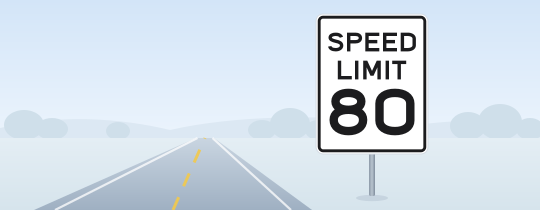
SPEED LIMIT 80 is the highest limit you'll see posted in South Dakota. On which roads does state law allow it?
Show answer
Correct answer: Interstate highways
Why
South Dakota sets 80 mph as the top speed on interstates, unless signs post less. Most other roads top out at 65 mph unless posted otherwise, and divided four-lane rural highways may be posted at 70. On the interstate, going under 40 mph is against the law too.
12Right-of-way
Storm damage has left the signals dark at a Sioux Falls intersection. Under South Dakota law, how should you treat it?
Show answer
Correct answer: Like a stop sign: stop fully, then go when it's safe
Why
In South Dakota, a traffic light that has gone completely dark carries the same rule as a stop sign. Everyone stops, drivers take their turns, and you go only when the intersection is clear. Treat a blinking red light the same way; blinking yellow means slow down and proceed carefully.
13Road signs
Crews are paving one lane of a South Dakota highway, and orange signs warn that fines double. What exactly is doubled, and when?
Show answer
Correct answer: Speeding fines, while workers are present
Why
Orange signs mark construction and maintenance zones. Under South Dakota law, a speeding fine in a posted highway work zone is double the usual amount while workers are present, and signs announcing the doubled fine stand ahead of the zone. Slow down early and expect lane shifts and equipment.
14Alcohol & phones
Waiting at a red light in town, an adult driver picks up the phone. Which of these is legal in South Dakota?
Show answer
Correct answer: Dialing a number to make a call
Why
South Dakota bans hand-held phone use while driving, and waiting at a light or in stopped traffic still counts as driving. Making or taking a call is an exception, and so is following GPS directions, but typing in a destination is not, so set your route before you pull out. Hands-free voice mode and emergency calls are allowed too.
15Parking
Which of these parked cars is breaking South Dakota law?
Show answer
Correct answer: A car 25 feet before a traffic signal at the roadside
Why
South Dakota keeps parked cars out of the last 30 feet before a stop sign, a yield sign, a flashing beacon or a traffic light standing beside the road, so nothing blocks other drivers' view of it. The other three cars are fine: the required gaps are 20 feet for an intersection crosswalk and 15 feet for a hydrant.
16Permit & teen rules
A 14-year-old gets an instruction permit and skips driver education. How long must the permit be held before applying for a restricted minor's permit?
Show answer
Correct answer: 275 days
Why
Without driver ed, South Dakota requires 275 days on the instruction permit. Passing an approved driver education course with 80% or better on both parts cuts that to 180 days. Driver ed is optional, but it saves you about three months.
17Safe driving
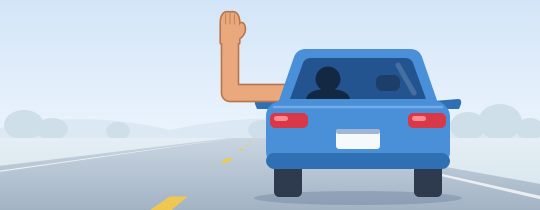
The driver ahead of you holds their left arm out the window with the forearm pointing straight up. What are they about to do?
Show answer
Correct answer: Turn right
Why
South Dakota hand signals all use the left arm: bent upward means a right turn, held straight out means a left turn, and bent downward means slowing or stopping. They help when bright sun washes out flashing turn signals, or in an antique car built without them.
18Sharing the road
A snowplow with its amber lights flashing is clearing a highway posted at 55 mph. How far behind it must you stay?
Show answer
Correct answer: At least 200 feet
Why
On roads posted at 35 mph or more, South Dakota requires at least 200 feet between you and a snowplow showing red or amber lights. Plows are wide, often run close to the center line and throw up clouds of snow that hide the road. Hang back and let the plow clear the way.
19Right-of-way
On a two-lane highway, the school bus ahead of you switches on its flashing amber lights. What does South Dakota law require?
Show answer
Correct answer: Slow to 15 mph or less and pass only with caution
Why
Amber lights warn that the bus is getting ready to stop; bus drivers switch them on 300 to 500 feet before the stop. South Dakota caps your speed at 15 mph while you go by a bus showing amber lights. Be ready for red lights, which mean a full stop.
20Crashes & emergencies
A low-speed collision on a Brookings street hurts no one, but the other car's dented door and fender look like at least $1,200 of damage. Who must you notify right away?
Show answer
Correct answer: The nearest law enforcement officer
Why
South Dakota requires an immediate report to the nearest law enforcement officer after any crash that injures or kills someone, or that does apparent damage of $1,000 to one person's property or $2,000 in all. You must also stop, share your name, address and plate number, and help anyone who is hurt.
Round 3 · Questions 21–30
21Right-of-way
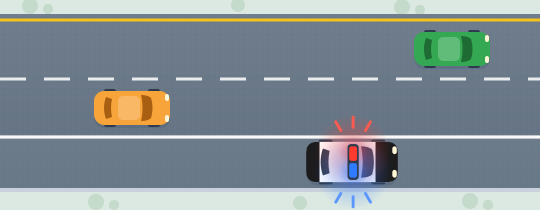
A Highway Patrol car sits on the right shoulder of I-90 with its red lights flashing. What does South Dakota law require as you approach?
Show answer
Correct answer: Stop completely before reaching it, then pass with care
Why
South Dakota is strict here: when a stopped emergency vehicle is using red lights, every driver approaching from either direction must stop completely before reaching it, then continue carefully only once it's safe. The move-over choice, changing lanes 300 feet ahead or slowing down, is for vehicles showing amber, yellow or blue lights.
22Road signs
Two red lights flash side by side under the white X-shaped crossbuck at a railroad crossing. Where does South Dakota law tell you to stop?
Show answer
Correct answer: 15 to 50 feet short of the nearest rail
Why
When a signal, a gate or an officer warns of a train, your stopping point must be at least 15 feet, but not more than 50 feet, short of the nearest rail, and you wait there until it's safe. Never drive around a lowered gate, and if a bell or horn is sounding, wait for it to stop before you cross.
23Speed limits
Kids are arriving for the school day as you drive past their school. Unless a sign sets something else, what is South Dakota's speed limit there?
Show answer
Correct answer: 15 mph
Why
State law limits you to 15 mph past a school during recess and while children are coming to or leaving school. Cities and counties may post their own school zones, and when lights are flashing or children are around, the slower limit is the one that counts. Watch for kids stepping out between parked cars.
24Alcohol & phones
Arrested near Pierre on suspicion of DWI, a driver says no to a blood test the officer lawfully requests. What does South Dakota do to the license?
Show answer
Correct answer: Revokes it for one year
Why
South Dakota's implied consent law treats every driver as having agreed in advance to a breath, blood or other chemical test when an officer lawfully asks. Refusing brings a one-year revocation, which outlasts the 30-day minimum revocation for a first DWI conviction.
25Parking
After parking on a two-way residential street, you check your right-side tires. How far from the curb or road edge may they be at most?
Show answer
Correct answer: 12 inches
Why
State law sets the limit at 12 inches: on a two-way street, your right-hand wheels must sit parallel to the curb or road edge and no farther out than that. The manual also suggests ending up at least 2 feet from the parked cars around you. A quick look along the curb after you get out tells you whether to pull in tighter.
26Permit & teen rules
Your parent is about to sign the Supervised Driving Affidavit for your restricted minor's permit. What practice does it confirm you have completed?
Show answer
Correct answer: 50 hours, with 10 at night and 10 in poor weather
Why
South Dakota asks for at least 50 supervised hours, and 10 of them must be at night and 10 in inclement weather such as rain or snow. A parent or guardian confirms the hours in writing at the exam station. Spread them over the months you hold the permit so you see every kind of road and season.
27Safe driving
Your high beams light up an empty prairie road at night. Then headlights appear ahead in the other lane. When must your high beams be off?
Show answer
Correct answer: Once it's within 500 feet
Why
Switch to low beams once an oncoming vehicle is within 500 feet, about a city block, and also when you're following another vehicle that closely. High beams at that range can blind the other driver. In fog, snow or heavy rain, stick with low beams, because bright light bounces back at you.
28Lane markings
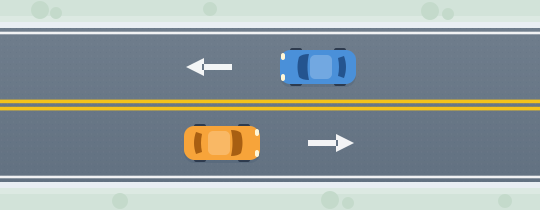
A double solid yellow center line runs along your two-lane road, and you realize you missed your turn. May you make a U-turn right here?
Show answer
Correct answer: No, U-turns are illegal in a marked no-passing zone
Why
A double yellow center line marks a no-passing stretch for traffic in both directions, and South Dakota law also forbids turning around in a marked no-passing zone. Drive on to a side road or a parking lot to turn around. Even elsewhere, skip U-turns on curves or near a hilltop where other drivers can't see you from 500 feet away.
29Alcohol & phones
Which of these is legal in a car on a South Dakota highway?
Show answer
Correct answer: A sealed, unopened six-pack on the back seat
Why
In South Dakota, no one in a vehicle on a public highway may drink alcohol or keep an opened container where anyone inside can reach it, and that includes passengers. Sealed packages can ride anywhere; once something is opened, it has to go somewhere no one inside can get at it, like the trunk.
30Road signs
Your car stalls on a railroad crossing, and everyone gets out safely. Where will you find the number to call the railroad?
Show answer
Correct answer: On a blue sign at the crossing with a phone number and a crossing number
Why
Every crossing has an emergency number for the railroad, usually on a blue Emergency Notification System sign that also shows a DOT number pinpointing that exact crossing. Calling it alerts the railroad, and the crossing number tells crews precisely where to go. Use it for a stalled car or any other trouble at the crossing.
Round 4 · Questions 31–40
31Sharing the road
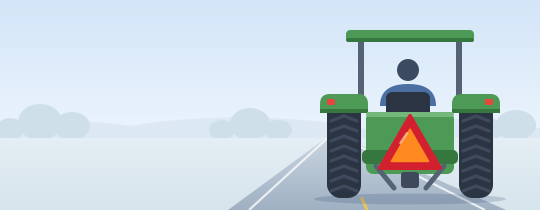
On a county road you come up behind a tractor with an orange triangle edged in red on its back. What does that emblem tell you?
Show answer
Correct answer: It moves at less than 25 mph
Why
The orange-and-red triangle marks a slow-moving vehicle, one that travels at less than 25 mph. In South Dakota you'll see it on tractors and other farm vehicles, construction machines and horse-drawn wagons. Close the gap gradually, and pass only where it's legal and you can see well ahead.
32Road signs
You're waiting in a left-turn lane when the arrow above it starts blinking yellow. What does that allow?
Show answer
Correct answer: A turn after yielding to oncoming traffic and pedestrians
Why
A flashing yellow arrow permits the left turn, but it isn't protected: oncoming vehicles and pedestrians have a green light and go first. Enter the intersection carefully, let them pass, and turn once a safe gap opens.
33Right-of-way
At a quiet corner in Aberdeen, a man with a guide dog starts across the street ahead of you. What does South Dakota law require?
Show answer
Correct answer: Come to a full stop before reaching the crossing point
Why
South Dakota requires a full stop for any pedestrian crossing with a guide dog or a raised white cane, including one tipped in red. Stay stopped until he has made it safely across, then move on with extra care.
34Speed limits
On a two-lane South Dakota highway posted at 65 mph, you pull out to pass a car doing 55. How fast may you go while completing the pass?
Show answer
Correct answer: 75 mph
Why
South Dakota adds 10 mph to the posted limit while you overtake a slower vehicle on a two-lane road posted at 65 mph or more. Here that means 75 mph at most, and only for the pass itself. Once you're back in your lane, return to the limit.
35Crashes & emergencies
On a two-lane highway posted at 65 mph, a tow truck with flashing amber lights is parked on the shoulder ahead. What does South Dakota's move-over law require?
Show answer
Correct answer: Starting at least 300 feet before it, slow to 45 mph or less
Why
South Dakota's law covers any vehicle stopped or on the shoulder with amber, yellow or blue lights, not just emergency vehicles. On a two-lane road, slow to at least 20 mph under the limit, beginning 300 feet ahead; with two or more lanes your way, move to the farthest lane instead. The minimum fine is $270.
36Alcohol & phones
You're driving on your instruction permit with your uncle beside you when a call comes in. Your car can connect it hands-free. What does South Dakota law say?
Show answer
Correct answer: You may not use the phone at all while driving, hands-free included
Why
South Dakota bars instruction permit and restricted minor's permit holders from using any wireless communication device behind the wheel, and the rule has no hands-free exception. Having a supervising adult in the car doesn't change it. Let the call go to voicemail and return it once you've parked.
37Permit & teen rules
It's 10:45 p.m., and you, 15 and holding a restricted minor's permit, are driving home alone from a friend's birthday party. Is that legal?
Show answer
Correct answer: No, not without a parent or guardian in the seat beside you
Why
A restricted minor's permit lets you drive alone, with your parent's permission, from 6 a.m. to 10 p.m. Later than that, a parent or guardian must sit next to you, unless you're taking the most direct route to or from school or a school event, a religious service, or work, farm work included. Coming home from a party isn't on that list.
38Permit & teen rules
Four months into her restricted minor's permit, Emma wants to drive her best friend to volleyball. The friend isn't family and doesn't live with her. Is that allowed?
Show answer
Correct answer: No, only family or household members for the first six months
Why
During the first six months on a restricted minor's permit, you may carry only immediate family or people who live in your home. After that, you're allowed one passenger under 18 from outside your family or household. The limits don't apply when a parent or guardian rides along.
39Safe driving
A left turn onto a gravel road is coming up. For how much distance before the turn must your signal run without a break?
Show answer
Correct answer: The last 100 feet
Why
State law calls for an unbroken signal over at least the last 100 feet before any turn. At higher speeds, the manual suggests signaling 4 to 5 seconds ahead, which covers far more than 100 feet. Make it automatic, even when the road looks empty: a habit you never skip is one you won't forget in traffic.
40Safe driving
The first snowstorm of the winter has left the interstate slick. What does the South Dakota manual say about cruise control?
Show answer
Correct answer: Leave it off on slippery roads
Why
On ice or packed snow you need to control your speed with your own foot, easing off smoothly the moment the tires start to slip. The manual also reminds you that posted limits are set with dry summer pavement in mind, so drive well below them in winter, and stay off roads that are closed.
South Dakota DPS knowledge test at a glance
What to know before you book an exam station appointment.
South Dakota · DPS knowledge test
80% to pass.
25 questions · English or Spanish
20 of 25 answers right to pass
$38for a permit, the same as a license
3 triesper fee in 6 months, written and drive tests combined
Next dayearliest retake after a fail: the next working day
Spanishor English, your choice by state law
By appt.in person at a driver exam station
20/40vision with both eyes for no restriction
Under 18? Your road to a license
14Instruction permitWith a parent’s consent, pass the vision test and the knowledge test (a recent driver ed certificate can stand in for the knowledge test), then practice with a licensed adult 18+ beside you.
275Days on your permitHold the permit 275 days (180 after approved driver ed) and log 50 hours, 10 at night and 10 in bad weather.
SoloRestricted minor’s permitPass the drive test (a recent driver ed certificate can waive it), then drive alone from 6 a.m. to 10 p.m., with only family or household passengers for the first six months.
16Operator’s licenseAfter six months on the restricted permit and no traffic convictions in the last six months, upgrade to a full license. Teen limits end at 18.
18 or older? No waiting period and no practice log: pass the vision, knowledge and drive tests for your license, or start with a permit if you want supervised practice first.
What’s on the South Dakota permit test
Study the South Dakota Driver License Manual from the Department of Public Safety. The test checks road signs, South Dakota traffic laws and safe driving. Below are the essentials in six key areas.
Road signs
Know signs by outline: the octagon is STOP, the downward triangle is YIELD, and the yellow circle with RR means tracks ahead.
Orange marks a work zone, where speeding fines double while workers are present.
A THINK sign beside a state highway marks a spot where someone died in a crash, one sign for each life lost.
Right-of-way
All-way stop: first to arrive goes first; arrive together and the driver on the right goes.
Emergency vehicle stopped with red lights: come to a complete stop before you reach it, then pass with care.
School bus flashing red: stop at least 15 feet back and wait until the lights go off.
Speed limits
80 mph is the interstate maximum; other highways top out at 65 mph unless signs say otherwise.
25 mph in town where nothing is posted; 15 mph past a school while children come and go.
Passing on a two-lane road posted 65 or more? You may go up to 10 mph over the limit to finish the pass.
Parking
Give a fire hydrant 15 feet of open curb, and an intersection crosswalk 20 feet.
Leave 30 feet before a stop sign, yield sign or roadside signal, and 20 feet from a fire station driveway.
Park within 12 inches of the curb; uphill with a curb, turn your wheels left, away from it.
Alcohol & phones
Blood alcohol: 0.08% is the legal line for adults; under 21, it drops to 0.02%.
Saying no to a breath or blood test costs you your license for a full year.
Adults: no texting, browsing or apps with the phone in hand; calls and GPS directions are allowed.
Teen rules
Instruction permit: a licensed adult 18+ beside you; from 10 p.m. to 6 a.m., only a parent or guardian.
Restricted permit: alone from 6 a.m. to 10 p.m., and only family or household passengers for the first six months.
Both permits ban any wireless device behind the wheel, including hands-free calls.
South Dakota numbers to know
Six figures every South Dakota driver should have memorized before test day.
100 ftof steady signal before you turn
4 secminimum gap behind the car ahead, per the manual
15–50 ftstopping zone before the nearest rail when a train is coming
300 ftto move over or slow down for amber, yellow or blue lights
200 ftbehind a snowplow with red or amber lights on
25/50/25minimum liability coverage, in thousands: per person, per crash, property
Your South Dakota course, in your pocket
These 40 questions are just the warm-up. The app gives you 448 South Dakota practice questions, 36 short lessons and the why behind every answer.
36 short lessonsFour levels, from fundamentals to expert, then a full practice exam.
448 South Dakota questions310 of them with pictures.
Your most-missed questionsA review lesson built from the questions you miss most.
Exam simulatorTake full practice exams and watch your readiness grow.
South Dakota permit
Your South Dakota path is ready.
36 lessons, 448 questions and full practice exams. In English and Spanish.
How many questions does the South Dakota permit test have, and what score passes?
25 questions, and you need 80% to pass, which means at least 20 right. The test covers road signs, South Dakota traffic laws and safe driving. It’s given by the Department of Public Safety (DPS), which handles driver licenses in South Dakota; the state’s Division of Motor Vehicles handles vehicle titles and registration instead.
What happens if I fail the South Dakota knowledge test?
Each $38 fee covers three tries within six months, and those tries are shared between the knowledge test and the drive test. If you fail, you can retest as soon as the next working day. Once the three tries are used up or six months have passed, you pay the fee again.
Can I take the South Dakota permit test online?
No. The knowledge test is taken in person at a South Dakota driver licensing location, and every test at an exam station needs an appointment, booked online or by phone. Online services cover things like renewals, duplicates and a teen’s upgrade from a restricted permit.
Can I take the South Dakota permit test in Spanish?
Yes. State law requires DPS to offer the knowledge test in English or Spanish, and the driver manual has a Spanish edition. The drive test is given in English, but you may bring an interpreter approved by the department, at your own cost. This practice test is in Spanish too, and so is the app.
How old do I have to be for an instruction permit in South Dakota?
14. With a parent’s consent, you can get an instruction permit by passing the vision and knowledge tests, then hold it 275 days (180 after approved driver ed) while you log 50 supervised hours, 10 at night and 10 in bad weather. Next comes the restricted minor’s permit: you may drive alone from 6 a.m. to 10 p.m., with only family or household passengers for the first six months. At 16, after six months on it and no traffic convictions in the past six months, you can get an operator’s license.
How much does a South Dakota permit cost?
$38 for an instruction permit, and the same for a restricted minor’s permit and an operator’s license. A duplicate costs $20. Paying by card at the exam station or online adds a small administrative fee.
What do I need to bring to the exam station?
Proof of identity and lawful status, such as a certified birth certificate or U.S. passport, proof of your Social Security number, and two documents less than a year old showing your South Dakota address. Photocopies and hospital birth certificates aren’t accepted. Book an appointment first. If you’re under 18, a parent or guardian must give consent, either in person at the exam station or on a notarized Parental Consent Form.
What’s the best way to study for the South Dakota permit test?
Read the South Dakota Driver License Manual, then practice until you score 80% without trouble. Begin with the 40 questions on this page, then move to the app: 448 South Dakota questions and 36 bite-size lessons, each answer explained.