Get ready for Hawaii’s 30-question knowledge test with 40 free questions on road signs, the phone law, provisional license limits and parking on hills. Pick an answer and a short explanation shows up instantly.
Four rounds of 10 questions on Hawaii signs, right-of-way, speed, parking on hills, alcohol and phone laws, and provisional license limits. A quick explanation follows every answer.
Round 1 · Questions 1–10
1Road signs
You’re driving through a Hilo neighborhood toward a red eight-sided STOP sign. The pavement has a marked crosswalk but no painted stop line. Where does Hawaii law say your car must stop?
Show answer
Correct answer: Before you reach the crosswalk
Why
Hawaii sets an order: stop at a marked stop line; with no line, stop before the crosswalk; with neither, stop where you can see approaching traffic before entering. Then yield to anyone with the right-of-way. If parked cars still block your view, creep forward and stop a second time.
2Right-of-way
Two cars reach an intersection with no signs or signals at about the same moment, coming from different roads. You’re the car on the left. What does Hawaii law say?
Show answer
Correct answer: You yield to the car on your right
Why
When two vehicles arrive from different roads at roughly the same time, Hawaii puts the duty on the driver on the left. Let the car on your right go ahead, and make eye contact before you pull out. If the other driver waves you on, still check that the way is clear before you go.
3Speed limits
Where does the legal speed limit on a Hawaii road come from?
Show answer
Correct answer: County ordinances and the limits HDOT posts on signs
Why
Hawaii’s traffic code sets no default numbers for neighborhood streets or rural highways: maximum and minimum speeds come from county ordinances or from signs the state Department of Transportation posts, so the sign is your guide. Lower limits are posted near schools and playgrounds when children are around, and in residential and business areas. Whatever the number, never drive faster than conditions allow.
4Parking
You parallel park on a steep street in Manoa with the curb on your right. According to the Hawaii Driver’s Manual, how should you set your front wheels?
Show answer
Correct answer: Turned to the right, toward the curb, whether you face uphill or downhill
Why
Hawaii’s manual uses one rule for every slope: set the parking brake, shift into Park (reverse or low with a manual transmission), and turn the front wheels right, toward the curb. If the car ever starts to roll, it heads away from traffic. Wheels aimed at the street would steer a runaway car straight into the lane.
5Alcohol & phones
A 19-year-old drives home from a beach party, and a breath test reads 0.03%. What does Hawaii law say?
Show answer
Correct answer: It’s a violation, because 0.02% is the limit for drivers under 21
Why
Hawaii has zero tolerance for drivers under 21: any measurable alcohol, starting at 0.02%, is against the law. A first violation brings an alcohol education program and a 180-day suspension, though a judge may let a driver aged 18 to 20 drive for work after the first 30 days. The 0.08% limit is for drivers 21 and older.
6Safe driving
You plan to turn right onto Kapiolani Boulevard. Under Hawaii law, when must your turn signal be on?
Show answer
Correct answer: Continuously, starting no later than 100 feet ahead of the turn
Why
Hawaii requires a turn signal given continuously through at least the final 100 feet before you turn, roughly five car lengths. The manual uses the same distance before changing lanes or stopping, and suggests signaling earlier at higher speeds. That way, drivers behind you have time to react.
7Permit & provisional license
What’s the youngest age at which you can apply for a Hawaii instruction (learner’s) permit?
Show answer
Correct answer: 15 years and 6 months
Why
Hawaii lets you apply at 15½. You’ll pass a vision screening and the 30-question knowledge test, and a parent signs a consent form if you’re under 18. The permit stays valid for one year.
8Safe driving
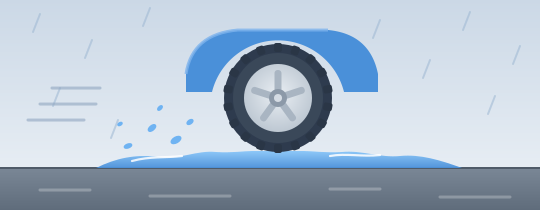
During a heavy downpour on a wet highway, at about what speed does the Hawaii manual say your tires can begin to ride up on the water?
Show answer
Correct answer: About 35 mph
Why
Hawaii’s manual puts the start of partial hydroplaning near 35 mph; by 55 mph in a downpour the tread can ride entirely on water, so braking and steering stop working. Worn tread and low tire pressure make it happen even sooner. Keep your tires in good shape and slow down whenever water pools on the road.
9Lane markings
A double solid yellow line runs down the center of a two-lane road near Waimea. According to the Hawaii manual, when may you cross it?
Show answer
Correct answer: Only to turn left into or out of a driveway, alley or private road
Why
Two solid yellow center lines mean no passing for traffic in either direction. The one exception in Hawaii’s manual is a left turn into or out of a driveway, alley or private road. If you want to pass, wait for a stretch where the line on your side is broken.
10Crashes & emergencies
After a fender bender in Pearl City, nobody is hurt, but the damage looks like about $4,000. Does Hawaii law require you to report it to the police right away?
Show answer
Correct answer: Yes, because the apparent damage tops the $3,000 reporting threshold
Why
Hawaii requires an immediate police report for any crash that injures or kills someone, or with apparent property damage reaching $3,000. If you hit a parked car with nobody in it, track down the owner or leave a written note giving your name and address and explaining what happened. Trading details with the other driver doesn’t replace the report.
Round 2 · Questions 11–20
11Sharing the road
You’re behind a school bus on a two-lane road through a Big Island neighborhood. It stops, red lights flashing and stop arm out. Who has to stop and wait?
Show answer
Correct answer: You and the oncoming drivers in the lane next to the bus
Why
Hawaii law stops traffic in the bus’s lane and in every lane beside it, whichever way that lane runs, so on a two-lane road the oncoming drivers stop too. Stay at least 20 feet back until the red lights go off or the bus moves on. Only opposite-direction traffic on a divided highway may keep going, and the fine can reach $1,000 on a state highway.
12Road signs
At a red-and-white triangle pointing down, you keep rolling without stopping and collide with a car that’s already crossing the intersection. How does Hawaii law look at that crash?
Show answer
Correct answer: As evidence on its face that you failed to yield
Why
That triangle is a YIELD sign: slow down, and stop only if traffic with the right-of-way is there. Under Hawaii law, driving past one without stopping and then colliding with a vehicle in the intersection is itself prima facie evidence that you didn’t yield. Slow early enough that a full stop is always possible.
13Right-of-way
You’ve stopped at a red light in downtown Honolulu. In what situation does Hawaii allow you to turn left on that red?
Show answer
Correct answer: Only if you’re leaving a one-way street for a left-flowing one-way street, with no sign against it
Why
Hawaii allows a left on red in just one case: after a complete stop, when the street you’re on and the street you’re entering both carry one-way traffic and the new street flows to your left, with no sign against it. Right on red is allowed more widely, again after a full stop and unless posted otherwise. Either way, people in the crosswalk and cross traffic go first.
14Speed limits
Heavy rain is pounding the Likelike Highway, and you’re driving exactly at the posted limit. Could you still be cited for speeding in Hawaii?
Show answer
Correct answer: Yes, if that speed isn’t safe for the conditions
Why
Hawaii’s basic speed rule says to fit your speed to traffic, weather and the road; going faster than is safe breaks the law even below the number on the sign, and on Oahu that ticket costs $157. The first minutes of rain are the slickest, because oil left on the road by traffic hasn’t been rinsed off yet. Slow down and leave at least double your usual following distance.
15Parking
When you parallel park on a Hawaii street, how far from the curb may your curb-side wheels be?
Show answer
Correct answer: No more than 12 inches
Why
Hawaii’s manual has you park facing the way traffic moves, with your curb-side wheels 12 inches or less from the curb, unless you’re in a marked stall. It also asks for at least two feet between your bumpers and the cars ahead and behind. Parking too far out squeezes the lane for everyone else.
16Alcohol & phones
You’re 30 and waiting at a red light on Ala Moana Boulevard when your phone buzzes. When does Hawaii law let you pick it up?
Show answer
Correct answer: Only after you’ve pulled out of traffic, stopped and shut off the engine
Why
Hawaii’s phone law treats holding a device as using it, and that includes sitting at a red light or a stop sign. You may handle the phone only once you’ve stopped in a safe spot out of traffic with the engine off; a 911 call is the exception. On Oahu the ticket is $347, or $447 in a school or construction zone.
17Safe driving
What following distance does the Hawaii Driver’s Manual treat as the minimum on a dry road, and what should change when rain begins?
Show answer
Correct answer: Two seconds; at least double it in the rain
Why
Pick a fixed object ahead; when the car in front passes it, start counting. If you get there before two seconds, you’re too close. When a shower begins, rainwater mixes with oil dripped by cars and the pavement turns slick, so give yourself at least twice the normal gap.
18Permit & provisional license
You’re 16 with a learner’s permit, and your licensed 25-year-old cousin offers to supervise a practice drive at 11:30 p.m. Is that allowed?
Show answer
Correct answer: No, from 11 p.m. to 5 a.m. only a licensed parent or guardian may sit beside you
Why
From 5 a.m. to 11 p.m., any licensed driver 21 or older may supervise from the front passenger seat. During the 11 p.m.–5 a.m. window, Hawaii narrows that to a licensed parent or guardian for permit drivers under 18. Plan late practice with a parent, or wrap up before 11.
19Road signs
Hanging over the lane you’re in, a signal lights up with a steady yellow X. What does it mean?
Show answer
Correct answer: Move out of this lane safely, because it’s about to close
Why
Lane-control signals sit over lanes whose direction can change. Hawaii’s manual reads them this way: a red X shuts the lane to your direction, a steady yellow X tells you to leave it, a flashing yellow X lets you use it only for left turns, and a green arrow means it’s yours to use. Signal and change lanes smoothly instead of braking hard.
20Sharing the road
You’re overtaking a cyclist on a highway along the Kona coast. How much space does Hawaii law require between your car and the bike?
Show answer
Correct answer: At least 3 feet, side mirrors included
Why
Hawaii requires at least 3 feet between a bicyclist and any part of your vehicle, mirrors included, as you pass. If the lane is too narrow for that, stay behind the rider until it’s safe. When you turn right, keep out of the bike lane and check for riders coming up on your right.
Round 3 · Questions 21–30
21Road signs
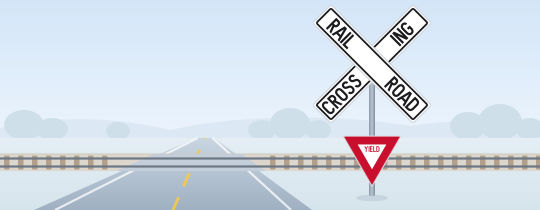
At a crossing marked by a white X-shaped RAILROAD CROSSING sign, you spot a train coming close enough to be a hazard. Where must you stop?
Show answer
Correct answer: No closer than 15 feet and no farther than 50 feet from the nearest rail
Why
Hawaii law sets that stopping zone, at least 15 but no more than 50 feet back from the closest rail, whenever signals flash, a gate is down, or a train is close enough to be a hazard. Wait until the train has passed and the tracks are clear. Never go around, under or through a gate that’s lowered or still moving.
22Right-of-way
A pedestrian steps into a marked crosswalk on your half of the road. What does Hawaii law require, and what does a first violation cost?
Show answer
Correct answer: Stop and let them cross; $150
Why
Hawaii drivers must stop, not merely slow, for anyone in a crosswalk on their half of the road or approaching so closely from the other half that they’re in danger. The fine is $150, and a second offense within a year brings $300 and a 90-day license revocation. Never pass a car that has stopped for someone crossing.
23Speed limits
A freeway sign posts a minimum speed, but you’re nervous and drive well below it. What does the Hawaii manual say about that?
Show answer
Correct answer: Going under a posted minimum is a violation; keep right or pull off to let traffic by
Why
A posted minimum counts just like a maximum, because a car crawling along forces others into risky passes. If you can’t keep up, stay in the right lane or leave the road where it’s safe. Hazard flashers are for a vehicle stopped in a dangerous spot, never for driving slowly.
24Parking
Heading off-island for a few days, you think about leaving your car on a public street in Kahului. What does Hawaii’s manual say?
Show answer
Correct answer: It may not sit on a public street for more than 24 hours in a row
Why
Hawaii’s manual forbids leaving a vehicle on a public street for over 24 hours straight. For a longer trip, use a driveway, a garage or a paid lot. Parking violations count as traffic infractions under state law.
25Alcohol & phones
Under Hawaii’s implied consent law, what have you agreed to simply by driving on the state’s public roads?
Show answer
Correct answer: Taking a breath or blood test for alcohol when an officer requests one
Why
Driving in Hawaii counts as agreeing to alcohol testing. Refusing a breath, blood or urine test triggers administrative license revocation: two years for a first refusal, and longer after prior alcohol or drug enforcement contacts. A result of 0.08% or more also starts revocation, with a 30-day temporary permit in the meantime.
26Safe driving
You’re tempted to leave your 7-year-old alone in the parked car while you shop at a store in Kapolei. What does Hawaii law say?
Show answer
Correct answer: Leaving a child under 9 alone in a vehicle for five minutes or more is illegal
Why
Hawaii makes it an offense for a driver or adult passenger to leave a child younger than 9 unattended in a vehicle for five minutes or longer. State law makes sure this rule appears on the knowledge test. Bring the child along, even for a quick errand.
27Permit & provisional license
How long must a Hawaii driver under 18 hold an instruction permit before getting a provisional license?
Show answer
Correct answer: At least 180 days
Why
Teens need the permit for 180 days or more, and they must be at least 16, before a provisional license. That time is when you finish a certified driver education course and behind-the-wheel training. To book the road test, you’ll need both completion certificates, the DE-20 and DE-21.
28Sharing the road
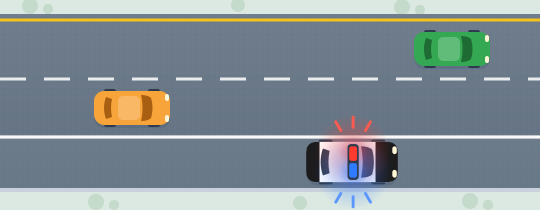
On a highway with two lanes going your way, you’re approaching a police car stopped on the right shoulder with its lights flashing. What does Hawaii’s move-over law expect from you?
Show answer
Correct answer: Slow to a safe speed and, if you safely can, change lanes to leave an empty one beside it
Why
Hawaii drivers must slow down and, when traffic allows, move over so an open lane separates them from a stopped emergency vehicle with flashing lights. Since June 5, 2026, the same duty covers any stopped vehicle showing hazard lights, flares, cones or warning signs, such as a stalled car. If you can’t change lanes, slow down even more and pass with care.
29Road signs
In a construction zone on the H-1 freeway, the orange-and-white stripes on a barricade slope downward toward the right. Which way should you go?
Show answer
Correct answer: Bear right, the way the stripes slope down
Why
On work-zone barricades and panels, the diagonal stripes steer you around the hazard: stripes running down to the right send you right, and stripes running down to the left send you left. Orange signs and devices always mean road work, so ease off and watch for crews.
30Right-of-way
Pulling out of a shopping center driveway in Kailua, you have to cross a sidewalk and a bike lane to reach the street. What does Hawaii law require?
Show answer
Correct answer: Stop before crossing the sidewalk or bike lane, then yield
Why
Coming out of an alley, driveway or building, Hawaii law makes you stop before the sidewalk or bike lane, then yield to people walking, riders and road traffic. That first stop gives you a clear look at anyone the parked cars may hide. Inch ahead for a second look at the street if you need it.
Round 4 · Questions 31–40
31Road signs
On a winding two-lane road on Maui, a yellow sign shaped like a long sideways pennant stands on the left shoulder and reads NO PASSING ZONE. What is it telling you?
Show answer
Correct answer: A stretch where you may not pass begins at the sign
Why
Hawaii’s manual describes this yellow-and-black pennant as standing on the driver’s left, with its point showing where the no-passing stretch starts. Yellow is the warning color, so treat it as an early heads-up. Finish any pass before you reach it, then stay in your lane until the zone ends.
32Right-of-way
A fire truck with its siren wailing and red lights flashing comes up behind you as you near an intersection. What should you do?
Show answer
Correct answer: Pull to the right edge, clear of the intersection, and stop until it passes
Why
Hawaii law has you steer to the right-hand edge, away from any intersection, and stay stopped until the fire truck has gone by. Stopping in the middle of an intersection blocks the path it needs. Check your mirrors before moving, because other drivers will be pulling over too.
33Speed limits
On Oahu, what happens if radar shows you going 30 mph or faster above the posted limit?
Show answer
Correct answer: You get a court summons instead of a set fine
Why
Honolulu police list speeding fines that climb with your speed: $62 plus $5 per mph for 1 to 10 over, and $122 plus $5 per mph for 11 to 29 over. At 30 mph or more over, it’s excessive speeding and you have to appear in court. Easing off a few mph costs nothing.
34Parking
On a narrow country road on Kauai, you want to park at the edge of the pavement. How much street width must you leave open for other traffic?
Show answer
Correct answer: At least 10 feet
Why
Hawaii’s manual bans parking anywhere that would leave less than 10 feet of the street for other vehicles. On a tight road, that usually means driving on to a wider spot or a pullout. And since January 2026, Hawaii law also bans parking within 20 feet of a crosswalk or intersection, sign or no sign.
35Alcohol & phones
Under Hawaii law, which of these is illegal for a driver on a public road, even with a BAC far below 0.08%?
Show answer
Correct answer: Having an opened container of alcohol while you drive
Why
Hawaii bars drivers from drinking, or having an opened or unsealed container of alcohol, while driving on a public road, whatever a breath test would show. The penalty can reach a $2,000 fine, 30 days in jail, or both. Keep any alcohol you’re carrying sealed.
36Alcohol & phones
You’re 17 and drive on a Hawaii provisional license. Which use of a phone is allowed while you’re driving?
Show answer
Correct answer: Calling 911 in an emergency
Why
Hawaii bars drivers under 18 from using any mobile electronic device behind the wheel, hands-free included. Adults may talk hands-free, but teens may not, and a red light still counts as driving. The law carves out one exception at every age: a call to 911 in an emergency.
37Safe driving
Hawaii law ties headlight use to sunset and sunrise. Which window is correct?
Show answer
Correct answer: From 30 minutes past sunset to 30 minutes ahead of sunrise
Why
Hawaii’s rule switches headlights on half an hour past sunset and keeps them on until half an hour ahead of sunrise. The manual also asks for low beams in heavy rain, in fog and at dawn and dusk so others can spot you. Skip high beams in fog; the glare bounces right back at you.
38Permit & provisional license
You’re 16 with a provisional license and no parent along. How many passengers under 18 who don’t live in your household may ride with you?
Show answer
Correct answer: One
Why
Hawaii’s provisional license allows just one passenger under 18 from outside your household unless a licensed parent or guardian is in the car. Passengers from your own household don’t count toward that limit, but everyone must buckle up. Fewer friends on board means fewer distractions.
39Permit & provisional license
As a 16-year-old provisional driver, you finish a shift at a Waikiki restaurant at 11:45 p.m. Can you drive yourself home alone?
Show answer
Correct answer: Yes, if you carry a signed statement for driving to or from work
Why
Provisional drivers may not drive from 11 p.m. to 5 a.m. unless a licensed parent or guardian sits beside them. The exceptions are trips to or from work or a school-authorized activity, with a signed statement in the car. Even then, carry no more than one passenger under 18.
40Lane markings
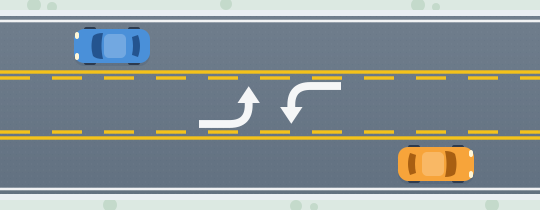
A middle lane has a solid yellow line along its outer edges and a dashed yellow line just inside them, with white turn arrows pointing opposite ways. What may you use it for?
Show answer
Correct answer: Left turns only, from either direction
Why
Those markings label a center lane that drivers from both directions share for turning left. Hawaii’s manual says to use it only for left turns and never to pass. Signal, move in just before your turn, and watch for a driver from the other side who wants the same space.
Hawaii DMV written test at a glance
Key numbers for test day, whether you test at home or at a county office.
Hawaii · Class 3 knowledge test
24 of 30 to pass.
30 questions · Multiple choice
24 of 30 answers right to pass
Onlineat home on a webcam computer, in English or Spanish
60 minto finish the online test
7 daysbefore you can retest after a fail
$12online test in Honolulu ($11–$25 elsewhere)
$5learner’s permit in Honolulu
20/40on the eye chart with your better eye, glasses OK
Under 18? Your road to a license
15½Instruction permitPass the vision screening and the 30-question test with a parent’s signed consent, then practice only with a licensed driver 21+ beside you.
180 dPractice + driver edHold the permit at least 180 days, finish certified driver ed (classroom or approved online course, plus behind-the-wheel lessons) and log 50 supervised hours, 10 of them at night.
16Provisional licenseBring your DE-20 and DE-21 certificates, pass the road test in your own insured car, and the provisional license is yours.
16–17Provisional limitsNo driving 11 p.m.–5 a.m. without a licensed parent or guardian (work and school trips excepted), one passenger under 18 from outside your household, and no phone, not even hands-free.
17Full licenseSix months on a provisional license with no pending violations, and you can move up to a full license from age 17.
18 or older? Driver ed and the 180-day permit wait are for teens only: get your instruction permit with the vision and knowledge tests, then take the road test. Moving here with a valid license from another state? The tests may be waived.
What’s on the Hawaii permit test
Study the Hawaii Driver’s Manual (2023 edition) from the Hawaii Department of Transportation. One 30-question test covers road rules, traffic law, safe driving and signs, and by law it must ask about phones and children left alone in cars. These six areas come up again and again.
Road signs
Color first: red stops or forbids, yellow warns, orange means road work, and green, blue and brown guide you.
At a STOP sign, halt at the stop line; with no line, before the crosswalk; with neither, where you can see the cross street.
A yellow pennant on the left side of the road marks where a no-passing zone begins.
Right-of-way
Two cars on crossing roads pull up together, with no sign or signal? The driver on the left gives way.
Someone in the crosswalk on your half of the road: stop, don’t just slow. A first offense costs $150.
Siren and lights behind you: pull to the right edge, out of the intersection, and stop.
Speed limits
Hawaii’s statutes set no default speed numbers: obey the posted signs, set by the counties and HDOT.
Driving faster than conditions allow is illegal, even under the posted limit.
On Oahu, 30 mph or more over the limit means a court summons, not just a fine.
Parking
Parked on any hill? Set the brake and turn your front wheels right, toward the curb.
Park facing the way traffic moves, within 12 inches of the curb, and for 24 hours at most on a public street.
Since January 2026, no parking within 20 feet of a crosswalk or intersection, even where no sign or curb marking warns you.
Alcohol & phones
BAC limits: 0.08% for adults, 0.04% in a commercial vehicle, 0.02% under 21.
Holding a phone while driving is banned, red lights included; adults may talk hands-free.
Drinking or having an opened container of alcohol while you drive can cost up to $2,000.
Teen rules
Permit driving from 11 p.m. to 5 a.m.? Only with a licensed parent or guardian beside you.
Provisional drivers carry one passenger under 18 from outside the household, unless a parent or guardian rides along.
Under 18, no phone behind the wheel, not even hands-free; a 911 call is the only exception.
Hawaii numbers to know
Six figures from Hawaii law and the driver’s manual worth memorizing before test day.
100 ftof steady signaling before you turn
2 secminimum following distance; double it in rain
20 ftof clear curb before a crosswalk or intersection
15–50 ftfrom the nearest rail when you stop for a train
3 ftof room when you pass a bicyclist
0.02%BAC limit for drivers under 21
Your Hawaii course, in your pocket
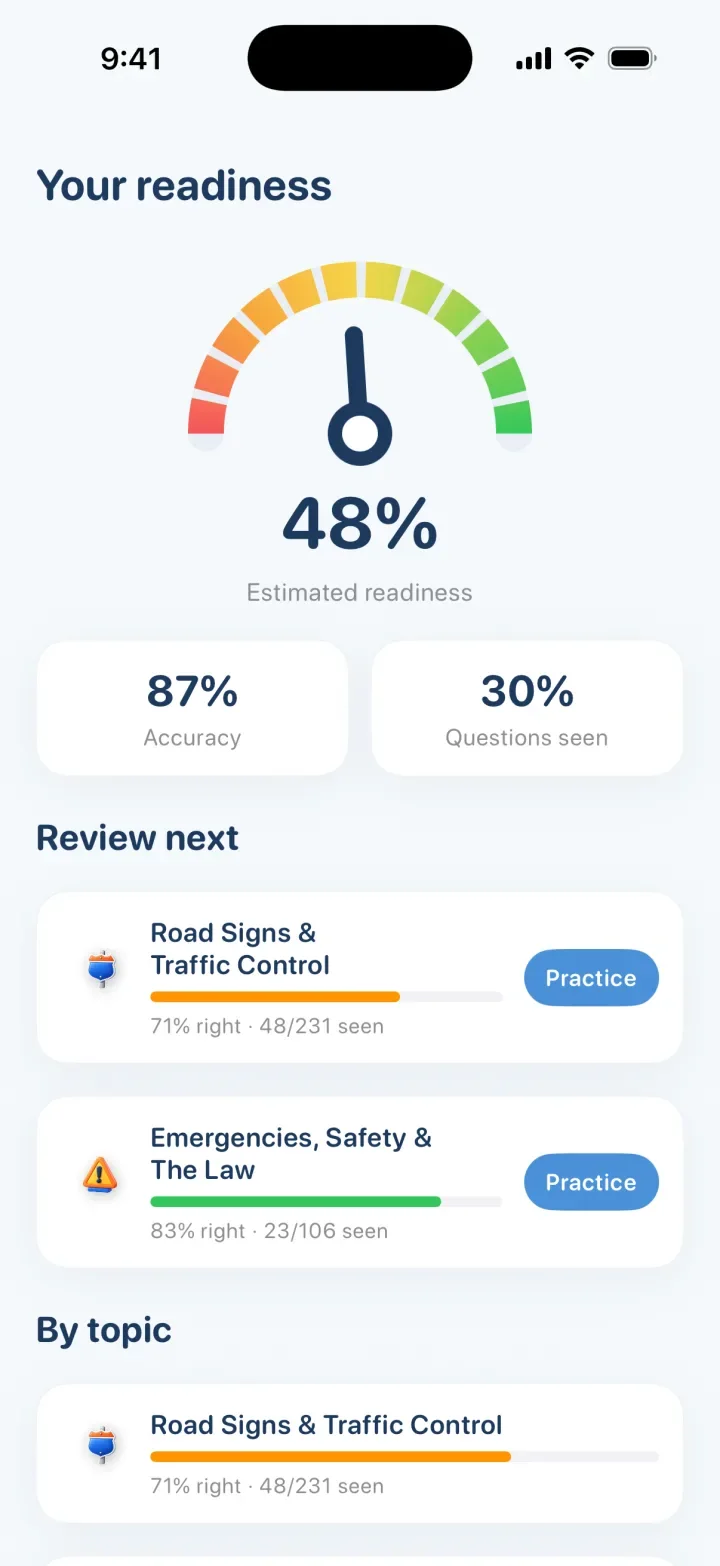
These 40 questions are just the warm-up. The app gives you 490 Hawaii practice questions, 36 short lessons and the why behind every answer.
36 short lessonsFour levels, from fundamentals to expert, then a full practice exam.
490 Hawaii questions324 of them with pictures.
Your most-missed questionsA review lesson built from the questions you miss most.
Exam simulatorTake full practice exams and watch your readiness grow.
Hawaii permit
Your Hawaii path is ready.
36 lessons, 490 questions and full practice exams. In English and Spanish.
How many questions are on the Hawaii permit test, and what score passes?
The car (Class 3) knowledge test has 30 multiple-choice questions on road rules, Hawaii traffic law, safe driving and traffic signs. You need 80% to pass, so at least 24 right, which means six misses at most. A vision screening comes with it.
What happens if I fail the Hawaii knowledge test?
Wait seven days, then try again. There’s no cap on the number of online attempts, but every retake costs the full fee again.
Can I take the Hawaii permit test online?
Yes, for the car permit. KnowTo Drive, HDOT’s online testing platform, lets you test at home on a desktop or laptop with a working webcam (phones and tablets aren’t accepted), with 60 minutes for the 30 questions. Pick the county where you’ll get your permit, then book a licensing center visit within 60 days to finish with your documents, photo and eye test. Prefer to test in person? County driver licensing offices give it too; on Oahu, book through AlohaQ.
Can I take the Hawaii permit test in Spanish?
Yes. The online test is offered in English or Spanish, and it can read each question aloud. HDOT also publishes the driver’s manual in Spanish, and state rules allow an oral test for applicants who struggle with English. This practice test and the app are in Spanish too.
How old do you have to be to get a permit in Hawaii?
15½. Under 18 you also need a parent’s consent, then you hold the permit at least 180 days and finish driver education before a provisional license at 16. Provisional drivers can’t drive 11 p.m.–5 a.m. without a licensed parent or guardian, may carry only one passenger under 18 from outside the household, and can’t use a phone, even hands-free. After six months, you can upgrade to a full license from 17.
How much does a Hawaii learner’s permit cost?
Each county sets its own fees. In Honolulu the in-person written test is $2 and the permit $5, and the road test is $8. Taking the test online costs $12 in Honolulu, $11 in Hawaii County, $20 on Kauai and $25 on Maui.
Who gives the permit test in Hawaii?
There’s no single state DMV office. Licenses are issued by the counties: Honolulu’s Department of Customer Service and the finance departments of Hawaii, Kauai and Maui counties. The Hawaii Department of Transportation (HDOT) coordinates the program and publishes the Hawaii Driver’s Manual. In Honolulu, every office visit is booked through AlohaQ.
What’s the best way to study for the Hawaii permit test?
Read the Hawaii Driver’s Manual, then practice until 80% feels easy. Start with the 40 questions above, then let the app guide you through 490 Hawaii questions and 36 short lessons, with every answer explained.