Prepare for the Delaware DMV knowledge test with 40 free questions on road signs, the 300-foot turn signal rule, Level One permit limits and what to do at a traffic stop. Every answer comes with a clear explanation the moment you pick it.
Four rounds of 10 questions on Delaware signs and signals, right-of-way, speed limits, parking, DUI and phone laws, teen permit rules and police traffic stops. Tap an answer to see the reasoning behind it.
Round 1 · Questions 1–10
1Sharing the road
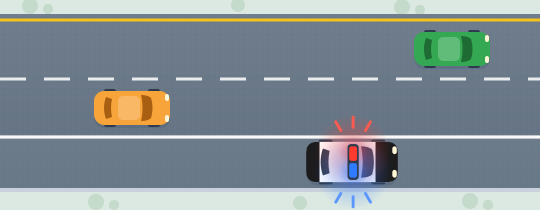
You’re cruising in the right-hand lane of a divided highway with two lanes each way, posted at 55 mph. A police car sits on the right shoulder with its lights flashing, and traffic in the left lane keeps you from moving over. How fast may you pass it under Delaware law?
Show answer
Correct answer: Slow to a safe speed of 35 mph or less
Why
Delaware’s move-over law first asks you to shift into a lane that isn’t next to the stopped vehicle. If you can’t, drop to a safe speed 20 mph or more below the limit wherever the limit is 50 mph or more, which means 35 mph or lower here. The rule also protects tow trucks, DelDOT and utility crews, and any car showing hazard lights, flares or cones.
2Right-of-way
Two cars reach a neighborhood crossroads with no signs or signals at about the same moment. You’re heading north; the other car is coming from the east, on your right. Who gives way?
Show answer
Correct answer: You yield to the car on your right
Why
If you and another driver pull up to a crossing without signs or signals at nearly the same time, Delaware law has the one on the left wait for the one on the right. A car that is already inside the intersection goes ahead of you both. Lift off the gas early so you are never forced into a hard stop.
3Parking
You spot an open space along the curb right next to a fire hydrant. In Delaware, how far from the hydrant must your car stay?
Show answer
Correct answer: At least 15 feet
Why
Delaware keeps every stopped or parked car at least 15 feet away from a hydrant. Fire crews need to hook up hoses fast, and a blocked hydrant can cost them precious minutes. Two more distances to learn with it: 20 feet from a crosswalk and 30 feet before a stop sign.
4Alcohol & phones
A 19-year-old is pulled over in Delaware and blows 0.03% on a breath test. What follows under the state’s zero-tolerance law?
Show answer
Correct answer: Loss of the license for 2 months on a first offense
Why
Delaware’s zero-tolerance law draws the line for drivers under 21 at 0.02%; reach it and the law treats it as proof you were drinking. A first offense costs the license for 2 months, and later ones 6 to 12 months. Don’t confuse it with 0.08%, the DUI level for every driver: under 21, the bar sits far lower.
5Permit & teen rules
How many correct answers does it take to pass Delaware’s Class D knowledge test at the DMV?
Show answer
Correct answer: 26 of 32
Why
The DMV’s knowledge test has 32 questions, and 26 right answers pass, about 81%. That leaves room for just 6 misses, so aim well above that line when you practice. A vision screening comes first, with 20/40 as the standard.
6Road signs
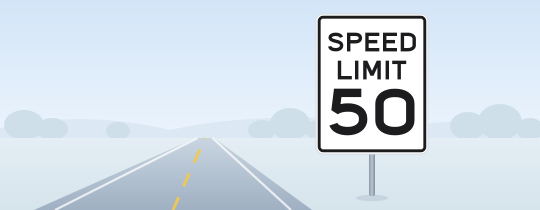
Under a yellow curve-warning sign, a smaller yellow plate reads 35 MPH. The white speed limit sign on this road says 50. What is the yellow plate?
Show answer
Correct answer: An advisory speed for the curve; the legal limit is still 50
Why
White rectangles carry the legal limit, while black-on-yellow speed plates are advice for the hazard they sit under. Exceeding an advisory plate isn’t a violation by itself, but the Delaware manual warns that if you crash there, you can be treated as having broken the general speed rule. Brake before the curve, not in it.
7Safe driving
You plan a right turn into a shopping center on a Delaware road. How far ahead must your turn signal be blinking?
Show answer
Correct answer: At least 300 feet before the turn
Why
Delaware law calls for an unbroken signal over at least the last 300 feet before you turn, and no more than half a mile ahead. The same rule covers moving from one lane to another. Signal before you stop or slow down suddenly too, with your blinkers or a hand signal.
8Speed limits
You’re rolling past the shops and offices of a downtown business district and haven’t seen any speed limit sign. What limit applies in Delaware?
Show answer
Correct answer: 25 mph
Why
Delaware sets 25 mph in business districts unless signs say otherwise. Downtown blocks are full of turning cars, delivery trucks and people stepping off curbs, so the low default buys you reaction time. Near a school with posted signs, the limit drops further, to 20 mph.
9Traffic stops
Flashing lights appear in your mirror and an officer signals you to pull over. Once you’ve stopped safely on the right, what does the Delaware Driver Manual advise?
Show answer
Correct answer: Shut off the engine, stay inside with your hands on the wheel and wait for instructions
Why
Delaware law makes traffic stops part of the knowledge test, and the manual’s advice is to stay calm, turn off the engine and radio, keep your hands where they can be seen and remain in the car. Wait to be asked before you reach for your license or registration. If there is a weapon in the car, tell the officer right away.
10Road signs
A fluorescent yellow-green sign with five sides, showing two people walking, stands at the edge of the road. What is it telling you?
Show answer
Correct answer: You’re near a school or a school crossing
Why
Delaware saves the five-sided shape for schools and school crossings, so the outline alone tells you children may be close. Older versions are plain yellow, newer ones glow yellow-green. Ease off the gas and look for a 20 mph school zone sign and the times it is in force.
Round 2 · Questions 11–20
11Speed limits
Unless signs say otherwise, Delaware law sets a 50 mph limit, like the one on this sign, for which kind of road?
Show answer
Correct answer: A two-lane road
Why
By Delaware law, 50 mph is the default on two-lane roads. Four-lane roads and divided highways default to 55 mph, and business districts to 25 mph. A posted sign always overrides these numbers, so keep reading the signs as the road changes.
12Right-of-way
You’re stopped at a red light in Wilmington and want to turn left. When does Delaware let you make that turn on red?
Show answer
Correct answer: Only if both streets are one-way, after a full stop
Why
Delaware permits a left on red in a single case: both streets carry traffic in one direction only, you have stopped completely, and no sign forbids it. Right on red is allowed more widely, also after a full stop, unless a sign bans it or the signal shows a steady red arrow. In both cases, people in the crosswalk and cross traffic go first.
13Permit & teen rules
What does a 16-year-old need before Delaware will issue a Level One Learner’s Permit?
Show answer
Correct answer: A Delaware Driver Education Certificate and a sponsor’s signature
Why
Teens enter Delaware’s Graduated Driver License program through driver education, and the Blue/White Certificate proves you passed an approved course. A sponsor, usually a parent, signs the application, shares liability for your driving and can cancel your privileges until you turn 18. The 50 practice hours come later, during your first 6 months on the permit.
14Alcohol & phones
After a DUI arrest, a Delaware driver says no to a breath, blood or urine test for the first time. How long is the license revoked?
Show answer
Correct answer: 12 months
Why
Under Delaware’s implied consent law, anyone who drives in the state is treated as having already agreed to chemical testing after a DUI arrest. A first refusal brings a 12-month revocation, a second 18 months and a third 24 months. The refusal penalty stands on its own, apart from how the DUI charge turns out.
15Parking
You’d like to park on a street just before a corner controlled by a stop sign. How far back from the sign does Delaware require you to stay?
Show answer
Correct answer: 30 feet
Why
Delaware keeps parked cars at least 30 feet back from a stop sign, a traffic signal or a flashing beacon. A car parked closer would hide the sign from approaching drivers and block their view of the cross street. Railroad crossings need even more room: 50 feet from the nearest rail.
16Road signs
At a Delaware intersection, the signal for your left-turn lane shows a flashing red arrow. How do you handle it?
Show answer
Correct answer: Stop completely, then turn left once there’s a safe gap
Why
Delaware uses flashing red arrows, and each one works like a stop sign for that single turn: a full stop first, then go when the gap is safe. A steady red arrow is stricter and means no turn at all until it changes. A flashing yellow arrow lets you turn without stopping, after giving way to oncoming traffic and pedestrians.
17Safe driving
On a dry, clear day, what is the minimum gap the Delaware Driver Manual wants you to keep behind the car in front?
Show answer
Correct answer: 3 seconds
Why
Pick a fixed point such as a sign or an overpass; when the car ahead passes it, start counting. If you reach the point before three seconds, drop back. The Delaware manual suggests 4 seconds on slippery roads, behind big vehicles that block your view, when towing and whenever it is hard to see.
18Sharing the road
On a quiet Delaware street, a bicyclist slows at a stop sign where it meets a small two-lane road and rolls on without stopping, because no traffic is coming. Is that legal?
Show answer
Correct answer: Yes, Delaware lets cyclists treat that stop sign like a yield sign
Why
Delaware allows bicyclists to handle a stop sign the way they would a yield sign where it meets a road of two lanes or fewer, as long as no vehicle is stopped at the sign. Where the cross road has three or more lanes, they still have to stop fully. As a driver, expect cyclists to keep rolling at these corners and leave them room.
19Lane markings
On a two-lane road with a double solid yellow center line, you come up behind a bicyclist, and your lane is too narrow to share. What does the Bicycle Friendly Delaware Act let you do?
Show answer
Correct answer: Change lanes fully to pass, even over the double yellow, once it’s safe
Why
Delaware requires at least 3 feet of space when you pass a bicyclist. If the lane is too narrow for that, the law lets you change lanes completely, even across a double yellow line, once the way is clear. Honking at a rider is also banned, except to warn of immediate danger.
20Right-of-way
You’re on a Delaware divided highway with two lanes each way. Across the median, a school bus heading the other way stops and switches on its flashing red lights. What’s required of you?
Show answer
Correct answer: Keep going slowly; oncoming traffic doesn’t stop on a road this wide
Why
On Delaware roads with four or more lanes, only traffic coming up behind a stopped school bus has to stop; drivers meeting it from the front keep going, slowly. On a road with fewer than four lanes, traffic in both directions stops until the bus moves or its red lights go off. Passing a stopped bus illegally can bring a fine or jail time, a license suspension and 6 points.
Round 3 · Questions 21–30
21Road signs
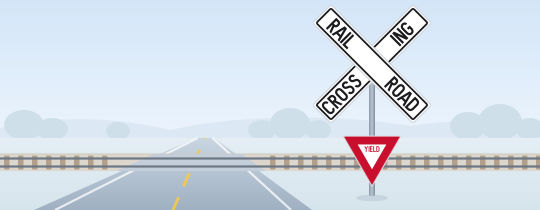
A country road crosses a single track at a white X-shaped RAILROAD CROSSING sign, with no flashing lights and no gate. In Delaware, what does that crossbuck ask of you?
Show answer
Correct answer: Yield: slow down, look both ways and stop if a train is coming
Why
The Delaware manual says a crossbuck means exactly what a YIELD sign means, and the train always goes first. At a crossing with no lights or gate, your eyes and ears are the only warning system, so turn the radio down and look both ways. If a train is coming, stop between 15 and 50 feet short of the nearest rail.
22Right-of-way
You’re halfway through an intersection on a green light when an ambulance with its siren on comes up behind you. What should you do?
Show answer
Correct answer: Clear the intersection, then pull to the right edge and stop until it passes
Why
Stopping in the middle of an intersection blocks the very path the ambulance needs. Delaware’s rule is to drive on through, then move as far right as you can, clear of the intersection, and stop until it has gone by. Check your mirrors before you merge back into traffic.
23Speed limits
Delaware school zones carry their own speed limit. What is it, and when does it apply?
Show answer
Correct answer: 20 mph, during the times posted on the school zone signs
Why
The school zone limit in Delaware is 20 mph where signs for the zone show when it is in force, such as while children are around or while its warning lights flash. Read the plate under the sign so you know whether it applies right now. Outside those hours, still expect kids near crosswalks and bus stops.
24Alcohol & phones
Driving through Dover, a 30-year-old wants to use her phone. Which of these does Delaware law allow while the car is moving?
Show answer
Correct answer: Talking hands-free through the car’s speakers
Why
Delaware bars every driver from using a handheld phone or other device while the car is moving: no texting, browsing, games or handheld calls. Adults may talk hands-free, and may dial or switch the device on or off before setting it down. A first ticket costs $100, and another within 2 years $200 to $300.
25Permit & teen rules
You’re 16 and in your first 6 months on a Level One permit. Which of these people may supervise your practice drives?
Show answer
Correct answer: A neighbor, 30, licensed 10 years and approved by your sponsor
Why
A Level One supervisor in Delaware must be your parent or guardian with a valid license, or someone 25 or older with 5 or more years on a Class D license, approved by your sponsor. That person sits beside you, and nobody else may ride up front. Your cousin is too young, and no one can supervise from the back seat.
26Parking
The curb along a Delaware street is painted yellow, and you need to pick up a friend. May you pull over there for a moment?
Show answer
Correct answer: No, stopping or parking there is not allowed
Why
In Delaware, a yellow curb, or a yellow line painted along the edge of the road, means no stopping or parking at all. Pull ahead to a legal spot and let your friend walk over. The same ban covers sidewalks, bridges, tunnels, fire lanes and the space in front of a driveway.
27Safe driving
A light drizzle starts on your mid-afternoon drive home from Rehoboth Beach, and you switch on the wipers. What else does Delaware law require?
Show answer
Correct answer: Turn on your headlights as well
Why
In Delaware, wipers running because of the weather mean your headlights must be on too. They are also required from sunset to sunrise and whenever people and vehicles aren’t clearly visible at 1,000 feet. Four-way flashers are only for warning others of a hazard, such as a car stopped on the shoulder, and never stand in for headlights.
28Road signs
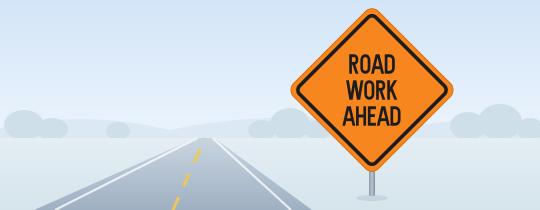
An orange diamond-shaped ROAD WORK AHEAD sign starts a stretch of cones and barrels on a Delaware highway. If you’re caught speeding inside that work zone, what changes?
Show answer
Correct answer: Your fine is doubled
Why
Orange is the color of work zones, and Delaware doubles speeding fines inside them. Expect lower posted limits, shifting lanes and flaggers holding STOP/SLOW paddles or red flags, and obey a flagger the way you would a signal. Leave extra room ahead, because traffic in a work zone can stop without warning.
29Traffic stops
During a traffic stop in Delaware, an officer asks for your name and address. What does the Delaware Driver Manual say about answering?
Show answer
Correct answer: You must give them, and you may ask for the officer’s name and agency
Why
Delaware expects you to give your name and address and explain where you are going, and you’re allowed to ask for the officer’s name and agency. The right to a lawyer doesn’t apply at the roadside; it comes into play later. A detention for questioning can last no more than 2 hours before you are released or arrested.
30Permit & teen rules
You’re 16 and have held your Level One permit for 8 months, with your 50 hours certified. When may you drive without a supervisor?
Show answer
Correct answer: Between 6 a.m. and 10 p.m.
Why
After the first 6 months, a Level One permit holder may drive solo from 6 a.m. to 10 p.m. From 10 p.m. to 6 a.m., a supervisor must ride along unless you are driving straight to or from work, church or a school activity held on school property. When you drive alone, one passenger is the limit.
Round 4 · Questions 31–40
31Right-of-way
A yellow diamond sign with three curved arrows chasing each other in a circle warns of a roundabout ahead. How should you enter it?
Show answer
Correct answer: Slow to 10–15 mph and yield to anyone already in the circle or crosswalk
Why
The Delaware manual has you slow to 10–15 mph, give way to people in the crosswalk and to cars already circling, then travel counterclockwise to your exit. Choose your lane before you enter: the right lane to turn right, the left lane to turn left or come back around. Once inside, keep moving unless stopping is the only way to avoid a crash.
32Road signs
A storm has knocked out the power, and the traffic lights at an intersection on your route show no light at all. What does Delaware law tell you to do?
Show answer
Correct answer: Slow down and be ready to yield to other traffic
Why
Under Delaware law, a signal that shows no light means ease off and get ready to give way to anyone already in the intersection or about to enter it. A dark signal never hands you the right-of-way. Make eye contact with the other drivers and go only when the way is clear.
33Speed limits
According to the speed table in the Delaware Driver Manual, which roads carry the state’s highest listed limit of 65 mph?
Show answer
Correct answer: Route 1 and Interstate 495
Why
The top figure in the manual’s table is 65 mph, and it belongs to Route 1 and I-495. Other four-lane and divided highways default to 55 mph, and two-lane roads to 50. DelDOT can raise or lower limits on state roads after engineering studies, so the posted sign is the number that counts.
34Alcohol & phones
A driver 21 or older is convicted of a first DUI in Delaware with a BAC of 0.10%. How long does the license revocation last?
Show answer
Correct answer: 12 months
Why
For a first DUI, Delaware revokes the license for 12 months when the BAC is under 0.15%, 18 months from 0.15 to 0.19%, and 24 months at 0.20% or more. A fine of $500 to $1,500 and up to 12 months in jail can come on top. At the arrest itself, the officer takes your license and hands you a 15-day temporary one.
35Permit & teen rules
How much supervised driving must a Delaware teen log during the first 6 months on the Level One permit?
Show answer
Correct answer: 50 hours, 10 of them at night
Why
Delaware requires 50 hours behind the wheel in those first 6 months, including 10 after dark. Your sponsor certifies the log, and it has to reach the Department of Education before you may drive without a supervisor. Spread the hours over highways, rain and night driving, not just quiet streets.
36Parking
Your car is parked on the shoulder of a Delaware highway, and the sun has gone down. What must the car be showing?
Show answer
Correct answer: Parking lights or four-way flashers
Why
From sunset to sunrise, or whenever you can’t see 1,000 feet ahead, a car left on a shoulder must show parking lights or hazard flashers. Get as far off the travel lane as you can so passing traffic has room. If you walk away from the car, shut off the engine, take the key and set the brake.
37Safe driving
You’re using high beams on a dark country road and gaining on a car traveling your way. By what distance must you switch to low beams?
Show answer
Correct answer: 200 feet
Why
Delaware wants your low beams on once you’re 200 feet or closer behind another car, and 500 feet or closer to oncoming traffic. Bright lights in a mirror can dazzle the driver ahead just as much as oncoming glare does. Switch back to high beams once the road ahead is empty.
38Alcohol & phones
A 19-year-old is caught holding a beer at a park, nowhere near a car. What does Delaware law set for a first offense?
Show answer
Correct answer: A $100 fine, handled as a civil offense
Why
Delaware penalizes anyone under 21 who has or drinks alcohol, whether or not a car is involved: $100 the first time and $200 to $500 after that. The first two violations are civil, so they stay off a criminal record. The 2-month zero-tolerance revocation is a separate rule for under-21 drivers who get behind the wheel after drinking.
39Lane markings
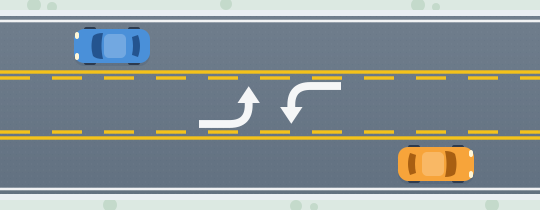
A middle lane is edged on both sides by a solid yellow line paired with a broken one, and painted arrows inside point left in opposite directions. What is it for?
Show answer
Correct answer: Left turns, and U-turns where allowed, by drivers from both directions
Why
This is a shared center lane, and Delaware keeps it for drivers turning left, or making a U-turn where that is permitted, from either direction. Signal, move in shortly before your turn and wait there for a gap. It is never a passing lane or a lane to cruise along in.
40Permit & teen rules
A 16-year-old with a Level One permit, driving alone, takes a call through the car’s speakers. What’s the rule in Delaware?
Show answer
Correct answer: It’s banned, and a first offense brings a 1-month suspension
Why
Teens in Delaware’s graduated program may not use a cell phone or any electronic device while driving, hands-free included, unless they have pulled off the travel lanes. A first conviction means a 1-month suspension, and each later one 3 months. Let calls go to voicemail and return them once you’re parked.
Delaware DMV knowledge test at a glance
What to know before your DMV visit, from the eye screening to the last question.
Delaware · Class D knowledge test
26 of 32 to pass.
32 questions · Multiple choice
About 81% right: you can miss 6 at most
$508-year Class D license fee, permit included
In personat a DMV office, or with a certified driver ed teacher
12 monthsfor adults to pass every exam after applying
2 or moretest questions on police traffic stops, by law
Translatormay read questions to you, but not on the sign part
20/40vision needed, with or without glasses
Under 18? Your road to a license
16Level One permitBring the Blue/White Certificate from a state-approved driver ed course (30 class hours, 7 behind the wheel, 7 observing in the car) and a sponsor’s signature.
6 moSupervised onlyEvery drive with a qualified supervisor beside you. Log 50 hours, 10 of them at night.
+6 moSolo by dayDrive alone from 6 a.m. to 10 p.m. with one passenger at most. Later at night, a supervisor must ride along, except on trips to and from work, church or school.
17Full Class D licenseAfter 12 months on the permit, it turns into a full license automatically, as long as your sponsor hasn’t withdrawn consent.
18 or older? The teen program is optional for you. Pass the eye screening and knowledge test at the DMV, practice with a licensed driver over 21 beside you, then take the road test.
What’s on the Delaware permit test
Study the Delaware Driver Manual (July 2026 edition). The knowledge test has a road-sign and signal part and a rules-of-the-road part, and state law adds questions on traffic stops. Below are the essentials in six key areas.
Road signs
Know signs by outline alone: eight sides for STOP, five for a school, a circle for a railroad ahead.
White speed signs are the legal limit. Yellow ones are advice, but crash above one and you may still face a speeding charge.
A flashing red arrow means stop, then turn when there’s a safe gap. A steady red arrow means no turn at all.
Right-of-way
Two cars reach a 4-way stop together? The one on the right goes first.
Signal dark from a power outage? Slow down and be ready to yield.
School bus flashing red: both directions stop, except oncoming traffic on roads with 4 or more lanes.
Speed limits
No sign? 25 mph in a business district, 50 on a two-lane road, 55 on four lanes or a divided highway.
School zones are 20 mph during the hours or conditions shown on their signs.
The manual’s highest listed limit is 65 mph, on Route 1 and I-495.
Parking
Leave 15 feet to a hydrant, 20 feet to a crosswalk and 30 feet to a stop sign or signal.
A yellow curb means no stopping, not even to drop someone off.
Parallel parked, your wheels must sit 12 inches or less from the curb.
Alcohol & phones
BAC limits: 0.08% at 21 and over, 0.02% under 21, 0.04% in a commercial vehicle.
Refuse a chemical test after a DUI arrest and lose your license for 12 months the first time.
Handheld phones are banned for every driver; adults may talk hands-free.
Teen rules
First 6 months on the Level One permit: a supervisor beside you on every drive.
After that, solo driving only from 6 a.m. to 10 p.m., with one passenger at most.
No phone at all for teen drivers, hands-free included.
Delaware numbers to know
Six Delaware figures to lock in before you sit down at the DMV computer.
300 ftof steady signaling before a turn or lane change
3 secminimum gap behind the car ahead
15 ftclearance to a fire hydrant
15–50 ftstopping zone before the nearest rail
500 ftto dim your high beams for an oncoming car
0.02%BAC that costs a driver under 21 the license
Your Delaware course, in your pocket
These 40 questions are just the warm-up. The app gives you 465 Delaware practice questions, 36 short lessons and the why behind every answer.
36 short lessonsFour levels, from fundamentals to expert, then a full practice exam.
465 Delaware questions331 of them with pictures.
Your most-missed questionsA review lesson built from the questions you miss most.
Exam simulatorTake full practice exams and watch your readiness grow.
Delaware permit
Your Delaware path is ready.
36 lessons, 465 questions and full practice exams. In English and Spanish.
How many questions are on the Delaware DMV permit test, and what’s a passing score?
The Class D knowledge test has 32 multiple-choice questions, taken on a computer, and you need 26 right, about 81%. That means 6 misses at most. It covers road signs and signals plus Delaware rules of the road, and by law at least 2 questions deal with police traffic stops. A vision screening comes first.
How long do I have to pass the Delaware tests?
Adults get 12 months from the day they apply and pay. Every exam, the road test included, must be passed in that window, or you reapply for the permit and repeat all the testing. Teens who test through driver ed get a certificate that stands in for the DMV written and road tests for 6 months.
Can I take the Delaware permit test online?
No. Delaware has no online or at-home knowledge test. Adults take the eye, knowledge and road exams in person at a DMV office in Wilmington, Delaware City, Dover or Georgetown. Teens usually take their written and road tests with a certified driver ed teacher as part of their course.
Can I take the Delaware DMV test in Spanish?
You can prepare in Spanish: the DMV publishes its Driver Manual in Spanish (Manual del Conductor) and offers its online practice exam in Spanish. On test day, you may bring a translator you choose and pay for, who can read the questions and answer choices to you and nothing more. The road-sign part is the exception: you must pass it on your own, because Delaware requires drivers to understand English highway signs. This practice test comes in Spanish as well, and so does the app.
How old do you have to be to get a permit in Delaware?
16. Under 18, you join the Graduated Driver License program: finish a state-approved driver ed course, have a sponsor sign, and hold the Level One Learner’s Permit for 12 months. The first 6 months are supervised only, with 50 practice hours (10 at night); after that you may drive alone from 6 a.m. to 10 p.m. with one passenger at most. Phones are off-limits the whole time, even hands-free.
How much does a Delaware permit cost?
The permit has no fee of its own. You pay the $50 Class D license fee, which covers your learner’s permit and then an 8-year license. Teens pay it when they apply for the Level One permit.
What do I bring to the Delaware road test?
Your valid learner’s permit, a licensed driver at least 21 who comes with you, and the registration and insurance card for the car you’ll drive. The car must pass a basic safety check, have at least half a tank of gas and have parking-assist features turned off. Expect about 30 minutes of normal driving, including a three-point turn and backing up 50 feet. Road tests run every weekday except Wednesday.
What’s the best way to study for the Delaware permit test?
Read the Delaware Driver Manual, including its section on traffic stops, then practice until 26 of 32 feels easy. Start with the 40 questions above, then let the app guide you through 465 Delaware questions and 36 short lessons, with the reasoning behind every answer.