Get ready for the PennDOT knowledge test, better known as the PA permit test, with 40 free questions on Pennsylvania road signs, speed limits, Paul Miller’s Law and junior license rules. Tap an answer to see right away why it’s right or wrong.
Four rounds of 10 questions covering Pennsylvania signs, right-of-way, speed limits, parking, DUI and phone laws, and junior license rules. A short explanation follows every answer.
Round 1 · Questions 1–10
1Speed limits
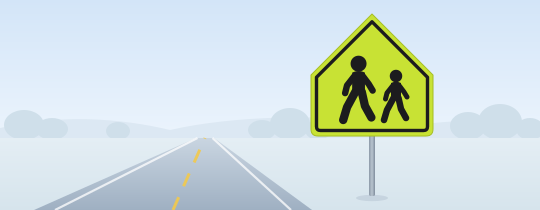
Near a school, you pass a five-sided fluorescent yellow-green sign showing two children, and the yellow lights on the speed sign beside it are flashing. What is Pennsylvania’s limit?
Show answer
Correct answer: 15 mph
Why
Pennsylvania school zones drop to 15 mph while the yellow lights flash or during the hours posted on the sign. Speeding there adds 3 points to your record on top of the fine. The five-sided shape is used only for school signs, so treat it as your cue to slow down and look for kids.
2Right-of-way
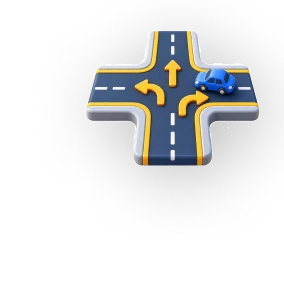
You and a pickup truck pull up to an all-way stop together, and the pickup is on the cross street to your left. Who has the right-of-way?
Show answer
Correct answer: You, since the pickup is to your left
Why
When arrival is a tie, Pennsylvania’s rule is that the driver on the left yields to the driver on the right. Here the pickup is on your left, so you have the right-of-way. Otherwise, the first to stop is the first to proceed; still check that the pickup is really waiting.
3Permit & teen rules
PennDOT’s knowledge test for a learner’s permit has 18 questions. How many must you answer correctly to pass?
Show answer
Correct answer: 15
Why
You need 15 right out of 18, about 83%, which leaves room for only three mistakes. If you fail, you may retest on the next business day, with one try per day. Aim to score well above that line in practice before you go.
4Alcohol & phones
A 19-year-old driver in Pennsylvania blows 0.03% on a breath test. What does that reading mean?
Show answer
Correct answer: DUI, because the limit under 21 is 0.02%
Why
Pennsylvania’s Zero Tolerance rule makes 0.02% the DUI line for anyone under 21, and those cases are punished on the high-rate scale. A first conviction can bring 2 days to 6 months in jail, a 12-month suspension and a fine of $500 to $5,000. At that age, the only safe number is zero.
5Road signs
Along Pennsylvania roads, some route numbers appear inside a marker shaped like a keystone. What kind of road does that marker identify?
Show answer
Correct answer: A Pennsylvania Traffic Route, numbered by the state
Why
The keystone outline belongs to Pennsylvania Traffic Routes, the roads the state numbers itself. Interstates and U.S. routes carry shield-shaped markers instead. Knowing the shapes makes it easier to follow directions when your route turns onto a different road.
6Parking
Pennsylvania law sets a minimum distance between a parked car and a fire hydrant. What is it?
Show answer
Correct answer: 15 feet
Why
Firefighters need room to hook up a hose fast, so Pennsylvania keeps parked cars at least 15 feet from any hydrant. The same rules call for 20 feet from an intersection crosswalk and 20 feet from a fire station driveway.
7Safe driving
PennDOT’s manual measures following distance in seconds. On dry pavement, how far behind the vehicle ahead should you stay?
Show answer
Correct answer: 4 seconds
Why
Watch the car ahead pass a sign or tree, then count; if you reach that spot before four seconds are up, back off. On wet pavement PennDOT suggests 5 to 6 seconds, and you need extra room behind trucks and motorcycles as well.
8Sharing the road
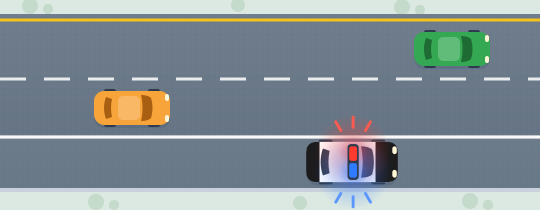
A police car with flashing lights is stopped on the right shoulder of a highway with two lanes in your direction. What does Pennsylvania’s Move Over law require?
Show answer
Correct answer: Move into the lane farther away if it’s safe; if you can’t, slow to at least 20 mph under the posted limit
Why
At an emergency response area, Pennsylvania wants you in a lane that isn’t next to it. If traffic won’t let you merge, cut your speed to at least 20 mph below the limit. Violations bring 2 points and fines of $500, then $1,000 and $2,000 for repeat offenses.
9Permit & teen rules
You’re 16 and just got your junior license. Unless a parent, guardian or spouse 18 or older rides along, during which hours may you not drive?
Show answer
Correct answer: 11 p.m. to 5 a.m.
Why
Pennsylvania keeps junior drivers off the road from 11 p.m. to 5 a.m. unless a parent, guardian or spouse 18+ is in the car. Trips for work, public or charitable service, or volunteer firefighting are exempt with a notarized affidavit or employer certificate. The limit ends once you hold a regular license.
10Right-of-way
Stopped at a red light in the far-left lane of a one-way street, you want to turn left. When is that turn legal in Pennsylvania?
Show answer
Correct answer: When the street you’re entering also carries traffic in one direction only, and no sign forbids it
Why
Pennsylvania allows a red-light left in one narrow case: your street is one-way and the street you’re entering is one-way too. Make a full stop in the far-left lane, yield to people walking and to cross traffic, and skip it if a sign says no. Right on red works the same way, stop first and yield, unless posted otherwise.
Round 2 · Questions 11–20
11Road signs
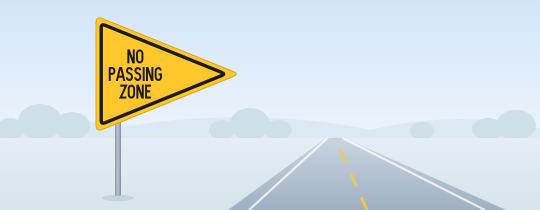
Climbing a hill on a two-lane country road, you notice a yellow sign shaped like a sideways pennant on the left shoulder. What does it mark?
Show answer
Correct answer: The start of a stretch where passing is not allowed
Why
This pennant is the NO PASSING ZONE sign, the only warning sign with that shape. Pennsylvania puts it on the left, in view of a driver who might pull out to pass, right where the restricted section begins. Hill crests and blind curves are typical spots for it.
12Right-of-way
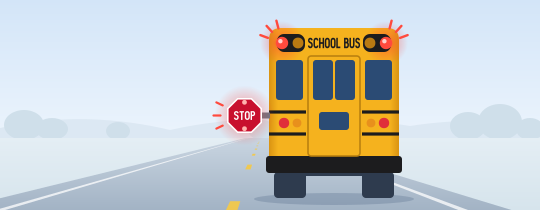
You’re behind a school bus on a two-lane road. It stops, its red lights start flashing and the stop arm swings out. What does Pennsylvania law require?
Show answer
Correct answer: Stop at least 10 feet behind it and stay put until the lights go off and the arm folds back
Why
Drivers behind the bus, drivers coming toward it and drivers at an intersection where it has stopped must all halt 10 or more feet away. Wait until the red lights stop flashing, the arm is withdrawn and the children are safe. Passing illegally means a $250 fine, 5 points and a 60-day license suspension.
13Speed limits
You’re on an unlit rural road at night with only your low beams on. To avoid overdriving your headlights, what is the fastest PennDOT’s manual says you should go?
Show answer
Correct answer: 45 mph
Why
Low beams reach only about 250 feet, and at 55 mph you need more than that to stop, even on dry pavement. Holding to 45 mph or less on a dark road lets you stop within the stretch your lights show. Let your headlight range, not the speed limit sign, set your pace.
14Alcohol & phones
Pennsylvania’s Implied Consent law applies when a driver arrested for DUI says no to a chemical test. What is the penalty for a first refusal?
Show answer
Correct answer: A one-year license suspension that stands whatever the verdict
Why
By driving in Pennsylvania you’ve already agreed to chemical testing if police arrest you for DUI. Refusing brings a one-year suspension, or 18 months with a prior offense, and it stays in place even if you’re found not guilty. That penalty is separate from any DUI sentence.
15Permit & teen rules
What is the youngest age at which you can apply for a learner’s permit in Pennsylvania?
Show answer
Correct answer: 16
Why
PennDOT won’t take a permit application before your 16th birthday, though the physical on the DL-180 can be done up to six months ahead. After at least six months with the permit, the earliest you can earn a junior license is 16½. The permit is valid for one year.
16Safe driving
You’re on a road posted at 45 mph and plan to turn right onto a side street. How far before the turn must your signal be on in Pennsylvania?
Show answer
Correct answer: At least 300 feet
Why
On faster roads Pennsylvania requires at least 300 feet of signal before a turn; on slower roads, under 35 mph, 100 feet is the minimum. The extra distance gives drivers behind you time to see your plan and slow down.
17Parking
You’re hunting for a space downtown. Which of these spots meets Pennsylvania’s parking distance rules?
Show answer
Correct answer: 35 feet before a stop sign
Why
Pennsylvania keeps parked cars at least 30 feet from a stop sign, so 35 feet is fine. Every other spot is too close: hydrants need 15 feet, intersection crosswalks 20 feet and railroad crossings 50 feet from the nearest rail. These buffers keep signs, hoses and sight lines clear.
18Road signs
On a Pennsylvania interstate you pass Exit 47, and you need to get off at Exit 75. What do those numbers tell you?
Show answer
Correct answer: Your exit is about 28 miles ahead, since exit numbers follow mile markers
Why
Pennsylvania numbers its exits to match the mile markers, so the gap between two exit numbers is roughly the distance between them: 75 minus 47 leaves about 28 miles. Use that to plan when to start working your way to the right lane.
19Crashes & emergencies
An ambulance with its siren on comes up behind you, and you pull to the right and stop. Once it has gone by, how closely may you follow it?
Show answer
Correct answer: No closer than 500 feet
Why
After an emergency vehicle passes, Pennsylvania wants you at least 500 feet behind it. When you first hear the siren, pull to the right edge and stop, but not inside an intersection. Look for a second emergency vehicle before you pull back out.
20Lane markings
On a two-lane road with a double solid yellow center line, you come up behind a cyclist. What does Pennsylvania law let you do?
Show answer
Correct answer: Cross the center line to pass when it’s safe, leaving at least 4 feet
Why
A double solid yellow line normally bans passing in both directions. Pennsylvania makes an exception for bicycles: when the way is clear, you may cross it to pass, giving the rider at least 4 feet. If oncoming traffic is near, slow down and wait behind the bike.
Round 3 · Questions 21–30
21Safe driving
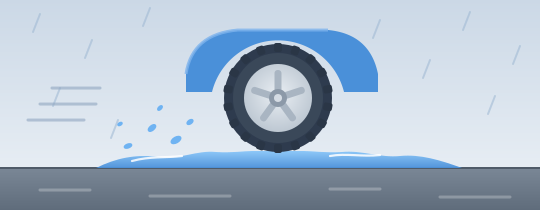
Heavy rain has left a film of water on the highway. According to PennDOT’s manual, at what speed can tires begin to hydroplane on just a tenth of an inch of water?
Show answer
Correct answer: As low as 35 mph
Why
On a thin layer of water, tires can start riding on the surface instead of the road at around 35 mph, and steering and braking grip fades. If you feel it, ease off the gas and avoid hard braking. On wet pavement, drive 5 to 10 mph below your usual speed.
22Road signs
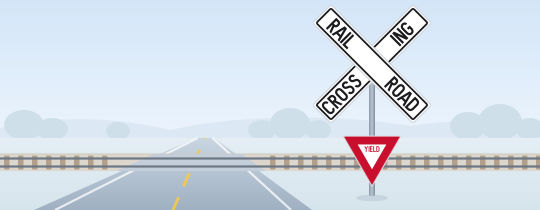
At a rail crossing marked only by a white X-shaped crossbuck, with no lights or gate, you see a train coming. Where must you stop?
Show answer
Correct answer: At least 15 feet short of the closest rail, but no more than 50 feet back
Why
A crossbuck works like a YIELD sign: slow down, look both ways and be ready to stop. With a train approaching, Pennsylvania law puts your stopping point inside a window: at least 15 feet short of the closest rail, yet within 50 feet of it. Never stop on the tracks themselves.
23Right-of-way
A funeral procession is moving through the intersection ahead of you. Your light turns green before the last cars have crossed. What should you do?
Show answer
Correct answer: Wait for the procession to finish crossing, even on your green
Why
Pennsylvania gives funeral processions the right-of-way. Once the lead vehicle has entered an intersection, the cars behind it may keep following even after the signal changes. Let the last car pass, then go.
24Speed limits
Out in the countryside, you’re on a two-lane state highway where no speed limit is posted. What is the most you may drive under Pennsylvania law?
Show answer
Correct answer: 55 mph
Why
Where no other limit applies, Pennsylvania’s statutory maximum is 55 mph. The higher 65 and 70 mph limits exist only on freeways where signs post them. Even below 55, police can cite you if rain, fog or traffic makes your speed unsafe, and that costs 2 points.
25Alcohol & phones
You’re stopped at a red light in Philadelphia and pick up your phone to change the playlist. Under Paul Miller’s Law, is that allowed?
Show answer
Correct answer: No, because hand-held use is banned even when you’re stopped in traffic
Why
Paul Miller’s Law makes it illegal for any Pennsylvania driver to hold or handle a phone behind the wheel, and that covers sitting at a light or in a jam. Since June 5, 2026 a violation costs $50 plus costs. Use hands-free features, or pull off the road safely before you touch the phone.
26Permit & teen rules
Before a Pennsylvania driver under 18 may take the road test, how much supervised driving must be logged?
Show answer
Correct answer: 65 hours, including 10 at night and 5 in bad weather
Why
Teens need at least 65 hours behind the wheel with a qualified adult: 10 after dark and 5 in bad weather. A parent or guardian certifies the hours on form DL-180C, which you bring to the road test. Up to 6 hours with a driver education instructor can count.
27Safe driving
It’s a gray afternoon and drizzle has your wipers running. Your car has daytime running lights. What does Pennsylvania law require?
Show answer
Correct answer: Turn on your headlights, since the wipers are on
Why
Pennsylvania’s wipers-on, headlights-on law applies whenever weather has your wipers going, and daytime running lights don’t satisfy it. Breaking it is a $25 fine, close to $100 once costs are added. Headlights also go on from sunset to sunrise and whenever you can’t see 1,000 feet ahead.
28Parking
Your Pittsburgh street climbs steeply, and you’ve parked nose-up right beside the curb. Before you set the brake, how do you angle the front tires?
Show answer
Correct answer: Away from the curb, to the left
Why
Turned left, your front tire will catch against the curb if the car starts rolling back. Facing downhill, turn the wheels right, toward the edge, with or without a curb; uphill with no curb, turn them right as well. Set the parking brake every time.
29Road signs
Orange diamond signs announce a work zone on a sunny afternoon, but nobody seems to be working. What does Pennsylvania require of your headlights?
Show answer
Correct answer: Keep them on through the whole posted work zone
Why
Pennsylvania wants headlights on in every posted work zone, day or night, whether or not a crew is active. A driver stopped there without them faces an extra $25 fine. When workers are present, speeding fines double too, so ease off the gas.
30Crashes & emergencies
You’re in a crash where one car has to be towed, and police don’t come to investigate. What must you do in Pennsylvania?
Show answer
Correct answer: Send a Driver’s Accident Report to PennDOT within 5 days
Why
Pennsylvania wants police called whenever a crash injures or kills someone or leaves a vehicle needing a tow. If no officer investigates, the reporting duty shifts to you: mail a Driver’s Accident Report to PennDOT within five days.
Round 4 · Questions 31–40
31Sharing the road
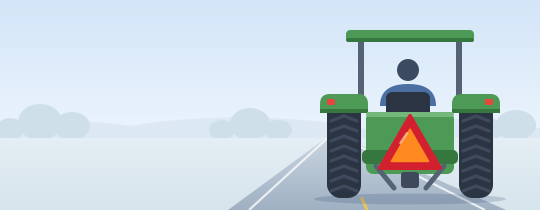
On a rural Pennsylvania road, you close in on a farm tractor with an orange triangle edged in red on its back. What’s the right way to handle it?
Show answer
Correct answer: Slow down early, keep back and pass only where it’s legal and safe
Why
That triangle marks a vehicle built to go 25 mph or slower, so the gap closes fast. Pennsylvania drivers also see it on horse-drawn buggies, where a horn can spook the horse and the buggy may roll back after stopping. Give extra room and be patient.
32Right-of-way
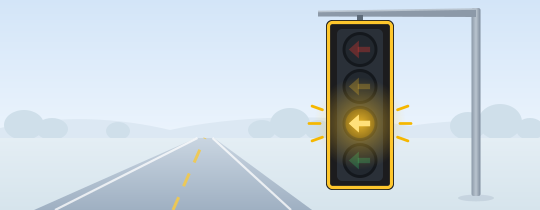
Waiting to turn left at a signal, you see only a flashing yellow arrow lit for your lane. What does it let you do?
Show answer
Correct answer: Turn left after yielding, since oncoming traffic may have a green light
Why
A flashing yellow arrow allows the turn but gives you no protection. Oncoming drivers usually have a green light at the same moment, so wait for a safe gap and check the crosswalk. Only a solid green arrow means oncoming traffic has been stopped for you.
33Right-of-way
You’re turning right at an intersection with no traffic signal. A pedestrian has just stepped into the crosswalk on the street you’re turning onto. What does Pennsylvania law require?
Show answer
Correct answer: Yield and let the pedestrian finish crossing
Why
At an intersection with no signal, Pennsylvania drivers yield to anyone crossing, marked crosswalk or not, and a driver turning a corner yields to people crossing with the light. Failing to yield costs a $50 fine and 2 points. A blind walker, guided by a dog or tapping a white cane, goes first every time.
34Speed limits
Crews are working in a Pennsylvania highway work zone, and you’re caught going 12 mph over the posted limit. On top of a doubled fine, what can happen?
Show answer
Correct answer: A 15-day license suspension
Why
In an active work zone, Pennsylvania doubles fines for speeding and many other violations, and going 11 mph or more over the limit brings a 15-day suspension. Lanes shift and workers stand close to traffic, so give yourself extra room. Keep your headlights on through the whole zone.
35Alcohol & phones
Your 25-year-old passenger wants to sip from an open beer while you drive on a Pennsylvania highway. What does state law say?
Show answer
Correct answer: Not allowed: no one in the vehicle may have an open container
Why
Pennsylvania’s open container rule covers the driver and every passenger. The exceptions are narrow: passengers in buses, taxis and limousines, or the living quarters of a motor home. Keep any alcohol sealed while the car is on the road.
36Alcohol & phones
Can you wear earbuds while driving in Pennsylvania?
Show answer
Correct answer: One ear only, and only for communication
Why
Pennsylvania allows a headphone or earpiece in one ear only, and only for communication, such as a hands-free call. Keep the other ear open for sirens, horns and train whistles. Music in both ears is out.
37Safe driving
Driving at night with your high beams on, you see headlights coming toward you. By what distance must you switch to low beams in Pennsylvania?
Show answer
Correct answer: Once it is within 500 feet
Why
Pennsylvania has you dim within 500 feet of an oncoming vehicle, and within 300 feet when you’re following someone. High beams at close range can blind the other driver for a few dangerous seconds. On a dark road with low beams, keep your speed down so you can stop within what you can see.
38Safe driving
After an overnight snowstorm, your car’s roof is buried under snow and ice. What does Pennsylvania law expect before you drive?
Show answer
Correct answer: A reasonable effort to clear the roof, hood and trunk, not only the windows
Why
Pennsylvania requires drivers to make a reasonable effort to remove snow and ice from the whole vehicle, roof, hood and trunk included, within 24 hours after a storm. Chunks flying off a car can smash a windshield behind you. If falling ice causes death or serious injury, the fine can reach $1,500.
39Permit & teen rules
For the first six months on a Pennsylvania junior license, how many passengers under 18 who aren’t immediate family may ride with you when no parent or guardian is in the car?
Show answer
Correct answer: One
Why
In those first six months the limit is one non-family passenger under 18 unless a parent or guardian is along. After six months it rises to three, but a junior driver who was partly or fully at fault in a crash or convicted of a violation stays at one. Under 18, you can never carry more people than the car has seat belts.
40Road signs
A storm has cut the power, and every traffic light at a busy crossroads has gone dark. What do you do when you get there?
Show answer
Correct answer: Stop fully, then take turns as at an all-way stop
Why
In Pennsylvania a signal that isn’t working is handled like an all-way stop: come to a full stop, then take turns. A flashing red light works the same way as a STOP sign. Expect other drivers to hesitate, and make eye contact before you go.
Pennsylvania permit test at a glance
What to know before you walk into a PennDOT Driver License Center.
Pennsylvania · PennDOT knowledge test
15 of 18 to pass.
18 questions · Multiple choice
15 of 18 answers right to pass
Walk-inno appointment needed for the knowledge test
Next dayretest the next business day, one try per day
Spanishwritten or audio, one of 30 test languages
$45.50covers your permit and first 4-year license
In personat a Driver License Center, not online
20/40combined vision to drive without glasses
Under 18? Your road to a license
16Learner’s permitTurn in the DL-180 with its physical exam and the DL-180TD parent consent form, then pass the vision screening and the 18-question test.
6 moSupervised practiceHold the permit at least six months and log 65 supervised hours (10 at night, 5 in bad weather) with a licensed adult 21+, or a licensed parent, guardian or spouse 18+, in the front seat.
16½Junior licenseBook the road test, bring the signed DL-180C log of your 65 hours, and pass it to earn your junior license.
16½+Junior limitsNo driving 11 p.m.–5 a.m. without a parent, guardian or spouse 18+ (work, public service and volunteer firefighting excepted), and one non-family passenger under 18 for six months, up to three after that.
17½Regular licenseUpgrade early after a year on the junior license, with driver education, a clean record and a parent’s consent. At 18 it happens on its own.
18 or older? You follow the same permit and road test steps, minus the six-month wait and the 65-hour log, and bring two proofs of residency.
What’s on the Pennsylvania permit test
Study the Pennsylvania Driver’s Manual (PUB 95) from PennDOT. The test pulls from its chapters on road signs, Pennsylvania driving laws and safe driving. Here’s what matters most in six key areas.
Road signs
Read the shape first: eight sides means STOP, a pennant on the left marks a no-passing zone, five sides means a school.
A keystone-shaped marker means a Pennsylvania route, and exit numbers match the mile markers.
Orange diamonds mean a work zone: headlights on, day or night.
Right-of-way
Two cars at a four-way stop at once? The one on the left lets the right go first.
School bus with red lights and stop arm out: stop at least 10 feet away, behind it or facing it, unless you’re across a divided highway.
Siren or flashing red lights: pull right and stop, then stay 500 feet behind.
Speed limits
15 mph in a school zone while the lights flash or during the posted hours.
No speed limit sign? The legal top speed is 55 mph, and less whenever rain, fog or traffic calls for it.
70 mph is the top limit, and only on freeways posted for it.
Parking
Keep 15 feet from a hydrant and 20 feet back from an intersection’s crosswalk.
Stay 30 feet back from a stop sign or signal and 50 feet from the nearest rail.
Facing downhill, wheels to the right; uphill against a curb, wheels to the left.
Alcohol & phones
BAC limits: 0.08% at 21+, 0.04% in a commercial vehicle, 0.02% under 21.
Say no to a breath or blood test after a DUI arrest and lose your license for a year, even if you’re acquitted later.
Paul Miller’s Law: no hand-held phone while driving, even at a red light. Fines started June 5, 2026.
Teen rules
A permit holder drives only with a licensed adult in the front seat: 21+, or a parent, guardian or spouse 18+.
Under 18, 6 points or a single conviction for 26+ mph over brings a 90-day suspension.
Under 18, never carry more passengers than the car has seat belts.
Pennsylvania numbers to know
Six figures worth knowing by heart before test day.
300 ftof turn signal on faster roads (100 ft under 35 mph)
15 ftfrom a fire hydrant when you park
10 ftminimum gap from a stopped school bus
4 secfollowing distance on dry pavement
500 ftdim your high beams for oncoming traffic
0.02%BAC limit for drivers under 21
Your Pennsylvania course, in your pocket
These 40 questions are just the warm-up. The app gives you 463 Pennsylvania practice questions, 36 short lessons and the why behind every answer.
36 short lessonsFour levels, from fundamentals to expert, then a full practice exam.
463 Pennsylvania questions314 of them with pictures.
Your most-missed questionsA review lesson built from the questions you miss most.
Exam simulatorTake full practice exams and watch your readiness grow.
Pennsylvania permit
Your Pennsylvania path is ready.
36 lessons, 463 questions and full practice exams. In English and Spanish.
How many questions are on the PA permit test, and what’s a passing score?
PennDOT’s knowledge test has 18 multiple-choice questions on road signs, Pennsylvania driving laws and safe driving. You need 15 right, about 83%, so you can miss three at most. You’ll also pass a vision screening, either at the Driver License Center or with your own health care provider on the DL-180.
What happens if I fail the PennDOT knowledge test?
You can try again on the next business day, with one attempt allowed per day. The examiner hands back your DL-180 (and DL-180TD if you’re under 18), so bring them on your next visit. Your DL-180 stays valid for one year from the date of its physical exam.
Can I take the Pennsylvania permit test online?
No. You take it in person at a PennDOT Driver License Center, and you don’t need an appointment for the knowledge test. The road test is different: you book it online or by phone.
Can I take the PA permit test in Spanish?
Yes. Every Driver License Center offers the test in Spanish, written or audio, as one of 30 languages. PennDOT also publishes the driver’s manual in Spanish, and this practice test and the app both work in Spanish too.
How old do you have to be to get a learner’s permit in Pennsylvania?
You can apply at 16. If you’re under 18, you hold the permit at least six months, log 65 supervised hours (10 at night, 5 in bad weather) and pass the road test for a junior license, at 16½ at the earliest. Junior drivers stay off the road 11 p.m.–5 a.m. unless a parent, guardian or spouse 18+ rides along, and carry only one non-family passenger under 18 for the first six months.
How much does a Pennsylvania learner’s permit cost?
$45.50 for a first-time Class C applicant. That one payment covers the permit and your first four-year photo license, with no separate fee for the knowledge test. Driver License Centers take cards, checks and money orders, but not cash.
What do I bring to the PennDOT knowledge test?
Your completed DL-180 with the physical exam filled in, the DL-180TD consent form if you’re under 18, original proof of identity and date of birth, your signed Social Security card and the fee. If you’re 18 or older, add two proofs of residency. Photocopies aren’t accepted, and the DL-180 can’t be mailed in.
What’s the best way to study for the PA permit test?
Read the Pennsylvania Driver’s Manual (PUB 95), especially the parts on signs, laws and safe driving, then practice until 15 of 18 feels easy. Start with the 40 questions above, then let the app take you through 463 Pennsylvania questions and 36 short lessons, each with a clear explanation.