Get ready for your Wisconsin temps with 40 free questions on road signs, right-of-way, speed limits, OWI laws and teen driving rules. Pick an answer and see right away why it’s correct.
Four rounds of 10 questions mixing Wisconsin signs with the rules of the road: right-of-way, speed limits, parking, OWI, phones and teen limits. Every answer comes with a short, clear explanation.
Round 1 · Questions 1–10
1Road signs
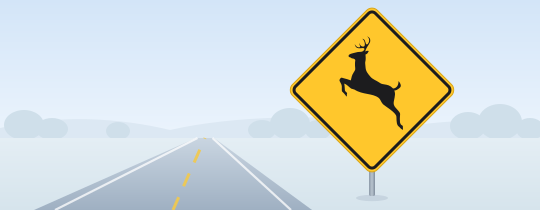
Just after sunset on a two-lane Wisconsin highway, you pass a yellow diamond sign with a leaping deer on it. A little later a deer bolts out and you can’t avoid hitting it. Under Wisconsin rules, who may keep the deer?
Show answer
Correct answer: You may, and you call the police so they can issue a tag for it
Why
Wisconsin lets the driver who hits a deer keep it; if you don’t want it, the next motorist may take it. Either way, call the police so an officer can tag the animal. Deer move most between sunset and sunrise, so when you see this sign, slow down, watch for eyes shining in your headlights and expect more than one.
2Speed limits
Children are walking to class past a Wisconsin school marked by a five-sided fluorescent yellow-green sign. With no other limit posted, what’s the speed limit while they’re present?
Show answer
Correct answer: 15 mph
Why
Wisconsin sets 15 mph when you pass a school while children are going to or from it or playing nearby, and the same 15 mph applies at a marked school crossing when a child or crossing guard is there. Kids can step out from between parked cars without looking, so cover the brake and scan both curbs.
3Right-of-way
Your street dead-ends into a cross street, forming a T, and there are no signs or signals. A car is approaching on the cross street. Who has the right-of-way?
Show answer
Correct answer: The car on the cross street, because your road is the one that ends
Why
At an uncontrolled T-intersection, Wisconsin law says the driver on the road that ends yields to traffic on the road that continues. Slow down or stop, let cross traffic clear, then make your turn. Treat the end of your street as a yield point even when no sign is posted.
4Parking
You find an open space on a Wisconsin street next to a fire hydrant, and no sign is posted. What’s the closest you may park to the hydrant?
Show answer
Correct answer: 10 feet
Why
Wisconsin law keeps parked cars at least 10 feet from a fire hydrant, or farther where a sign says so, so firefighters can reach it fast. Check the curb too: the handbook says not to park where it’s painted yellow.
5Alcohol & phones
Wisconsin’s ‘Not a Drop’ law covers drivers under 21. What alcohol concentration may they have while driving?
Show answer
Correct answer: 0.00
Why
Under 21, Wisconsin demands absolute sobriety: any alcohol at all is a violation, even a single drink. Breaking the law means a $200 fine, 4 demerit points and a three-month suspension. Line up a sober ride before the party starts.
6Safe driving
In good weather on a dry road, how much following distance does the Wisconsin Motorists’ Handbook recommend?
Show answer
Correct answer: Four seconds
Why
Wisconsin teaches a four-second gap: when the car ahead passes a fixed object like a sign or tree, count ‘one thousand one’ to ‘one thousand four’ before you reach it. Add a second for each problem, such as heavy traffic, rain, snow or ice. That cushion gives you time to react if the driver ahead brakes hard.
7Permit & teen rules
You’re 15 and want your Wisconsin instruction permit, often called ‘temps.’ Besides passing the tests, what do you need?
Show answer
Correct answer: Enrollment in a certified driver ed course, plus an adult sponsor
Why
At 15 you can get your temps if you’re enrolled in a certified driver education course (the instructor signs your application) and an adult sponsor, usually a parent or guardian, signs and accepts liability for your driving. You must also be enrolled in school or a home-based program. The 50 practice hours come later, before the probationary license.
8Lane markings
Some Wisconsin highways open the paved shoulder as a flex lane during busy times. When may you drive in it?
Show answer
Correct answer: Only when a green arrow is shown above it
Why
A flex lane is open only under a green arrow. A yellow X means it’s closing and you should merge into the regular lanes; a red X means it’s closed. Large trucks may not use it at all.
9Road signs
Before Wisconsin issues your instruction permit, you take a Highway Signs Test on top of the 50-question knowledge test. How is that signs test set up?
Show answer
Correct answer: 15 questions, and you need 12 right
Why
The Highway Signs Test covers regulatory, warning and guide signs: 15 questions, with 12 correct needed, the same 80% bar as the knowledge test. You must pass both, plus a vision screening, before you get your temps. Learn signs by shape and color first, since many carry no words at all.
10Crashes & emergencies
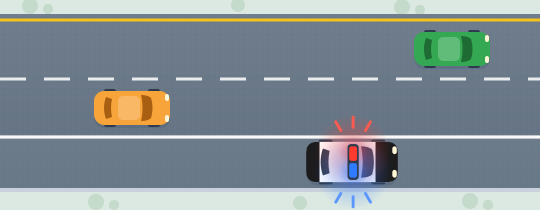
On a highway with two lanes in your direction, a squad car is stopped on the right shoulder with its lights flashing. What does Wisconsin’s Move Over Law require?
Show answer
Correct answer: Move out of the lane next to it if it’s safe; if you can’t, slow down
Why
With two or more lanes going your way, Wisconsin requires you to leave the lane beside a stopped squad car, ambulance, fire truck, tow truck, utility or highway maintenance vehicle with flashing lights; if changing lanes isn’t safe, slow down. Since December 2025 the law also covers disabled vehicles with hazard lights on, flares set out, or people tending to them.
Round 2 · Questions 11–20
11Right-of-way
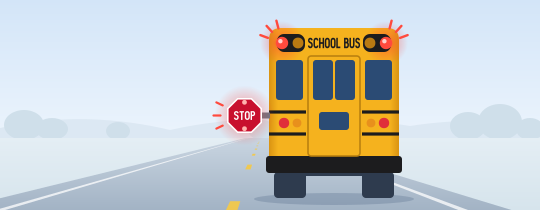
You’re following a school bus on a two-lane road when it stops, flashes its red lights and swings out its stop arm. How close to the bus may you stop?
Show answer
Correct answer: No closer than 20 feet
Why
Wisconsin law has you stop at least 20 feet from a bus with flashing red lights, whether you’re behind it or coming toward it, and wait until the lights go off. The only exception is traffic on the far side of a divided highway with a barrier or median. Passing a stopped bus illegally can bring a $500 to $1,000 fine and four demerit points.
12Road signs
A friend’s directions tell you to take County A out of town. What kind of marker should you watch for along that Wisconsin road?
Show answer
Correct answer: A white sign with rounded corners and black lettering that shows the letter A
Why
Wisconsin names its county highways with letters instead of numbers, and their markers are white with black lettering, like COUNTY A. State highway markers are white with black numbers, U.S. routes use a badge shape, and the red, white and blue shield means an interstate. Matching the marker to the road type helps you confirm your route at a glance.
13Speed limits
What is the highest speed limit you’ll find on a Wisconsin road?
Show answer
Correct answer: 70 mph, on freeways where it’s posted
Why
Wisconsin’s top limit is 70 mph, allowed only on freeways, interstates included, where WisDOT has posted it. Expressways, divided four-lane highways that still have some crossroads, top out at 65 mph where posted. On state and county highways with no posted limit, the cap is 55.
14Parking
Hunting for street parking in Green Bay, you spot four open spaces. Going by Wisconsin’s parking distances, which one is legal?
Show answer
Correct answer: 5 feet from a private driveway
Why
You need only 4 feet of clearance from a driveway, alley or private road, so 5 feet is fine. The others fall short: Wisconsin requires 15 feet from a crosswalk, 15 feet from a fire station driveway and 25 feet from the nearest rail. These four numbers are worth learning as a set.
15Alcohol & phones
When may a Wisconsin driver with an instruction permit or a probationary license use a cell phone while driving?
Show answer
Correct answer: Only to report an emergency
Why
Wisconsin bars anyone with an instruction permit or probationary license from using a phone while driving, except to report an emergency, at any age and on any road. The ban lasts as long as you hold that license, not just the first months. Texting while driving is illegal for every driver, so silence the phone before you pull out.
16Safe driving
When does Wisconsin law require your headlights to be on?
Show answer
Correct answer: From 30 minutes past sunset until 30 minutes before sunrise, plus any time you can’t make out people or cars 500 feet ahead
Why
Wisconsin counts darkness as starting 30 minutes past sunset and lasting until 30 minutes before sunrise, and your headlights belong on that whole time, plus whenever visibility drops under about 500 feet, roughly a block. Parking lights don’t count. Switch to low beams within 500 feet of an oncoming car or one you’re following.
17Permit & teen rules
You’re 15 and hold a Wisconsin instruction permit. Which of these people may supervise your daytime practice drive from the front passenger seat?
Show answer
Correct answer: Your mom, 42, who has held a regular license for 20 years
Why
A Wisconsin supervisor needs at least two years of driving experience and a valid regular license, and must be a qualified instructor, a parent, guardian or spouse 19 or older, or anyone 21 or older (with your parent’s written OK if you’re under 18). Siblings and cousins under 21 don’t qualify, however long they’ve driven. After dark, the person beside you must be an instructor or a licensed adult 25 or older.
18Sharing the road
You come up behind a bicyclist riding near the right edge of a Wisconsin road. How much room must you leave when you pass?
Show answer
Correct answer: At least 3 feet
Why
Wisconsin law requires at least 3 feet between your vehicle and the cyclist, kept until you’ve safely passed. If oncoming traffic won’t let you give that much room, slow down and wait behind the bike. A pothole or a gust of wind can push a rider sideways without warning.
19Right-of-way
In the middle of a Madison block, a person using a white cane steps off the curb to cross in front of you. What does Wisconsin law require?
Show answer
Correct answer: Come to a halt 10 or more feet short of the person and stay put until they’re off the road
Why
Wisconsin has a special rule for someone using a white cane or led by a guide dog: halt no closer than 10 feet and remain stopped until they’ve cleared the roadway, crosswalk or not. A horn can startle and confuse someone who can’t see your car. Give them time, then pull away slowly.
20Road signs
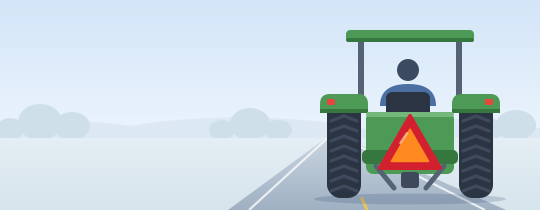
A green tractor is rolling along a two-lane town road ahead of you, and a reflective orange-and-red triangle is fixed to its back. What top speed does that emblem tell you to expect?
Show answer
Correct answer: 25 mph or less
Why
That triangle is the slow-moving vehicle emblem, and the Wisconsin handbook ties it to vehicles that may travel 25 mph or less, such as farm machinery. At highway speed you’ll close the gap within seconds, so ease off the moment you spot it. Be patient around farm traffic, and never honk at livestock near the road.
Round 3 · Questions 21–30
21Lane markings
On a two-lane Wisconsin highway split by two solid yellow lines, you’re stuck behind a car creeping along at well under half the speed limit. What does the Wisconsin handbook say?
Show answer
Correct answer: You may pass it when it’s safe, because it’s going less than half the limit
Why
Two solid yellow lines normally ban passing in both directions, but Wisconsin makes two exceptions: crossing to turn into a driveway, and carefully passing a vehicle going under half the speed limit, as long as it isn’t farm equipment. Even then, you may never exceed the limit to get around it. If you can’t see far enough ahead, stay put.
22Road signs
Orange diamond signs and barrels mark a road crew ahead on a Wisconsin highway. What changes for you inside that work zone?
Show answer
Correct answer: Fines double, and using a hand-held phone is illegal unless you’re reporting an emergency
Why
Orange is the color of construction and maintenance signs. In Wisconsin work zones traffic fines double, and no driver may talk on a hand-held phone there except to report an emergency; hands-free use is allowed. Slow down, leave extra room and expect lane shifts and equipment close to traffic.
23Speed limits
Wisconsin’s Rustic Roads program picks out scenic country roads for unhurried drives. What top speed does state law allow on a Rustic Road?
Show answer
Correct answer: 45 mph
Why
State law caps Rustic Roads at 45 mph, 10 below the usual 55 on rural highways, and the limit applies where its signs are posted. Treat it as a ceiling: on a narrow back road with hills and curves, the basic speed rule may call for going slower still.
24Parking
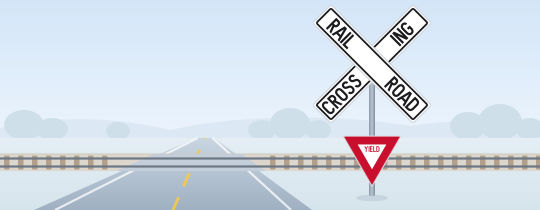
You want to pull over and wait for a friend near a crossing marked by a white X-shaped RAILROAD CROSSING sign. Under Wisconsin law, how close to the nearest rail may you park?
Show answer
Correct answer: No closer than 25 feet
Why
Wisconsin keeps stopped and parked cars 25 feet or more from the closest rail, which leaves the path and the view clear for trains and crossing traffic. The X-shaped crossbuck itself means yield to trains. Pick a spot farther back or around the corner.
25Alcohol & phones
An officer asks you to take a breath test after stopping you on suspicion of drunk driving. What happens under Wisconsin’s Implied Consent Law if you refuse?
Show answer
Correct answer: You’re arrested, and your driving privilege is revoked for at least a year
Why
By driving in Wisconsin you’ve agreed in advance to a breath or blood test when an officer asks. A refusal leads to arrest and the loss of your driving privilege for at least one year, and a first refusal also brings a year with an ignition interlock or a 24/7 sobriety program.
26Safe driving
On an icy Wisconsin morning, the rear of your car starts sliding sideways on a curve. What should you do?
Show answer
Correct answer: Stay off the brake and steer where you want the car to go
Why
Braking in a skid can lock the wheels and make the slide worse. Take your foot off the brake, look and steer toward where you want to go, and straighten the wheel as the tires grab again. In freezing weather, bridges and overpasses ice up before the rest of the road, so slow down before you reach them.
27Permit & teen rules
Before a Wisconsin teen can apply for a probationary license, what does the permit stage require?
Show answer
Correct answer: Six months on the permit with no tickets, and 50 practice hours including 10 at night
Why
Teens must hold their temps at least six months without a traffic violation and log 50 hours of supervised driving, 10 of them at night, which the sponsor certifies. You also need to be at least 16 and done with driver ed. A printed log or the RoadReady app keeps the hours straight.
28Right-of-way
You’re already circling inside a Wisconsin roundabout when an ambulance with its siren on comes up behind you. What should you do?
Show answer
Correct answer: Leave at the next exit, then pull over
Why
Stopping inside a roundabout can block the very path the ambulance needs. The Wisconsin handbook says to exit safely at the next right and then pull over; if you haven’t entered yet, pull over outside and let it go by. On an ordinary trip, entering drivers yield to traffic already in the circle, which comes from the left.
29Road signs
A storm knocks out power, and the traffic lights at a busy Wisconsin intersection are completely dark. How should you handle it?
Show answer
Correct answer: Treat it as a stop sign: stop fully, then go when it’s your turn
Why
Wisconsin treats a signal that has no power, or isn’t working properly, as a stop sign. Come to a full stop and take turns as you would at a four-way stop, where the first to arrive goes first. If an officer is directing traffic, follow the officer instead.
30Alcohol & phones
You’re driving home from a cookout with an opened bottle of wine. Where may it ride in your car under Wisconsin law?
Show answer
Correct answer: In the trunk
Why
Wisconsin bans any opened container of alcohol in the passenger area, and the glove compartment counts as passenger area. Put it in the trunk, or, in a vehicle without one, a space people don’t normally ride in. Nobody in the car may drink while you’re on the road.
Round 4 · Questions 31–40
31Lane markings
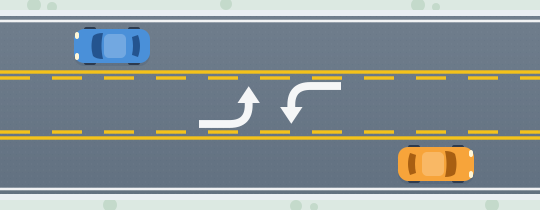
A road has a center lane bordered by solid yellow lines on the outside and dashed yellow lines on the inside, with left-turn arrows painted in both directions. What is that lane for?
Show answer
Correct answer: Left turns and U-turns by drivers from either direction
Why
This is a shared center lane, and in Wisconsin it’s only for left turns and U-turns, open to traffic from both directions. Never use it to pass or as a travel lane. Enter it only when it’s safe, and watch for a driver coming the other way who wants the same space.
32Road signs
At every highway-railroad crossing in Wisconsin there’s a blue sign with white lettering and a phone number. What is it for?
Show answer
Correct answer: Reporting unsafe conditions, like a vehicle stuck on the tracks or warning lights that don’t work
Why
The blue Report Problem or Emergency sign gives the number for reporting trouble at that particular crossing, such as a stalled vehicle or failed signals. Farther back, a round yellow sign warns that a crossing is coming, and the white X-shaped crossbuck at the tracks means yield to trains.
33Speed limits
You’re driving through a residential neighborhood inside a Wisconsin village and haven’t seen any speed limit sign. What limit applies?
Show answer
Correct answer: 25 mph
Why
Unless signs say otherwise, Wisconsin sets 25 mph on streets inside a city or village. In the outlying parts of a city or village with no posted limit, it rises to 35 mph. In town, 25 is your default.
34Speed limits
Out in the country on a Wisconsin county highway, you haven’t passed a speed limit sign in miles. What’s the most you may drive?
Show answer
Correct answer: 55 mph
Why
Where no other limit is set or posted, Wisconsin law caps speed at 55 mph, which covers most state and county highways and town roads. It’s a ceiling, not a target: the basic speed rule still calls for a reasonable speed for traffic, weather and the road. Ease off before curves, hilltops and intersections.
35Parking
You park facing uphill on a rural Wisconsin road with no curb, just a gravel shoulder. Which way should your front wheels point?
Show answer
Correct answer: To the right, toward the edge of the road
Why
With no curb to catch a tire, turn the wheels right so that if the car rolls, it heads off the road instead of into traffic. Uphill with a curb is the one case where you turn left, away from the curb. Facing downhill, turn right, and always set the parking brake.
36Alcohol & phones
An adult with a clean record is convicted of a first OWI in Wisconsin, with no child in the car. What is the usual penalty?
Show answer
Correct answer: A $150–$300 forfeiture plus a $435 surcharge, and a 6–9 month revocation
Why
A first OWI in Wisconsin usually carries no jail time, but it costs a $150 to $300 forfeiture and a $435 OWI surcharge, and your license is revoked for 6 to 9 months. An alcohol concentration of 0.15 or more adds an ignition interlock or 24/7 sobriety program, and a child under 16 in the car brings jail. The adult limit is 0.08, or 0.04 in a commercial vehicle.
37Safe driving
A snowplow with flashing lights is clearing a Wisconsin highway posted at 55 mph. How far back should you stay?
Show answer
Correct answer: At least 200 feet
Why
Wisconsin keeps drivers at least 200 feet behind a working snowplow on roads posted above 35 mph; on roads posted 35 or lower, the minimum is 75 feet. Plows stop and turn often and throw up clouds of snow. Hang back, and don’t pass unless you can see well ahead.
38Permit & teen rules
A 16-year-old has just received a Wisconsin probationary license. During the first nine months, which rule applies?
Show answer
Correct answer: At most one passenger besides immediate family and a qualified adult supervisor
Why
For nine months, or until 18 if that comes first, a Wisconsin teen may carry only one passenger other than immediate family and a qualified adult supervisor. From midnight to 5 a.m., driving alone is limited to trips between home, school and work. A moving violation or a broken restriction adds six months to these limits.
39Permit & teen rules
A 16-year-old who has finished the classroom part of driver ed wants to take the Wisconsin knowledge test from home. How does that work?
Show answer
Correct answer: Through KnowToDrive on a computer with a webcam, with a parent or guardian monitoring, for $10 a try
Why
Wisconsin teens 15 to 17 can take the knowledge test at home through KnowToDrive, the DMV’s vendor, on a laptop or desktop with a webcam while a parent or guardian watches. Each try costs $10 and you get two online attempts; after that you test in person at a DMV service center, where it’s free. A pass earns an emailed certificate to bring when you buy your permit.
40Right-of-way
Two lanes run your way on a city street, and you’re in the one on the right. At an intersection with no traffic light, the car beside you in the left lane stops, and you can’t see why. What should you do?
Show answer
Correct answer: Don’t pass it, and be ready to stop for a pedestrian
Why
Wisconsin law forbids passing a vehicle that has stopped at an intersection or crosswalk to let a pedestrian or bicyclist cross, because that car can hide someone stepping into your lane. Where there’s no signal, drivers yield to pedestrians in marked and unmarked crosswalks alike. Stop, look, and go only when the crossing is clear.
Wisconsin DMV knowledge test at a glance
The numbers that matter before you walk into a DMV service center.
Wisconsin · Class D knowledge and signs tests
80% on both tests.
50 law questions · 15 sign questions
40 of 50 right, plus 12 of 15 on the signs test
Freeat a DMV service center, no appointment
Onlineat home for ages 15–17, $10 a try
Next dayearliest retake, up to 5 tries a year
Spanishone of 11 test languages, ASL included
$35instruction permit, valid 18 months
20/40vision needed in at least one eye
Under 18? Your road to a license
15Instruction permitEnroll in driver ed, line up an adult sponsor, and pass the vision, signs and knowledge tests to get your temps.
6 moSupervised practiceHold the permit six months without a ticket and log 50 hours, 10 of them at night, with a qualified adult beside you.
16Probationary licenseFinish driver ed (30 hours of class, 6 behind the wheel), then pass the road test in your own car.
9 moTeen limitsOne passenger beyond immediate family, and from midnight to 5 a.m. only home, school or work trips unless a qualified adult rides along.
18 or older? Skip driver ed: pass the knowledge, signs and vision tests, hold your permit seven days, then take the road test. Your probationary license comes with no passenger or night limits.
What’s on the Wisconsin permit test
Study the Wisconsin Motorists’ Handbook (BDS126, 2026 edition): the knowledge test draws on its traffic laws, the signs test on its regulatory, warning and guide signs. Here’s what to know cold in six key areas.
Road signs
Yellow diamonds warn of hazards ahead; orange signs mark work zones, where fines double.
County highways go by letters, like County A, on white signs with black lettering.
An orange triangle on the back of a tractor marks a vehicle that may go 25 mph or less.
Right-of-way
Four-way stop: first to arrive goes first; arrive together and the driver on the right goes.
At a T-intersection with no signs, the road that ends yields; turning left, let oncoming traffic go.
School bus with red lights flashing: stop at least 20 feet away, behind it or facing it.
Speed limits
Basic speed rule: never faster than is reasonable for traffic, weather and the road.
25 mph in cities and villages, 35 mph in their outlying areas, 15 mph by a school when children are present.
55 mph where nothing is posted; 70 mph only on freeways where it’s posted.
Parking
Park at least 10 feet from a fire hydrant and 15 feet from a crosswalk.
Keep 25 feet from the nearest rail and 15 feet from a fire station driveway.
Uphill with a curb, wheels left; uphill with no curb or facing downhill, wheels right.
Alcohol & phones
OWI limits: 0.08 for adults, 0.04 in a commercial vehicle, 0.00 under 21.
Refuse a breath or blood test and you lose your license for at least a year.
Texting while driving is banned for everyone; in work zones, so is any hand-held phone use.
Teen rules
Permit drivers need a supervisor licensed at least 2 years: a parent 19+ or any adult 21+.
First 9 months: one non-family passenger, and midnight–5 a.m. only to home, school or work.
With a permit or probationary license, the phone is for emergency calls only.
Wisconsin numbers to know
Six figures every Wisconsin test-taker should know by heart.
100 ftof turn signal before you turn
4 secfollowing distance on a dry road
20 ftfrom a school bus with red lights flashing
500 ftto dim your high beams for oncoming traffic
200 ftbehind a working snowplow on faster roads
0.00alcohol limit under 21 and for every permit holder
Your Wisconsin course, in your pocket
These 40 questions are just the warm-up. The app gives you 422 Wisconsin practice questions, 36 short lessons and the why behind every answer.
36 short lessonsFour levels, from fundamentals to expert, then a full practice exam.
422 Wisconsin questions290 of them with pictures.
Your most-missed questionsA review lesson built from the questions you miss most.
Exam simulatorTake full practice exams and watch your readiness grow.
Wisconsin permit
Your Wisconsin path is ready.
36 lessons, 422 questions and full practice exams. In English and Spanish.
How many questions are on the Wisconsin permit test, and what’s a passing score?
There are two tests, and you need 80% on each. The knowledge test has 50 questions on traffic laws and you need 40 right; the Highway Signs Test has 15 questions and you need 12. You also pass a vision screening (20/40 in at least one eye) before DMV issues your instruction permit.
How many times can I take the Wisconsin knowledge test?
Failed? You can retest the very next day. You may take the same test up to five times in a year; after that, DMV staff must approve another attempt. Teens testing online get two tries there before they test in person.
Can I take the Wisconsin permit test online?
Yes, if you’re 15 to 17 and have finished the classroom part of driver ed. You test at home through KnowToDrive on a laptop or desktop with a webcam, a parent or guardian monitors you, and each try costs $10. Adults test in person: walk in to any DMV service center except Milwaukee Downtown and Sauk City, with no appointment and no fee. Teens can test there for free too.
Can I take the Wisconsin permit test in Spanish?
Yes. At DMV service centers the knowledge and signs tests come in Spanish, Hmong, Somali, American Sign Language and several other languages, and the online test is offered in English and Spanish. WisDOT also publishes a shorter Spanish handbook, the Manual del Conductor. This practice test is in Spanish too, and so is the app.
How old do you have to be to get a permit in Wisconsin?
15. Under 18 you must be enrolled in driver ed and have an adult sponsor. Hold your temps six months without a ticket and log 50 supervised hours, 10 at night, before a probationary license at 16. For the first nine months you may carry only one passenger outside your immediate family, and from midnight to 5 a.m. you may drive alone only between home, school and work.
How much does a Wisconsin permit cost?
The knowledge and signs tests are free at a DMV service center ($10 a try if a teen tests online). The instruction permit costs $35 and is valid for 18 months. Later, each road test appointment is $15 and the probationary license is $28.
What’s on the Wisconsin road test?
You book it online and drive your own car, which the examiner checks first: horn, lights, signals, mirrors and more. You’re scored on turns, stops, uncontrolled intersections, lane changes, a Y-turn, a roadside stop and start, parking and backing. If you fail, the wait before the next try is 1 to 14 days, depending on your results.
What’s the best way to study for the Wisconsin permit test?
Read the Wisconsin Motorists’ Handbook, then practice until 80% comes easily on both laws and signs. Start with the 40 questions above, then open the app for all 422 Wisconsin questions and 36 bite-size lessons, every answer explained.