Prepare for the knowledge test from Louisiana’s Office of Motor Vehicles (OMV) with 40 free questions on speed limits, school bus and railroad rules, the handheld phone ban and teen driving limits. Pick an answer and the explanation appears instantly.
Four rounds of 10 questions on Louisiana road signs, right-of-way, speed limits, parking, OWI and phone laws and teen rules, plus the railroad and litter questions every OMV test includes. Each answer comes with a short explanation.
Round 1 · Questions 1–10
1Road signs
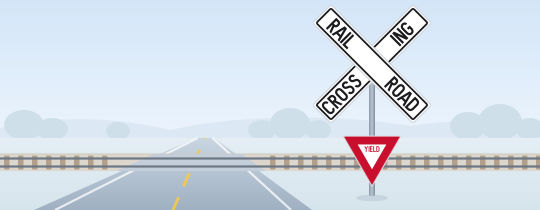
Your road crosses a single track marked only by a white X-shaped RAILROAD CROSSING sign with a YIELD sign below it. There are no lights and no gate. What does Louisiana expect from you here?
Show answer
Correct answer: Slow down, look both ways, and if a train is near, halt between 15 and 50 feet short of the closest rail
Why
Louisiana's Driver's Guide gives the crossbuck the same meaning as a YIELD sign: the train always has the right-of-way. Ease off, look and listen in both directions, and when a train is coming, stop no closer than 15 feet and no farther than 50 feet from the nearest rail. Railroad safety is a required part of every OMV knowledge test, so learn these numbers.
2Speed limits
You're on a two-lane state highway in rural Louisiana, and no speed limit is posted anywhere along it. What is the most state law allows here?
Show answer
Correct answer: 55 mph
Why
With no sign saying otherwise, the ceiling on a Louisiana highway is 55 mph. Higher maximums belong to bigger roads: 65 on multi-lane divided highways and 70 on interstates. Louisiana's general speed law still requires you to go slower when traffic, the road or the weather make 55 unsafe.
3Parking
There's an open curb space on your street just before a STOP sign at the corner. How much distance does Louisiana law require between your parked car and the sign?
Show answer
Correct answer: 20 feet
Why
Louisiana bars parking within 20 feet of a stop sign, flashing beacon or traffic signal at the roadside, so drivers can see it. Don't carry over the 30-foot figure you may have heard elsewhere; Louisiana's is 20. The same 20-foot gap applies to a crosswalk at an intersection.
4Alcohol & phones
Jordan is 20 and has a couple of beers at a crawfish boil before driving home. A breath test shows a BAC of 0.03%. What's true under Louisiana law?
Show answer
Correct answer: It's an offense, because the limit for drivers under 21 is 0.02%
Why
For drivers under 21, Louisiana treats a BAC of 0.02% or more as underage operating while impaired. A first conviction brings a $100 to $250 fine and 10 days to 3 months in jail, and a failed test also suspends the license for 180 days. The 0.08% figure applies only at 21 and older, and commercial drivers are held to 0.04%.
5Right-of-way
After a storm knocks out the power, you reach an intersection where every traffic light is completely dark. What does Louisiana law tell you to do?
Show answer
Correct answer: Treat it as an all-way stop and take turns
Why
Louisiana handles a dead signal as an all-way stop. Stop completely; the first vehicle to stop goes first, and when two arrive together, the driver on the left lets the one on the right go. A signal flashing red means the same as a stop sign, while flashing yellow means slow down and proceed with care.
6Permit & teen rules
In Louisiana, what must every new driver get from OMV before taking the knowledge test?
Show answer
Correct answer: A Temporary Instructional Permit (TIP)
Why
The Class E Temporary Instructional Permit comes first, and you can get it at 14. It lets you drive only with your driver education instructor, during lessons or a skills test. It costs the same as a Class E license, and moving up to a learner's permit or full license costs nothing more.
7Safe driving
You're driving a pickup with a loose pile of trash in the open bed, and some of it blows out onto the highway. Under Louisiana's litter law, who is responsible?
Show answer
Correct answer: You, the driver
Why
In Louisiana the driver answers for anything thrown or blown out of the vehicle, an uncovered truck bed included. Cover or tie down every load before you set off. State law puts at least two litter questions on every knowledge test, so expect one like this.
8Sharing the road
On a two-lane road you catch up with someone riding a bicycle. When you pass, how much space must Louisiana drivers leave between the car and the bike?
Show answer
Correct answer: At least 3 feet
Why
The Colin Goodier Protection Act requires at least 3 feet when you pass a cyclist, and you may even pass in a no-passing zone if it's safe to do so. Cyclists have the same rights and duties on the road as drivers. A violation can cost up to $250.
9Road signs
A crash has shut down part of an interstate, and crews put out temporary signs in fluorescent pink to steer traffic around it. What does that pink color tell you?
Show answer
Correct answer: A traffic incident is being managed ahead, such as a crash closure or storm damage
Why
In Louisiana's Driver's Guide, fluorescent pink is reserved for incident management, from crash closures to the aftermath of a hurricane. Orange belongs to work zones, fluorescent yellow-green to school and pedestrian areas, and blue to services and evacuation routes. The move-over law covers these incident scenes as well, so slow down and give responders room.
10Crashes & emergencies
At a city intersection you rear-end another car. Nobody is hurt, but the damage is clearly more than $500. What does Louisiana law require?
Show answer
Correct answer: Report the crash to the local police right away
Why
Louisiana requires an immediate report whenever a crash injures or kills someone or causes more than $500 in property damage: to the city police in town, or the sheriff or State Police outside. Stop, help anyone hurt and swap names, addresses and plate numbers. If both cars still drive, move them out of the travel lane under the Move It law.
Round 2 · Questions 11–20
11Right-of-way
You're following a school bus on a two-lane road. It stops, its red lights start flashing and the stop arm swings out. Under Louisiana law, how far back must you stop?
Show answer
Correct answer: At least 30 feet
Why
Louisiana's minimum is 30 feet, and you stay put until the bus moves on or turns its signals off. The bus driver switches on flashing amber lights 100 to 500 feet before stopping, so start slowing the moment you see amber. Passing a stopped bus can cost $100 to $500 and your license.
12Speed limits
On a Louisiana interstate with no special limit posted, what is the maximum speed set by state law?
Show answer
Correct answer: 70 mph
Why
Interstates and other controlled-access highways top out at 70 mph by law. DOTD can post a higher limit after an engineering study, which is why some stretches of I-49 allow 75. Interstates may also have posted minimum speeds, so don't crawl along in the travel lanes either.
13Parking
Parallel parking on a busy street in Lafayette, you find the only open gap beside a fire hydrant. What is the closest you may legally park to it?
Show answer
Correct answer: 15 feet
Why
Louisiana keeps parked cars at least 15 feet from a hydrant so fire crews can hook up without delay. When you parallel park, your curb-side wheels must also be within 18 inches of the curb. Sidewalks, driveways, bridges and tunnels are off-limits altogether.
14Alcohol & phones
Arrested for impaired driving, a Louisiana driver refuses the breath test. It's the first time this driver has ever refused. What happens to the license?
Show answer
Correct answer: It's suspended for one year
Why
Driving on Louisiana roads means you've already agreed to a breath, blood or urine test if you're arrested for impaired driving. A first refusal costs your license for a year, and a second within 10 years costs two years. That's twice the 180-day suspension for a first failed test at 0.08% or more.
15Safe driving
You'll be turning right into a gas station on a city street. How far before the turn does Louisiana law require your signal to be on?
Show answer
Correct answer: For at least the last 100 feet
Why
Louisiana wants your blinker running nonstop through the final 100 feet or more leading up to a turn, so drivers behind you can slow in time. One more Louisiana rule: don't flash your signal to tell the driver behind that it's safe to pass, because that's illegal.
16Permit & teen rules
You're 15 and just got your Louisiana learner's permit. Which of these licensed drivers can you legally drive with?
Show answer
Correct answer: Your 18-year-old sister
Why
Louisiana allows a licensed parent or guardian, any licensed adult 21 or older, or a licensed brother or sister 18 or older. Your sister qualifies at 18, but a cousin has to be 21 like any other adult. With anyone else in the passenger seat, the permit doesn't let you drive.
17Road signs
Along a highway near the coast you keep seeing blue signs marked EVACUATION ROUTE. What are they for?
Show answer
Correct answer: They show the highway to follow out of the area when an emergency evacuation is ordered
Why
Louisiana uses blue for driver services and for Highway Evacuation Route signs, which mark the highways used to move people out during an emergency. Find the route nearest your home before you ever need it. When an evacuation is called, follow these signs and any directions from officers along the way.
18Right-of-way
You're stopped at a red light on a one-way street. Your left turn leads onto a second one-way street whose traffic flows to the left, and no sign prohibits turns on red. What may you do?
Show answer
Correct answer: Turn left after a full stop, yielding to pedestrians and cross traffic
Why
Louisiana lets you turn left on red from one one-way street onto another, the same way you may turn right on red, as long as you stop fully first and no sign forbids it. Pedestrians in the crosswalk and traffic with the green go first. A NO TURN ON RED sign cancels both options.
19Lane markings
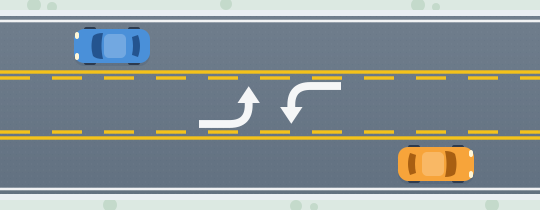
A center lane edged with solid and dashed yellow lines, with turn arrows pointing both ways, runs down the middle of the road. How far may you drive in it before making your turn?
Show answer
Correct answer: No more than 200 feet
Why
That's a two-way left-turn lane, shared by drivers turning left from both directions. In Louisiana the lane is meant for left turns and U-turns, and you may not stay in it for more than 200 feet. Move in shortly before your turn and watch for someone turning from the other side.
20Safe driving
A gust pulls napkins and receipts out of a driver's open window and scatters them along the highway. It's the driver's first citation for simple littering, the accidental kind. What penalty does Louisiana set?
Show answer
Correct answer: $150 or 8 hours of community service
Why
Louisiana calls accidental littering, like trash blowing out of a window or a truck bed, simple littering: $150 or eight hours of community service the first time, and $900 or 20 hours the second. Throwing trash out on purpose is a separate offense, intentional littering. To report someone littering, call 855-LA-LITTER.
Round 3 · Questions 21–30
21Road signs
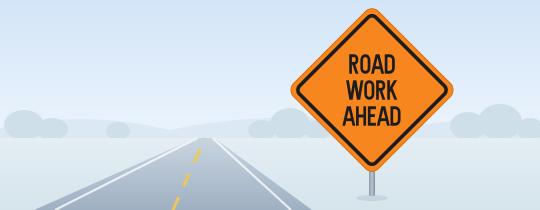
An orange diamond-shaped ROAD WORK AHEAD sign leads into a highway repair project, and crews are working beside the lanes. If you get a speeding ticket in this stretch, what does Louisiana law do to the fine?
Show answer
Correct answer: Doubles it
Why
Louisiana doubles speeding fines in highway construction and repair zones while workers are on site, and in designated highway safety corridors too. Orange is the color of work zones, so slow down as soon as you see it, leave extra room and expect lane shifts, flaggers and equipment pulling out.
22Right-of-way
You're driving on a road with two lanes in each direction and a center two-way left-turn lane. A school bus coming the other way stops with its red lights flashing. What does Louisiana law require of you?
Show answer
Correct answer: Continue with care, since this road counts as a divided highway
Why
You need not stop for a school bus on the other roadway of a divided highway, and Louisiana counts a road with two or more lanes each way plus a center two-way left-turn lane as divided. With just one lane each way and a turn lane, drivers in both directions must stop. Either way, stay alert for children near the road.
23Speed limits
Near a school you pass a sign that reads SCHOOL SPEED LIMIT 20 WHEN FLASHING. It's a Saturday afternoon and its lights are dark. Which limit applies?
Show answer
Correct answer: The road's regular posted limit
Why
The reduced school limit applies only while the sign's lights are flashing; when they're dark, the road's normal limit is back. The beacons, not the day of the week, decide which limit is in force. On a two-lane road, passing another vehicle in a school zone during its posted hours is illegal.
24Parking
You want to park on a street that crosses a railroad track. How close to the nearest rail may you leave your car?
Show answer
Correct answer: No closer than 50 feet
Why
Louisiana requires at least 50 feet between a parked vehicle and the nearest rail of a crossing, so trains and drivers can see each other. Don't mix it up with the other railroad number: when a train is coming, you stop 15 to 50 feet from the rail. Railroad questions appear on every Louisiana knowledge test.
25Alcohol & phones
Ana, 24, had never held a license anywhere until she got her first Louisiana driver's license last month. During her first year, which phone use is allowed while she drives?
Show answer
Correct answer: None, except calling for emergency help or while parked
Why
For a full year after a first Louisiana license, the law bans any cell phone use while driving, hands-free included, at any age. The exceptions are calls to police, fire or other public safety services and use while legally parked. A first offense costs $100.
26Permit & teen rules
At 7 p.m., a 16-year-old with an intermediate license wants to drive three friends, all 16 and none of them related to her, to a football game. No adult is riding along. Is that allowed?
Show answer
Correct answer: No: after 6 p.m. the limit is one non-family passenger younger than 21
Why
From 6 p.m. to 5 a.m., Louisiana allows an intermediate driver only one passenger under 21 who isn't immediate family, unless a licensed parent, guardian or adult 21+ is in the car. Between 5 a.m. and 6 p.m. there's no passenger limit. And at any hour, the car can't move until everyone is buckled up.
27Safe driving
A steady drizzle starts in the middle of the afternoon, and you switch on your wipers and leave them running. What does Louisiana law say about your headlights?
Show answer
Correct answer: Turn them on: wipers in continuous use require headlights
Why
Louisiana requires headlights whenever rain or mist keeps your wipers running, not only from sunset to sunrise. They're also required any time you can't clearly see people or vehicles 500 feet ahead. At night, dim your high beams within 500 feet of an oncoming car and 200 feet behind one you're following.
28Sharing the road
You're following a motorcycle on a highway. How much following time does Louisiana's Driver's Guide tell you to leave?
Show answer
Correct answer: At least 4 seconds
Why
Behind a car the guide's rule is three seconds, but behind a motorcycle it asks for at least four, giving the rider room to brake or swerve. Riders have a right to the whole width of a lane, so never squeeze in beside one. Pass it just as you would pass a car.
29Right-of-way
A line of cars with headlights and hazard flashers on is following a hearse toward the intersection you're about to enter. What does Louisiana law say?
Show answer
Correct answer: Yield and let the procession go by
Why
Louisiana drivers and pedestrians must yield to vehicles in a funeral procession, which drive with headlights and hazard flashers on. Never cut into the line or tag along at its end. On a multilane highway you may pass a procession traveling in the right lane, and breaking the rule can cost $100.
30Crashes & emergencies
Your car stalls on a railroad crossing, and you hear a horn and see a train's headlight coming down the track. What should you do first?
Show answer
Correct answer: Get everyone out and move away from the tracks, toward the direction the train is coming from
Why
Get out at once and move off the tracks, heading toward the oncoming train, so flying debris from the crash won't hit you. Then call the number on the Emergency Notification System sign posted at the crossing so the railroad can warn the train. Better still, never stop on the tracks in the first place.
Round 4 · Questions 31–40
31Right-of-way
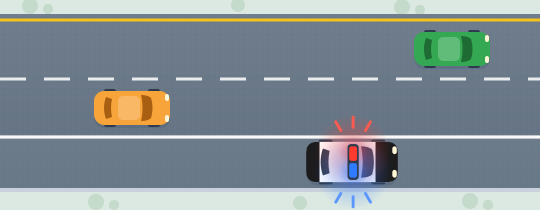
You're in the right lane of a highway with two lanes going your way. A police car with its lights flashing is stopped on the right shoulder, and the lane to your left is clear. What does Louisiana's move-over law require?
Show answer
Correct answer: Move into the left lane, away from the police car, if it's safe
Why
Louisiana wants a free lane between you and any stopped vehicle showing flashing lights, and that covers green, amber and yellow warning lights too, not only police lights. When you can't change lanes safely, slow down to a safe speed instead. Ignoring the law can mean a fine of up to $200.
32Road signs
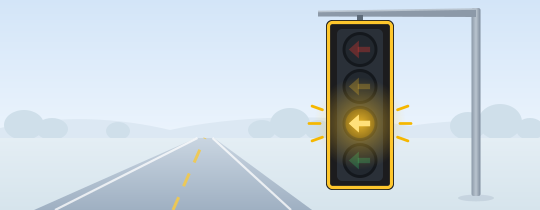
At a busy intersection, the signal over your left-turn lane is showing a blinking yellow arrow. What may you do?
Show answer
Correct answer: Turn left, but only after yielding to oncoming vehicles and pedestrians
Why
A flashing yellow arrow allows the turn but doesn't protect it: oncoming cars may still have a green light. Louisiana law makes you yield to them and to anyone in the crosswalk first. If the gap looks tight, wait for the next one; a horn behind you is no reason to rush.
33Speed limits
On a four-lane Louisiana highway, you're cruising in the left lane slightly under the speed limit while cars stack up behind you. What does state law expect?
Show answer
Correct answer: Move right: the left lane is for passing and left turns
Why
Louisiana reserves the left lane for passing and for getting ready to turn left, and a slower driver has to keep right. Rolling along under the limit in the left lane can draw a $150 fine the first time, then $250 and $350 for repeats within a year. Never speed to please the driver behind; just move over.
34Parking
Running a quick errand, you see that the only open space near the door is the striped access aisle beside an accessible parking spot. May you leave your car there for a few minutes?
Show answer
Correct answer: No: blocking the aisle is a violation and your car can be towed
Why
That striped aisle gives people with disabilities room to get in and out and to load equipment such as a wheelchair. Blocking it breaks the law just like parking in the accessible space without a placard or plate, and the car can be towed. Accessible parking is one of the topics Louisiana law requires on the knowledge test.
35Alcohol & phones
Your passenger wants to carry home an opened bottle of wine from dinner. Where in the car may it legally ride?
Show answer
Correct answer: Locked in the glove box or in the trunk
Why
Louisiana forbids open alcohol containers in a vehicle's passenger area on a public road, and that applies to passengers as well as the driver. The trunk and a locked glove box count as outside that area. A violation can cost up to $100.
36Alcohol & phones
You're 35 and have driven for years. Which of these is legal while you're driving in Louisiana?
Show answer
Correct answer: Talking hands-free through the car's speakers
Why
Since 2025, Louisiana has banned handheld phone use behind the wheel, and simply holding the phone counts. Hands-free calls and hands-free GPS remain legal for experienced drivers. The fine is $100, or $250 in a school zone or highway work zone, and it doubles if you crash.
37Permit & teen rules
Before a Louisiana teen moves from the learner's permit to an intermediate license, how much supervised driving must a parent or guardian certify?
Show answer
Correct answer: 50 hours, 15 of them at night
Why
A parent or guardian signs a statement that you drove at least 50 supervised hours, 15 of them after dark. You also need 180 days on the permit, a passed road skills test and a clean record, and you must be 16. First-time drivers 18 and older sign the same 50-hour statement.
38Permit & teen rules
You're 16 with an intermediate license, and a movie with friends ends at 11:30 p.m. Under Louisiana law, can you drive home at that hour?
Show answer
Correct answer: Only if a licensed parent, guardian, adult 21+ or sibling 18+ rides with you
Why
Until 17, an intermediate licensee may not drive from 11 p.m. to 5 a.m. unless a qualifying licensed driver is in the car: a parent or guardian, an adult 21 or older, or a brother or sister 18 or older. Plan rides home before 11, or bring a qualifying driver along. The restrictions end on your 17th birthday.
39Road signs
A barricade blocks part of the road, painted with diagonal orange-and-white stripes that slope downward toward the left. Which way should you go around it?
Show answer
Correct answer: Keep to the left of it
Why
On barricades and vertical panels, the stripes point you around the hazard: they slope down toward the side you should pass on. Down to the left means bear left; down to the right means bear right. Slow down near these devices, because lanes often narrow or shift.
40Sharing the road
You're driving beside an 18-wheeler on I-20. How can you tell that the truck driver probably can't see you?
Show answer
Correct answer: In the truck's side mirror, you can't spot the trucker's face
Why
Big trucks have large blind spots, often called no-zones. When the trucker's eyes aren't visible to you in a mirror, assume you're invisible to the trucker too, so pass promptly or drop back. Follow a truck at four to five seconds, and never cut in close ahead of one: loaded, it needs at least 290 feet to stop from 55 mph.
Louisiana OMV knowledge test at a glance
The numbers that matter before you test at your driving school or an OMV office.
Louisiana · Class E knowledge test
80% to pass.
40 questions · Multiple choice
32 of 40 answers right to pass
Spanishone of 11 languages on OMV’s computer test
TIP firsta Temporary Instructional Permit, from age 14
$32.25for the TIP, plus up to $8 at some offices
Same dayone retake after a fail, if time allows
In personat your driving school or an OMV office
20/40eyesight needed, in one eye or both
Under 18? Your road to a license
14Instructional permitGet a Temporary Instructional Permit (TIP). It lets you drive with your driver ed instructor, and you need it before the knowledge or road test.
15Learner’s permitFinish the 38-hour driver ed course (30 hours in class, 8 behind the wheel), then pass the vision test and the knowledge test with 80%.
50 hSupervised practiceHold the permit 180 days. A parent or guardian signs that you drove at least 50 supervised hours, 15 of them at night, with a licensed parent, guardian or adult 21+.
16Intermediate licensePass the road skills test with a clean permit record: no at-fault crashes, moving violations, or seat belt, curfew, alcohol or drug violations.
16–17Intermediate limitsUntil 17: no driving 11 p.m.–5 a.m. without a qualifying adult, one non-family passenger under 21 at most from 6 p.m. on, and everyone buckled.
18 or older? Get a TIP, take the 14-hour adult course (6 hours in class, 8 behind the wheel) or the full 38-hour one, sign the 50-hour practice statement, and pass the vision, knowledge and road tests. A learner’s permit is optional.
What’s on the Louisiana permit test
Study the Class D & E Driver’s Guide (DPSMV 2052, August 2025 revision): every test question is drawn from it. By law the test covers signs and traffic rules, railroad crossings, littering, distracted driving, sharing the road with motorcycles and trucks, accessible parking and how to handle a police traffic stop. Here’s what to know cold in six key areas.
Road signs
Shape first: an octagon always means STOP, a point-down triangle always means YIELD, and a sideways pennant marks a no-passing zone.
Fluorescent pink marks an incident such as a crash closure; orange marks a work zone, where speeding fines double while crews are on site.
A crossbuck works like a YIELD sign: with a train coming, halt between 15 and 50 feet short of the closest rail.
Right-of-way
Tie at an all-way stop? The driver on the left lets the driver on the right go first.
School bus with red lights flashing: stop at least 30 feet away, from either direction, unless it’s on the far side of a divided highway.
Vehicle with flashing lights stopped on the shoulder, amber ones included? Change lanes away from it, or slow down if you can’t.
Speed limits
No sign on a highway? 55 mph is the most Louisiana law allows.
Interstates top out at 70 mph and multi-lane divided highways at 65; parts of I-49 are posted at 75.
Keep right unless passing: dawdling in the left lane below the limit can cost $150.
Parking
Leave 15 feet to a fire hydrant and 20 feet to a crosswalk at an intersection.
A stop sign gets 20 feet, not 30; a railroad crossing gets 50 feet from the nearest rail.
Curb-side wheels within 18 inches of the curb; facing downhill, turn them toward it.
Alcohol & phones
BAC limits: 0.08% at 21 and over, 0.02% under 21, 0.04% in a commercial vehicle.
Refuse the chemical test and lose your license for a year, two years for a second refusal.
Handheld phones are banned for every driver: $100, or $250 in a school or work zone.
Teen rules
Learner’s permit: drive only with a licensed parent or guardian, an adult 21+, or a sibling 18+.
Intermediate license under 17: off the road 11 p.m.–5 a.m. unless a qualifying adult rides along.
First year of your first license, at any age: no phone at all, hands-free included.
Louisiana numbers to know
Six Louisiana figures to lock in before you sit the test.
30 ftback from a school bus showing its red lights
100 ftof signaling before every turn
20 ftfrom a stop sign when you park
15–50 ftfrom the nearest rail when you stop for a train
3 secfollowing distance behind a car
500 ftto dim your high beams for an oncoming car
Your Louisiana course, in your pocket
These 40 questions are just the warm-up. The app gives you 468 Louisiana practice questions, 36 short lessons and the why behind every answer.
36 short lessonsFour levels, from fundamentals to expert, then a full practice exam.
468 Louisiana questions322 of them with pictures.
Your most-missed questionsA review lesson built from the questions you miss most.
Exam simulatorTake full practice exams and watch your readiness grow.
Louisiana permit
Your Louisiana path is ready.
36 lessons, 468 questions and full practice exams. In English and Spanish.
How many questions are on the Louisiana permit test, and what’s a passing score?
40 multiple-choice questions, and you need 80% to pass, which means at least 32 right. The test comes from Louisiana’s Office of Motor Vehicles (OMV), the state’s version of the DMV, and is usually taken on a computer. By law it always includes at least two questions on railroad crossings and two on littering.
What happens if I fail the Louisiana knowledge test?
If there’s time, you can take it once more the same day. OMV sets no other waiting period for an ordinary fail, but a test-taker caught cheating has to wait at least 30 days to come back. Since the test is drawn only from the Driver’s Guide, review the sections you missed before you retake it.
Can I take the Louisiana permit test online?
No. OMV has no online or at-home version, so you test in person. Most new drivers take the knowledge test, and later the road test, at their licensed driving school as part of driver education, and OMV offices give tests too. You can book an OMV office visit online.
Can I take the Louisiana permit test in Spanish?
Yes. OMV’s computer testing system offers the Class E test in 11 languages, Spanish among them, and you may bring your own translator (just not for the CDL test). The Class D & E Driver’s Guide comes only in English, so this practice test and the app, both available in Spanish, make studying easier.
How old do you have to be to get a learner’s permit in Louisiana?
15. You can get a Temporary Instructional Permit at 14 for driver ed, then the learner’s permit at 15 once you finish the 38-hour course and clear the vision and knowledge tests. Hold it 180 days and complete 50 supervised hours, 15 at night, before an intermediate license at 16. Until 17, no driving 11 p.m.–5 a.m. without a qualifying adult, and after 6 p.m. no more than one passenger under 21 from outside your family.
How much does a Louisiana permit cost?
The Temporary Instructional Permit costs $32.25 (a $20.25 license fee plus a $12 handling fee), and some offices add a service fee of up to $8. Moving up to a learner’s permit or full license costs nothing extra. A Class E license is $32.25 too, $18.75 at 70 and older, and lasts about six years.
What’s on the Louisiana road test?
You start with 100 points and need 80 to pass. Expect a straight-in park, backing out, left and right turns, lane changes, traffic signals, intersections and stop signs. At OMV you supply an inspected, registered and insured car; driving schools may rent you one.
What’s the best way to study for the Louisiana permit test?
Read the Class D & E Driver’s Guide, since every question comes from it, and memorize its numbers and distances; the guide itself suggests reading it at least three times. Start with the 40 questions above, then let the app walk you through 468 Louisiana questions and 36 short lessons, with an explanation for every answer.