Get ready for the Nevada DMV knowledge test with 40 free questions on road signs, carpool lanes, school zones, DUI limits and teen driving rules. Pick an answer and the reasoning shows up instantly.
Four rounds, 10 questions each, covering Nevada road signs, right-of-way, speed rules, parking, DUI and phone laws, and teen limits. Every answer tells you why.
Round 1 · Questions 1–10
1Lane markings
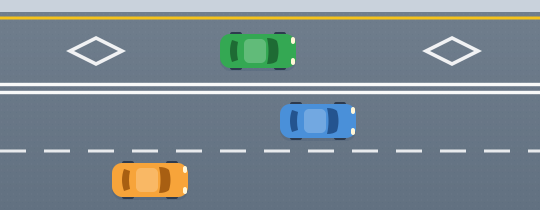
You and a friend are driving on a Nevada freeway. The carpool lane beside you is set off by double solid white lines. What’s the rule?
Show answer
Correct answer: Two people qualify, but enter only where the line turns to broken white
Why
Nevada’s HOV lanes are open to vehicles carrying 2 or more people, and motorcycles qualify too. Double solid white lines must not be crossed, so wait for a stretch of broken white line to move in or out. Pets don’t count toward the two, and the hours vary from one segment to the next.
2Permit & teen rules
What is the youngest age at which you can get a Nevada instruction permit?
Show answer
Correct answer: 15½
Why
Nevada issues instruction permits from age 15½. You pass a vision test and the knowledge test, and a parent or guardian authorizes the application. While you practice, a licensed supervisor aged 21 or older, with a year of driving behind them, must sit beside you.
3Alcohol & phones
What blood alcohol concentration is the legal limit for a Nevada driver under 21?
Show answer
Correct answer: 0.02%
Why
Nevada sets 0.02% for drivers under 21, 0.08% for drivers 21 and older and 0.04% for commercial drivers. A minor who tests between 0.02% and 0.08% can have the license revoked for 185 days. Under 21, the only safe plan is not to drink before driving at all.
4Right-of-way
At a T intersection with no painted lines, a woman steps off the corner to cross the street in front of you. What does Nevada law say?
Show answer
Correct answer: Every intersection has a crosswalk, painted or not, so you yield
Why
In Nevada, a crosswalk exists wherever streets meet, T intersections included, whether or not anyone painted it. Yield to a person crossing on your half of the road or coming close from the other half. As you approach a corner, scan the curbs, not just the pavement markings.
5Speed limits
A Nevada school zone has a reduced speed limit sign, but no flashing beacons and no hours posted. When does the lower limit apply?
Show answer
Correct answer: School days only, starting 30 minutes before classes and ending 30 minutes after dismissal
Why
Nevada school zones are 15 or 25 mph. When no other times are posted, the handbook puts the limit in force on school days from 30 minutes before classes begin until 30 minutes after they finish; where yellow beacons are installed, it applies while they flash. While children are around, no U-turns in the zone.
6Parking
You’re parallel parking on a street with a fire hydrant. What is the closest your car may be to the hydrant in Nevada?
Show answer
Correct answer: 15 feet
Why
Where parallel parking is allowed, Nevada law keeps parked cars at least 15 feet from a hydrant so firefighters can hook up their hoses fast; with angle parking, a local ordinance can push that to 20. Two more gaps worth knowing: 20 feet from a crosswalk and 30 feet from a traffic signal at the side of the road.
7Road signs
On the way to Lake Mead, you pass a brown sign with a white symbol on it. What kind of information do brown signs carry?
Show answer
Correct answer: Information about recreation and scenic areas
Why
In the sign color system Nevada teaches, brown guides you to recreation areas. Blue is for driver services, orange for road work and green for directions. Learning the colors lets you know what a sign is about before you’re close enough to read it.
8Safe driving
You’re driving 35 mph on a dry city street. What is the minimum gap the Nevada handbook wants between you and the car ahead?
Show answer
Correct answer: At least 2 seconds
Why
The handbook’s floor is two seconds at 40 mph or less, and many instructors suggest up to four. Add more at highway speed, at night or on slippery roads. To check, count the seconds from when the car ahead passes a fixed point until you reach it.
9Right-of-way
You’re following a school bus on a two-lane road. It stops, its red lights begin flashing and the stop arm swings out. When may you go around it?
Show answer
Correct answer: Only after its red lights are turned off
Why
In Nevada, once a school bus shows flashing red lights, every driver halts and stays halted until those lights shut off. On a two-lane road that includes oncoming traffic, not just the cars behind it. Passing a stopped school bus also adds 4 demerit points to your record.
10Crashes & emergencies
A low-speed crash on a side street causes about $1,500 in damage and no injuries, and police don’t investigate. What must each driver do?
Show answer
Correct answer: Send form SR-1 to the DMV within 10 days
Why
In Nevada, a crash with any injury or $750 or more in damage has to be reported. When police don’t investigate, each driver or owner files form SR-1 with the DMV within 10 days. At the scene, trade names, addresses, license, registration and insurance details.
Round 2 · Questions 11–20
11Road signs
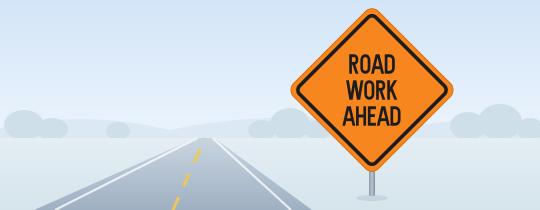
Past an orange ROAD WORK AHEAD sign, you enter a Nevada highway work zone where crews are busy behind the cones. If you’re caught speeding there, what changes?
Show answer
Correct answer: The fine for speeding is doubled
Why
Nevada doubles speeding fines in a marked work zone while crews are on the job or the lanes are narrowed, shifted or rough, and a DOUBLE PENALTIES IN WORK ZONES sign warns you before it begins. Ease off at the first orange sign and expect cones, barrels and flaggers. A phone ticket there can cost double too.
Nevada’s written test is 25 multiple-choice questions on signs, traffic laws and safe driving, and you need 20 right, which is 80%. That leaves room for only five misses. Practice until you score comfortably above 80%, so one or two tricky questions on test day won’t sink you.
13Speed limits
On a Nevada freeway well outside any city or town, with two lanes your way, you’re cruising in the left lane slightly under the limit when a faster car comes up behind you. What does Nevada law expect?
Show answer
Correct answer: Move to the right lane and let it go by
Why
On freeways outside city and town limits, Nevada law (NRS 484B.208) bars you from lingering in the far-left lane below the posted limit while a faster vehicle closes in behind you. Use the left lane to pass, then move back right. Staying put only tempts the other driver into a risky pass on your right.
14Right-of-way
A pedestrian using a white cane begins crossing the street ahead of you. Under Nevada law, what must you do?
Show answer
Correct answer: Yield, stopping if needed: this pedestrian always has the right-of-way
Why
Nevada gives pedestrians who are blind or have low vision and carry a white cane or use a guide dog the right-of-way in every situation, so yield and stop if you must. Don’t honk: a sudden horn can startle and confuse someone who relies on hearing traffic. Wait until the person has fully crossed.
15Alcohol & phones
You’re 25 and driving through Reno when your phone rings. Which way of taking the call is legal?
Show answer
Correct answer: A hands-free setup, touching the phone only to start or end the call
Why
Nevada bans every driver from holding a phone to talk, text or go online while driving. Hands-free calling is allowed, and you may touch the phone just to start or end a call. Mount the phone or pair it with the car before you pull out.
16Parking
There’s an open spot near a corner where a traffic signal stands at the side of the road. How far back from the signal must your car be?
Show answer
Correct answer: 30 feet
Why
Under Nevada law (NRS 484B.450) you must stay 30 feet back from a roadside traffic signal, because a parked car could hide it from approaching drivers. The crosswalk distance is 20 feet, and a railroad crossing needs 50 feet, measured to the closest rail.
17Safe driving
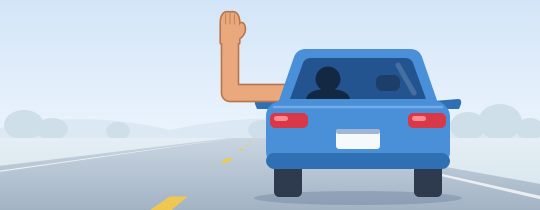
The driver ahead of you puts the left arm out of the window and bends it upward at the elbow. What is that driver about to do?
Show answer
Correct answer: Turn right
Why
Hand signals use the left arm. Held straight out, it means a left turn; bent up, a right turn; bent down with the palm facing back, slowing or stopping. They matter when turn signals or brake lights fail, so give that driver room to make the turn.
18Permit & teen rules
A 16-year-old Nevada driver needs to be on the road at 11 p.m. Which trip is allowed?
Show answer
Correct answer: Driving home from a scheduled shift at work
Why
Nevada keeps drivers under 18 off the road from 10 p.m. to 5 a.m., unless the trip is to or from something scheduled, like a job or a school event. The curfew lasts until your 18th birthday, no matter when you were licensed. Proof of the event may be requested, so keep it handy.
19Sharing the road
You’re passing a cyclist on a street where you can’t move over into another lane. What is the least clearance Nevada law allows?
Show answer
Correct answer: 3 feet
Why
Nevada (NRS 484B.270) wants you in the next lane to the left when one exists and it’s safe; where that isn’t possible, give the rider a cushion of 3 feet or more. On a two-lane road you may cross the center line to give that room when it’s safe. If you can’t see far enough ahead, wait behind the bike.
20Road signs
You’re first in line to turn left, and the arrow on your signal begins flashing yellow. What does that allow?
Show answer
Correct answer: A left turn once you’ve yielded to oncoming traffic and pedestrians
Why
A flashing yellow arrow means the turn is permitted but not protected: oncoming drivers may still have a green light. Wait for a gap you can trust, check the crosswalk you’ll be turning across, then go. A flashing red light is different: it calls for a full stop, just like a stop sign.
Round 3 · Questions 21–30
21Speed limits
On a highway with two lanes your way, a police car sits on the right shoulder with its lights flashing, and the lane to your left is open. What does Nevada law expect as you approach?
Show answer
Correct answer: Slow below the speed limit, be ready to stop, and move into the left lane if it’s safe
Why
Nevada’s move-over law (NRS 484B.607) asks for two things: slow to a reasonable speed below the posted limit, ready to stop, and switch to a lane that isn’t next to the stopped vehicle when you safely can. It covers police, fire and ambulance vehicles, tow trucks, NDOT vehicles with amber lights and even a stalled car on the shoulder.
22Road signs
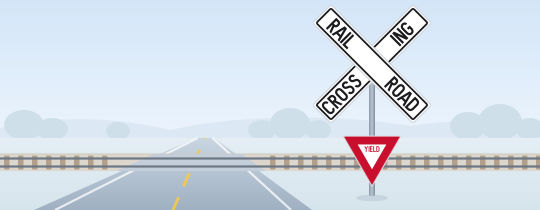
A country road crosses railroad tracks marked only by a white X-shaped crossbuck with a YIELD sign under it: no lights, no gate. A train is on its way. What is the closest you may stop to the nearest rail?
Show answer
Correct answer: 15 feet
Why
The crossbuck marks the crossing itself and tells you to yield to trains. With one approaching, Nevada law wants your car halted somewhere between 15 and 50 feet back from the closest rail. Where a crossing has a stop sign or flashing lights you always stop, and you never drive around a lowered gate.
23Alcohol & phones
A Nevada officer directs a driver to take a breath test, and the driver says no. It’s the first refusal. What happens to the license?
Show answer
Correct answer: It’s revoked for at least one year
Why
Under Nevada’s Implied Consent Law, refusing an officer’s blood, breath or urine test costs your license for at least a year, or three years if you had a refusal revocation in the previous seven. Police can also get a warrant to draw blood anyway. That’s roughly double the 185-day revocation for testing at 0.08% or more.
24Right-of-way
On a street with two lanes going your way, the car in the lane beside you slows and stops just before an intersection. You can’t see why. What should you do?
Show answer
Correct answer: Slow down and don’t pass it until you can see why it stopped
Why
That car may be stopped for someone in the crosswalk whom its body hides from you. Nevada law says you may not pass a slowing or stopped vehicle until you’ve slowed enough to see the reason. Be ready to stop: the pedestrian could step out right in front of your bumper.
25Parking
You want to park on the side of the street opposite a fire station’s driveway. How far from the entrance must you stay?
Show answer
Correct answer: 75 feet
Why
Fire engines need room to swing out, so when you park across the street from a station’s driveway, Nevada wants 75 feet between your car and the entrance. On the same side as the driveway, the gap is 20 feet. When you can’t tell which rule fits, park farther away.
26Permit & teen rules
A Nevada teen lives more than 30 miles from any driver education course and can’t take one online. How much supervised driving must the teen log instead?
Show answer
Correct answer: 100 hours, 10 of them at night
Why
Most Nevada teens complete driver ed plus 50 logged hours, 10 of them after dark. With no course within 30 miles and no online option, the requirement grows to 100 hours, still with 10 at night. Record every drive in the DLD-130 log or the RoadReady app; no other log is accepted.
27Safe driving
At night you’re following another car with your high beams on. Within what distance of that car must you switch to low beams?
Show answer
Correct answer: 300 feet
Why
Nevada wants low beams within 300 feet of a car you’re following and within 500 feet of one coming toward you, so your lights don’t blind the other driver. Forgetting to dim costs 2 demerit points. If an oncoming driver forgets, look down toward the right side of your lane until they pass.
28Speed limits
The Nevada Driver’s Handbook lists typical speed limits. What is the usual limit on streets in business or residential neighborhoods?
Show answer
Correct answer: 25 mph
Why
Nevada’s handbook uses 25 mph as the typical limit for business and residential areas, 45 mph for the slower stretch as a highway enters town, and 65 mph for urban freeways and rural highways. Signs set the exact figure, so keep reading them. Near schools it can drop to 15.
29Road signs
On a Nevada freeway, an electronic sign hanging over your lane lights up with a red X. What should you do?
Show answer
Correct answer: Move out of that lane, because it’s closed
Why
Overhead lane-use signals give each lane its own instruction. A red X closes that lane, so merge out of it safely; a yellow X means drive the lane with caution, or, shown with MERGE, get ready to leave it, and a green arrow pointing down means the lane is open. They often light up after a crash ahead.
30Crashes & emergencies
A summer thunderstorm sends muddy water rushing across a dip in a desert road ahead, and you can’t tell how deep it is. What does the Nevada handbook advise?
Show answer
Correct answer: Turn around and find another way
Why
Nevada’s handbook warns that under an inch of water can make you lose control, 6 inches can push a fast-moving car off the road and 2 feet will float most vehicles. You can’t judge depth or current from the driver’s seat. Turn around, then wait it out or take another route.
Round 4 · Questions 31–40
31Lane markings
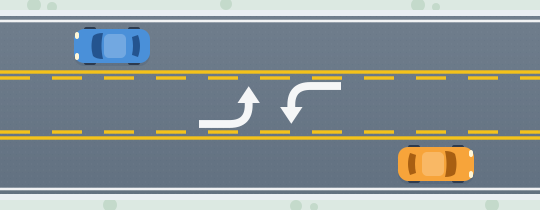
You plan to turn left into a shopping center from a road with a shared center turn lane, marked by solid and dashed yellow lines and arrows facing both ways. What is the farthest you may drive in that lane before turning?
Show answer
Correct answer: 200 feet
Why
Nevada law (NRS 484B.223) reserves the two-way center lane for left turns and limits you to 200 feet in it before your turn. When you turn left into it from a side street or driveway, you may travel no more than 50 feet before merging into traffic. Never use it to pass.
32Alcohol & phones
What does a first offense for using a hand-held phone while driving cost in Nevada?
Show answer
Correct answer: A $50 fine, and it doesn’t count as a moving violation
Why
Nevada starts at $50 for a first offense, and it doesn’t go on your record as a moving violation. A second offense brings $100 and 4 demerit points, a third or later $250 and 4 points. Inside an active work zone, each of those fines can double.
33Right-of-way
You’re traveling on a highway split by a concrete median barrier. On the far side, a school bus heading the other way stops and flashes its red lights. What do you do?
Show answer
Correct answer: Keep going with care; the barrier means you don’t have to stop
Why
Nevada makes an exception for divided highways with a median or physical barrier: traffic on the opposite side may continue. Drivers on the bus’s own side still stop. On every other road, one with just a painted center line included, both directions must stop.
34Speed limits
Snow is coming down on a mountain highway posted at 55 mph. Under Nevada’s Basic Rule, how fast may you drive?
Show answer
Correct answer: No faster than is reasonable and proper for the conditions, even if that’s far below 55
Why
Nevada’s Basic Rule (NRS 484B.600) requires a speed that fits the traffic, the weather and the road, and that can be well under the number on the sign. On slippery pavement, stopping can take 2 to 10 times as far as on a dry road. Slow down early and leave far more space ahead.
35Permit & teen rules
Three months after getting your Nevada license at 16, you’d like to drive a 17-year-old classmate home. May you?
Show answer
Correct answer: No; for the first six months, passengers under 18 must be immediate family
Why
For the first six months after a 16- or 17-year-old is licensed, Nevada bars riders younger than 18 unless they’re immediate family. Brothers and sisters can ride along; friends wait until the six months are up. The 10 p.m.–5 a.m. curfew is a separate rule that lasts until 18.
36Parking
Your car is pointed up a steep hill, nose first, alongside a curb. Before you walk away, how should the steering be set?
Show answer
Correct answer: Turned to the left, away from the curb
Why
Turned away from the curb, the back of the front tire rests against it, so if the brakes ever let go, the car rolls into the curb instead of into traffic. Facing downhill, turn the wheels toward the curb; uphill with no curb, toward the shoulder. Set the parking brake every time.
37Road signs
Inside a Nevada work zone, some speed signs are orange and others are black on white. How do they differ?
Show answer
Correct answer: Black-and-white limits are enforceable; orange ones are advisory
Why
A black-and-white speed sign is a regulatory limit, so going over it can get you a ticket, and in an active work zone that ticket can cost double. Orange speed signs give advice for a curve, lane shift or rough patch ahead. Treat the advisory number as your target anyway: it’s set for the conditions you’re about to meet.
38Alcohol & phones
Friends are celebrating a birthday in Las Vegas. Where is an opened bottle of champagne allowed under Nevada’s open container law?
Show answer
Correct answer: In the passenger area of a hired limousine
Why
Nevada bans opened alcoholic drinks in the driver and passenger areas of a moving vehicle. The law makes room for the passenger areas of limousines, buses and taxis and the living quarters of a motor home. In your own car, keep any opened bottle out of the passenger area, such as in the trunk.
39Safe driving
You’re giving a ride to a 5-year-old who is 48 inches tall. What does Nevada law require?
Show answer
Correct answer: An approved child restraint system
Why
Since 2022, Nevada requires an approved child restraint for children under 6 who are also under 57 inches tall, and weight no longer decides it. Children under 2 ride rear-facing. Check the seat’s label for the right fit before you set off.
40Safe driving
You’re on an open highway outside town and want to change lanes. How far ahead should your signal go on?
Show answer
Correct answer: About 300 feet
Why
Nevada law (NRS 484B.413) wants your signal on for at least the last 300 feet outside business and residential districts, and at least the last 100 feet inside them. The handbook pegs those at roughly 30 and 10 car lengths, for lane changes as well as turns. At highway speed 300 feet passes in a few seconds, so start early.
Nevada DMV written test at a glance
Key numbers before you test, online or at a DMV office.
Nevada · Class C knowledge test
20 of 25 to pass.
25 questions · Multiple choice
20 of 25 answers right to pass
Onlineat home, 24/7, no appointment needed
Next dayretake after a failed online test
Spanishonline and at DMV offices
$25first test fee, then $10 per retest
$22.50for your instruction permit
20/40vision needed in at least one eye
Under 18? Your road to a license
15½Instruction permitPass the vision test and the 25-question knowledge test, with a parent or guardian signing and a school attendance form (DMV 301).
6 moPracticeHold the permit at least six months, finish driver ed and log 50 hours beside a licensed driver 21+, 10 of them at night.
16Driver licenseKeep six months free of at-fault crashes and violations, then pass the road test with your driving log in hand.
16–17Teen limitsNo passengers under 18 except family for the first six months, and no driving 10 p.m.–5 a.m. until 18 unless it’s for a scheduled event like work.
18 or older? The permit is optional: pass the vision, knowledge and drive tests. Skip it, though, and the drive test has to be booked at a DMV office rather than online.
What’s on the Nevada permit test
Study the Nevada Driver’s Handbook (DMV 700, March 2024 edition): the knowledge test is built on it and covers road signs and pavement markings, traffic rules and safe driving habits. These six areas deserve the most attention.
Road signs
Know shapes on sight: octagon for STOP, upside-down triangle for YIELD, pennant for no passing, pentagon for schools.
Orange means road work: speeding fines double while crews are working, and only black-and-white speed signs are enforceable.
Overhead lane signals: a green arrow means open, a yellow X means caution or merge, a red X means closed.
Right-of-way
Right-of-way is given, never taken: Nevada law only spells out who must yield.
Every intersection has a crosswalk, painted or not, T intersections included.
School bus flashing red: stop in both directions, unless a median or barrier divides the highway.
Speed limits
The Basic Rule: a speed that suits traffic, weather and the road, even when that’s under the posted limit.
School zones are 15 or 25 mph, enforced on school days from 30 minutes before the bell until 30 minutes after classes let out.
Stopped emergency vehicle, tow truck or stalled car? Slow below the limit and move over a lane if you safely can.
Parking
Stay 15 feet from a hydrant, 20 from a crosswalk and 30 from a roadside traffic signal.
Keep 50 feet from the closest rail of a railroad track, and 75 feet across the street from a fire station driveway.
Park facing the flow of traffic, with both curbside wheels no more than 18 inches out.
Alcohol & phones
BAC limits: 0.08% at 21 and up, 0.02% under 21, 0.04% for commercial drivers.
Refuse an officer’s chemical test (breath, blood or urine) and you lose your license for at least a year.
No hand-held phone for any driver, hands-free calls only. The first ticket is $50.
Teen rules
Permit at 15½; practice only with a licensed driver 21+ with a year of experience in the seat beside you.
Log 50 hours, 10 at night, in the DLD-130 log or the RoadReady app.
Under 18: no driving 10 p.m.–5 a.m. except to or from scheduled events, and no passengers under 18 except family for the first six months.
Nevada numbers to know
Six Nevada figures to have down before test day.
100 ftof signaling before a turn on city streets
15 ftbetween your parked car and a hydrant
200 ftmax distance in a shared center turn lane before you turn left
0.02%BAC limit if you’re under 21
3 ftminimum clearance when passing a cyclist
80 mphtop speed allowed anywhere in Nevada
Your Nevada course, in your pocket
These 40 questions are just the warm-up. The app gives you 466 Nevada practice questions, 36 short lessons and the why behind every answer.
36 short lessonsFour levels, from fundamentals to expert, then a full practice exam.
466 Nevada questions325 of them with pictures.
Your most-missed questionsA review lesson built from the questions you miss most.
Exam simulatorTake full practice exams and watch your readiness grow.
Nevada permit
Your Nevada path is ready.
36 lessons, 466 questions and full practice exams. In English and Spanish.
How many questions are on the Nevada DMV written test, and what’s a passing score?
25 multiple-choice questions on road signs and markings, traffic rules and safe driving. You need 20 right, which is 80%. Online you get 60 minutes; at a DMV office there’s no time limit.
What happens if I fail the Nevada permit test?
Try again. After a failed online test you can retake it the next day, and each retest costs $10. Once you pass, your result stays good for a year.
Can I take the Nevada permit test online?
Yes, and the DMV recommends it. KnowTo Drive Nevada lets you take the full knowledge test at home any time of day, with no appointment, on a computer with a webcam facing you (touch-screen devices won’t work). Your result goes to the DMV automatically. Prefer an office? There the test is on touch screens, and you’ll need an appointment.
Can I take the Nevada permit test in Spanish?
Yes. The online test and the touch-screen test at DMV offices both come in Spanish, and offices also offer an audio version. The DMV publishes a Spanish handbook too, the Manual del Conductor de Nevada (2021 edition). This practice test and the app are in Spanish as well.
How old do you have to be to get a permit in Nevada?
15½. Under 18, a parent or guardian co-signs, and you bring a school attendance form (DMV 301). Hold the permit six months, finish driver ed and log 50 hours, 10 at night, with a licensed driver aged 21+ before you get a license at 16. Then no passengers under 18 except family for six months, and no driving 10 p.m.–5 a.m. until 18 except to or from scheduled events like work or school.
How much does a Nevada instruction permit cost?
$22.50, plus a $25 testing fee that covers the knowledge test and your first drive test. Each retest is $10. After you pass the road test, turning the permit into a license costs another $22.50.
What do I bring to the Nevada road test?
Teens bring a parent or guardian, the permit, proof of identity and residency, the completed driving log, form DMV 002 and a registered, insured car (rentals aren’t accepted). Leave the phone alone: using it during the test is an automatic fail, and driver aids like cruise control and parking assist stay off.
What’s the best way to study for the Nevada permit test?
Read the Nevada Driver’s Handbook, since the test is built on it, then practice until 80% comes easily. Start with the 40 questions above, then let the app take you through 466 Nevada questions and 36 short lessons, each answer explained.