In Maryland, the DMV is called the MVA (Motor Vehicle Administration). Get ready for its 25-question learner’s permit test with 40 free questions on road signs, speed limits, the Move Over law and Rookie Driver rules, and see why each answer is right the moment you tap it.
Four rounds of 10 questions on Maryland signs, right-of-way, speed limits, parking, alcohol and phone laws, and Rookie Driver rules, with every answer explained.
Round 1 · Questions 1–10
1Sharing the road
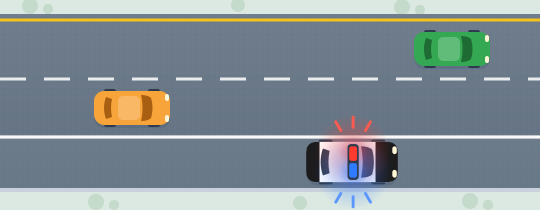
A police car on the shoulder with its lights flashing is the classic Move Over scene. Which other stopped vehicles does Maryland’s Move Over law cover?
Show answer
Correct answer: Any vehicle showing hazard lights, flares, cones or caution signs, a disabled car included
Why
Since October 2022, Maryland’s law covers every stopped, standing or parked vehicle with flashing emergency or hazard lights, road flares, cones or caution signs. Move into a lane not next to it, or slow to a safe speed if you can’t. A violation costs $110 and 1 point, and more if it causes a crash.
2Right-of-way
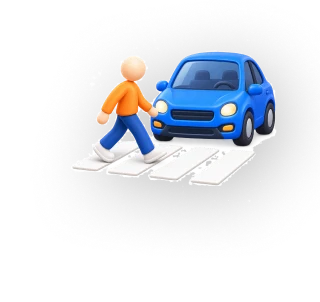
At a corner in Annapolis with no traffic light, a pedestrian steps into the unmarked crosswalk and is now on your half of the street. What does Maryland law require of you?
Show answer
Correct answer: Come to a full stop and let the person cross
Why
Maryland requires a complete stop, not just slowing down, when someone on foot is in a crosswalk, painted or not, and is on your half of the road or about to reach it from the nearest lane on the other side. Most intersections count as crosswalks even with no paint, so treat every corner as one.
3Permit & provisional license
What is the youngest age at which you can get a Maryland learner’s instructional permit?
Show answer
Correct answer: 15 years and 9 months
Why
Maryland lets you apply at 15 years and 9 months. Book an appointment at a full-service MVA office, have a parent or guardian co-sign the application and, if you’re under 16, bring a school attendance form. Pass the vision screening and the 25-question knowledge test, and the permit arrives by mail.
4Alcohol & phones
A 19-year-old with a Maryland provisional license had a glass of wine at a family dinner. Before driving home, what blood alcohol level does the law allow?
Show answer
Correct answer: None: any alcohol breaks the under-21 restriction
Why
Every Maryland license held by someone under 21 carries an alcohol restriction: driving with any alcohol in the blood violates it, and a test result of 0.02 or more is prima facie evidence. A first violation can mean an ignition interlock or a 6-month suspension, so the only safe number is zero.
5Road signs
Near a Maryland elementary school, you pass a fluorescent yellow-green sign with five sides, showing two walking children. What does that shape tell you?
Show answer
Correct answer: You’re in a school zone or near a school crossing
Why
Maryland’s manual uses the five-sided shape only for school zones and school crossings, and fluorescent yellow-green flags places where kids, pedestrians and bikes are likely. Slow to the posted school-zone limit and watch for crossing guards; signs there can double speeding fines.
6Parking
You find an open spot along the curb near a fire hydrant on a Rockville street. What is the closest your car may legally be to the hydrant?
Show answer
Correct answer: 15 feet
Why
Maryland keeps parked and standing cars at least 15 feet away from a hydrant, so fire crews can reach it and run hose quickly. Pair it with two more Maryland numbers: 30 feet back from a stop sign, and 50 feet clear of a railroad crossing’s nearest rail.
7Safe driving
In good weather, how much following distance does the Maryland Driver’s Manual recommend?
Show answer
Correct answer: At least 3 to 4 seconds
Why
Choose a fixed point such as a sign; when the car ahead passes it, start counting. If you reach the point before three seconds, ease off. The Maryland manual asks for 4 to 5 seconds or more behind buses, delivery vans and other vehicles that stop often, and 3 to 4 behind a motorcycle.
8Speed limits
No speed limit signs are posted on an undivided street in a Maryland residential neighborhood. What is the most you may drive there?
Show answer
Correct answer: 30 mph
Why
Maryland law sets 30 mph on undivided roads in residential districts and on all roads in business districts. If the residential road is divided, the default rises to 35 mph. Any posted sign overrides the default, so keep an eye out for one.
9Lane markings
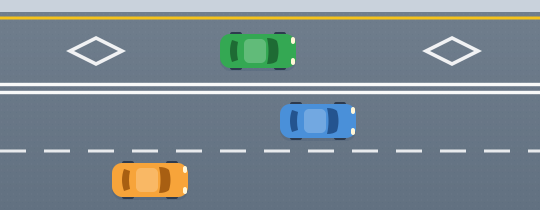
Two solid white lines separate your lane from the carpool (HOV) lane beside you. What do the lines mean?
Show answer
Correct answer: Lane changes across them are not allowed
Why
In the Maryland manual, a double solid white line means no lane changes, and it can also set an HOV lane apart from the regular lanes. White lines divide lanes going the same direction, yellow lines opposite directions. Also know the yield line: a row of small triangles across your lane.
10Crashes & emergencies
You bump another car in light traffic on Route 50. No one is hurt and both cars still drive fine. What does the Maryland manual tell you to do?
Show answer
Correct answer: Move the cars off the road nearby, then exchange information
Why
With no injuries and cars that still run, get them out of traffic close to the scene, then share names, addresses and registration numbers. Call police if anyone is hurt, a car can’t be moved, a driver seems impaired or unlicensed, or public property is damaged.
Round 2 · Questions 11–20
11Speed limits
You spot a white SPEED LIMIT 70 sign. On which kind of Maryland road can that limit legally be posted?
Show answer
Correct answer: Only interstates and expressways
Why
70 mph is the highest limit Maryland allows anywhere, and only interstates and expressways may be posted above 55. Away from business and residential districts, other divided highways default to 55 mph and undivided ones to 50. Even at 70, the posted number assumes ideal conditions.
12Right-of-way
In the lane beside you, a car has stopped at a crosswalk on a busy Silver Spring street. You can’t see anyone in front of it. May you pass it?
Show answer
Correct answer: No: it may be stopped for someone you can’t see, and Maryland bans passing it
Why
A stopped car can hide a pedestrian who is about to walk into your lane. Maryland bans passing a vehicle that has stopped at a crosswalk to let someone cross, and if that contributes to a crash, the penalty can reach $1,000 or jail. Stop as well and go only once the crosswalk is clear.
13Sharing the road
You’re following a school bus on a two-lane Maryland road when it stops, flashes its red lights and swings out its stop arm. Where must you stop?
Show answer
Correct answer: At least 20 feet away, until the bus moves on or the red lights go off
Why
Once those red lights blink, Maryland makes drivers approaching from the front or the back halt at least 20 feet short of the bus, and wait there until it moves or the lights go dark. Flashing yellow lights mean it’s about to stop, so slow early. Getting caught by police passing one can cost up to $570 and 3 points.
14Permit & provisional license
Who may sit beside a Maryland learner’s permit holder as the supervising driver?
Show answer
Correct answer: A driver 21 or older with 3 or more years of licensed driving
Why
Your supervisor must be at least 21, licensed for 3 years or more, and sitting in the front passenger seat; nobody else may ride up front. Each supervising driver also signs for the hours they spend with you in your Practice and Skills Log.
15Alcohol & phones
A 35-year-old driver blows 0.07 on a breath test in Maryland, just under 0.08. What can happen?
Show answer
Correct answer: A charge of driving while impaired by alcohol
Why
0.08 is Maryland’s per se DUI line, but the state also has a lesser offense, driving while impaired (DWI). A result from 0.07 up to 0.08 counts as evidence of impairment, and a DWI conviction still puts 8 points on your record. A DUI brings 12.
16Road signs
At the end of an on-ramp to the Baltimore Beltway (I-695) stands a red-and-white triangle, point down, reading YIELD. What does it require?
Show answer
Correct answer: Giving way to traffic already on the highway, stopping only if you have to
Why
A yield sign means slow down and let vehicles and pedestrians with the right-of-way go first, coming to a stop only when that’s needed. On an entrance ramp, drivers already on the highway have priority, so use the acceleration lane to match their speed and slide into a gap.
17Parking
Which of these parking spots breaks Maryland’s statewide parking rules?
Show answer
Correct answer: 25 feet before a stop sign
Why
Maryland keeps parked cars at least 30 feet back from a stop sign, a yield sign or a traffic signal at the roadside, so 25 feet is too close. The other spots are legal: the minimums are 15 feet from a hydrant, 50 feet from the nearest rail and 20 feet from an intersection crosswalk, a rule that doesn’t apply in Baltimore City.
18Safe driving
Under Maryland law, which of these means your headlights must be on, even at noon?
Show answer
Correct answer: Rain or snow has your wipers running continuously
Why
Maryland ties headlights to wipers: when bad weather keeps your wipers going, your headlights go on too. They’re also required whenever you can’t clearly see people and vehicles 1,000 feet ahead. In the rain, being seen matters as much as seeing.
19Road signs
On a country road in Frederick County, you’re stuck behind a tractor with an orange-and-red triangle on its back, and there’s no safe place to pass yet. What does the Maryland manual suggest?
Show answer
Correct answer: Hang back, turn on your hazard flashers and pass only when it’s safe
Why
That orange triangle with a red border is the slow-moving vehicle emblem, used on farm machinery, horse-drawn vehicles and similar traffic that travels at 25 mph or less. Maryland’s manual says to switch on your flashers if you have to follow one, warning drivers behind you, and to pass only when it’s safe.
20Sharing the road
You’re about to pass a bicyclist riding near the right edge of a Maryland road. How much room must you leave?
Show answer
Correct answer: At least 3 feet
Why
Maryland requires at least 3 feet when you pass a bicycle, a motor scooter or a personal mobility device. To give that room safely you may cross into a no-passing zone just enough to get around the rider. Also yield to cyclists in a bike lane before you turn across it.
Round 3 · Questions 21–30
21Road signs
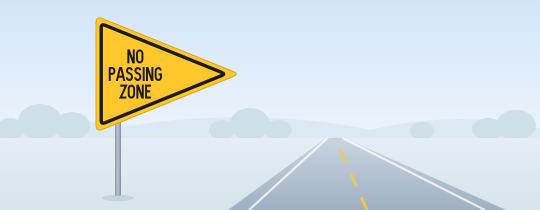
Cruising a two-lane road on the Eastern Shore, you see a yellow sign shaped like a sideways pennant, posted on the left shoulder. What is it telling you?
Show answer
Correct answer: Passing is not allowed from here on
Why
The Maryland Driver’s Manual saves the pennant shape for no-passing zones, and you’ll find it on the left shoulder, marking the spot where the no-passing zone starts. Wrap up any pass before you reach it: Maryland also rules out passing on the left when you’re 100 feet or less from an intersection or a rail crossing, or close to a hilltop or curve.
22Right-of-way
You’re about to leave an unpaved dirt road and pull onto a paved county road, and there’s no sign where they meet. What does Maryland law require?
Show answer
Correct answer: Stop, then yield to traffic on the paved road
Why
Maryland treats a driver coming off an unpaved road the way it treats one leaving a driveway, private road or parking lot: stop, then let traffic on the paved road go first. Where two equal roads meet with no signs, the first to arrive goes first, and in a tie, yield to the driver on your right.
23Speed limits
Out in the countryside, you’re on an undivided two-lane Maryland highway and haven’t passed a speed limit sign. What is the legal maximum?
Show answer
Correct answer: 50 mph
Why
Outside business and residential districts, Maryland caps undivided highways at 50 mph and divided highways at 55 mph unless signs say otherwise. Only interstates and expressways can be posted faster, and never above 70.
24Permit & provisional license
A 17-year-old in Maryland wants a provisional license. How much supervised driving must be logged, and over how long a permit period, before the road test?
Show answer
Correct answer: 60 hours, 10 at night, over at least 9 months with the permit
Why
Drivers under 25 log 60 supervised hours, at least 10 of them at night, in the Practice and Skills Log, and a 17-year-old must hold the permit for 9 months. Driver education, 30 hours of class plus 6 behind the wheel, comes on top. A moving violation restarts the 9-month clock.
25Alcohol & phones
Stopped on suspicion of drunk driving, a Maryland driver with no prior offenses refuses the breath test. How long is the license suspended?
Show answer
Correct answer: 270 days
Why
By driving in Maryland you’ve already agreed to a breath or blood test when police suspect impairment. A first refusal costs 270 days and a second one 2 years, longer than the 180 days for a first test result of 0.08 or more. Refusing never gets you out of a penalty; it makes it heavier.
26Road signs
Traffic slows on I-95 near Baltimore, and you pass a fluorescent pink sign with black lettering. What does that color usually point to?
Show answer
Correct answer: A crash or other traffic incident ahead
Why
The Maryland Driver’s Manual keeps fluorescent pink for emergency traffic incidents, such as a crash or a disabled truck blocking a lane. Orange is for work zones, fluorescent yellow-green for schools, pedestrians and bikes, and blue for services. Ease off early and be ready for a closed lane.
27Parking
Signs are posted across the street from a fire station driveway. If you park on that opposite side, how far from the driveway must you be?
Show answer
Correct answer: 75 feet
Why
Maryland keeps cars at least 20 feet from a fire station driveway on the station’s own side of the street, and 75 feet on the opposite side wherever signs say so. Fire engines swing wide as they pull out and need the whole road.
28Safe driving
Driving a dark road near Cumberland with your high beams on, you see another car’s headlights coming toward you. By what distance must you switch to low beams?
Show answer
Correct answer: 500 feet
Why
Maryland requires low beams within 500 feet of an oncoming vehicle and within 300 feet when you’re following one, so your glare doesn’t blind the other driver. If oncoming lights dazzle you, glance at the right-hand edge line of your lane until the car goes by.
29Safe driving
On a rain-soaked stretch of I-70, your steering suddenly feels light, as if the tires are floating on water. What should you do?
Show answer
Correct answer: Ease off the gas, keep the wheel straight and don’t brake
Why
That’s hydroplaning: a film of water lifts the tires off the pavement. The Maryland manual says to take your foot off the accelerator, skip the brakes and hold the car straight until the tires grip again. In a skid, the idea is the same: ease off and steer where you want to go.
30Right-of-way
You’re approaching a single-lane roundabout in Howard County and nobody is in it. According to the Maryland manual, what do you do?
Show answer
Correct answer: Enter without stopping and stay right of the center island
Why
At a traffic circle you yield to vehicles already circling and to people in the crosswalk, but if the circle is empty you don’t have to stop. Always stay right of the center island, and signal right just before your exit.
Round 4 · Questions 31–40
31Lane markings
Two solid yellow lines run down the center of a two-lane Maryland road. When may you cross them?
Show answer
Correct answer: To turn left into a driveway
Why
A double solid yellow line bans passing from both directions, but you may cross it to turn left into a driveway. Maryland also lets you edge into a no-passing zone just enough to give a bicyclist 3 feet when it’s safe. Yellow lines always split traffic moving in opposite directions.
32Right-of-way
Your light turns green, but a funeral procession, every car with headlights and hazard lights on, is still crossing the intersection ahead of you. What’s the right move?
Show answer
Correct answer: Wait until the whole procession has passed
Why
The Maryland manual gives a funeral procession the right-of-way, and its cars may keep moving even through a red signal. Other drivers yield, green light or not, until the last car is through. Never cut into the line.
33Speed limits
The posted limit is 50 mph, but rain is pounding down and a sharp curve is coming up. Under Maryland’s basic speed rule, how fast may you go?
Show answer
Correct answer: No faster than is reasonable and safe for the rain and the curve
Why
Maryland law asks for a speed that stays reasonable and prudent given the weather, traffic and road, and expects you to slow for curves, hilltops, railroad crossings and other hazards. Posted limits describe ideal conditions, so driving too fast for the weather is a violation even below the sign.
34Speed limits
Driving through a highway work zone in Maryland, you notice flashing blue lights beside the road. What do they mean?
Show answer
Correct answer: Work zone speed cameras are switched on
Why
Maryland color-codes its work zone lights: flashing amber or yellow means workers are present, flashing blue means speed cameras are active, and flashing green marks highway maintenance vehicles. Keep to the posted limit the whole way through, since speeding fines can run much higher in work zones.
35Permit & provisional license
You’re 17 with a Maryland provisional license and no adult in the car. During which hours may you drive only if you’re heading to or from work, a school activity, sports or organized volunteer work?
Show answer
Correct answer: Midnight to 5 a.m.
Why
Provisional drivers under 18 may drive unsupervised only from 5 a.m. to midnight. Outside those hours you need a licensed driver 21 or older beside you unless the trip is for a job, a school activity, an organized volunteer program or an athletic event or training. The restriction ends on your 18th birthday.
36Permit & provisional license
A 16-year-old just got a Maryland provisional license. For how long are passengers under 18 off-limits, unless they’re family or a qualified supervising driver rides along?
Show answer
Correct answer: The first 151 days
Why
Maryland’s passenger limit runs 151 days from the day the provisional license is issued. Brothers, sisters and other immediate family don’t count, and the limit lifts when a supervising driver 21+ with 3 years of licensed driving sits beside you. Breaking it can mean a 1-year suspension.
37Alcohol & phones
Your cousin, 16, is on a Maryland learner’s permit and wants to take a hands-free call through the car speakers during a practice drive. What does state law say?
Show answer
Correct answer: It’s not allowed: under 18, the only call permitted is to 911
Why
Maryland bars drivers under 18 with a learner’s permit or provisional license from using any wireless device while driving, hands-free included. The one exception is a 911 call. A violation can lead to a suspension of up to 90 days, so silence the phone before you start the car.
38Alcohol & phones
Which of these is against Maryland law for an adult driver?
Show answer
Correct answer: Wearing earbuds in both ears
Why
Maryland bans headsets, earphones and earplugs worn over or in both ears, because you need to hear sirens and horns; hearing aids are an exception. Hands-free calls and GPS are fine for adults, but holding a phone to use it while moving can cost up to $75 the first time, and texting is banned outright.
39Parking
You’re parallel parking on a two-way street in Maryland. How should your car end up?
Show answer
Correct answer: Pointed the way traffic moves, with the right tires 12 inches or less from the curb
Why
Maryland law has you park facing the direction of traffic, with your right wheels 12 inches or less from the curb or road edge. Parking farther out squeezes the lane for passing cars and bikes. Parked on a slope? Set the brake too, and angle the front wheels in to the curb, or toward the road’s edge where there’s none.
40Road signs
Over a reversible lane, the lane-use signal above you shows a steady red X. What should you do?
Show answer
Correct answer: Stay out of that lane entirely
Why
Lane-use signals hang over lanes that can carry traffic either way. In the Maryland manual, a red X means never drive in that lane, a steady yellow X means move out of it safely, a flashing yellow X marks a shared left-turn lane, and a green arrow means you may drive there.
Maryland MVA knowledge test at a glance
What to know before your MVA appointment.
Maryland · MVA knowledge test
88% to pass.
25 questions · 20 minutes
22 of 25 answers right to pass
$65first learner’s permit; the test itself is free
Spanishone of 17 test languages, with a Spanish manual
Next dayfirst retest, on the next business day; then 7-day waits
In personat a full-service MVA office, by appointment
6 monthshow long a passing score stays valid
20/40in each eye, plus a 140° field of vision
Under 18? Your road to a license
15¾Learner’s permitBook an appointment at a full-service MVA office, then pass the vision screening and the 25-question test, with a parent or guardian co-signing.
9 moPractice and driver edHold the permit 9 months with no violations, finish driver ed (30 hours of class, 6 at the wheel) and log 60 hours, 10 at night.
16½Provisional licensePass the driving skills test in an insured car you bring and move up to a provisional license.
16–17Provisional limitsNo solo driving from midnight to 5 a.m. unless it’s for work, school activities, sports or volunteering; no passengers under 18 except family for 151 days; no phone, not even hands-free.
18 moFull licenseKeep the provisional license 18 months conviction-free and, once you’re 18, the MVA upgrades it to a full license automatically.
18 or older? The Rookie Driver program still applies: driver ed, 60 practice hours and a 3-month permit at 19–24 (or at 18 with a diploma or GED), and from 25 just 14 hours and a 45-day permit.
What’s on the Maryland permit test
Every question on the MVA knowledge test comes from the Maryland Driver’s Manual (DL-002, December 2025 edition): traffic laws, road signs and safe driving. Six areas to master before test day:
Road signs
Shape first: an octagon is always STOP, a pentagon means a school zone or crossing, a pennant marks a no-passing zone.
Orange means road work, fluorescent pink a traffic incident, fluorescent yellow-green schools, pedestrians and bikes.
In work zones, flashing blue lights mean speed cameras are on; flashing amber means crews are present.
Right-of-way
No signal, and someone on foot is crossing on your half of the street, painted lines or not? Maryland wants a full stop, not just a slowdown.
Never pass a car that has stopped at a crosswalk; someone may be crossing in front of it.
School bus with red lights flashing: stop at least 20 feet away. Only drivers on the far side of a physical median may keep going.
Speed limits
No signs? 30 mph in business districts and on undivided residential streets, 35 on divided ones.
Outside towns: 50 mph on undivided highways, 55 on divided ones; only interstates and expressways go higher, to 70 max.
Posted limits are for ideal conditions: drive slower in rain, on curves and near hilltops.
Parking
Keep 15 feet from a hydrant, 20 feet from an intersection crosswalk and 30 feet from a stop sign.
Park 50 feet or more from a railroad crossing’s nearest rail, and 20 feet or more from a fire station driveway.
Parallel park facing the way traffic moves, right tires 12 inches or less from the curb.
Alcohol & phones
0.08 is DUI for any driver, and a 0.07 reading already counts as evidence of driving while impaired.
Under 21, any alcohol breaks your license restriction. Refuse a breath test and a first refusal costs your license for 270 days.
Adults: hands-free only, no texting. Under 18: no phone at all, except to call 911.
Teen rules
Permit drivers need a supervisor 21+, licensed 3 years or more, in the front passenger seat, and nobody else up front.
Provisional under 18: no solo driving midnight–5 a.m., except for work, school activities, sports or volunteering.
For the first 151 days, no passengers under 18 unless they’re family.
Maryland numbers to know
Six figures from Maryland law and the Driver’s Manual to have down cold.
100 ftof continuous signaling before you turn
15 ftfrom a fire hydrant when you park
20 ftfrom a school bus with red lights flashing
3–4 secfollowing distance in good conditions
500 ftto dim your high beams for oncoming cars
30/60/15minimum liability insurance, in thousands of dollars
Your Maryland course, in your pocket
These 40 questions are just the warm-up. The app gives you 477 Maryland practice questions, 36 short lessons and the why behind every answer.
36 short lessonsFour levels, from fundamentals to expert, then a full practice exam.
477 Maryland questions316 of them with pictures.
Your most-missed questionsA review lesson built from the questions you miss most.
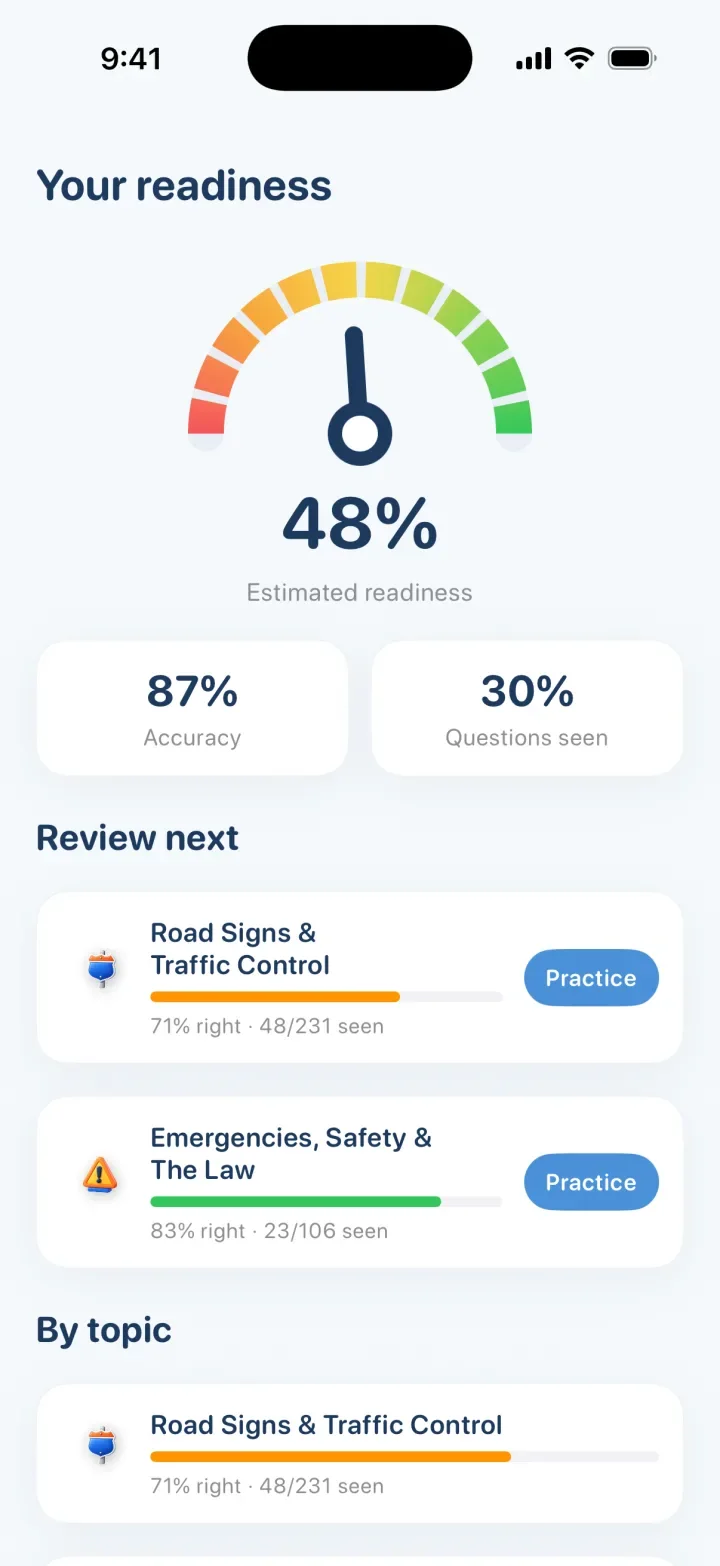
Exam simulatorTake full practice exams and watch your readiness grow.
Maryland permit
Your Maryland path is ready.
36 lessons, 477 questions and full practice exams. In English and Spanish.
How many questions are on the Maryland MVA knowledge test, and what’s a passing score?
25 multiple-choice questions covering road signs, Maryland traffic laws and safe driving, usually on a computer at an MVA office, with a 20-minute limit. You need 88% to pass, which means at least 22 right answers: three misses at most. You’ll also need to pass a vision screening.
What happens if I fail the Maryland permit test?
You can retest as soon as the next business day if an appointment is open. After two or more fails, each new try must wait at least 7 calendar days. There’s no fee for the test itself, and once you pass, the score stays good for 6 months.
Can I take the Maryland permit test online?
No. The MVA gives the knowledge test only in person at an MVA office, by appointment; teens book at a full-service office and can schedule through a myMVA account. What you can do online is practice: the MVA’s free tutorial and the 40 questions above.
Can I take the Maryland permit test in Spanish?
Yes. The Class C knowledge test is offered in 17 languages, Spanish and American Sign Language among them. The MVA also publishes a Spanish edition of the Driver’s Manual and a Spanish version of its practice tutorial, and this practice test and the app are in Spanish too.
How old do you have to be to get a learner’s permit in Maryland?
15 years and 9 months. Under 18, a parent or guardian co-signs, and if you’re under 16 you bring a school attendance form. Plan to hold the permit at least 9 months, finish driver ed (30 hours of class and 6 behind the wheel) and log 60 supervised hours, 10 at night, before the road test for a provisional license at 16½ at the earliest.
How much does a Maryland learner’s permit cost?
$65 for a first-time (Type I) learner’s permit, and that fee also covers the later conversion to a full license. The knowledge test itself is free. The permit is good for up to 2 years.
What do I need for the Maryland driving test?
A car you supply, with current plates and registration, proof of insurance, a clear windshield and at least half a tank of gas, plus a licensed driver who comes with you. Examiners end the test on the spot for unsafe moves, such as rolling through a stop sign or hitting and moving a cone on the closed course.
What’s the best way to study for the Maryland permit test?
Read the Maryland Driver’s Manual (DL-002), since every test question comes from it, then practice until 88% feels easy. Start with the 40 questions above, then let the app take you through 477 Maryland questions and 36 short lessons, each answer explained.