Get ready for Tennessee’s 30-question Class D knowledge test with 40 free practice questions on road signs, right-of-way, speed limits, DUI and the Hands Free law, plus teen license rules. Pick an answer and find out instantly why it’s right.
Four rounds of 10 questions on Tennessee signs and signals, right-of-way, speed limits, parking, DUI, the Hands Free law and teen license rules. Every answer comes with a short explanation.
Round 1 · Questions 1–10
1Sharing the road
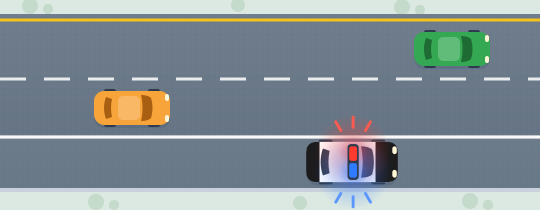
You’re on a four-lane interstate with two lanes heading your way, and a patrol car sits on the right shoulder with its emergency lights flashing. What does Tennessee’s Move Over law require?
Show answer
Correct answer: Move to the lane farther from it if it’s safe; if not, slow down
Why
Tennessee wants a full lane of space between you and any stopped emergency, tow, highway maintenance, utility or garbage truck showing flashing lights. When traffic boxes you in, ease off the gas and pass with care instead. Since July 2023 the same duty covers any vehicle stopped with its hazard lights blinking, so give a stranded motorist room too.
2Road signs
A storm has knocked out power, and the traffic lights at a busy Memphis intersection are completely dark. What’s the right way to handle it?
Show answer
Correct answer: As an all-way stop: stop fully and take turns
Why
Tennessee law treats a signal that isn’t working as an all-way stop. Stop completely, let whoever arrived first go first, and yield to the car on your right if you tie. Other drivers may be confused, so make eye contact before you pull out.
3Right-of-way
You’re following a school bus on a two-lane road when it stops, flashes its red lights and swings out its stop arm. When may you drive on?
Show answer
Correct answer: Once the stop arm folds back and the bus starts moving
Why
On an undivided road like this one, Tennessee makes drivers from every direction stop for a school or church bus loading with red lights flashing and the arm out. Wait until the arm is pulled in and the bus pulls away. Passing it illegally is a Class A misdemeanor with a fine of $250 to $1,000.
4Speed limits
You’re on a two-lane U.S. highway in rural Tennessee, and no speed limit is posted anywhere along this stretch. Which limit applies?
Show answer
Correct answer: 55 mph
Why
Unless a sign sets another number, primary and secondary state and federal highways in Tennessee carry a 55 mph limit. A posted sign overrides it, higher or lower. On narrow, winding country roads, the safe speed can be well under that.
5Parking
There’s an open parking space next to a fire hydrant on a Tennessee street. What is the closest your car may be to the hydrant?
Show answer
Correct answer: 15 feet
Why
Tennessee keeps parked cars 15 feet clear of a fire hydrant, so fire crews can connect a hose without hunting for room. A typical car is about that long, so leave at least one car’s worth of curb empty. Crosswalks need even more space: 20 feet.
6Alcohol & phones
An 18-year-old has two drinks at a party, drives home and gets pulled over. A breath test shows 0.03%. What does Tennessee law say?
Show answer
Correct answer: It’s underage driving while impaired: a year without a license and a $250 fine
Why
Tennessee draws the line at 0.02% for drivers aged 16 to 20, far below the 0.08% adult limit. Crossing it costs your license for one year plus a $250 fine, and a judge may add community service. If you’re under 21, the only safe amount before driving is none.
7Safe driving
You plan to turn right into a driveway on a quiet Tennessee street. How far ahead should your turn signal go on?
Show answer
Correct answer: At least 50 feet before the turn
Why
Tennessee’s rule is 50 feet or more before a turn, and the same applies to a lane change. That gives drivers and cyclists behind you time to react. On faster roads, start signaling earlier so the warning comes well before you brake.
8Permit & teen rules
You turn 15 next week and plan to apply for your Tennessee learner permit. Once you have it, how long must you hold it before moving up to the next license?
Show answer
Correct answer: 180 days
Why
Tennessee teens can get a learner permit at 15 by passing the vision screening and the knowledge test, then must keep it for 180 days, about six months, before the Intermediate Restricted license. The permit itself is issued for a year, which leaves room to finish your practice hours. Use those months to drive in rain, at night and on the interstate, not just around the block.
9Lane markings
You’re cruising in the left lane of a Tennessee interstate when a faster car comes up behind you. What should you do?
Show answer
Correct answer: Move right when it’s safe, because the left lane is for passing
Why
On Tennessee interstates the left lane is meant for passing, not cruising. Signal, check your mirror and blind spot, and move right to let faster traffic by. Lingering there holds up traffic and invites risky passes on the right.
10Road signs
A single traffic light hanging over a rural intersection blinks red in your direction. What must you do?
Show answer
Correct answer: Make a complete stop, then go when the way is clear
Why
A blinking red light means exactly what the eight-sided STOP sign means: stop completely, yield to cross traffic and pedestrians, then go when it’s clear. Rolling through one is an easy way to earn a ticket. Look both ways before you pull out, even if the road seems empty.
Round 2 · Questions 11–20
11Speed limits
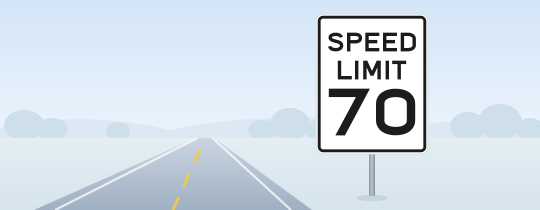
You pass a SPEED LIMIT 70 sign like this one on a Tennessee interstate. What does that 70 mph stand for?
Show answer
Correct answer: The top interstate limit state law allows, posted mostly in rural areas
Why
Seventy is the highest interstate limit Tennessee law allows, and you’ll see it on most rural stretches. Through congested metro areas, interstate limits typically drop to 55 mph, so watch for the change as a city gets closer. Even at 70, the manual’s Basic Speed Rule tells you to ease off for rain, fog or heavy traffic.
12Road signs
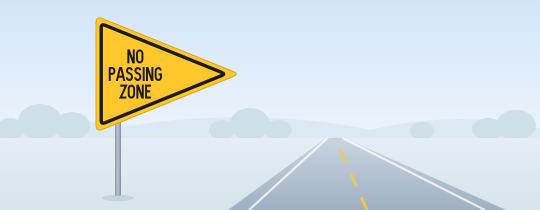
Driving a two-lane Tennessee highway, you see a yellow pennant-shaped NO PASSING ZONE sign on the left shoulder. Which marking on your side of the center line gives the same order?
Show answer
Correct answer: A solid yellow line
Why
The pennant always stands on the left side of the road, where a driver getting ready to pass will spot it. Where solid and broken yellow lines run side by side, the solid one on your side means you may not pass. Stay in your lane until the solid line ends.
13Right-of-way
Two cars reach an all-way stop at the same moment, one on each of two crossing streets. Which driver should go first?
Show answer
Correct answer: The driver on the right
Why
At an all-way stop, Tennessee’s order is simple: first to arrive, first to go. When two cars arrive together, the one on the left yields to the one on the right. A wave is polite, but wait until you’re sure the other driver is staying put.
14Parking
You have to park on a hill along a rural road that has no curb. How should you leave your front wheels?
Show answer
Correct answer: Turned toward the edge of the road
Why
With no curb to catch the tires, aim the wheels toward the road’s edge so a rolling car heads off the road, not into traffic. With a curb, turn them toward it facing downhill and away from it facing uphill. Set the parking brake every time.
15Alcohol & phones
After a DUI arrest, a Tennessee driver refuses to give a breath or blood sample. What is the likely result for the license?
Show answer
Correct answer: A 12-month suspension ordered by the court
Why
By driving in Tennessee, you have already agreed to a breath or blood test if you’re arrested for DUI. Saying no usually leads the court to suspend your license for 12 months, on top of any DUI penalty. Keep in mind you can be convicted even below 0.08% if your driving shows impairment.
16Safe driving
It’s raining after dark and you’re on I-40 at highway speed. What is the smallest following gap the Tennessee manual calls for?
Show answer
Correct answer: 4 seconds
Why
Two seconds is the minimum on state and U.S. highways at moderate speeds in good conditions. Bad weather, darkness, interstate speeds and following a motorcycle each call for four seconds or more. Count from when the car ahead passes a fixed point; if you reach it before you finish, drop back.
17Permit & teen rules
Before a Tennessee teen can trade a learner permit for an Intermediate Restricted license, how much supervised driving must be certified?
Show answer
Correct answer: 50 hours, 10 of them at night
Why
A parent, guardian or driving instructor signs the official 50-hour form confirming 50 hours behind the wheel, including 10 after dark. Spread the hours across the 180-day permit period and mix in highways, rain and night trips. Jotting down each drive as you go makes the form quick to fill out.
18Sharing the road
A bicyclist riding ahead of you raises the left arm, bent upward at the elbow. What is the rider about to do?
Show answer
Correct answer: Turn right
Why
Since 2026, Tennessee’s knowledge test must cover bicyclist hand signals. For a right turn, riders either raise the left forearm at a 90-degree angle or stick the right arm straight out; a straight left arm means a left turn, and an arm angled down with the palm facing back warns of slowing or stopping. When you pass a cyclist, Tennessee law requires at least 3 feet of space.
19Crashes & emergencies
You back into another car on a Tennessee city street, causing about $300 in damage. No one is hurt. What does the law require?
Show answer
Correct answer: Notify the police right away, since the damage is over $50
Why
Tennessee requires drivers to notify police at once after a crash with injury, death or more than $50 in property damage: city police inside a town, otherwise the sheriff or Highway Patrol. Swapping information is still smart, but it doesn’t replace the call. Bigger crashes also mean a written report to the state within 20 days.
20Road signs
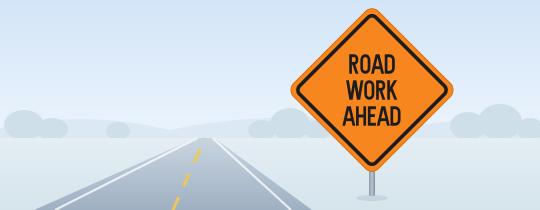
Orange diamond ROAD WORK AHEAD signs lead you into an active work zone on a Tennessee highway. If you’re caught speeding inside it, what fine does state law set?
Show answer
Correct answer: From $250 up to $500
Why
Tennessee sets the fine for speeding in an active work zone at $250 to $500. Lanes shift, pavement changes and crews work just feet from traffic, so ease off as soon as the first sign appears. Keep extra room for sudden stops.
Round 3 · Questions 21–30
21Road signs
Beside the road stands a five-sided fluorescent yellow-green sign showing two children, and the school-zone flashers are on. A student starts across at an unmarked crosswalk. What does Tennessee require?
Show answer
Correct answer: Stop and stay stopped until the student has crossed the whole road
Why
Fluorescent yellow-green is the color Tennessee uses for school zones and pedestrian crossings. With the flashers on, you must stop for anyone in a marked or unmarked crosswalk and wait until they reach the far side, not just the edge of your lane. Look for kids between parked cars as you pull away.
22Right-of-way
On a five-lane road with a center turn lane, a school bus coming toward you halts, red lights blinking and stop arm extended. Does Tennessee law make you stop too?
Show answer
Correct answer: Yes, because a center turn lane doesn’t count as a median or barrier
Why
Tennessee excuses oncoming drivers only when a median or physical barrier divides the highway. A painted turn lane separates nothing, so traffic in both directions stops. Stay put until the arm is pulled back and the bus moves on.
23Right-of-way
You’re stopped at a red light on a one-way street in downtown Chattanooga. You’d like to go left onto a cross street where traffic also runs one way, toward your left. What does Tennessee allow?
Show answer
Correct answer: The turn, once you’ve stopped fully and yielded to others
Why
Tennessee permits a left on red in one case only: the street you’re leaving and the street you’re entering both carry one-way traffic, and the new one flows to your left. A full stop comes first, and right turns on red follow the same stop-and-yield rule unless a sign forbids them. Check for cyclists and pedestrians before you go.
24Speed limits
Traffic is flowing freely on a Tennessee interstate, and you’re in the far-left lane. What is the slowest you may legally drive there?
Show answer
Correct answer: 55 mph
Why
Tennessee sets a 45 mph minimum on interstates, but the left-most lane has a higher floor: going under 55 there is unlawful unless congestion makes it impossible. If you’d rather drive slower, move to the right. Remember that the posted maximum still applies on top of these floors.
25Parking
You’re circling the block for a space. Which spot can you legally take in Tennessee?
Show answer
Correct answer: 25 feet from a crosswalk
Why
Tennessee requires 20 feet from a crosswalk, so 25 feet is fine. Stop signs and traffic signals need 30 feet and railroad crossings 50 feet, so the other two spots break the law. Near a fire station driveway, leave 20 feet on the same side or 75 feet across the street.
26Alcohol & phones
Under Tennessee’s Hands Free law, which of these can an adult driver legally do while the car is moving?
Show answer
Correct answer: Answer a call with one button press, then talk through an earpiece
Why
Tennessee drivers may not hold a phone with any part of the body, read or write texts, or reach for a phone in a way that pulls them out of a normal belted position. Drivers 18 and older may talk through an earpiece or wrist device and use a single touch to start or end a call. A first offense costs $50, and $200 in a work zone with workers present or a school zone with flashers on.
27Alcohol & phones
What is the least jail time a Tennessee court must impose for a first DUI conviction?
Show answer
Correct answer: 48 hours
Why
A first DUI in Tennessee means at least 48 hours behind bars, rising to 7 days when the BAC reading hits 0.20% or more. Add a fine of $350 to $1,500 and a one-year license revocation. A ride home costs far less.
28Safe driving
It’s 2 p.m., a steady drizzle keeps your windshield wipers running nonstop, and you can still see well ahead. What does Tennessee law require?
Show answer
Correct answer: Headlights on, because your wipers are running
Why
In Tennessee, wipers on means headlights on, whether it’s rain, mist or snow. Headlights are also required from half an hour after sundown until half an hour before sunup, and any time you can’t clearly see people or vehicles 200 feet ahead. They help others see you as much as they help you see.
29Permit & teen rules
You’re 15 with a Tennessee learner permit. It’s 10:30 p.m., and your 25-year-old licensed cousin offers to ride along so you can drive home. Is that allowed?
Show answer
Correct answer: No, teen permit holders can’t drive 10 p.m.–6 a.m.
Why
A Tennessee learner permit lets you drive only with a licensed driver 21 or older in the front seat, and for teens, never from 10 at night until 6 in the morning. Your cousin qualifies as a supervisor, but the clock rules out this drive. Plan practice sessions so you’re parked by 10.
30Lane markings
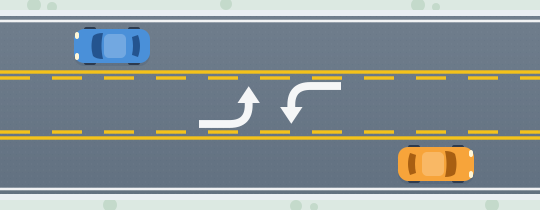
This road has three lanes, and the one in the center is edged in yellow: solid on the outside, broken on the inside, with turn arrows facing both ways. Under Tennessee rules, how far may you travel in it?
Show answer
Correct answer: Up to 300 feet
Why
That’s a shared center lane for left turns from either direction. Tennessee lets you travel no more than 300 feet in it and never allows passing there. Enter close to your turn, signal, and watch for a driver coming the other way who wants the same space.
Round 4 · Questions 31–40
31Road signs
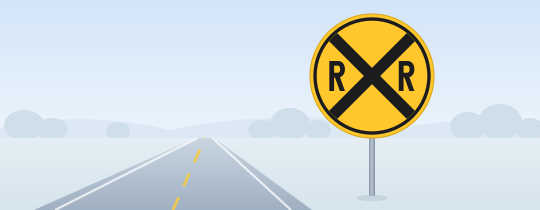
On Tennessee roads, a round sign carries just one message. When this yellow one, marked with a big X and the letters RR, comes into view, what is it telling you?
Show answer
Correct answer: A railroad crossing is ahead, so slow down and be ready to stop
Why
Round signs are reserved for railroad warnings, so this one gives you time to slow, look and listen. When a train is coming or the lights flash, your stopping spot is 15 to 50 feet short of the closest rail. Trains are faster and closer than they look, so don’t race one to the crossing.
32Right-of-way
You hear a siren, and an ambulance with flashing lights is coming up behind you on a two-lane road. What should you do?
Show answer
Correct answer: Pull right, parallel to the edge, and stop until it passes
Why
When a siren or flashing lights come up behind you, Tennessee wants you to steer to the right-hand side, parallel to the curb or shoulder, and come to a full stop. Wait until it has gone by, check for a second one, then merge back. Never tail it to get through traffic.
33Speed limits
Children are on their way to school, and you speed through a posted Tennessee school zone. How does state law treat that?
Show answer
Correct answer: As reckless driving, with 6 points on your record
Why
Breaking the school-zone limit while children are heading to or from school, or at recess, counts as reckless driving in Tennessee and adds 6 points. School limits are posted on SCHOOL SPEED LIMIT signs and are never set below 15 mph. Slow down early and watch for kids darting between cars.
34Parking
You need to stop beside a rural Tennessee highway, outside any city. How should you park?
Show answer
Correct answer: Fully off the pavement if possible, with 18 feet of road left open
Why
Outside city limits, Tennessee wants the whole car off the pavement where possible, at least 18 feet of roadway left open for traffic, and your vehicle visible for 200 feet in both directions. Avoid stopping just past a curve or hilltop, where drivers can’t see you in time.
35Alcohol & phones
You’re 15 and practicing on a learner permit with your mom beside you. The car has a built-in hands-free phone. When may you use it to take a call while driving?
Show answer
Correct answer: Not at all while you’re driving
Why
Tennessee bans permit and intermediate license holders from using any phone behind the wheel, whether handheld, built into the car or otherwise. A conviction brings a $50 fine, 6 points and a 90-day delay before you can move up to the intermediate license. Silence the phone and put it out of reach before you start the car.
36Safe driving
On a dark country road with your high beams on, you come up behind another car going your way. Within what distance must you switch to low beams?
Show answer
Correct answer: 500 feet
Why
Tennessee uses one number for both cases: dim your lights when an oncoming vehicle is within 500 feet and when you’re following within 500 feet. High beams glaring in someone’s mirrors can blind the driver ahead of you. Switch back once the road ahead is clear.
37Safe driving
Where is a U-turn always illegal in Tennessee?
Show answer
Correct answer: On any interstate highway
Why
Tennessee bans U-turns on every interstate, at any intersection run by a signal light or an officer directing traffic, and anywhere you can’t see traffic 500 feet away in each direction. Even where one is legal, wait for a long, clear view both ways. When in doubt, go around the block.
38Permit & teen rules
You’ve had your Intermediate Restricted license for two months. If none of the exceptions apply, how many passengers may ride with you?
Show answer
Correct answer: One
Why
Tennessee holds Intermediate Restricted drivers to a single passenger. The limit lifts when a rider is 21 or older with a valid unrestricted license, or for brothers and sisters from the same home riding to or from school with a parent’s letter. Fewer friends in the car means fewer distractions while you build skill.
39Permit & teen rules
A 16-year-old with an Intermediate Restricted license wants to drive alone to a friend’s house at 11:30 p.m. What does Tennessee law say?
Show answer
Correct answer: No: 11 p.m.–6 a.m. is off-limits unless an exception applies
Why
Intermediate Restricted drivers stay off the road from 11 p.m. to 6 a.m. The exceptions are a parent or guardian in the car, a licensed adult 21+ named in writing by a parent, trips to or from work or a school event with written parental permission, and hunting or fishing trips between 4 and 6 a.m. A late visit to a friend fits none of them.
40Crashes & emergencies
A crash on a Tennessee road leaves $3,000 in damage to your car but injures no one. Besides calling the police, what must be filed with the state?
Show answer
Correct answer: An Owner Operator Report within 20 days
Why
The owner or driver must file an Owner Operator Report with the Department of Safety within 20 days when a crash causes injury or death, more than $1,500 in property damage, or over $400 in damage to government property. Fault doesn’t matter. Photos and the other driver’s details make it easier to fill out.
Tennessee DMV knowledge test at a glance
The numbers that matter before you head to a Driver Services Center.
Tennessee · Class D knowledge test
80% to pass.
30 questions · Multiple choice
24 of 30 answers right to pass
Onlineat home for ages 15–17, with a parent as proctor
Spanishtest offered online and at centers
60 mintime limit on the online test
Next dayearliest retest after a fail
$10.50learner permit under 18, valid a year
20/40vision in each eye and both together
Under 18? Your road to a license
15Learner permitPass the vision screening and the knowledge test, with a parent or guardian signing the Minor/Teenage Affidavit.
6 moSupervised practiceHold the permit 180 days and log 50 hours, 10 at night, with a licensed driver 21+ up front. No driving 10 p.m.–6 a.m.
16Intermediate RestrictedPass the road skills test. For a year: no driving 11 p.m.–6 a.m. and one passenger at most, with a few exceptions.
17Intermediate UnrestrictedAfter a clean year, the curfew and passenger limits end, with no extra test.
18Regular Class DTrade up at 18, or sooner once you graduate high school or earn a GED.
18 or older? The graduated steps don’t apply: pass the vision screening and knowledge test at a Driver Services Center, then the road test. A $5.50 learner permit lets you practice first.
What’s on the Tennessee permit test
Study the Tennessee Comprehensive Driver License Manual. The test draws on its Sections B and C, split about evenly between signs and signals, safe driving, rules of the road, and drugs and alcohol. Here’s what to know cold in six key areas.
Road signs
Shape tells you first: eight sides means STOP, and a round sign always warns of a railroad crossing ahead.
A yellow pennant on the left shoulder starts a no-passing zone; fluorescent yellow-green flags schools and pedestrian crossings.
Signal gone dark? Treat it as an all-way stop: everyone stops, then takes turns.
Right-of-way
All-way stop: first to arrive goes first; on a tie, yield to the car on your right.
Turning left without a green arrow? Oncoming cars going straight or turning right go first.
School bus with red lights and stop arm: both directions stop, unless a median or barrier divides the road.
Speed limits
No sign on a state or U.S. highway? The limit is 55 mph.
Interstates top out at 70 mph in the country and usually run 55 through cities.
Interstate minimum is 45 mph, and under 55 in the left lane is illegal unless traffic is jammed.
Parking
Keep 15 feet from a hydrant, 20 from a crosswalk and 30 from a stop sign or signal.
Stay 50 feet from a railroad crossing and 20 feet from a fire station driveway, 75 across the street.
Hills: downhill with a curb, wheels toward it; uphill, away; no curb, toward the road’s edge.
Alcohol & phones
BAC limits: 0.08% at 21 and up, 0.04% in a commercial vehicle, 0.02% for drivers 16 to 20.
Refuse a breath or blood test after an arrest and expect a 12-month suspension.
Hands Free law: never hold the phone. Drivers 18+ may use an earpiece or one touch to answer.
Teen rules
Learner permit: a licensed driver 21+ in the front seat, and no driving 10 p.m.–6 a.m.
Intermediate Restricted: off the road 11 p.m.–6 a.m. and one passenger, with a few exceptions.
Permit and intermediate drivers can’t use any phone at the wheel, not even a built-in one.
Tennessee numbers to know
Short numbers, easy points: learn these six before test day.
50 ftof signaling before a turn or lane change
15 ftbetween your parked car and a fire hydrant
500 ftto dim high beams, oncoming or following
3 ftof space when you pass a bicyclist
0.02%BAC that costs drivers 16–20 their license
25/50/25minimum liability insurance, in thousands of dollars
Your Tennessee course, in your pocket
These 40 questions are just the warm-up. The app gives you 446 Tennessee practice questions, 36 short lessons and the why behind every answer.
36 short lessonsFour levels, from fundamentals to expert, then a full practice exam.
446 Tennessee questions302 of them with pictures.
Your most-missed questionsA review lesson built from the questions you miss most.
Exam simulatorTake full practice exams and watch your readiness grow.
Tennessee permit
Your Tennessee path is ready.
36 lessons, 446 questions and full practice exams. In English and Spanish.
How many questions are on the Tennessee permit test, and what’s a passing score?
There are 30 multiple-choice questions, and the online version gives you 60 minutes. You need 80% to pass, which means 24 correct. One test covers traffic signs and signals, safe driving, rules of the road, and drugs and alcohol in roughly equal parts, so there’s no separate sign test. You’ll also need 20/40 vision in each eye.
How many times can I retake the Tennessee knowledge test?
Fail at a Driver Services Center and you can try again the next day; every failed attempt means paying the $2 application fee again. Online, teens get two attempts with at least 24 hours between them, and after a second online fail the next try is at a center.
Can I take the Tennessee permit test online?
Yes, if you’re 15 to 17. You test at home on a computer, laptop or tablet, not a phone, while a parent or legal guardian proctors and confirms identity through the Tennessee Proctor ID app. Applicants 18 and older take the test in person at a Driver Services Center.
Can I take the Tennessee permit test in Spanish?
Yes. The online test comes in English and Spanish, and centers with computer testing also offer Spanish, Korean and Japanese. Interpreters can’t help, but a paper translation dictionary without notes is allowed. One change to know: starting January 1, 2027, a license earned by testing in another language lasts 36 months and can’t be renewed; to keep driving after that, you retake the written test in English. This practice test and the app are in Spanish too.
How old do you have to be to get a learner permit in Tennessee?
15. Hold the permit 180 days and log 50 practice hours, 10 at night, with a licensed driver 21 or older in the front seat; no driver education course is required. At 16, pass the road test for an Intermediate Restricted license: for a year, no driving 11 p.m.–6 a.m. and only one passenger, with some exceptions. After a clean year those limits end at 17, and a regular Class D follows at 18 or once you finish high school or earn a GED.
How much does a Tennessee learner permit cost?
$10.50 if you’re under 18, which covers the permit for a year plus the $2 application fee; at 18 or older it’s $5.50. Moving up to the Intermediate Restricted license costs $24.50, and a regular Class D is $28 for eight years. County clerk partner offices add a $4 fee.
Does Tennessee have a DMV for driver’s licenses?
Not by that name. In Tennessee, licenses are the job of TDOSHS, the state Department of Safety and Homeland Security, and its Driver Services Division runs the Driver Services Centers where you take the knowledge test. You don’t need an appointment for it, since walk-ins are welcome, but booking one can save you time.
What’s the best way to study for the Tennessee permit test?
Read Sections B and C of the Tennessee Comprehensive Driver License Manual and try the review questions at the end of each chapter. Then practice until 80% feels easy: start with the 40 questions above, then let the app walk you through 446 Tennessee questions and 36 short lessons.