Prep for the Connecticut DMV knowledge test with 40 free questions on road signs, right-of-way, work zones, the new 2026 phone law and teen driving limits. Each answer is explained the moment you tap it.
Four rounds of 10 questions on Connecticut road signs, right-of-way, speed and parking rules, alcohol and phone laws, and teen limits. Pick an answer to see right away why it’s right or wrong.
Round 1 · Questions 1–10
1Road signs
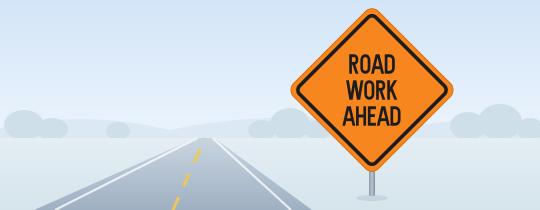
An orange diamond-shaped ROAD WORK AHEAD sign comes up on a two-lane state highway, and a crew is working right beside your lane. What happens in Connecticut if you pass them at 15 mph or more over the limit?
Show answer
Correct answer: It’s charged as endangerment of a highway worker, with a fine of up to $500
Why
Connecticut doubles traffic fines in active highway work zones, and going 15 mph or more over the limit near workers is a separate offense carrying fines as high as $500, rising to $1,000 when someone is injured. Treat every orange sign as your cue to ease off, open up space and follow any flagger.
2Right-of-way
On a residential street in New Haven, an ice cream truck is parked with red lights flashing and both its stop arm and crossing arm swung out. What does Connecticut law tell you to do?
Show answer
Correct answer: Stop 10+ feet away, then pass at 5 mph or less, yielding to kids
Why
Connecticut has a special rule for frozen-dessert trucks. When one shows flashing red lights with its stop and crossing arms out, stop at least 10 feet away, then creep past at 5 mph or less and let any child cross first. Kids thinking about a treat can dart out from behind the truck without looking.
3Alcohol & phones
Stopped at a red light, a 35-year-old driver picks up her phone to read a new text. Under the Connecticut distracted-driving law in effect since October 1, 2026, is that allowed?
Show answer
Correct answer: No; only once she’s parked safely off the road
Why
Connecticut’s ban covers holding a phone and reading, viewing or typing messages, and it still applies while you wait in traffic or at a light or stop sign. You may pick the phone up only once you’re safely parked at the side of the road. Fines start at $200 and rise to $375 and $625 for repeat offenses, and each violation goes on your driving record.
4Parking
You spot an open curb space next to a fire hydrant on a Bridgeport street. What’s the closest you may legally park to the hydrant?
Show answer
Correct answer: 10 feet
Why
Connecticut law keeps parked cars at least 10 feet from a fire hydrant, so firefighters can reach it and hook up hoses without delay. Since October 2025, repeat violations can cost up to $200.
5Permit & teen rules
A 16-year-old in Connecticut has just gotten a learner’s permit. Who may sit in the front passenger seat as the trainer?
Show answer
Correct answer: A licensed instructor, or a driver 20+ licensed 4+ years with no suspension
Why
Connecticut is specific about supervisors: a licensed driving instructor, or someone 20 or older who has been licensed for four years or more, with no suspension in that span. The trainer rides in the front passenger seat, ready to take control. A friend who just turned 18 doesn’t qualify.
6Speed limits
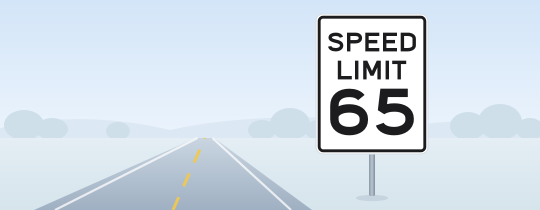
Heading onto a multilane divided highway in Connecticut, you pass a white SPEED LIMIT 65 sign. What is true about that number?
Show answer
Correct answer: It’s the highest speed limit anywhere in Connecticut
Why
Connecticut tops out at 65 mph, a limit the state may post only on multilane, limited-access highways. On every other road the ceiling is 55 mph, and many are posted lower. Even at 65, slow down whenever traffic, weather or visibility call for it.
7Safe driving
It’s 2 p.m. and a light drizzle makes you switch on your windshield wipers. What does Connecticut law say about your headlights?
Show answer
Correct answer: They must be on; rain alone requires them
Why
Connecticut wants headlights on at night, starting 30 minutes past sunset and ending 30 minutes ahead of sunrise, plus whenever people and vehicles 500 feet away aren’t clearly visible, and any time it’s raining, snowing or foggy. The manual boils it down to one habit: wipers on, headlights on. In gray weather, lights help others spot you as much as they help you see.
8Road signs
A thunderstorm has cut the power, and the traffic lights at a busy Hartford intersection are completely dark. No officer is directing traffic. What does Connecticut law require when you get there?
Show answer
Correct answer: Stop as you would for a STOP sign, then go when it’s your turn
Why
When a signal isn’t working, Connecticut drivers must stop as if the intersection had a stop sign. Then use four-way-stop manners: whoever stopped first goes first, and if two cars arrive together, the one on the right goes. Other drivers may be confused too, so make eye contact before you pull out.
9Lane markings
You’re on a stretch of I-95 with three lanes in your direction. Since October 1, 2026, when may an ordinary car use the far-left lane?
Show answer
Correct answer: To pass, to take a left exit, or in heavy congestion
Why
Connecticut’s new left-lane law keeps the far-left lane of divided limited-access highways with more than two lanes each way for passing, left exits and entrances, heavy congestion, police direction and emergency or road-work vehicles. Cruising there otherwise can bring an $88 fine. On any road, slower traffic belongs on the right.
10Permit & teen rules
A 17-year-old with a Connecticut license leaves a friend’s party at 11:30 p.m. Can she legally drive herself home?
Show answer
Correct answer: No, a party isn’t a curfew exception
Why
Connecticut’s teen curfew runs from 11 p.m. to 5 a.m. until the driver turns 18. The exceptions are work, school events, religious activities, a medical necessity and a few volunteer emergency or Safe Ride duties; a party isn’t one of them, so she needs a ride. A first curfew violation means a 30-day license suspension and a $175 restoration fee.
Round 2 · Questions 11–20
11Road signs
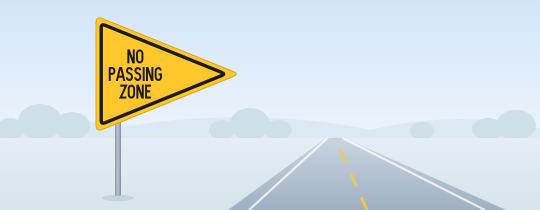
On a road with one lane each way, you’ve just driven past a yellow pennant-shaped sign planted on your left, so a no-passing zone has begun. Up ahead, a cyclist is pedaling slowly near the edge. Under Connecticut law, may you go around the rider?
Show answer
Correct answer: Yes, if it’s safe, you can see far enough ahead and you leave at least 3 feet
Why
The pennant marks where the zone starts, yet Connecticut still lets you pass a bicycle, a pedestrian, an animal, a parked car or a very slow vehicle there when you can do it safely with a clear view ahead, even across a double yellow line. Give the rider at least 3 feet, and if a curve or an oncoming car limits your view, stay behind.
12Alcohol & phones
Connecticut has a zero-tolerance law for drivers under 21. At what blood alcohol content does a 19-year-old driver start breaking it?
Show answer
Correct answer: 0.02% or more
Why
For drivers under 21, a BAC of 0.02% or more is illegal, on public roads and private property alike. A single drink can be enough, so the only safe plan is not to drink at all before driving. The adult limit is 0.08%, and 0.04% for anyone driving a commercial vehicle.
13Parking
You want to park on a side street just before a corner with a YIELD sign. Under the parking rules in effect since October 2025, how far from that sign must your car be?
Show answer
Correct answer: At least 30 feet
Why
Connecticut now keeps parked cars 30 feet or more from a stop or yield sign, and the same distance from an intersection or the approach to a marked crosswalk unless a space is marked there. The extra room lets drivers see the sign and anyone stepping off the curb. The March 2023 manual still prints the old 25-foot rule for stop signs; the law raised it to 30 feet in October 2025.
14Right-of-way
You’re behind a school bus on a two-lane road when it stops, its red lights begin flashing and the stop arm swings out. What does Connecticut law require?
Show answer
Correct answer: Stop at least 10 feet behind the bus and stay there until the red lights go off
Why
Traffic from either direction must stop 10 feet or more from a school bus showing flashing red lights and wait until the lights stop. Passing a stopped bus costs $450 for a first offense, and the bus driver can report your plate number to police. Even after the lights go off, wait until the children are out of the road.
15Permit & teen rules
During a practice drive, a 16-year-old permit holder wants to give a school friend a ride home. Who else, besides the trainer, may be in the car?
Show answer
Correct answer: Only a parent or guardian (or, since October 2026, a sibling with a permit)
Why
Connecticut keeps practice drives focused: a teen permit holder may carry only the trainer and the teen’s parents or legal guardian, with more people allowed only during driving-school lessons. Starting October 1, 2026, a sibling who also holds a youth learner’s permit may ride along too. The school friend will need another way home.
16Speed limits
You’re on a rural Connecticut highway that isn’t one of the designated 65 mph roads, and no speed limit is posted anywhere along this stretch. What’s the fastest state law lets you drive there?
Show answer
Correct answer: 55 mph
Why
Away from the highways posted for 65 mph, Connecticut law counts anything above 55 mph as speeding, and plenty of roads carry lower posted limits. When signs are scarce, treat 55 as a ceiling rather than a target: curves, hills and weather may call for less.
17Safe driving
The morning after a snowstorm in Torrington, you scrape the windshield and windows but leave a thick layer of snow on the roof. What does Connecticut law say?
Show answer
Correct answer: You can be fined $75, more if flying snow or ice causes harm
Why
Connecticut requires drivers to clear snow and ice from the hood, trunk and roof before setting out; the fine is $75, or $200 to $1,000 if flying snow or ice injures someone or damages property. A slab sliding off at highway speed can smash the windshield of the car behind you. Brush off the whole car, not just a peephole in the glass.
18Sharing the road
Connecticut’s 3-foot passing law protects bicyclists. Which of these does it also cover?
Show answer
Correct answer: A mail or delivery vehicle
Why
When you pass a bicyclist, an e-bike or e-scooter rider, a garbage or recycling truck, a tank vehicle, a mail or delivery vehicle or a farm tractor, Connecticut requires at least 3 feet of space. These road users stop often or have people stepping out beside them. If you can’t give 3 feet safely, wait behind until you can.
19Road signs
Near an elementary school you pass a five-sided, fluorescent yellow-green sign showing two children walking, and then a sign reading SCHOOL ZONE AHEAD, FINES DOUBLED. What is that second sign telling you?
Show answer
Correct answer: Speeding fines are twice the usual amount inside the posted school zone
Why
Connecticut doubles speeding fines in posted school zones, and the limit there is whatever the signs show, so watch for a lower number. Slow down early, look for children stepping out between parked cars and always follow a crossing guard’s signals.
20Safe driving
Driving at night on a dark country road with your high beams on, you see headlights coming toward you. Within what distance of that car must you switch to low beams?
Show answer
Correct answer: 500 feet
Why
Connecticut law has you dim within 500 feet of an oncoming vehicle, and within 300 feet when you’re following someone. If an oncoming driver keeps the brights on, don’t answer with your own; look down and to the right, toward the white edge line, until it goes by.
Round 3 · Questions 21–30
21Right-of-way
At a crosswalk with no traffic light or officer, a woman standing at the curb raises her hand toward oncoming traffic. She hasn’t stepped into the street yet. What does Connecticut law require of you?
Show answer
Correct answer: Yield and let her cross
Why
Under Connecticut’s pedestrian law, you must yield at a marked or unmarked crosswalk to anyone who is in it, who raises a hand at the curb to show they want to cross, or who moves a foot, cane, stroller or leashed dog into it. Failing to yield can cost up to $750. And never pass a car that has stopped to let someone cross.
22Road signs
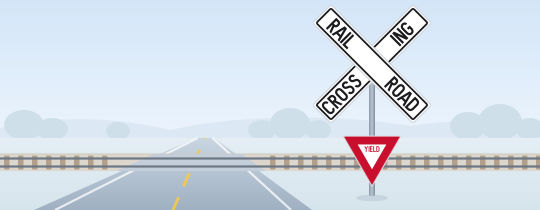
A country road crosses a single track marked only by a white X-shaped RAILROAD CROSSING sign with a YIELD sign under it. There are no lights and no gate. According to the Connecticut Driver’s Manual, what does that crossbuck mean?
Show answer
Correct answer: The same as a YIELD sign: slow down and be ready to stop
Why
In Connecticut a crossbuck carries the same meaning as a YIELD sign, and a train always has the right-of-way. With no lights or gate to warn you, slow down, check both directions and stop if a train is coming. Farther back, a round yellow sign with the letters RR tells you a crossing is near.
23Safe driving
It’s raining and you’re following a motorcycle on the highway. What following distance does the Connecticut Driver’s Manual recommend?
Show answer
Correct answer: 4 seconds or more
Why
The manual’s baseline is three seconds: when the vehicle ahead passes a fixed point, count, and if you reach that point before “three-one-thousand,” drop back. On slippery roads, behind motorcycles or large vehicles, in poor visibility or when someone is tailgating you, stretch it to four seconds or more. Rain plus a motorcycle gives you two reasons for extra room.
24Speed limits
Thick fog settles over a stretch of Route 2 where the posted limit is 50 mph. You keep driving at exactly 50. Can you still be ticketed?
Show answer
Correct answer: Yes, your speed must suit the conditions
Why
Connecticut’s basic speed rule says your speed must suit the road, the traffic and the weather, and being under the posted number doesn’t excuse failing to slow for hazards. In fog, drop your speed until you could stop inside the stretch of road you can actually make out. The manual is clear that going too fast for conditions can earn a ticket even at the limit.
25Permit & teen rules
A 16-year-old has finished the full course at a licensed driving school. How long must she hold her learner’s permit before she can take the road test?
Show answer
Correct answer: 120 days
Why
Teens trained through a driving school or high school program must hold the permit at least 120 days; with home training, the wait is 180 days. Either way, at least 40 hours of behind-the-wheel practice are required too. Use that time for rain, darkness and highway merges, not just laps around the neighborhood.
26Alcohol & phones
A driver arrested for impaired driving in Connecticut refuses to take a breath, blood or urine test. What happens to the license after a first refusal?
Show answer
Correct answer: At least 45 days’ suspension, then a year with an interlock
Why
Under Connecticut’s implied consent law, driving means you’ve agreed to a chemical test if you’re arrested for impaired driving. Refusing, at any age, brings a license suspension of at least 45 days, followed by one year with an ignition interlock device for a first refusal. Saying no doesn’t dodge a suspension; it triggers one.
27Lane markings
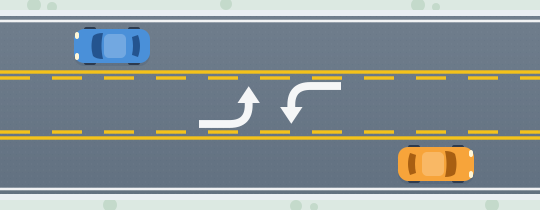
The road ahead has a middle lane edged with paired yellow lines, solid on the outside and broken on the inside, and left-turn arrows painted in opposite directions. What is that lane for?
Show answer
Correct answer: Left turns by traffic from both directions
Why
This shared center lane lets drivers from both directions wait for a gap and turn left, and make U-turns where those are permitted. Never drive along it to pass or to get ahead of traffic. Move in shortly before your turn and watch for an oncoming driver using the same lane.
28Parking
You’re parallel parking on a two-way street in Connecticut. Which of these is the legal way to leave your car?
Show answer
Correct answer: On the right, headed in the direction of traffic, within 12 inches of the curb
Why
Connecticut law has you park on the right-hand side of the road, pointed the same way as traffic, with the curb-side wheels 12 inches or less from it. Parked against traffic, you’d have to cut across the oncoming lane to leave, and a car sitting far from the curb squeezes the lane for everyone else.
29Alcohol & phones
Since October 1, 2026, how does Connecticut treat texting while driving through a highway work zone?
Show answer
Correct answer: As reckless driving, a criminal offense
Why
A 2026 law makes any distracted-driving violation inside a highway work zone count as reckless driving, a crime rather than a simple ticket. Work zones bring narrow lanes, sudden stops and people on foot just inches from traffic. Put the phone away before you reach the first orange sign.
30Right-of-way
You’re halfway through an intersection on a green light when a fire engine with its siren wailing and lights flashing comes up behind you. What should you do?
Show answer
Correct answer: Finish crossing, then ease to the right edge and stop until it goes by
Why
Connecticut law says to move as close as you can to the right edge, away from intersections, and stay stopped until the emergency vehicle is past. If you’re already in the intersection, finish crossing first, because stopping in the middle can box the fire engine in. Getting in its way can mean a fine of up to $250, and afterward stay at least 500 feet behind a fire truck answering an alarm.
Round 4 · Questions 31–40
31Sharing the road
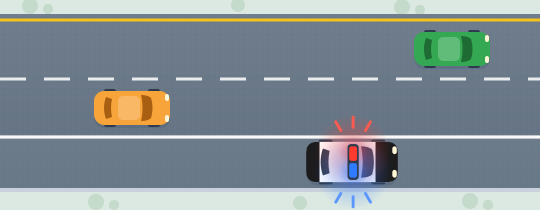
On a highway with two lanes in your direction, a police car with flashing lights is stopped on the right shoulder, and you’re in the right lane. What does Connecticut’s move-over law require?
Show answer
Correct answer: Slow down below the speed limit and move one lane to the left if it’s safe
Why
Coming up on a police car, ambulance, fire truck, wrecker or road-maintenance truck that’s stopped with lights flashing, ease below the limit and, with two or more lanes your way, shift over a lane when it’s safe. Connecticut also wants you to move over a lane for any vehicle stopped on the shoulder or breakdown lane, flashing lights or not. If skipping these steps injures someone in the emergency vehicle, the fine can reach $5,000.
32Speed limits
A driver on I-95 is clocked far above the limit. Under Connecticut law, what is the lowest speed that, once exceeded, counts as reckless driving all by itself?
Show answer
Correct answer: 85 mph
Why
Going over 85 mph is reckless driving in Connecticut, a criminal offense: a first conviction can bring a $100–$300 fine, a jail term of as long as 30 days, or the two together. A driver under 18 also loses the license for six months on a first reckless-driving offense. Above 100 mph, a separate reckless charge carries fines of up to $600.
33Road signs
At a mid-block crosswalk, an overhead pedestrian beacon that is normally dark switches on. It shows yellow, then solid red, and now its red lights are flashing. What should you do?
Show answer
Correct answer: Stop, then go once pedestrians have cleared the crosswalk
Why
This is a HAWK beacon, which lights up only after someone pushes the crossing button. Solid red means stop and wait; flashing red means stop, then continue once the crosswalk is clear. Think of it as a stop sign that switches on only when someone needs to cross.
34Alcohol & phones
Under Connecticut’s 2026 phone rules, which of these may an adult still do while driving?
Show answer
Correct answer: Follow a navigation map on a phone sitting in a dashboard mount
Why
Adults may use a phone only in hands-free mode and may not hold or prop it with any part of the body. No video may be visible from the driver’s seat, except a mounted GPS map and backup or parking cameras. Set your route before you pull out so you aren’t tapping the screen on the move.
35Parking
You park on a steep downhill street in Waterbury, next to a curb. Besides setting the parking brake, what should you do with the front wheels?
Show answer
Correct answer: Turn them sharply toward the curb
Why
The Connecticut manual’s rule for hills is to aim the front wheels toward the curb or road edge, so a car that starts rolling heads away from traffic. Facing downhill, the curb then catches the front tire. Always set the parking brake and leave an automatic in park.
36Permit & teen rules
As of January 1, 2026, what must every Connecticut learner’s permit applicant finish before taking the knowledge test?
Show answer
Correct answer: A free online Work Zone Safety Course
Why
Since January 1, 2026, everyone applying for a learner’s permit must complete Connecticut’s free online Work Zone Safety Course, which takes under an hour, and bring the certificate to the test. Work zones show up on the test itself as well: state law puts at least one work-zone question on every Class D knowledge test. Finish the course a few days ahead so the printout is ready.
37Right-of-way
A yellow diamond sign showing three curved arrows in a ring tells you a roundabout is coming. When you reach the entry, a car is already going around inside. Who has the right-of-way?
Show answer
Correct answer: The car already circling in the roundabout
Why
Connecticut law gives vehicles already in a rotary or roundabout the right-of-way over those entering. Wait for a gap, circle with the island on your left and keep moving; don’t stop inside to wave someone in. Signal right just before your exit.
38Safe driving
You plan to turn right into a shopping center driveway. By Connecticut law, how long must your turn signal be on before you turn?
Show answer
Correct answer: Continuously over the final 100 feet or more
Why
Connecticut law wants your signal blinking without a break through the final 100 feet before any right or left turn. The manual adds a timing check: signal three seconds or more before you move, but not so early that others think you’re turning into an earlier driveway. Switch it off once the turn is done.
39Permit & teen rules
For the first six months after a 16-year-old gets a Connecticut license, who may ride along as a passenger?
Show answer
Correct answer: Parents or a guardian, or one instructor or driver 20+ licensed 4+ years
Why
In the first six months, a new teen driver may carry only parents or a legal guardian (at least one of them licensed), or one passenger who is a licensed instructor or a driver 20 or older licensed for four years with no suspension. In months seven through twelve, immediate family members may ride too. After the license’s first year, the passenger limits end.
40Crashes & emergencies
You have a minor fender-bender on I-91. Nobody is hurt and both cars can still be driven safely. What does Connecticut law expect you to do?
Show answer
Correct answer: Move the cars off the travel lanes to the nearby shoulder
Why
After a crash with only property damage on a limited-access highway, Connecticut drivers must move their vehicles off the traveled lanes to the nearby shoulder if they can be driven safely. Staying in a live lane invites a second, worse crash. Then trade names, license and registration details, and report the crash to police.
Connecticut DMV knowledge test at a glance
Key facts to have down before your DMV appointment.
Connecticut · Class D knowledge test
20 of 25 to pass.
25 questions · In person
20 of 25 answers right to pass
By appt.in person at 10 DMV offices; there’s no online test
$40 + $19testing fee, then the learner’s permit
7 dayswait to retest after a fail, plus the $40 again
Spanishone of 11 languages on the electronic test
Freeonline Work Zone Safety Course you finish first
20/40vision, plus 140° of side vision
Under 18? Your road to a license
16Learner’s permitFinish the free Work Zone Safety Course online, then pass the vision test and the 25-question knowledge test at a DMV office.
30 hrsDriver trainingComplete 30 hours of class through a driving school, high school or home training. That total includes the 8-hour Safe Driving Practices course and a 2-hour session a parent attends with you.
40 hrsPractice and waitLog at least 40 hours behind the wheel with a driving school or a qualified trainer (20+, licensed 4+ years), and hold the permit 120 days, or 180 with home training.
48 hrsRoad testYour trainer signs off on your hours at the DMV. Pass the road test, then wait 48 hours to pick up your license.
Year 1First-year limitsMonths 1–6: passengers limited to a parent, guardian or one qualified adult; months 7–12, immediate family too. Until 18, no driving 11 p.m.–5 a.m. without a work, school, religious or medical reason, and no phone, even hands-free.
18 or older and never licensed? You still start with a learner’s permit: hold it at least 90 days and finish the 8-hour Safe Driving Practices course before your road test.
What’s on the Connecticut permit test
Test questions come only from the Connecticut Driver’s Manual (revised March 2023), and state law puts at least one work-zone and one distracted-driving question on every test. We also cover the newer laws the manual doesn’t show yet, like the 2026 phone rules. Here’s what to know in six key areas.
Road signs
Shapes give it away: an octagon is STOP, a point-down triangle is YIELD, a five-sided sign marks a school zone or crossing.
A yellow pennant posted on the driver’s left marks where a no-passing zone begins.
Orange means road work. Fines double in active work zones, and every test includes a work-zone question.
Right-of-way
Four-way stop: the first car to stop goes first; if two arrive together, the one on the right goes.
Yield to a walker who raises a hand at the curb or puts a foot, cane or stroller into the crosswalk.
School bus or ice cream truck flashing red with its stop arm out: stop at least 10 feet away.
Speed limits
Your speed must fit the road, traffic and weather, even when you’re under the posted limit.
65 mph is the top, and only on multilane, limited-access highways; everywhere else the ceiling is 55.
Over 85 mph is reckless driving, a criminal charge, not just a ticket.
Parking
Park at least 10 feet from a hydrant, with your wheels within 12 inches of the curb.
Stay 30 feet back from an intersection, a marked crosswalk, or a stop or yield sign.
On a hill, set the brake and point the front wheels toward the curb or road edge.
Alcohol & phones
BAC limits: 0.08% at 21 and over, 0.04% in a commercial vehicle, 0.02% under 21.
Refuse the chemical test and lose your license for at least 45 days, then drive a year with an interlock.
Since October 1, 2026, no holding the phone at all, even at a red light: hands-free only.
Teen rules
On a permit, ride only with your trainer and parents or guardian; since October 2026, a sibling with a permit too.
Licensed but under 18? Off the road 11 p.m.–5 a.m., except for work, school, religious or medical reasons.
Under 18, the phone stays untouched behind the wheel, hands-free included.
Connecticut numbers to know
Six Connecticut figures worth knowing cold before test day.
100 ftof steady turn signal before you turn
10 ftminimum gap between your car and a hydrant
30 ftback from a crosswalk, stop sign or yield sign
500 ftto switch to low beams for an oncoming car
3 secfollowing gap in good conditions, 4+ in bad
0.02%BAC that’s already illegal under 21
Your Connecticut course, in your pocket
These 40 questions are just the warm-up. The app gives you 486 Connecticut practice questions, 36 short lessons and the why behind every answer.
36 short lessonsFour levels, from fundamentals to expert, then a full practice exam.
486 Connecticut questions332 of them with pictures.
Your most-missed questionsA review lesson built from the questions you miss most.
Exam simulatorTake full practice exams and watch your readiness grow.
Connecticut permit
Your Connecticut path is ready.
36 lessons, 486 questions and full practice exams. In English and Spanish.
How many questions are on the CT DMV permit test, and what score do I need?
The knowledge test has 25 questions, and you pass with 20 correct, which is 80%. Every question comes from the Connecticut Driver’s Manual, and state law requires at least one on work zones and one on distracted driving. You take the vision test first, at the same appointment.
What happens if I fail the Connecticut knowledge test?
You wait seven days, book a new appointment and pay the $40 testing fee again. The DMV doesn’t publish a cap on attempts, so each retry mostly costs you a week and the fee. Practicing until 80% comes easily is the cheaper route.
Can I take the Connecticut permit test online?
No. Connecticut gives the vision and knowledge tests in person only, by appointment, at 10 DMV offices: Bridgeport, Cheshire, Danbury, Enfield, Hamden, Norwalk, Old Saybrook, Waterbury, Wethersfield and Willimantic. You prepay the fees online when you book. Before test day you also finish the free online Work Zone Safety Course, required since January 1, 2026.
Can I take the CT permit test in Spanish?
Yes. The electronic test comes in 11 languages, Spanish included, and 24 more are available as a paper test on request. CT DMV also publishes the driver’s manual in Spanish, the Manual del conductor. This practice test and the app work in Spanish too.
How old do you have to be to get a learner’s permit in Connecticut?
16. Teens then complete driver training (30 hours of class, including a 2-hour session a parent attends), log at least 40 hours behind the wheel and hold the permit 120 days, or 180 with home training, before the road test. Passengers are limited for the license’s first year, and until 18 there’s no phone use, even hands-free, and no driving from 11 p.m. to 5 a.m. except for work, school, religious or medical reasons.
How much does a Connecticut learner’s permit cost?
Plan on $40 for testing, which covers the vision, knowledge and road tests, plus $19 for the learner’s permit itself. You prepay online when you book. After you pass the road test, your first Connecticut license costs $84.
What should I bring to the knowledge test?
Proof of identity, your Social Security number and Connecticut residency, a signed Form R-229, the printed Work Zone Safety Course certificate, and your glasses or contacts if you wear them. Under 18 and no parent coming along? Bring the signed parental consent Form 2-D. You need 20/40 vision to pass the eye test.
What’s the best way to study for the Connecticut permit test?
The DMV draws every question from the Connecticut Driver’s Manual, so read it first. Then drill until you clear 80% with room to spare: work through the 40 questions above, and keep going in the app with 486 Connecticut questions and 36 short lessons, each answer explained.