Get ready for the NC DMV written test: 40 free questions covering road signs, school bus stops, speed limits and North Carolina’s teen license levels. Pick an answer and see instantly why it’s right.
Four rounds of 10 questions on signs, right-of-way, speed limits, school buses, alcohol and North Carolina’s teen license levels. Every answer comes with a quick explanation.
Round 1 · Questions 1–10
1Right-of-way
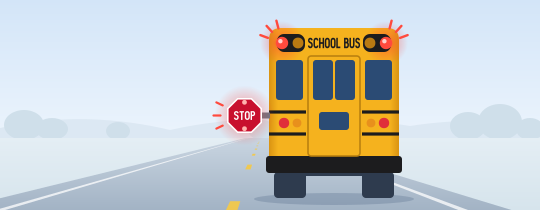
On a two-lane road, the school bus just ahead of you stops, flashes its red lights and swings out its stop arm. When may you move again?
Show answer
Correct answer: Only after the stop arm is pulled in, the red lights go off and the bus starts moving
Why
North Carolina law keeps you stopped until all three things happen: the stop arm is withdrawn, the red lights go dark and the bus pulls away. On a two-lane road, drivers coming from the other direction must stop as well. Passing a stopped school bus brings a fine of at least $500 and 5 license points.
2Road signs
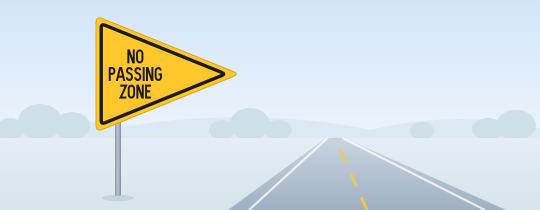
A yellow sign shaped like a sideways pennant is posted on the left shoulder of a two-lane highway. What is it telling you?
Show answer
Correct answer: A no-passing zone begins here
Why
The pennant stands on the driver's side, right where your eyes go when you think about pulling out to pass, and it points to the start of the no-passing zone. In North Carolina it backs up the rectangular DO NOT PASS sign. Finish any pass before you reach it, then stay in your lane until the zone ends.
3Speed limits
Inside a North Carolina town, you're on a paved street with a painted center line. You haven't passed a speed limit sign since the town line. How fast may you go?
Show answer
Correct answer: 35 mph
Why
Unless a sign says otherwise, the limit inside city and town limits is 35 mph, and outside them it's 55 mph. Starting December 1, 2026, unpaved roads and roads with no painted center line get a lower default of 25 mph. Posted signs override all of these, and rain or a crowded street can call for less.
4Parking
Under North Carolina law, how much space must you leave between your parked car and a fire hydrant?
Show answer
Correct answer: At least 15 feet
Why
State law keeps parked vehicles at least 15 feet from a hydrant, in either direction, and the same distance from the entrance to a fire station. Firefighters need that room to reach the hydrant and connect hoses fast. Fire lanes are off-limits for parking altogether.
5Alcohol & phones
A 19-year-old has one beer at a party, waits an hour and drives home. A breath test finds a small amount of alcohol, far below 0.08%. What does North Carolina law say?
Show answer
Correct answer: An offense, because under 21 any alcohol in the body is illegal
Why
North Carolina has zero tolerance for drivers under 21: driving with any alcohol in the body is against the law, and a conviction brings a one-year license revocation. The 0.08% limit applies to drivers 21 and older, and 0.04% to commercial drivers. Under 21, the only safe amount before driving is none.
6Safe driving
Steady rain begins, and you switch on your windshield wipers. What else does North Carolina law require?
Show answer
Correct answer: Turn on your headlights
Why
North Carolina requires headlights whenever your wipers are running because of rain, snow, sleet, fog or smoke, day or night. The only exception is using intermittent wipers in a light mist. Headlights make you easier to spot in gray weather; in fog, keep them on low beam.
7Permit & provisional license
Which set of requirements must a North Carolina teen meet before getting a Level 2 limited provisional license?
Show answer
Correct answer: Be 16, hold a Level 1 permit for 9 months and log 60 hours, 10 at night
Why
Level 2 starts at 16, after at least nine months on a Level 1 permit and a signed log of 60 supervised hours, including 10 at night. No more than 10 hours in a single week count toward the total, so start logging early. You also need six months with no moving violation, seat belt or phone convictions, and a road test.
8Right-of-way
Your light is red. You're on a one-way street, and the street you'd like to enter on your left also runs one way. May you make that left on red in North Carolina?
Show answer
Correct answer: No; it's never legal here, so wait for the green light
Why
North Carolina never allows a left turn against a red light, even when both streets carry traffic in a single direction. Right on red is legal after a full stop and after yielding to traffic and pedestrians, unless a sign prohibits it. For a left, wait for the green.
9Lane markings
Driving at night, you notice small blue reflectors set into the pavement. What do they mark?
Show answer
Correct answer: The location of a nearby fire hydrant
Why
In North Carolina, blue reflective pavement markers show where fire hydrants are, which helps fire crews find them in the dark. Red reflective markers mean something very different: they face drivers who are going the wrong way. If red reflectors are shining back at you, get off the road safely and turn around.
10Crashes & emergencies
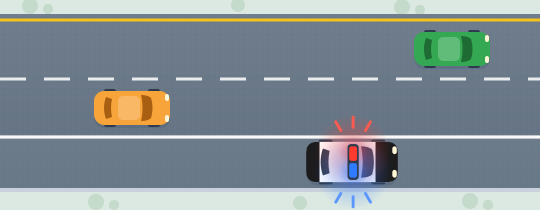
On a highway with two lanes in your direction, a police car is stopped on the right shoulder with its lights flashing. You're in the right lane. What does North Carolina's Move Over law require?
Show answer
Correct answer: Move to the left lane if safe; if not, slow down and be ready to stop
Why
The Move Over law covers emergency and public service vehicles stopped within 12 feet of the road with warning lights on, from police cars and ambulances to tow trucks, utility trucks and highway maintenance crews. Change to a lane that isn't next to the vehicle when you safely can; otherwise, slow down and be ready to stop. Ignoring the law costs a $250 fine.
Round 2 · Questions 11–20
11Road signs
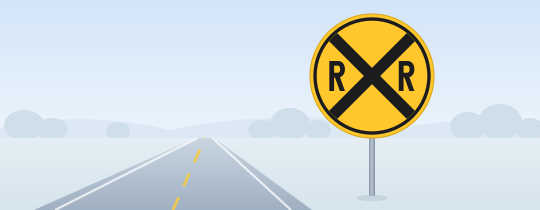
A round yellow sign with a large black X and the letters RR appears ahead. With a train approaching the crossing, what is your legal stopping zone?
Show answer
Correct answer: At least 15 but no more than 50 feet back from the closest rail
Why
The round sign is an early warning that a railroad crossing is ahead; the white X-shaped crossbuck marks the crossing itself. When a signal, a lowered gate, a flagger or an oncoming train calls for a stop, North Carolina law puts your stopping point at least 15 feet, and no more than 50 feet, short of the closest rail. A train at 55 mph can need more than a mile to stop, so never try to beat it.
12Right-of-way
You and another driver arrive together at a crossroads that has no traffic signs or lights. The other car is approaching from your right. Who should proceed first?
Show answer
Correct answer: The other driver; you yield to the car on your right
Why
Where nothing controls an intersection, any vehicle already in it goes first. If two vehicles get there together, the one on the left gives way to the one on the right. Even when it's your turn, ease off the gas as you approach and make sure the other driver is really yielding.
13Speed limits
What is the highest speed limit that may be posted anywhere in North Carolina, interstates included?
Show answer
Correct answer: 70 mph
Why
State law caps every posted limit at 70 mph, a figure used on interstates and other controlled-access highways. Many highway stretches are posted lower, so read the signs rather than assuming the top number. Outside towns, where no sign is posted, the default is 55 mph.
14Parking
On a street with curbs, how far back from an intersection must you park, measured from the point where the curb lines meet?
Show answer
Correct answer: 25 feet
Why
North Carolina bans parking within 25 feet of the spot where the curb lines of an intersection meet. Where there is no curb, the distance is 15 feet from where the property lines meet. Cars parked tight against a corner hide pedestrians and turning vehicles from other drivers.
15Alcohol & phones
You're 30 and driving on a North Carolina road. Which of these breaks the law?
Show answer
Correct answer: Typing a text message while the car is moving
Why
North Carolina bans texting and email behind the wheel for drivers of every age: you may not type or read messages while you drive. It is allowed only when you are lawfully parked or stopped, or through voice-operated technology. A violation costs $100 plus court costs, so put the phone away before you pull out.
16Safe driving
Besides the hours from sunset to sunrise, when does North Carolina require your headlights to be on?
Show answer
Correct answer: Whenever you can't clearly see a person 400 feet ahead
Why
Headlights are required from sunset to sunrise and any time conditions keep you from clearly seeing a person 400 feet ahead, such as at dusk or in heavy rain. In town, use low beams. If you're unsure whether you need them, switch them on: being seen matters as much as seeing.
17Permit & provisional license
You're 15 and just got a Level 1 permit. Who may sit beside you as your supervising driver?
Show answer
Correct answer: Your grandmother, who has been licensed for 40 years
Why
A supervising driver must be a parent, grandparent or guardian, or another adult your parent or guardian approves, and must have been licensed for at least five years. At Level 1, the supervisor sits in the front seat next to you and no one else may ride up front. You never drive alone on a Level 1 permit.
18Road signs
Besides the knowledge test, North Carolina gives a separate road sign test. How many of its 12 signs must a Class C applicant identify correctly?
Show answer
Correct answer: 9 of them
Why
For a regular Class C license you must get 9 of 12 signs right, and you need to know each sign by its color and shape and explain what it means. Shape drills pay off: an octagon is always STOP, a five-sided sign means a school, a pennant means no passing. The knowledge test is scored on its own, with an 80% pass mark.
19Sharing the road
In a no-passing zone on a two-lane road, you come up behind a bicyclist going your way who is not turning left. When may you pass?
Show answer
Correct answer: If you give the rider at least 4 feet or move fully into the left lane
Why
North Carolina lets you pass a bicycle or moped in a no-passing zone if it is going your way and not turning left, as long as you leave at least 4 feet of space or move completely into the left lane. Every other passing rule still applies, so be sure the oncoming lane is clear. Bicycles are vehicles under state law, and riders may use the full lane.
20Crashes & emergencies
You have a minor crash on a busy road. No one is hurt, and both cars can still be driven. What does North Carolina's Fender Bender law expect you to do?
Show answer
Correct answer: Move the cars out of the travel lanes onto the shoulder
Why
After a minor crash with no injuries, drivable vehicles must be moved out of the travel lanes to the shoulder; leaving them in the road can cost $110 plus court costs. Then trade names, addresses, license numbers, registration and insurance details with the other driver. A crash with an injury, a death or $1,000 or more in damage must be reported to police right away.
Round 3 · Questions 21–30
21Road signs
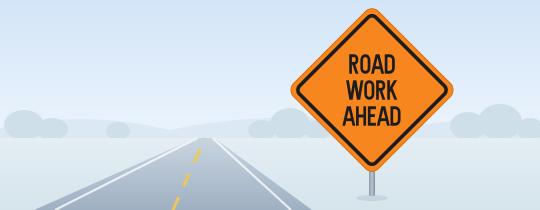
You pass an orange, diamond-shaped ROAD WORK AHEAD sign. If the work zone is posted with penalty signs, what does speeding there cost?
Show answer
Correct answer: The regular fine plus an extra $250 penalty
Why
Orange is the color North Carolina saves for construction and maintenance zones, while ordinary warning signs are yellow. In a work zone marked with penalty signs, speeding adds $250 on top of the usual fine. The zone runs from the first work-zone sign to the last one, so keep your speed down all the way through.
22Right-of-way
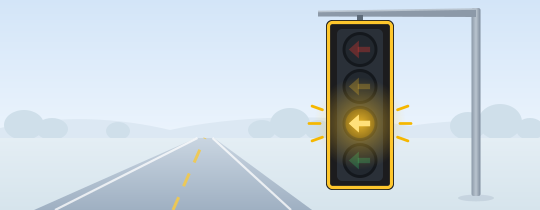
The signal for your left-turn lane shows a flashing yellow arrow. What should you do?
Show answer
Correct answer: Turn left only after yielding to oncoming traffic and pedestrians
Why
A flashing yellow arrow allows the turn but doesn't protect it, so oncoming cars may still be coming through. Give way to approaching vehicles and to people in the crosswalk, then go when there's a safe gap. A solid yellow arrow is different: it means the arrow is about to change, so prepare to stop.
23Speed limits
The sign says 55 mph, but heavy rain has cut your view of the road ahead. What speed does North Carolina law expect?
Show answer
Correct answer: Only as fast as is reasonable and safe in the rain, even well under 55
Why
In North Carolina the posted number is only a ceiling: your speed must also be reasonable and prudent given the weather, traffic and road. Being under the posted limit is no excuse if you fail to slow down enough to avoid a crash. In rain, the handbook also says to leave at least twice your normal following distance.
24Parking
On a rural highway, when is it legal to park on the shoulder?
Show answer
Correct answer: Only where drivers both ways can see your car from 200 feet
Why
North Carolina forbids parking on the paved or main-traveled part of a highway. The shoulder is allowed only where approaching drivers in both directions can clearly see your vehicle from 200 feet, so never stop just beyond a bend or a hilltop. On an interstate, stop only in a designated area or in an emergency.
25Alcohol & phones
Charged with DWI, a driver refuses to take a breath test. What happens to the driver's North Carolina license?
Show answer
Correct answer: An immediate 30-day revocation, then at least 12 more months
Why
Under North Carolina's implied-consent law you can refuse a chemical test, but the refusal costs you your license on the spot for 30 days, and NCDMV then revokes it for at least 12 more months. The refusal can also be used against you in court. Refusing never makes a DWI case go away.
26Safe driving
On a dry road, what following distance does the North Carolina Driver Handbook teach as the minimum?
Show answer
Correct answer: A gap of at least two seconds
Why
Pick a fixed object such as a sign; when the vehicle ahead passes it, start counting. If you reach the object before two seconds are up, you're following too closely. On wet roads at least double the gap, and on snow or ice leave much more room.
27Permit & provisional license
You have a Level 2 license and are driving to the mall on a Saturday. No supervisor and no family member is with you. How many friends under 21 may ride along?
Show answer
Correct answer: One
Why
Without a supervising driver, a Level 2 driver may carry only one passenger under 21 from outside the family. Family and household members under 21 don't count toward that limit, but if one of them is along, the only outside passenger under 21 allowed is a student riding directly to or from school. Once you move up to Level 3, the passenger limit ends.
28Road signs
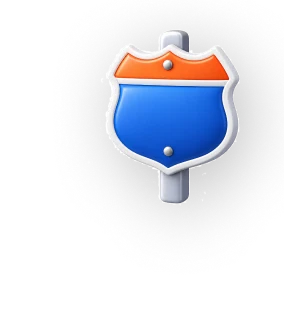
Traveling across North Carolina, you see a route number inside a diamond-shaped marker. Which kind of road is it?
Show answer
Correct answer: A North Carolina state route
Why
North Carolina posts its own state route numbers in diamond-shaped markers. U.S. routes use a shield, interstates use a red, white and blue shield, and secondary roads get rectangular signs. A handy pattern: odd route numbers usually run north and south, even numbers east and west.
29Lane markings
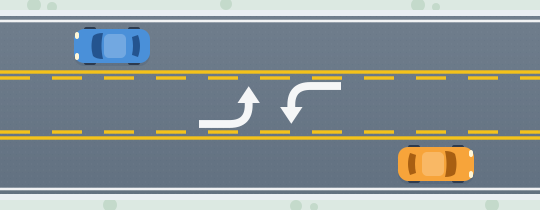
A center lane runs down the middle of the road. Each side of it has a pair of yellow stripes, one solid and one dashed, and turn arrows point both ways. What is the lane for?
Show answer
Correct answer: Left turns by drivers from either direction
Why
You're looking at a center turn lane shared by left-turning drivers from both directions. The North Carolina handbook says it must not be used for passing or for merging into traffic. Move into it just before your turn, and watch for an oncoming driver turning from the same lane.
30Right-of-way
A school bus has stopped with its stop arm out on the far side of a road that has one lane each way plus a center turning lane. You are driving toward the bus. What must you do?
Show answer
Correct answer: Stop, because on this road traffic from both directions must stop
Why
A center turning lane does not count as a divider. On a two-lane road, with or without a center turning lane, everyone stops for a school bus that is loading or unloading. Oncoming traffic may keep going only on a road divided by a median or barrier, or on a road of four or more lanes with a center turning lane.
Round 4 · Questions 31–40
31Road signs
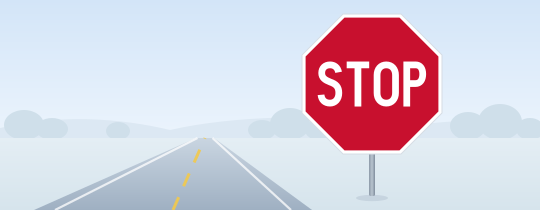
You come to a STOP sign, but no stop line or crosswalk is painted on the road. Where should you stop?
Show answer
Correct answer: At the point nearest the intersection with a clear view of cross traffic
Why
The red octagon is used only for STOP signs, and the stop must be complete. A painted stop line comes first; without one, stop before the crosswalk; with neither, stop at the point nearest the intersection where you can see the cross traffic. These signs are usually posted 6 to 50 feet from the intersection, so the post alone is not a reliable guide.
32Right-of-way
You have a green arrow for a U-turn. Across the intersection, drivers turning right have a green arrow at the same time. Who has to yield?
Show answer
Correct answer: You, the driver making the U-turn
Why
When a U-turn and the opposing right turn run on green arrows together, both cars head for the same lanes. The North Carolina Driver Handbook says the U-turning driver yields to the right-turning traffic. Check the far lanes before you swing around, even on a green arrow.
33Speed limits
On a highway posted 60 mph, you are caught going 76 mph. What can happen to your North Carolina license?
Show answer
Correct answer: It can be revoked for at least 30 days
Why
A conviction for driving more than 15 mph over the limit at a speed above 55 mph costs a North Carolina driver the license for at least 30 days. At 76 in a 60 zone you are 16 mph over, so both conditions are met. Speeding also brings license points, and 12 points within three years can lead to a suspension.
34Speed limits
An interstate posted at 55 mph also has minimum-speed signs. What is the minimum speed there?
Show answer
Correct answer: 40 mph
Why
Where minimum-speed signs are posted, North Carolina sets the floor at 40 mph in a 55 mph zone and 45 mph in a zone of 60 mph or more. Driving so slowly that you hold up the normal flow of traffic is against the law as well.
35Alcohol & phones
You're driving home with a bottle of wine that was opened at dinner. Where in the car may it legally ride?
Show answer
Correct answer: In the trunk
Why
North Carolina keeps opened alcohol out of the passenger area, meaning any space a seated driver or passenger can reach, including the glove box. A bottle with a broken seal still counts as opened after you push the cork back in. Put it in the trunk or, in a vehicle without a trunk, behind the last upright seat.
36Alcohol & phones
A 17-year-old with a provisional license wants to take a hands-free call from a friend while driving. Is that allowed in North Carolina?
Show answer
Correct answer: No; under 18, only emergency calls or calls to a parent, guardian or spouse
Why
Drivers under 18 may not use a mobile phone while driving, and that includes hands-free devices. The exceptions are emergency calls, such as to 911, and calls to a parent, legal guardian or spouse. A violation brings a $25 fine and can delay your move up to the next license level.
37Safe driving
You plan to turn right off a highway posted 55 mph. How far before the turn must your signal be on?
Show answer
Correct answer: 200 feet
Why
North Carolina wants your signal on for the final 100 feet ahead of any turn or stop, and for the final 200 feet before a turn where the limit is 45 mph or higher. At highway speed those 200 feet go by in moments, so the earlier signal gives drivers behind you time to slow down.
38Permit & provisional license
You have a Level 2 license and are driving to a friend's house. At which of these times must a supervising driver be in the car with you?
Show answer
Correct answer: 10:30 p.m. on a Friday
Why
Level 2 drivers may drive alone from 5 a.m. to 9 p.m. From 9 p.m. to 5 a.m. a supervising driver must ride along, unless you are driving directly to or from work, or to or from a volunteer fire, rescue or EMS activity as a member. These time limits end at Level 3.
39Road signs
You pass a five-sided school zone sign. What is true of school zone speed limits in North Carolina?
Show answer
Correct answer: They're posted with their days and hours and can't go below 20 mph
Why
The pentagon shape is used only for school zones and school crossings. The state or local authorities set each school zone's limit and post the days and hours it applies, but the law never allows one below 20 mph. Speeding in a school zone carries a $250 penalty, so check the posted hours as you approach.
40Crashes & emergencies
Your car stalls on a railroad crossing and won't restart. After getting everyone out and away from the tracks, what should you do next?
Show answer
Correct answer: Call the emergency number on the blue sign posted at the crossing
Why
Every highway-railroad crossing in North Carolina has a blue Emergency Notification System sign facing each direction. It lists the crossing's ID number and the railroad's emergency phone number, so the railroad knows exactly which crossing is blocked. Make the call from a safe spot well away from the tracks.
North Carolina DMV written test at a glance
The numbers that matter before your NCDMV visit.
North Carolina · Class C knowledge test
80% to pass.
Knowledge test + road sign test
At least 80% of your answers right
9 of 12road signs to name on the separate sign test
7 dayswait before you retake a failed test
$25.50learner permit, teen or adult
In personat a driver license office; walk-ins welcome
20/40vision standard (one eye is enough)
Audioor oral test, available on request
Under 18? Your road to a license
15Level 1 learner permitFinish driver ed (30 hours in class, 6 behind the wheel), then pass the written, sign and vision tests with a parent or guardian there.
9 moSupervised practiceLog 60 hours, 10 at night, with a supervisor licensed 5+ years. For the first 6 months, drive only 5 a.m.–9 p.m.
16Level 2 limited provisionalPass the road test. Drive solo 5 a.m.–9 p.m.; only one passenger under 21 from outside the family.
+6 moLevel 3 full provisionalAfter six clean months, upgrade online: the curfew and passenger limits end.
18Regular Class C licenseTurn 18 and upgrade online.
18 or older? Pass the vision, sign and knowledge tests for a learner permit good for 18 months, or add the road test and go straight to a license.
What’s on the North Carolina permit test
Your study guide is the North Carolina Driver Handbook. Here’s what to know cold in six key areas.
Road signs
An octagon always means STOP; a red-and-white triangle pointing down means YIELD.
A yellow pennant on the left marks a no-passing zone; a five-sided sign means a school is near.
A diamond-shaped route marker means a North Carolina state route; orange signs mean a work zone.
Right-of-way
No signs or signals and you arrive together? Yield to the car on your right.
Right on red is OK after a full stop unless a sign forbids it; left on red is never allowed.
School bus stopped with its arm out on a two-lane road? Traffic both ways stops.
Speed limits
35 mph in cities and towns, 55 mph outside them, unless a sign says otherwise.
70 mph is the most any road may be posted, and bad weather can demand far less.
From December 1, 2026, the default is 25 mph on unpaved roads and roads with no painted center line.
Parking
Keep 15 feet from a fire hydrant or a fire station entrance.
Park at least 25 feet back from the corner where an intersection’s curb lines meet.
On a highway shoulder, drivers must be able to see your car from 200 feet both ways.
Alcohol & phones
BAC limit: 0.08% at 21 and over, 0.04% in a commercial vehicle, zero under 21.
Refuse a breath test and lose your license for 30 days on the spot, then at least 12 months more.
No texting or email while driving at any age; under 18, no phone at all.
Teen rules
Level 1: a supervisor licensed 5+ years always rides beside you, 5 a.m.–9 p.m. for the first 6 months.
Level 2: solo driving 5 a.m. to 9 p.m.; just one non-family passenger under 21.
Everyone in a Level 1 or Level 2 driver’s car must be buckled up.
North Carolina numbers to know
The distances and limits worth memorizing before test day.
100 ftsignal before a turn; 200 ft where the limit is 45 mph or more
2 secminimum following distance on a dry road
15 ftfrom a fire hydrant or fire station entrance
25 ftfrom the corner of an intersection with curbs
15–50 ftback from the closest rail when a train is coming
400 ftheadlights on if you can’t see a person this far ahead
Your North Carolina course, in your pocket
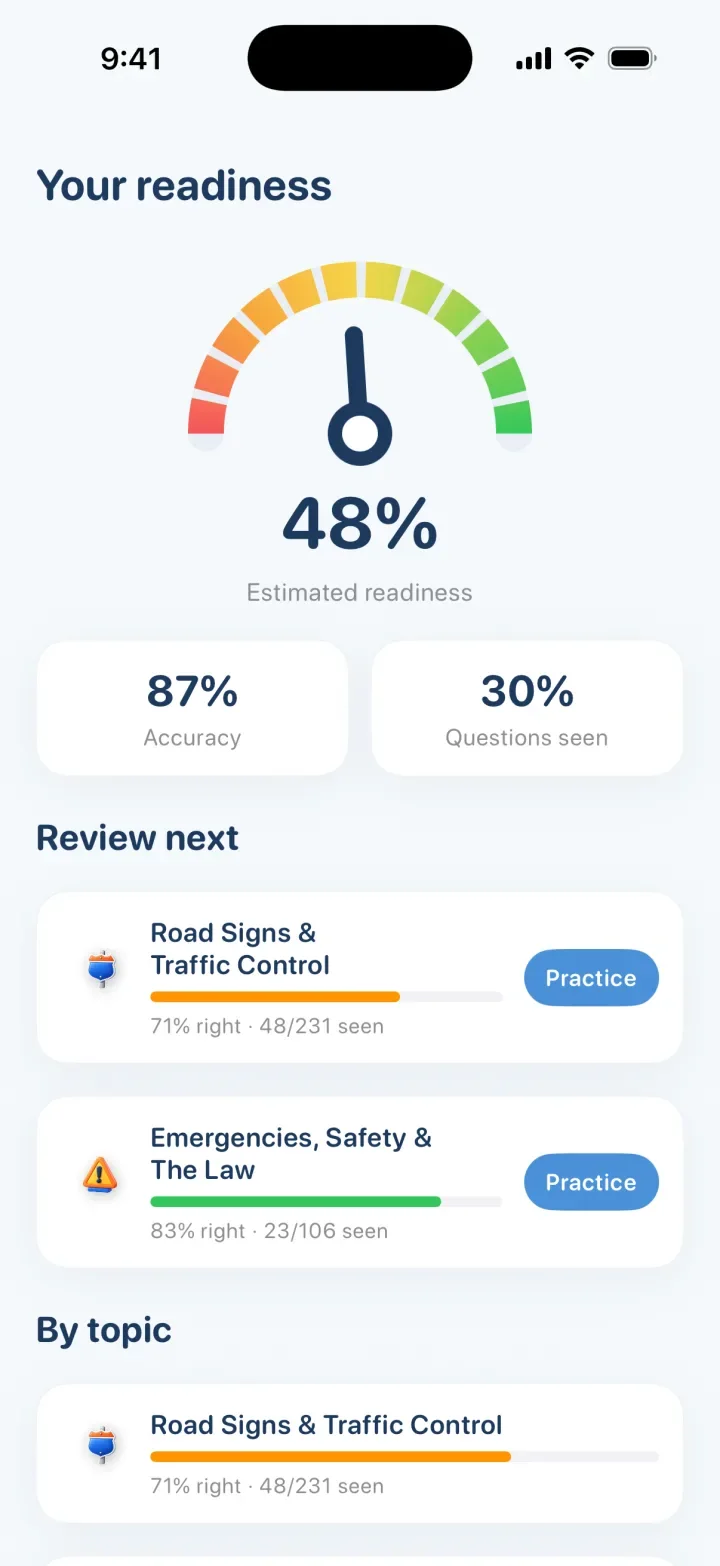
These 40 questions are just the warm-up. The app gives you 472 North Carolina practice questions, 36 short lessons and the why behind every answer.
36 short lessonsFour levels, from fundamentals to expert, then a full practice exam.
472 North Carolina questions309 of them with pictures.
Your most-missed questionsA review lesson built from the questions you miss most.
Exam simulatorTake full practice exams and watch your readiness grow.
North Carolina permit
Your North Carolina path is ready.
36 lessons, 472 questions and full practice exams. In English and Spanish.
What score do I need to pass the North Carolina permit test?
80% on the knowledge test, which you take on a computer at an NCDMV driver license office. There’s also a separate road sign test: for a Class C license you must identify 9 of 12 signs by their color and shape and explain what they mean.
What happens if I fail the NC DMV written test?
You can take it again after seven calendar days. Use that week well: reread the handbook sections that tripped you up, then run the practice rounds until 80% feels easy.
Can I take the North Carolina knowledge test online?
No. The knowledge, sign and vision tests are taken in person at an NCDMV driver license office. Walk-ins are welcome until the office reaches capacity, or you can book an appointment online at skiptheline.ncdot.gov.
Can I take the test in Spanish?
NCDMV offers the written test in different languages and gives oral tests on request, and you can ask for a language interpreter for your visit. The whole handbook is published in Spanish as the Manual de Manejo de Carolina del Norte. This practice test is in Spanish too, and so is the app.
How old do I have to be to get a learner permit in North Carolina?
15. First finish driver education, a course with at least 30 hours of class time and 6 hours of in-car training (you can enroll at 14½). Then pass the written, sign and vision tests with a parent or guardian present. Since October 1, 2026, you no longer need a Driving Eligibility Certificate from your school.
What are the rules for a Level 2 license?
Level 2 starts at 16, after nine months on a Level 1 permit, 60 logged hours and a road test. You may drive alone from 5 a.m. to 9 p.m.; from 9 p.m. to 5 a.m., a supervising driver must ride along unless you’re heading straight to or from work or a volunteer fire, rescue or EMS activity. Without a supervisor, only one passenger under 21 from outside your family may ride, and until 18 no phone use is allowed except in an emergency or to talk with a parent, guardian or spouse. After six clean months, you can move up to Level 3.
How much does a North Carolina permit cost?
A Level 1 limited learner permit, an adult learner permit and a Level 2 limited provisional license each cost $25.50. A Level 3 license is $32.50 at 16 or $26 at 17, and a regular Class C license costs $6.50 for each year it’s valid.
What’s the best way to study for the North Carolina permit test?
Read the North Carolina Driver Handbook and learn every sign by its color and shape for the sign test. Then practice until 80% feels easy: start with the 40 questions above, and let the app walk you through 472 North Carolina questions and 36 short lessons, with an explanation for every answer.