Get ready for both parts of the Virginia DMV knowledge exam: road signs first, then general knowledge. 40 free questions on speed limits, school buses, DUI laws and teen driving rules, each explained the moment you answer.
Four rounds of 10 questions on road signs, right-of-way, speed limits, parking, alcohol and phone laws, and teen rules: 40 in all, the same count as Virginia’s exam, each with a quick explanation.
Round 1 · Questions 1–10
1Road signs
Close to a school, you pass a five-sided, fluorescent yellow-green sign with two children walking on it, and the school-zone lights are flashing. What is Virginia’s standard speed limit in that school crossing zone right now?
Show answer
Correct answer: 25 mph
Why
The five-sided shape belongs to school zones and school crossings, and the yellow-green color flags people on foot. Virginia sets 25 mph in a marked school crossing zone while the signs are up or flashing, usually from 30 minutes before to 30 minutes after school hours, and some localities post an even lower 15 mph. Ease off before the sign, not at it.
2Right-of-way
You and a pickup arrive at the same moment at a crossroads with no signs or traffic lights. The pickup is on the street to your right. Who should go first?
Show answer
Correct answer: The pickup, because you yield to the driver on your right
Why
At an open intersection the first to arrive goes first; when two arrive together, Virginia law has the driver on the left let the one on the right go. Make eye contact before you pull out. Having the right-of-way never means you should force it.
3Speed limits
You turn into a Virginia subdivision and haven’t spotted any speed limit sign. Unless one says otherwise, what is the limit for your car?
Show answer
Correct answer: 25 mph
Why
Virginia’s default for cars in residential, business and school areas is 25 mph. Neighborhood streets come with kids, pets and cars backing out of driveways. If the street looks residential and no sign says different, hold it to 25.
4Parking
You find an open curb space next to a fire hydrant. Under Virginia law, how close to the hydrant may you park?
Show answer
Correct answer: No closer than 15 feet
Why
Virginia keeps parked cars at least 15 feet from a hydrant, the same clearance required at a fire station or rescue squad entrance. Crews need room to hook up hoses in seconds. If you can’t judge the distance, find another space.
5Alcohol & phones
A 19-year-old drives home after a party, and a breath test reads 0.03%. What does Virginia’s zero-tolerance law impose?
Show answer
Correct answer: A year without a license, plus a $500 minimum fine or community service of at least 50 hours
Why
For drivers under 21, Virginia draws the line at 0.02%. Driving after drinking with a BAC from 0.02% up to 0.08% is a Class 1 misdemeanor that costs a year of driving privileges plus a $500 minimum fine or 50 hours of community service, and at 0.08% adult DUI penalties take over. Under 21, the only safe amount is none.
6Safe driving
You’re cruising at 40 mph on a dry, clear road. What following distance does the Virginia manual recommend at that speed?
Show answer
Correct answer: 3 seconds
Why
Virginia scales the gap to your speed: below 35 mph, keep 2 seconds; at 35 to 45 mph, 3 seconds; at 46 to 70 mph, 4 seconds. Start counting when the car ahead passes a fixed point, and stop when you reach it. Add time in rain, heavy traffic or behind a motorcycle.
7Permit & provisional license
On Virginia’s two-part knowledge exam, what happens if you miss one of the 10 road-sign questions?
Show answer
Correct answer: You can’t move on to part two, since the signs must be 10 for 10
Why
Virginia’s exam opens with 10 sign questions, and all of them must be right before the general-knowledge part appears. In that second part you need 24 of 30 correct, or 80%. Master signs by shape and color first, since that section leaves zero room for error.
8Sharing the road
How much room must you give a bicyclist when you pass in Virginia?
Show answer
Correct answer: At least 3 feet, moving into the next lane if yours is too narrow
Why
Virginia law requires at least 3 feet, at a reasonable speed, when passing a bicycle, e-bike, moped, horse or horse-drawn vehicle. If the lane can’t fit that gap, change lanes to pass. Driving in a marked bike lane is off-limits, passing included.
9Road signs
At a downtown intersection, a white sign shows a black left-turn arrow inside a red ring with a diagonal bar through it. Your map app tells you to turn around right here. May you make a U-turn?
Show answer
Correct answer: No, because Virginia treats a U-turn as two left turns
Why
That sign bans left turns, and Virginia counts a U-turn as a pair of left turns, so turning around is off-limits too. Keep going and reverse direction at a later intersection where turns are allowed. Inside cities and towns, you may only turn around at an intersection anyway.
10Safe driving
The driver in front of you holds the left arm out the window with the forearm pointing straight up from a bent elbow. What is that driver about to do?
Show answer
Correct answer: Turn right
Why
All three hand signals in Virginia use the left arm: straight out means a left turn, bent upward means a right turn, and bent downward means slowing or stopping. Drivers fall back on them when a turn signal fails or can’t be seen. Give that car space until the turn is finished.
Round 2 · Questions 11–20
11Crashes & emergencies
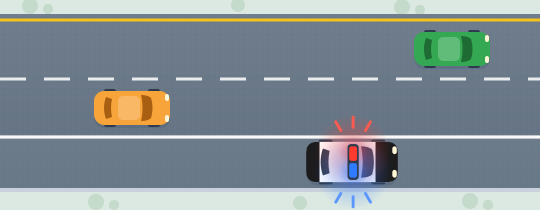
On a Virginia interstate with two lanes in your direction, a police car is stopped on the right shoulder with its lights flashing. You’re in the right lane. What does the law require?
Show answer
Correct answer: Move to the left lane if it’s safe, or slow down and pass carefully if you can’t
Why
Virginia’s move-over law applies on highways with at least two lanes each way: when safe, shift into a lane that isn’t beside a stopped vehicle showing flashing blue, red or amber lights. If you can’t, slow down and pass with caution. Ignoring it for emergency lights is reckless driving, and the same lane change is owed to a car with hazard flashers or flares.
12Road signs
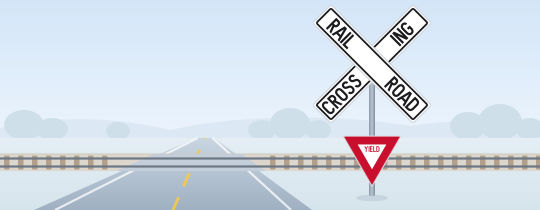
At a rural crossing with a white X-shaped RAILROAD CROSSING sign and a YIELD sign, but no lights or gate, you see a train approaching. Where does Virginia law have you stop?
Show answer
Correct answer: No closer than 15 feet and no farther than 50 feet from the nearest rail
Why
With a train near, Virginia wants you stopped in the band between 15 and 50 feet from the closest rail, and you stay there until it’s safe to cross. A train hangs out past the rails and needs a long way to brake, so that buffer protects you. At crossings that do have gates, never steer around one that is down.
13Right-of-way
On a 30 mph street, a pedestrian crossing at the intersection is about to step from the next lane into yours. What does Virginia law require of you?
Show answer
Correct answer: Stop and stay stopped until the person has passed your lane
Why
Virginia requires a full stop, not just a yield, for anyone crossing in your lane or heading into it from the next lane, at marked crosswalks and at intersections where the limit is 35 mph or less. Hold the stop until the person is clear of your lane. And never pass a car that has stopped for a pedestrian.
14Speed limits
Which statement about speed limits on Virginia interstates is correct?
Show answer
Correct answer: Where no other limit is posted, the maximum is 55 mph; 70 mph applies only where signs show it
Why
Virginia’s general maximum is 55 mph, and that covers interstates too when no other limit is posted. The 70 mph top limit applies only where signs post it on interstates, other limited-access divided highways and separated HOV lanes. Let the signs, not the road type, tell you your speed.
15Parking
Which of these parking spots breaks Virginia law?
Show answer
Correct answer: 10 feet from a fire station entrance
Why
A fire station or rescue squad entrance needs 15 feet of clearance, so 10 feet is too close. The other spots meet Virginia’s minimums: 20 feet from an intersection, 50 feet from a railroad crossing and 15 feet from a hydrant. Whatever the distance, never block a driveway.
16Alcohol & phones
Under Virginia’s handheld law, which of these may a driver do while the car is moving?
Show answer
Correct answer: Hold the phone to call 911 and report a crash
Why
Virginia bars every driver from holding a phone or other handheld device while driving, but reporting an emergency is allowed. You may also use the phone once lawfully parked or stopped, or for navigation as long as you’re not holding it or typing. Fines start at $125 and rise to $250, with a mandatory $250 in a highway work zone.
17Safe driving
It’s 2 p.m., a steady rain is falling and your wipers are running nonstop. What does Virginia law say about your headlights?
Show answer
Correct answer: They must be on, because bad weather has your wipers going
Why
Virginia links the two: when weather has your wipers running, your headlights must be on, day or night. They’re also required from sunset to sunrise and whenever rain, fog, snow or smoke cuts visibility to 500 feet. Only occasional wiping in a light mist gets a pass.
18Permit & provisional license
What is the earliest age at which you can apply for a Virginia learner’s permit?
Show answer
Correct answer: 15 years and 6 months
Why
Virginia accepts permit applicants from 15 years and 6 months, once they pass the vision screening and both parts of the knowledge exam. A driver’s license can follow no earlier than 16 years and 3 months. Start studying a few weeks before that half-birthday so you can test right away.
19Right-of-way
A storm has knocked out the power, and the traffic signal at a busy intersection is completely dark. No officer is there. What are you supposed to do?
Show answer
Correct answer: Stop completely, then take your turn as you would at a four-way stop
Why
Virginia’s manual tells drivers to handle a dead signal as an all-way stop: everyone stops, then goes in turn. Take turns in order of arrival, and when two cars arrive together, the one on the left waits. If an officer or temporary stop signs show up, follow them instead.
20Permit & provisional license
A 17-year-old with a Virginia provisional license wants to drive home from a friend’s house at 12:30 a.m. Is that allowed?
Show answer
Correct answer: No, under 18 you may not drive from midnight to 4 a.m. except in a few listed cases
Why
Virginia keeps drivers under 18 off the road from midnight to 4 a.m. The exceptions are trips to or from work or an adult-supervised school, civic, religious or public event, driving with a parent in the front seat, and emergencies. A learner’s permit gives no exceptions at all for those hours.
Round 3 · Questions 21–30
21Speed limits
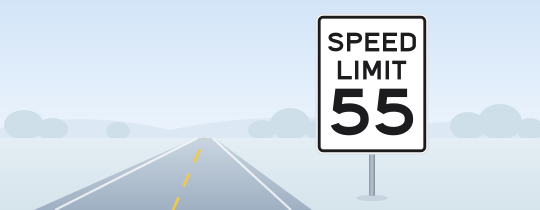
You pass a SPEED LIMIT 55 sign on a rural Virginia highway. It’s pouring rain and you can barely see the car ahead. Is 55 mph a legal speed right now?
Show answer
Correct answer: No, if 55 is faster than the conditions safely allow
Why
Virginia law calls it reckless driving to go faster than is reasonable for the traffic and the road, even at or below the posted limit. The sign gives the top speed for good conditions, not a target. In heavy rain, fog or ice, drop your speed and open up the gap ahead.
22Road signs
You’re stopped at a traffic light showing a red arrow that points right. No sign mentions turning. What does Virginia law allow?
Show answer
Correct answer: No turn until the arrow changes, since a red arrow forbids it
Why
A solid red light allows a right turn after you stop, but a red arrow works differently: Virginia prohibits turning against it unless a sign specifically permits the turn. Wait for the arrow to turn green. Think of the red arrow as a closed door for that one direction.
23Right-of-way
You’re about to enter a roundabout. A car is already circling toward your entry, and a pedestrian is waiting at the crosswalk in front of you. What’s the right move?
Show answer
Correct answer: Yield to the pedestrian and the circling car, then enter
Why
Drivers entering a roundabout give way to people on foot and to vehicles already in the circle. When a safe gap opens, merge in and travel counterclockwise to your exit. Choose your exit before you enter so you’re not hunting for it mid-circle.
24Speed limits
You’re driving a gravel back road in rural Virginia, and there’s no speed limit sign anywhere. What is the default limit on an unpaved road?
Show answer
Correct answer: 35 mph
Why
Virginia caps unpaved roads at 35 mph unless a sign sets something else. Loose gravel gives your tires far less grip, so stopping distances grow and the car can slide in a curve. Brake early and steer gently.
25Parking
You’ve parked on a steep street, nose pointing uphill, right next to the curb. To keep the car from rolling into traffic, how should you leave the steering?
Show answer
Correct answer: Turned left, away from the curb
Why
Turned left, the front tire will catch the curb if the car starts to roll backward. Facing downhill, turn the wheels right into the curb; with no curb at all, turn them right so a runaway car leaves the road instead of rolling into traffic. Set the parking brake every time.
26Alcohol & phones
After a first DUI arrest in Virginia, a driver unreasonably refuses the breath test. What does that refusal alone cost?
Show answer
Correct answer: A one-year license suspension
Why
Driving on Virginia roads means you’ve already agreed to breath or blood testing if you’re arrested for DUI. A first unreasonable refusal is a civil offense that takes your license for one year, separate from the DUI case itself. A refusal within 10 years of an earlier DUI or refusal becomes a crime with a three-year loss.
27Safe driving
You’re using high beams on a dark Virginia road. When does the law require you to switch to low beams?
Show answer
Correct answer: Within 500 feet of an oncoming vehicle and 200 feet of one you’re following
Why
Virginia sets two distances: dim for oncoming traffic at 500 feet, and for a car ahead of you at 200 feet. Bright beams in a rear-view mirror dazzle the driver in front just as much as head-on glare. Switch back to high beams once the road ahead is empty again.
28Permit & provisional license
A 16-year-old Virginian with a learner’s permit wants a driver’s license. Besides finishing driver education, what does the law require first?
Show answer
Correct answer: At least 9 months on the permit and 45 practice hours, 15 of them after sunset
Why
Under 18, Virginia requires nine months or more on the permit (or until your 18th birthday, if that comes sooner) and 45 hours of supervised driving, at least 15 after sunset, certified by a parent or guardian. A state-approved driver ed course is mandatory too. Spread the night hours out so you practice in rain and darkness before driving alone.
29Lane markings
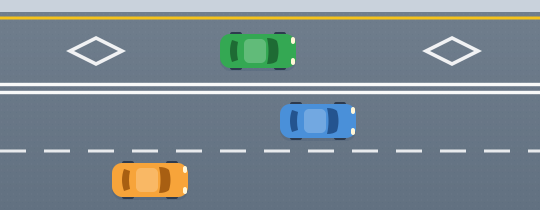
On a busy Virginia freeway, the leftmost lane has large white diamonds painted in it. What does that marking tell you?
Show answer
Correct answer: It’s an HOV lane, and posted signs give the rider minimum and hours
Why
A white diamond normally marks a high-occupancy vehicle (HOV) lane, though on some roads it flags a bus lane, so read the signs: they spell out the minimum number of riders and the hours the rule applies. Where double solid white lines border the lane, as here, don’t cross them; enter only at the openings the signs and markings allow.
30Sharing the road
On a two-lane street, a garbage truck is stopped while the crew collects trash. How does the Virginia Driver’s Manual tell you to pass it?
Show answer
Correct answer: At least 10 mph under the limit, leaving 2 feet or more
Why
The Virginia Driver’s Manual gives trash crews their own passing rule. On a road with four or more lanes, move to a lane not beside the stopped truck; on a narrower road, or when you can’t change lanes, slow to 10 mph below the limit and leave at least 2 feet. Expect someone to step out from behind the truck.
Round 4 · Questions 31–40
31Road signs
You pass a yellow diamond sign showing a leaping deer. Minutes later at dusk, a deer bounds into your lane and there’s no room to stop short of it. What does the Virginia manual tell you to do?
Show answer
Correct answer: Brake hard, keep to your lane and stop under control
Why
Virginia’s manual says not to swerve. A sudden jerk of the wheel can send you into oncoming traffic, a tree or a ditch, which is often far worse than hitting the animal. Deer are most active at dawn and dusk, above all in the fall, so slow down wherever this sign appears.
32Road signs
Some warning signs are painted a bright fluorescent yellow-green instead of ordinary yellow. What kind of hazard does that color point to?
Show answer
Correct answer: Schoolchildren, pedestrians or bicyclists nearby
Why
Virginia’s manual uses the high-visibility yellow-green for school, pedestrian and bicycle warnings, the people most exposed on the road. That bright shade sets these signs apart from ordinary yellow warnings. When you spot it, cover the brake and scan the roadside.
33Right-of-way
You’re on a four-lane divided highway with a wide grass median. On the far side of the median, a school bus has halted, red lights blinking, to let children off. What do you do?
Show answer
Correct answer: Keep going with care, since the unpaved median separates you from the bus
Why
Virginia lets you keep going when the bus is on the opposite roadway of a divided highway and a barrier or an unpaved median separates you. Otherwise you stop from either direction, even on private roads and school driveways, and wait until the bus moves on. Illegally passing a stopped school bus counts as reckless driving.
34Speed limits
A Virginia trooper clocks a driver at 77 mph in a 55 mph zone. What can that driver be charged with?
Show answer
Correct answer: Reckless driving, a criminal misdemeanor
Why
In Virginia, going 20 mph or more over the limit, or above 85 mph anywhere, is reckless driving rather than simple speeding. That makes it a criminal misdemeanor that can carry a fine, a suspension and even jail. Set cruise control at the limit on long highway stretches.
35Parking
When you park beside a curb in Virginia, what is the farthest your car may be from it?
Show answer
Correct answer: 1 foot
Why
Virginia’s manual asks you to park within 1 foot of the curb. On a two-way street, use the right-hand side; on a one-way street, either curb works. Parking farther out squeezes the lane for everyone driving past.
36Alcohol & phones
Virginia’s open-container law focuses on the passenger area of a car. Which of these places counts as part of it?
Show answer
Correct answer: An unlocked glove compartment
Why
Virginia counts an unlocked glove box as part of the passenger area, but not the trunk or the cargo space behind an SUV’s last row. An opened container in the passenger area, partly emptied, together with signs that the driver has been drinking, lets a court presume drinking while driving, a Class 4 misdemeanor. Carry alcohol sealed, and keep it in the trunk.
37Alcohol & phones
A driver is charged with a first DUI after a breath test shows 0.10%. What happens to the license right away, before any trial?
Show answer
Correct answer: It’s suspended for 7 days
Why
Virginia’s administrative suspension kicks in on the spot when a DUI charge is backed by a test reading at or above 0.08% (0.02% for drivers under 21) or by a refused test. It lasts 7 days for a first offense, 60 days for a second and until trial for a third. Court penalties come later, on top of it.
38Permit & provisional license
During the first year of a Virginia provisional license, how many passengers under 21 may a 16-year-old carry, family and household members aside?
Show answer
Correct answer: One
Why
For the first year, the cap is one passenger under 21, and family or household members don’t count toward it. After that and until 18, up to three are allowed only on trips to and from school-sponsored events, with a licensed driver 21 or older beside you, or in an emergency. Fewer friends in the car means fewer distractions.
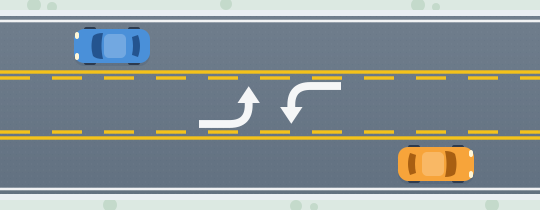
39Lane markings
A center lane has solid yellow lines along its outer edges and broken yellow lines on the inside, with left-turn arrows painted in both directions. How far may you drive in it in Virginia?
Show answer
Correct answer: No more than 150 feet
Why
This is a shared left-turn lane, used by traffic from both directions only to set up a left turn. Virginia limits travel in it to 150 feet, so move in shortly before your turn. Watch for a driver coming the other way who wants the same stretch.
40Crashes & emergencies
On a two-lane road with no median, an ambulance with its siren on and lights flashing is coming toward you from the opposite direction. What should you do?
Show answer
Correct answer: Steer over to the right side, stop and wait for it to go by
Why
When an emergency vehicle comes with lights and siren on, Virginia has every driver ease onto the side of the road nearest them, away from any intersection, and wait there until it goes by; on an undivided road, that includes traffic coming the other way. Afterward, never trail a fire truck or ambulance on a call by less than 500 feet. Passing a moving emergency vehicle running its lights and siren is reckless driving.
Virginia DMV knowledge exam at a glance
The numbers that matter before your visit to a DMV customer service center.
Virginia · Two-part knowledge exam
10 of 10 signs, then 24 of 30.
40 questions · Multiple choice
34 of 40 at minimum, all 10 sign questions included
34 of 40the lowest passing total, with no sign misses
Spanishone of 26 test options, ASL included
15 daysbefore a retest if you’re under 18; adults may test once per business day
$3permit fee, plus $4 for each year of license
Walk-inor by appointment at a DMV customer service center
20/40vision, plus a 110° field of view
Under 18? Your road to a license
15½Learner’s permitPass the vision screening and both parts of the knowledge exam. A licensed driver 21+ (or a parent, guardian or sibling 18+) rides beside you, and midnight to 4 a.m. is off-limits.
9 moPractice and driver edHold the permit at least nine months, log 45 hours with a parent’s sign-off (15 after sunset) and complete a state-approved driver ed course.
16¼Provisional licenseFrom 16 years and 3 months, pass the road test that ends driver ed, and your certificate plus permit work as a license for 180 days. In some areas, a judge hands you the license at a court ceremony.
Year 1First-year limitsOne passenger under 21 at most, family aside. No driving midnight–4 a.m. unless it’s for work, an adult-supervised event, an emergency or with a parent beside you.
Year 2Until you turn 18After year one, up to three passengers under 21 are allowed only to or from school events, with a licensed driver 21+ beside you, or in an emergency. The curfew stays, and every limit ends at 18.
18 or older? Through December 31, 2026, hold your permit 60 days before a DMV road test or finish driver ed instead. From January 1, 2027, ages 18 to 20 need both driver ed and 90 days on the permit, while 21+ keep the choice.
What’s on the Virginia permit test
Study the Virginia Driver’s Manual (DMV 39, April 2026 edition). The exam opens with 10 road-sign questions you have to ace, then 30 on traffic laws and safe driving. Here are the six areas to master.
Road signs
Signs come first, and all 10 must be right before part two opens.
Five sides mean a school zone or crossing; fluorescent yellow-green warns of schools, walkers and bikes.
A No Left Turn sign also rules out a U-turn, which Virginia counts as two left turns.
Right-of-way
Arrive together at a 4-way stop or an open intersection? The driver on the left lets the one on the right go.
At crosswalks, stop, don’t just slow, for a walker in your lane or heading into it from the next one.
Stop for a loading school bus from either direction, even on a school driveway, unless a barrier or unpaved median separates you.
Speed limits
No sign? 25 mph in residential, business and school areas, 35 on unpaved roads, 55 everywhere else.
70 mph is the top limit, and only where signs post it on interstates and similar highways.
20 over the limit or above 85 mph is reckless driving, a criminal charge. Radar detectors are illegal, too.
Parking
Stay 15 feet from a hydrant or a fire station entrance, and 20 feet from an intersection.
Leave 50 feet to a railroad crossing and 500 feet to fire trucks stopped at an alarm.
Park within 1 foot of the curb. Uphill with a curb, wheels left; downhill or no curb, wheels right.
Alcohol & phones
BAC limits: 0.08% at 21 and up, 0.04% in a commercial vehicle, 0.02% under 21.
A first breath-test refusal costs you a year of driving; a first DUI charge at 0.08% or higher brings an instant 7-day suspension.
No phone in your hand while the car moves: $125 the first time, $250 after that.
Teen rules
On a permit, a licensed driver 21+ (or a parent, guardian or sibling 18+) sits beside you every time.
Midnight to 4 a.m. is off-limits under 18; licensed teens get exceptions for work, supervised events and emergencies.
First licensed year: one passenger under 21 at most, family and household members aside.
Virginia numbers to know
Six Virginia figures to have memorized before you sit the exam.
100 ftof signaling before you turn
15 ftfrom a fire hydrant when you park
15–50 ftfrom the nearest rail when you stop for a train, outside cities and towns
4 secfollowing distance at 46–70 mph
0.02%BAC limit for drivers under 21
50/100/25minimum liability insurance, in thousands of dollars
Your Virginia course, in your pocket
These 40 questions are just the warm-up. The app gives you 415 Virginia practice questions, 36 short lessons and the why behind every answer.
36 short lessonsFour levels, from fundamentals to expert, then a full practice exam.
415 Virginia questions291 of them with pictures.
Your most-missed questionsA review lesson built from the questions you miss most.
Exam simulatorTake full practice exams and watch your readiness grow.
Virginia permit
Your Virginia path is ready.
36 lessons, 415 questions and full practice exams. In English and Spanish.
How many questions are on the Virginia DMV permit test, and what’s a passing score?
40 multiple-choice questions on a computer, in two parts. Part one is 10 road-sign questions, and every one must be right before part two opens. Part two has 30 general-knowledge questions, and 24 correct (80%) passes, so 34 of 40 is the lowest passing total.
How many times can I take the Virginia knowledge exam?
Once per business day. If you’re under 18 and fail, wait 15 full days: fail on January 1 and your next try is January 17. After three fails, you must first complete the classroom part of driver ed, or, if you’re 18 or older, an 8-hour course built on the Driver’s Manual.
Can I take the Virginia permit test online?
No, Virginia has no at-home online exam. You test on a computer at a DMV customer service center, by appointment or as a walk-in (arrive by 4:30 p.m. Monday to Friday, or by 11:30 a.m. Saturday). Students at participating high schools can also take a proctored exam at school and bring the receipt to DMV.
Can I take the Virginia permit test in Spanish?
Yes. Virginia gives the car knowledge exam in Spanish, English, American Sign Language and 23 other languages. DMV also publishes the Manual del conductor de Virginia (DMV 39S) and a Spanish study guide, and this practice test and the app are in Spanish too.
How old do you have to be to get a learner’s permit in Virginia?
15 years and 6 months. Under 18, you hold the permit at least nine months, log 45 practice hours (15 after sunset) and finish driver ed, and the license can come at 16 years and 3 months at the earliest. Until 18, midnight to 4 a.m. is off-limits, though licensed teens get exceptions for work, adult-supervised events, emergencies or a parent beside them. Licensed teens may also carry just one passenger under 21 from outside the family, or up to three in set cases after the first year.
How much does a Virginia learner’s permit cost?
The permit itself is $3, paid together with the license fee of $4 per year, because the permit application doubles as your license application. A standard eight-year license comes to $32. A passed knowledge exam stays good for one year, so get your permit within that time.
Where do you take the road test in Virginia?
If you’re under 18, your driver ed course gives the road test, so there’s no DMV visit for it. Adults on the 60-day permit route test at DMV; after a fail they can retry two days later, and after three fails they must first finish the in-car part of driver ed. For teens, some local courts hold a licensing ceremony where a judge hands over the license; elsewhere DMV mails it.
What’s the best way to study for the Virginia permit test?
Read the Virginia Driver’s Manual (DMV 39) and drill road signs until you never miss one, since that part must be perfect. Start with the 40 questions above, then let the app walk you through 415 Virginia questions and 36 short lessons, with the reason behind every answer.