Road signs
- An octagon always means STOP; a triangle pointing down means YIELD.
- A pennant marks a no-passing zone; a pentagon flags a school zone or school crossing.
- Brown signs lead to parks and recreation; orange signals a work zone.
Get ready for the WV DMV knowledge test with 40 free questions on West Virginia speed limits, school bus and move-over laws, parking distances and Level 1 permit rules. Choose an answer and the reason behind it appears instantly.
 Download on the App Store
First lesson free
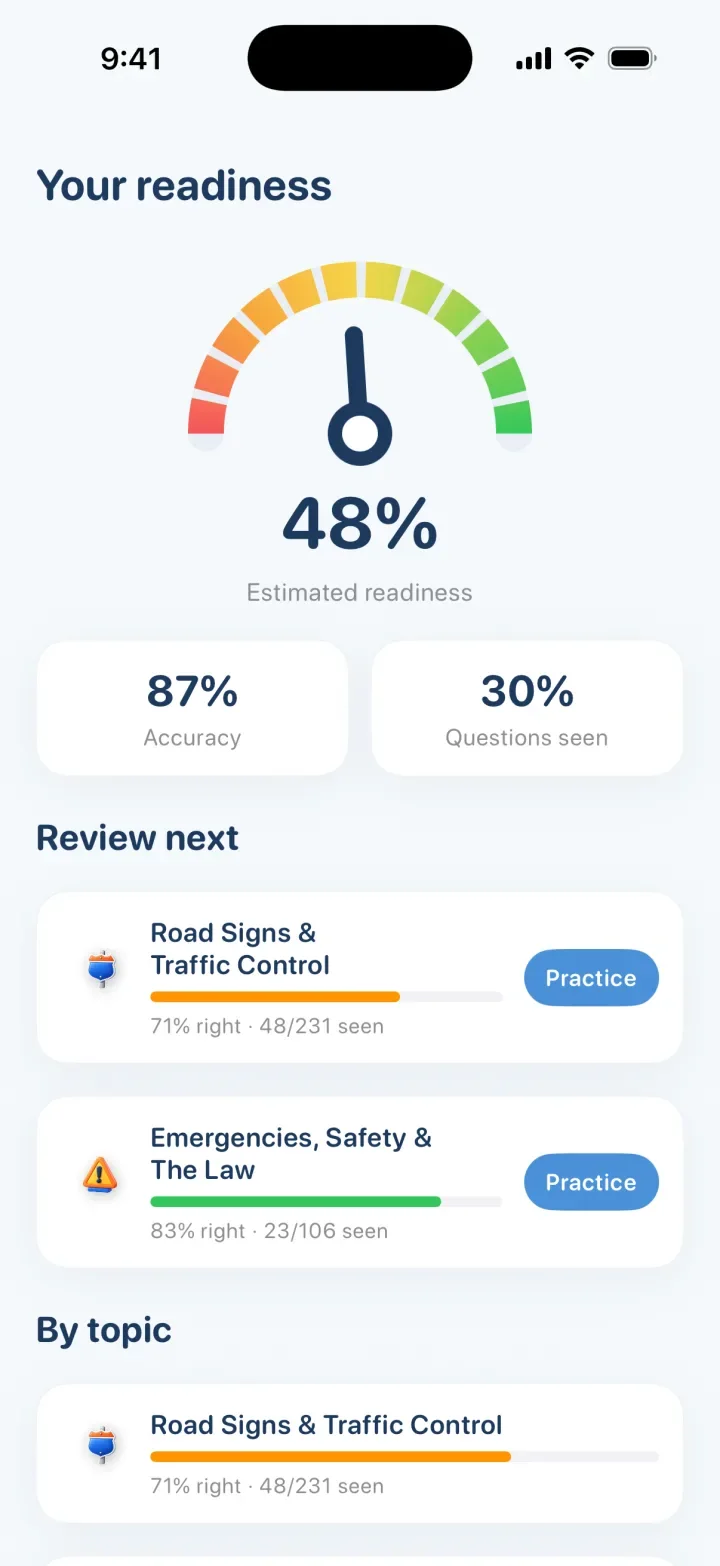
Four rounds of 10 questions on West Virginia road signs, right-of-way, speed limits, parking, DUI and phone laws, and GDL rules. Each answer comes with a short explanation.
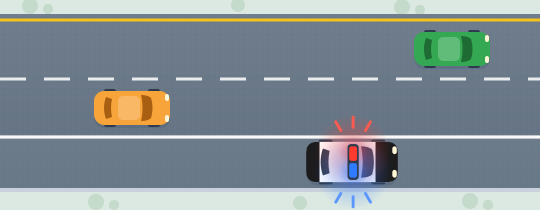
On a divided highway with two lanes each way, you’re in the lane next to the shoulder when you spot a police car stopped there with its lights flashing. What does West Virginia’s move-over law require?
Correct answer: Move to the left lane if it’s safe; if you can’t, slow to 25 mph or less
Why
When a highway has two or more lanes going your way, West Virginia wants you in a lane that isn’t next to a stopped vehicle with flashing lights, if traffic allows. If you can’t move over safely, keep to 25 mph or less on a divided highway (15 mph on an undivided road) until you’re past. The law also covers stranded cars showing hazard flashers, flares or a reflective warning sign, and a violation can cost up to $500.
You and a pickup pull up to a four-way stop in Morgantown at the same moment. The pickup is on the street to your right. Who goes first?
Correct answer: The pickup, because it is on your right
Why
West Virginia law has the driver on the left give way when two vehicles reach an intersection from different roads at about the same time, and the handbook uses that rule at four-way stops and at crossings with no signs at all. If the other driver waves you ahead, check that the way is really clear before you roll. When in doubt, let the other car go.
Driving through a small town’s business district, you haven’t seen a speed limit sign in a while. What limit does West Virginia law set here?
Correct answer: 25 mph
Why
State law makes 25 mph the default in every business or residence district, so it covers Main Street and quiet neighborhood streets alike until a sign says otherwise. A posted limit always takes over, and so does the basic rule: never drive faster than conditions make reasonable and prudent.
There’s an open space along the curb near a fire hydrant in Huntington. How close to the hydrant may you legally park?
Correct answer: No closer than 15 feet
Why
A hydrant needs a 15-foot buffer under West Virginia law, so fire crews can reach it and connect a hose without delay. The same law adds two more gaps to learn: 20 feet from an intersection crosswalk, and 30 feet on the approach to a stop sign or a signal light.
A 19-year-old driver is pulled over and blows a 0.03% BAC. What does West Virginia law say?
Correct answer: It’s an offense, because drivers under 21 face a 0.02% limit
Why
Under West Virginia’s zero-tolerance law, a driver under 21 whose BAC reaches 0.02%, but stays below 0.08%, commits a separate offense. A first offense brings a $25 to $100 fine and a license suspension. At 0.08% or higher, the regular DUI law applies.
You’re 15 and have a Level 1 instruction permit. When may you drive in West Virginia?
Correct answer: Only from 5 a.m. to 10 p.m., with a licensed driver 21 or older beside you
Why
A Level 1 permit limits driving to the hours from 5 a.m. to 10 p.m., always with a licensed supervisor aged 21 or older (or a driver-ed instructor) in the front seat, alert and unimpaired. Everyone in the car buckles up, and the permit holder’s alcohol level must be zero.
Packed snow covers the road as you follow a car up a hill near Beckley. According to the West Virginia handbook, how far back should you stay?
Correct answer: At least 6 seconds
Why
The handbook’s everyday rule is three to four seconds, counted from when the car ahead passes a fixed object. Darkness or rain stretches that to at least four seconds, and ice or snow to at least six, because stopping on snow or ice can take up to 12 times the usual distance.
On a back road in farm country, the rear of a hay wagon ahead shows an orange triangle with a red border. What does that emblem mean?
Correct answer: It’s a slow-moving vehicle, so you’ll close the gap quickly
Why
The West Virginia Driver’s Licensing Handbook lists the orange triangle with a red border as the mark of a slow-moving vehicle, such as farm equipment. Lift off the gas the moment you see it and keep a safe gap. Pass only in a legal passing zone, with a long clear view ahead.
On a four-lane divided highway with a grassy median and side-street intersections (not an interstate), a school bus on the far side is letting children off while its red lights flash. How do you respond?
Correct answer: Stop: in West Virginia, only interstate traffic across the median may keep moving
Why
West Virginia’s exception is narrow: it covers only controlled-access highways such as interstates, where the bus is on a separate roadway. On an ordinary divided road you stop and wait until the bus moves, the driver signals you on or the red lights shut off. The rule comes from the 2019 Haven McCarthy Memorial Act.
You’re in a crash where nobody is hurt, but the damage comes to about $1,500. What does West Virginia law require?
Correct answer: A report to police by the quickest means available
Why
In West Virginia, a crash that injures or kills someone or causes $1,000 or more in property damage must be reported to police by the quickest means available: city police inside a town, otherwise the sheriff or the closest State Police post. At the scene, stop, help anyone who is hurt and swap names, addresses, plate numbers and insurance details.
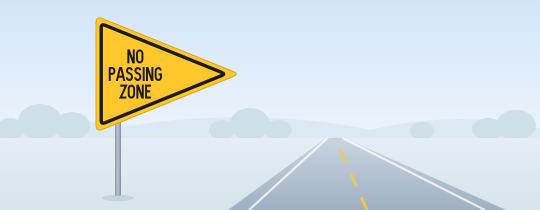
Climbing a two-lane mountain road, you spot a yellow sign shaped like a sideways pennant on the left shoulder. What is it telling you?
Correct answer: You are entering a stretch where passing is not allowed
Why
The pennant shape is saved for one message: no passing from here on. West Virginia also bans driving left of center near a hill crest or a curve where your view is blocked. Stay behind slower traffic until the zone ends and the yellow line on your side turns broken again.
You’re stopped at a red light on a two-way street in Charleston and want to turn left onto a one-way street. May you turn on red?
Correct answer: No: West Virginia allows a left on red only when both streets are one-way
Why
West Virginia allows a left turn on red in just one setup: the street you leave and the street you enter are both one-way, with traffic on the new street flowing left. You still stop fully, yield and obey any sign that forbids it. Starting from a two-way street doesn’t qualify, so wait for green; a right on red, by contrast, is legal after a full stop unless a sign prohibits it.
You’re on an open country highway in West Virginia, and no speed limit is posted. What is the most you may drive?
Correct answer: 55 mph
Why
With no sign telling you otherwise, West Virginia caps open country highways at 55 mph. Winding roads through the hills often call for less: the basic speed law makes you slow down for curves, fog, rain or traffic even when you’re under the number.
Which of these parking spots is legal in West Virginia?
Correct answer: 25 feet back from the crosswalk at a street corner
Why
The crosswalk rule is 20 feet, so 25 feet is fine. The others break state law: rail crossings need a 50-foot gap to the closest rail, stop signs need 30 feet, and double parking is never allowed. West Virginia also keeps cars 20 feet from a mailbox served daily by a carrier’s vehicle when parking there would hold up the carrier.
A 35-year-old driver’s breath test shows a BAC of 0.06%. Which statement fits West Virginia law?
Correct answer: At 0.08% DUI is presumed, but a result between 0.05% and 0.08% can still be used as evidence of impairment
Why
At 0.08% or more, West Virginia presumes you’re under the influence. A result between 0.05% and 0.08% is still evidence that can be weighed together with how you were driving. The only safe plan is to skip driving after you drink.
You hold a Level 1 permit, and your 25-year-old aunt is supervising from the front seat. How many friends who aren’t family may ride in the back?
Correct answer: Two
Why
West Virginia caps Level 1 passengers at two besides the supervising driver, unless the riders are family members. Your supervisor must be the only other person up front, and every person in the car wears a seat belt.
You plan to turn right into a driveway ahead. Under West Virginia law, when must your turn signal be on?
Correct answer: Without a break, starting 100 feet or more before you turn
Why
West Virginia law requires a signal shown continuously over at least the final 100 feet before you turn. On faster roads, start earlier so drivers behind you have time to react, but not so early that they think you’re turning at an earlier street or driveway.
Driving toward one of West Virginia’s state parks, you pass a brown sign with a white symbol on it. What do brown signs point you to?
Correct answer: Parks, recreation areas and scenic sites
Why
In the sign color code the handbook teaches, brown marks park and recreation sites. Blue signs list motorist services such as gas and food, green signs guide you to places, and yellow ones warn. Knowing the colors lets you read a sign long before the words come into focus.
You come up behind a cyclist on a narrow two-lane road. How much space does West Virginia law require when you pass?
Correct answer: At least 3 feet
Why
West Virginia requires at least three feet between your car and a bicycle you’re passing, at a careful, reduced speed. If oncoming traffic leaves no room for that, stay behind the rider until it clears, and don’t cut back to the right until you’re well past.
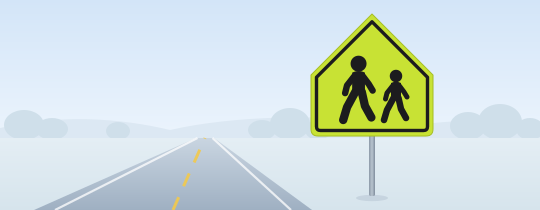
You pass a five-sided yellow-green sign showing two children walking, and students are heading home along the road. Unless a different limit is posted, how fast may you go in West Virginia?
Correct answer: 15 mph
Why
West Virginia sets 15 mph in a school zone during recess and whenever kids are arriving at school or heading home. The zone covers the school grounds plus 125 feet of every street that borders them. Speeding there can bring a $100 to $500 fine and 6 points on your record.
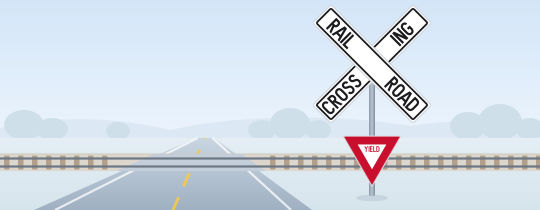
This crossing has no lights or gates, only a white X-shaped crossbuck with a YIELD sign. You hear a horn and see a train coming. Where does West Virginia law have you stop?
Correct answer: Somewhere 15 to 50 feet short of the closest rail
Why
When a train is close, or lights flash, a gate is lowered or a flagger holds you, West Virginia law wants your car stopped no nearer than 15 feet and no farther than 50 feet from the closest rail. Wait there until the way is safe. If a small sign under the crossbuck shows the number of tracks, look both ways again after the train clears: a second one may be on the other track.
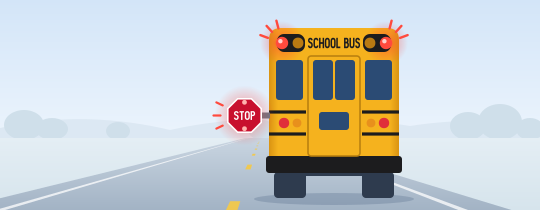
You’re following a school bus on a two-lane road when it stops to let students off, red lights flashing and stop arm out. A car is coming the other way. Who has to stop?
Correct answer: Both you and the oncoming car
Why
Whenever a school bus shows flashing red lights while students get on or off, West Virginia stops traffic coming from both directions, and that holds on streets, highways, parking lots and even private roads. Move again only when the bus starts moving, its driver waves you on or the lights go off. A first illegal pass can bring a $500 to $1,000 fine or up to six months in jail, plus a 60-day license suspension.
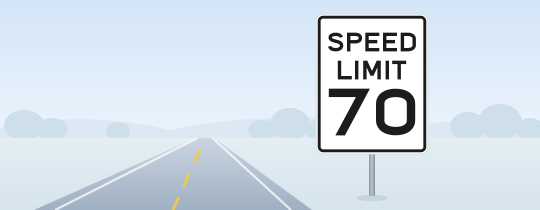
On which West Virginia roads can you expect a SPEED LIMIT 70 sign like this one?
Correct answer: Interstates, where 70 mph is the maximum unless a lower limit is posted
Why
70 mph is the top limit on West Virginia interstates unless signs set a lower one. Off the interstates, an unposted open country highway defaults to 55 mph. Treat 70 as a ceiling for good conditions, not a goal.
When you parallel park along a curb in West Virginia, how close to it must your wheels be?
Correct answer: Within 18 inches
Why
State law wants your wheels parallel to the curb and no more than 18 inches from it. Leave more space than that and you squeeze the lane that passing cars need. Before you pull back out, check your mirror and over your shoulder, and signal.
After a DUI arrest in West Virginia, a driver refuses the secondary breath test. What follows?
Correct answer: A license revocation, because driving in the state counts as consent to testing
Why
By driving in West Virginia you are treated as having agreed to a preliminary breath test and a secondary chemical test. Refusing the secondary test after an arrest triggers its own license revocation, which can last up to life. Saying no doesn’t protect your license.
What practice does a West Virginia teen need before moving from Level 1 to a Level 2 license?
Correct answer: 50 hours of supervised driving with 10 at night, or an approved driver’s education course
Why
West Virginia gives teens a choice: finish a state-approved driver’s ed course, or log 50 hours behind the wheel, at least 10 after dark, certified by a parent, guardian or another responsible adult over 21. Whichever you pick, bring the certificate or the log to your road skills test.
Driving at night with your high beams on, you catch up to a car going the same way. How close may you get before you must switch to low beams?
Correct answer: 200 feet
Why
West Virginia law has you dim within 200 feet when you’re following another vehicle, and within 500 feet of one coming toward you. Bright lights from behind bounce off the other driver’s mirrors and can blind them.
At a quiet crossroads, the traffic light facing you is blinking red. How do you handle it?
Correct answer: Stop completely, yield, and go when the way is clear
Why
A blinking red light works like a STOP sign: a full stop, then yield to traffic and people on foot before you go. A blinking yellow asks less of you: slow down and proceed with care. The same rules apply when a regular signal is switched over to flashing mode.
You’ve missed your exit on I-64, and a paved crossover in the median is just ahead. What should you do?
Correct answer: Drive on to the next exit and turn around there
Why
The West Virginia handbook rules out U-turns on interstates entirely: drive on to the next exit and turn around there. Median crossovers are for police and emergency vehicles only. On other roads, state law also bans U-turns on curves or near a hilltop where drivers can’t see you from 500 feet away.
Your car breaks down on an interstate at night. You’ve steered well onto the shoulder and turned on your flashers. Where should your flares go?
Correct answer: One roughly a car length behind and a second around 300 feet behind
Why
The West Virginia handbook puts one flare roughly a vehicle length behind your car and a second about 300 feet back, both set on the shoulder beside the edge of the travel lane. Move everyone out of the car and far from traffic while you wait for help.
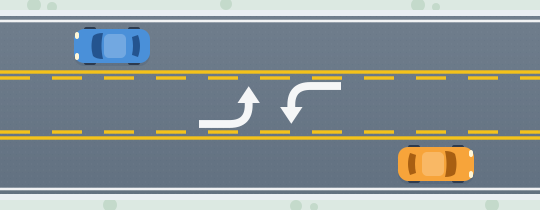
A middle lane is edged by a solid and a dashed yellow line on each side, with turn arrows pointing opposite ways. What may you use it for?
Correct answer: Left turns only, by drivers from either direction
Why
The West Virginia handbook reserves a center left-turn lane for left turns, shared by drivers from both directions. Move into it shortly before your turn, signal, and watch for a car entering from the other end. Using it to pass or as a travel lane is off limits.
A funeral procession is crossing the intersection ahead, and its lead car has already gone through. What does the West Virginia handbook advise?
Correct answer: Let the rest of the procession pass and don’t cut into it
Why
State law doesn’t force you to yield to a funeral procession, but the handbook treats it as a courtesy: after the first car gets through an intersection, the cars behind it keep the right-of-way. Wait for the last car, and never cut into or out of the procession. On an expressway you may pass one.
Traffic is light and the weather is clear on I-79, and no minimum speed is posted. According to the West Virginia handbook, what is the slowest you should drive?
Correct answer: 55 mph
Why
The handbook asks you to hold at least 55 mph on interstates, unless bad weather, a poor road surface or a lower posted speed calls for less. A car crawling far under the flow forces others into sudden lane changes. Keep right except when you’re passing.
You park facing uphill on a West Virginia road that has no curb. Which way should your front wheels point?
Correct answer: Right, toward the edge of the road
Why
The handbook’s hill-parking chart says that uphill with no curb, you turn the wheels right, so a car that starts rolling heads off the road instead of into traffic. With a curb, uphill wheels turn away from it and downhill wheels turn toward it. Set the parking brake every time.
Under West Virginia’s distracted driving law, which of these may an adult do while driving?
Correct answer: Talk on a call through the car’s hands-free system
Why
West Virginia’s Electronically Distracted Driving Act bars every driver from holding or supporting a phone with any part of the body, and from typing texts, browsing, watching video or gaming at the wheel. Calls are legal only hands-free. A first offense costs up to $100, and drivers under 18 can’t use a phone at all, not even hands-free.
You just got your Level 2 intermediate license. During the first six months, how many passengers under 20 who aren’t family may ride with you?
Correct answer: None
Why
For the first six months on Level 2, West Virginia allows no passengers under 20 unless they are family members. In the second six months, one non-family passenger under 20 may ride along. Keep in mind that until you turn 18, even a hands-free call is off limits, except to 911.
You’re 17 and drive on a Level 2 license. Which phone use is allowed while you’re behind the wheel?
Correct answer: A call to 911 in an emergency
Why
West Virginia bars drivers under 18 at every GDL level from using a phone or other wireless device while driving, hands-free included. The only exception is a call to 911. A phone citation also restarts the conviction-free period you need before moving up a level.
Four months into a Level 1 permit, a West Virginia teen is convicted of a traffic violation. What happens to the 180-day period needed for Level 2?
Correct answer: It starts over from day one
Why
Moving up to Level 2 takes 180 days in a row on the Level 1 permit with no convictions, so a conviction resets the six-month clock. A second conviction gets the permit revoked, and the teen then waits 90 days before testing again.
On a two-lane road you’re about to pass a slow car going your way. What does West Virginia law expect as you pull out?
Correct answer: Give an audible signal, such as a tap of the horn, and pass on the left with room to spare
Why
West Virginia law calls for an audible signal when you overtake another vehicle, and the handbook suggests a light tap of the horn, or a blink of the headlights at night. Pass on the left with plenty of room, and move back only when both headlights of the car you passed show in your rearview mirror.
A white sign shows a black arrow bending to the left, with a red circle and a diagonal red bar over it. What is it telling you?
Correct answer: You may not turn left here
Why
On regulatory signs, a red ring crossed by a slash always means NO, and the symbol underneath shows what is forbidden. Here that’s a left turn, so go straight or turn right and plan another route. The same red slash over a U-shaped arrow bans U-turns.
What to expect, whether you test at home or at a DMV regional office.
West Virginia · DMV knowledge exam

19 of 25 to pass.
25 questions · On a computer19 of 25 answers right to pass
18 or older? Pass the vision screening and knowledge test for a Class E instruction permit, then hold it at least 30 days, practicing with a licensed driver 21+ beside you, before your road skills test. There’s no hour log, and the permit is good for six months.
The test is built on the West Virginia Driver’s Licensing Handbook (revised 07/2026): traffic laws, rules of the road, signs and pavement markings. Master these six areas before test day.

Six West Virginia figures to have down cold before you sit the test.
These 40 questions are just the warm-up. The app gives you 404 West Virginia practice questions, 36 short lessons and the why behind every answer.
The test has at least 25 questions, and you need 76% to pass: 19 right out of 25. It runs on a computer and covers traffic laws, signs and pavement markings from the Driver’s Licensing Handbook. It’s timed, and any question still blank when time runs out counts as wrong. You’ll also need 20/40 vision to clear the screening.
You wait a week: state law doesn’t allow two tries within seven days. Each attempt at a DMV office costs $7.50, and each online try costs $14, with no refund for a failed one. Use the week to go back over the topics you missed.
Yes, through Know To Drive Online. You need a West Virginia address and a desktop or laptop with a working webcam (no phones or touch screens), you get 50 minutes, and each try costs $14. Under 18, an adult over 18 joins your registration and stays off camera during the test. A passing score is good for six months: take the certificate and your documents to a DMV office, where your photo is taken and the permit is issued.
The DMV’s online testing portal, Know To Drive Online, has a Spanish language setting. At a DMV office, the DMV may let you use a translator at its discretion, so ask before your visit. The handbook comes in English only, which makes this practice test and the app, both available in Spanish, an easy way to study.
15. With a parent’s consent and passing vision and knowledge tests, you get a Level 1 permit; hold it 180 days without a conviction and log 50 hours (10 at night) or finish driver’s ed. At 16, the road skills test earns a Level 2 license: no driving 10 p.m.–5 a.m. without a licensed driver 21+ (trips to work, school-sanctioned activities, religious events or emergencies excepted), no passengers under 20 for six months unless they’re family, and no phone use except to call 911. At 17, after 12 conviction-free months, you can move up to Level 3.
$7.50 per attempt at a DMV office, or $14 per attempt online. If you’re 18 or older, the instruction permit costs another $7.50. Later, a Class E license costs $5 for each year it’s valid.
Proof of identity, your Social Security number, any legal name-change papers and two proofs of West Virginia residence. Under 18, also bring a certified birth certificate and a parent’s signed consent on form DMV-DS-23P. Knowledge testing is one of the visit types you can book in the DMV’s online scheduler.
Read the West Virginia Driver’s Licensing Handbook (revised 07/2026), then practice until 19 of 25 feels easy. Work through the 40 questions above, then move on to the app: 404 West Virginia questions and 36 short lessons, with every answer explained.