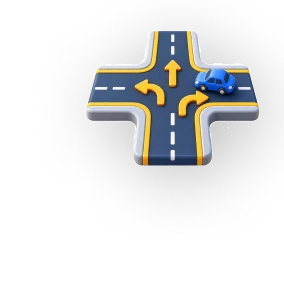
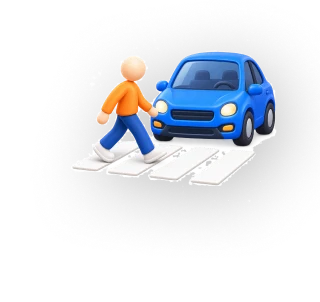
Get ready for the DC DMV knowledge test with 40 free questions on the District’s own rules: the 20 mph default limit, full stops for pedestrians in crosswalks, parking distances and the GRAD program for drivers under 21. Every answer comes with a quick explanation.
Four rounds of 10 questions on D.C. road signs, right-of-way, speed limits, parking, DUI and phone laws, and GRAD rules. Tap an answer to see the reasoning behind it.
Round 1 · Questions 1–10
1Road signs
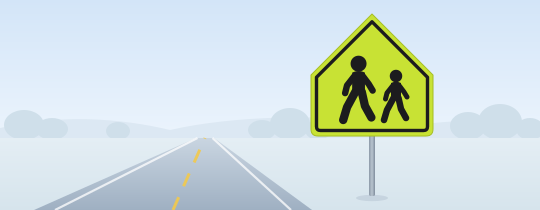
On a weekday morning in D.C., you pass a five-sided, fluorescent yellow-green sign showing two children walking. If no other hours are posted, what speed limit applies in this school zone?
Show answer
Correct answer: 15 mph
Why
The five-sided shape is saved for school zones and school crossings. D.C. sets 15 mph in school zones from 6 a.m. to 7 p.m. unless signs list other hours, and the same limit can apply next to signed playgrounds, pools and recreation centers. Ease off before you reach the sign, not after it.
2Right-of-way
A pedestrian in a marked crosswalk ahead is crossing the lane next to yours, walking toward your lane. What does D.C. law require you to do?
Show answer
Correct answer: Stop and stay stopped while the pedestrian crosses
Why
D.C. asks for more than a yield: when someone is crossing in a marked crosswalk, or an unmarked one at an intersection, and is in your lane or one lane away and heading toward it, you have to stop and hold still until they’re past. Failing to stop costs 3 points, so keep scanning the lanes beside yours, not just your own.
3Speed limits
On a D.C. street with no posted speed limit at all, how fast may you go?
Show answer
Correct answer: 20 mph
Why
Unless a sign says otherwise, the top legal speed on every D.C. street and highway is 20 mph. Higher limits apply only where they’re posted, and alleys and school zones drop lower. On a crowded block, even 20 can be too fast.
4Parking
You find an open curb space near a fire hydrant. What’s the closest D.C. lets you park to it?
Show answer
Correct answer: 10 feet
Why
D.C. bans standing or parking within 10 feet of a fire hydrant, so fire crews can hook up a hose fast. Learn it alongside two other D.C. distances: 25 feet before a STOP sign and 40 feet from an intersection.
5Alcohol & phones
A 19-year-old drives home after one drink, and a breath test finds a small but measurable amount of alcohol. How does D.C. law treat it?
Show answer
Correct answer: Illegal: any measurable alcohol counts for drivers under 21
Why
D.C. has zero tolerance for drivers under 21: any alcohol that can be measured makes them legally intoxicated. At 21 and older the line is 0.08%, and drivers of commercial vehicles are held to 0.04%. If you’ve been drinking at any age, hand someone else the keys.
6Safe driving
Using the counting method in the DC DMV manual, what gap should you keep behind the car ahead on a dry, clear day?
Show answer
Correct answer: 3 to 4 seconds
Why
Pick a fixed point, such as a sign. When the car ahead passes it, start counting seconds; if you reach the point before you get to four, you’re too close. In rain, snow or fog, stretch the gap to four or five seconds, and give buses and vans that stop often extra room.
7Permit & provisional license
With a D.C. learner permit and a qualified supervisor beside you, during which hours may you drive?
Show answer
Correct answer: 6 a.m. to 9 p.m.
Why
D.C. lets learner permit holders drive only between 6 a.m. and 9 p.m., every day of the week; having a supervisor beside you doesn’t stretch those hours. Plan practice drives so you’re home by 9. Night practice comes later: you need 10 hours of it before the full license with conditions.
8Sharing the road
At a D.C. intersection with STOP signs, a rider on an e-bike slows, checks both ways and rolls through without stopping. What should you know?
Show answer
Correct answer: D.C. lets bike and e-scooter riders treat a STOP sign like a YIELD sign
Why
Under a 2022 D.C. law, people riding bikes, e-bikes and e-scooters may go through a STOP sign without stopping after slowing and yielding, and may turn right on red after a full stop. They still have to yield to pedestrians and to traffic with the right-of-way. Expect riders to keep moving at stop signs, and give them room.
9Right-of-way
You’re stopped at a red light on a one-way D.C. street and want to turn left onto a cross street that also runs one way. When may you go?
Show answer
Correct answer: Only once the light turns green
Why
Even from one one-way street onto another, turning left against a red light is never legal in D.C. Only right turns on red are allowed, after a complete stop and where no sign prohibits them. Wait for the green, then yield to anyone still crossing.
10Crashes & emergencies
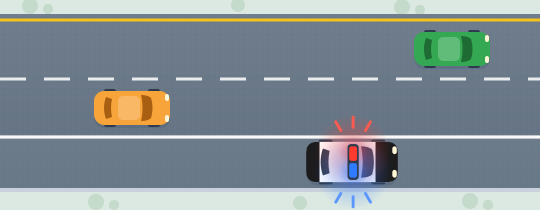
On a D.C. road with two lanes in your direction, a police car with flashing lights is stopped on the right shoulder. What should you do?
Show answer
Correct answer: Move to the lane farther from it if that’s safe; if not, slow down and pass with care
Why
D.C.’s move-over rule asks you to switch to a lane not next to a stopped emergency vehicle with its lights on whenever you safely can. On a road with a single lane, slow down and pass with caution. Ignoring the rule costs 6 points.
Round 2 · Questions 11–20
11Road signs
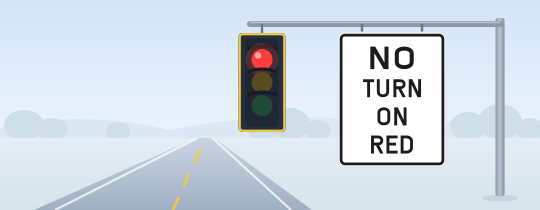
You’re stopped at a red light in D.C. and want to turn right, but a white NO TURN ON RED sign hangs next to the signal. What may you do?
Show answer
Correct answer: Wait for a green light before turning
Why
D.C. normally allows a right turn on a steady red after a full stop, yielding to pedestrians and traffic. A posted NO TURN ON RED sign cancels that, so look for one before every right on red. Even once the light turns green, yield to anyone still in the crosswalk.
12Right-of-way
On a D.C. street with two lanes going your way, the car in the other lane stops at a crosswalk to let someone cross. What should you do?
Show answer
Correct answer: Stop as well, and don’t pass it until the crosswalk is clear
Why
D.C. rules forbid passing a vehicle that has stopped at a crosswalk for a pedestrian, and doing it costs 3 points. The stopped car can hide a person stepping into your lane. Stop, wait until the crosswalk is empty, then go.
13Speed limits
Cutting through an alley behind a row of D.C. houses, what is your speed limit?
Show answer
Correct answer: 15 mph
Why
Every alley in the District has a 15 mph limit. Garages, trash bins and back gates open right onto the pavement, so creep past blind corners. When you leave the alley, stop before the sidewalk.
14Parking
Measured from where the curb lines meet, how far from an intersection must you keep your parked car in D.C.?
Show answer
Correct answer: 40 feet
Why
D.C. keeps its corners clear: no standing or parking within 40 feet of an intersection. That open space lets drivers and pedestrians see each other. On the far side of a one-way street, the gap shrinks to 25 feet.
15Alcohol & phones
Which of these is legal for an adult driving in D.C.?
Show answer
Correct answer: Calling 911 to report a crash you just saw
Why
Since December 2025, D.C. drivers may not even hold a phone while driving, and texting is never allowed; hands-free calls are fine. Calls to 911 or other emergency services are one of the few exceptions. The fine is $100, so mount the phone and set up the car’s system before you go.
16Safe driving
Before a turn in D.C., how long must your turn signal be flashing?
Show answer
Correct answer: For at least the last 100 feet
Why
D.C. rules call for a continuous signal through at least the final 100 feet before you turn, and earlier at higher speeds. The DC DMV manual also asks for a signal at least 300 feet before a lane change. If your lights fail, signal by hand from the left window: arm straight out for left, bent up for right, bent down to slow or stop.
17Permit & provisional license
You’re 16 and practicing on a D.C. learner permit with your aunt, who is 30 and fully licensed, in the front seat. May your best friend ride in the back?
Show answer
Correct answer: No: your supervising driver is the only passenger allowed
Why
A D.C. learner permit holder may drive only with a licensed driver 21 or older who holds a full license, sits in the front passenger seat and buckles up, and no one else may ride along. Breaking a GRAD restriction leads to a suspension. Friends under 21 can ride with you once you reach the full license with conditions, up to two at a time until you turn 18.
18Lane markings
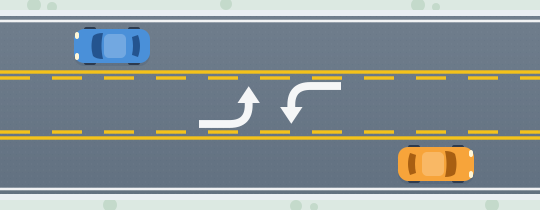
Down the middle of the road runs a lane bordered by two yellow lines on each edge, solid outside and dashed inside, with left-turn arrows painted in both directions. How does the DC DMV manual say you may use it?
Show answer
Correct answer: For left turns from either direction, driving no more than 150 feet in it
Why
Drivers heading both ways share this middle lane for left turns only. The DC DMV manual lets you travel no more than 150 feet in it before your turn. Never use it to pass or as a lane to drive along.
19Road signs
A HAWK pedestrian signal hangs over a mid-block crosswalk, and its two red lights have started flashing back and forth. What should you do?
Show answer
Correct answer: Stop, then go once the crosswalk is clear
Why
For drivers, a HAWK (pedestrian hybrid beacon) works in steps: flashing yellow means go with caution, steady yellow means get ready to stop, steady red means stop while people cross, and alternating flashing red means stop, then go if the crosswalk is clear. D.C. put up its first one at Georgia Avenue and Hemlock Street NW in 2009.
20Alcohol & phones
Under D.C.’s implied consent law, what has every driver agreed to just by driving in the District?
Show answer
Correct answer: Giving breath, blood or urine samples if arrested for DUI
Why
D.C. counts every driver as having consented to give two breath, blood or urine samples after a DUI arrest. Refusing has its own cost: a driver licensed elsewhere loses the right to drive in D.C. for 12 months, a D.C. license holder must join the Ignition Interlock program, and the refusal can be used as evidence in court.
Round 3 · Questions 21–30
21Road signs
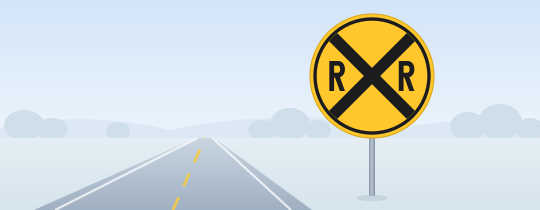
A round yellow sign marked with an X and two R’s comes up, and soon the crossing lights start flashing. Where must you stop under D.C. rules?
Show answer
Correct answer: 15 to 50 feet back from the closest rail
Why
The round sign is an early warning that tracks are ahead. When signals flash, a gate comes down, a flagger signals or a train is clearly close, D.C. has you stop somewhere between 15 and 50 feet short of the nearest rail. Cross only once the tracks are clear and the way is safe.
22Right-of-way
You’re about to enter one of D.C.’s traffic circles, and cars are already moving around it. Who has the right-of-way?
Show answer
Correct answer: The vehicles already in the circle
Why
D.C. rules have entering drivers yield to traffic already inside a traffic circle, the same way you yield when you come off a ramp onto a freeway. Traffic in a roundabout flows counterclockwise, to the right of the center island. Watch for people walking and biking at the crossings on your way in and out.
23Speed limits
How far over the speed limit does a driver have to go to be charged with reckless driving in D.C. on speed alone?
Show answer
Correct answer: 20 mph or more
Why
D.C. law treats driving 20 mph or more over the limit as reckless driving, which carries 6 points and possible jail time. At 30 mph or more over, the charge becomes aggravated reckless driving, worth 12 points, the level at which a license is revoked.
24Parking
Which of these parking spots is legal in D.C.?
Show answer
Correct answer: 8 feet from the entrance of an alley
Why
D.C. sets a different buffer for each: 5 feet from a driveway or alley, 20 feet from a fire station entrance, 25 feet before a STOP or YIELD sign, and 50 feet from a railroad crossing. Only the spot 8 feet from the alley clears its limit. Read the posted signs as well before you walk away.
25Alcohol & phones
You’re 17 with a D.C. provisional license, and your phone is paired with the car’s speakers. When may you take a call while driving?
Show answer
Correct answer: Only in an emergency
Why
D.C. bans every use of a phone or other electronic device behind the wheel for drivers under 18 and anyone on a learner permit, even hands-free. Emergencies are the only exception. Silence the phone before you start the car, and the temptation goes away.
26Safe driving
At 2 p.m., steady rain has your windshield wipers running nonstop. What does D.C. law say about your headlights?
Show answer
Correct answer: They must be on
Why
D.C. requires headlights whenever your wipers are in continuous use, from 30 minutes past sunset until 30 minutes before sunrise, and any time people and vehicles aren’t clearly visible 500 feet ahead. Use low beams in fog, and dim your high beams 500 feet before meeting an oncoming car.
27Permit & provisional license
Before a teen can get a D.C. provisional license, how many hours of supervised driving must a licensed driver 21 or older certify?
Show answer
Correct answer: 40 hours
Why
D.C. requires at least 40 hours of driving experience, certified on a form by a licensed driver 21 or older. You must also have had your learner permit six months or longer, with no pointable moving violations. Driver education is recommended but not required in the District.
28Lane markings
On a D.C. street, one lane is painted solid red and marked BUS ONLY. You plan a right turn at the next corner. When may you move into that lane?
Show answer
Correct answer: Within 40 feet of the intersection, yielding to buses and bikes, unless a sign says otherwise
Why
D.C. marks bus lanes with red pavement and BUS ONLY lettering. Other drivers may enter one only to turn: where a sign allows it, or, if no sign says otherwise, within 40 feet of the intersection or driveway. Yield to buses and bikes, and never stop or park in the lane.
29Right-of-way
You’re behind a school bus on a two-lane D.C. street. It stops with its red lights flashing and the stop arm out. Who has to stop?
Show answer
Correct answer: Drivers in both directions
Why
In D.C., drivers coming from both ways have to halt for a school bus showing flashing warning lights or an extended stop arm, and stay stopped until the lights go off and the arm folds. Drivers coming the other way may continue only on a street with a median strip. The DC DMV manual wants a gap of 20 feet or more between your bumper and the bus.
30Crashes & emergencies
You’re in a crash on a D.C. street, and the other driver says their neck hurts. What should you do?
Show answer
Correct answer: Stop, call 911 and stay until police arrive
Why
After any collision in D.C. you must stop right away. When someone is hurt, call 911, stay until police arrive and give your information. Crashes are never reported to DC DMV; after a crash with no injuries, notify your insurance company and use DDOT’s non-injury checklist.
Round 4 · Questions 31–40
31Road signs
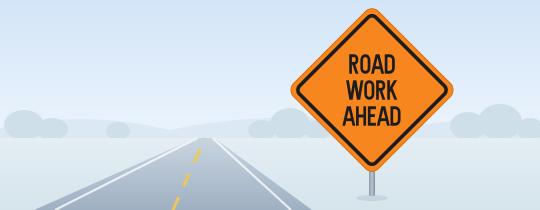
Orange diamond signs reading ROAD WORK AHEAD lead into a construction zone on a D.C. street. If you speed or commit another moving violation inside the zone, what happens to the fine?
Show answer
Correct answer: It doubles
Why
D.C. doubles the civil fine for moving violations committed in a work zone. Orange marks construction and maintenance areas, and most of those signs are diamond-shaped. Slow down early, follow any flagger and expect lanes to shift.
32Right-of-way
You’re pulling out of an alley onto a busy D.C. street, and a sidewalk runs across the alley’s mouth. Where must you make your first stop?
Show answer
Correct answer: Just before you drive onto the sidewalk
Why
D.C. rules require a full stop right before the sidewalk whenever you leave an alley, driveway, building or private road. Let anyone on the sidewalk pass, then yield to all traffic on the street before you pull out. People walking by can’t see a car coming out from between buildings until it’s right there.
33Speed limits
The sign says 25 mph, but heavy rain and fog have cut how far you can see. What speed does D.C. law expect?
Show answer
Correct answer: Whatever is reasonable for the conditions, even well under 25
Why
D.C.’s basic speed rule says your speed must always suit the traffic, road and weather in front of you, and you must control it to avoid a crash. Slow down for intersections, curves, hilltops and storms. Creeping so slowly that you block normal traffic breaks the rules too.
34Parking
You’re dropping off a friend on a D.C. street where a marked bike lane runs between the parked cars and traffic. Where may you stop the car?
Show answer
Correct answer: In a legal curbside space, out of the bike lane
Why
D.C. bans stopping, standing or parking in a bike lane, even for a moment, and you may never stop on a crosswalk either. Pull into a legal space at the curb, and have your passenger use the Dutch Reach the DC DMV manual teaches: open the door with the far hand, so you turn and spot riders coming.
35Alcohol & phones
Your passenger wants to open a can of beer while you drive across D.C. What does the law say?
Show answer
Correct answer: It’s not allowed: no one may ride with an opened drink in the passenger area
Why
D.C. bars anyone from driving or riding in a vehicle with an opened alcoholic drink in the passenger area. An opened container may travel only in a locked compartment, the trunk or a cargo area no one can reach. The driver faces a $100 fine.
36Safe driving
May you drive in D.C. with earbuds in both ears to listen to a podcast?
Show answer
Correct answer: No, earbuds in both ears aren’t allowed while driving
Why
D.C. law bars drivers from wearing headphones that cover both ears or earbuds in both ears, unless the device helps a driver with a hearing impairment. You need to hear sirens, horns and bike bells. Play audio through the car’s speakers instead.
37Permit & provisional license
It’s a Tuesday night in October. A 16-year-old with a D.C. provisional license is driving home alone from a friend’s house. By what time must she be off the road?
Show answer
Correct answer: 11 p.m.
Why
From September through June, provisional drivers may not drive from 11 p.m. to 6 a.m. on Sunday through Thursday nights, or from 12:01 a.m. to 6 a.m. on Friday and Saturday nights; in July and August the 12:01 a.m. limit applies every night. Trips to or from work, school-sponsored activities and religious or athletic events are exempt, and so is driving with a licensed adult 21+ beside you.
38Permit & provisional license
You’re 19 and getting your first driver license in D.C. Which rules apply to you?
Show answer
Correct answer: GRAD, which covers every new driver under 21
Why
D.C. enrolls every new driver under 21 in GRAD automatically, so a 19-year-old goes through the learner permit, provisional license and full-license stages just like a 16-year-old. At 21 you’re released from GRAD and can book the road test without the six-month wait or the driving-hours form.
39Sharing the road
A city bus is stopped at a bus stop on the near side of an intersection, and you want to turn right there. What does D.C. law require?
Show answer
Correct answer: Stay behind the bus, or merge in behind it, to make your turn
Why
D.C. law forbids passing a bus stopped at an intersection bus stop and then turning right in front of it. Wait or merge behind the bus to make your turn, since riders getting off may be crossing right where you’d go. Once the bus pulls away, turn when the crosswalk is clear.
40Road signs
An overhead signal above your lane changes to a steady yellow X. What is it telling you?
Show answer
Correct answer: Change out of that lane when it’s safe
Why
The DC DMV manual lists four lane-use signals. A steady yellow X warns you to leave the lane safely; a red X means never drive there, a flashing yellow X marks a lane for left turns, and a green arrow means you may use it.
DC DMV knowledge test at a glance
Know these before you walk into a DC DMV service center or log in for the virtual test.
Washington, D.C. · GRAD learner permit test
35 questions, 75 minutes.
Ages 16–20 · Multiple choice
60 minfor the 30-question test if you’re 21 or older
$10per try at a DC DMV service center
Onlineat home with a live proctor, by appointment
Spanishone of 24 languages for the test
Day 4earliest retest after a failed try
20/40standard vision mark for your better eye, glasses OK
Under 21? Your road to a license
16Learner permitPass the vision screening and knowledge test, bring a parent’s or guardian’s consent and pay $20. Drive only 6 a.m.–9 p.m., with a licensed driver 21+ beside you and no other passengers.
6 moSupervised practiceKeep the permit at least six months with no pointable violations, and log 40 hours behind the wheel, signed off by a licensed driver 21 or older.
16½Provisional licensePass the road skills test and you can drive alone. From September to June, no driving 11 p.m.–6 a.m. Sunday–Thursday nights or 12:01–6 a.m. Friday and Saturday nights. Passengers: one licensed adult 21+ up front, plus your parents or siblings.
17Full license with conditionsQualify after six months on the provisional, 12 straight months with no pointable violations and 10 night hours with a driver 21+. Until 18, the night limits stay and you can carry up to 2 passengers under 21, siblings not counted.
New drivers stay in GRAD until they turn 21, so 18- to 20-year-olds go through the same three stages as 16-year-olds. At 21 or older you skip it: pass the vision and knowledge tests for a learner permit, then book the road skills test with no waiting period and no hours log.
What’s on the Washington, D.C. permit test
Everything on the test comes from the DC DMV Automobile Driver Manual (December 2023 edition): traffic laws, road signs and safe driving. These six areas are the place to start.
Road signs
Shape first: an octagon is STOP, a point-down triangle YIELD, a pentagon a school zone, a circle a railroad ahead.
Overhead lane signals: red X, stay out; steady yellow X, leave the lane safely; green arrow, the lane is open to you.
At a HAWK pedestrian signal, steady red means stop; flashing red means stop, then go once the crosswalk is clear.
Right-of-way
Pedestrian in a crosswalk in your lane, or one lane over and heading your way? D.C. says stop and stay stopped, not just yield.
Traffic already in a circle goes first; at an uncontrolled intersection, yield to a car arriving at the same time from your right.
School bus with flashing lights or its stop arm out: stop from both directions, unless a median strip separates you.
Speed limits
No sign? Every D.C. street is 20 mph.
15 mph in alleys, and in school zones from 6 a.m. to 7 p.m. unless signs show other hours.
20 mph or more over the limit is reckless driving; 30 or more over is aggravated reckless driving.
Parking
Keep 10 feet from a fire hydrant and 40 feet from an intersection.
25 feet before a STOP or YIELD sign, 20 from a fire station driveway, 50 from a railroad crossing.
Park within 12 inches of the curb, never in a bike or bus lane, and never double-parked.
Alcohol & phones
BAC limits: 0.08% at 21 and over, 0.04% in a commercial vehicle, and any measurable amount under 21.
Refusing a chemical test after a DUI arrest costs a year of D.C. driving privileges, or the Ignition Interlock program if you hold a D.C. license.
Licensed adults: hands-free only, and since December 2025 you can’t even hold the phone. Never text.
Teen rules
Learner permit: 6 a.m.–9 p.m. only, a licensed driver 21+ up front, no other passengers.
Provisional curfew, September–June: off the road from 11 p.m. Sunday–Thursday nights and from 12:01 a.m. Friday and Saturday nights, until 6 a.m.
On a permit or under 18, no phone at all while driving, even hands-free, except in an emergency.
Washington, D.C. numbers to know
The distances and limits worth memorizing before test day.
20 mphon any D.C. street without a speed sign
100 ftof steady signal before every turn
10 ftbetween your parked car and a fire hydrant
40 ftbetween your parked car and an intersection
15–50 ftfrom the nearest rail when you stop for a train
3 ftminimum gap when you pass a bicycle
Your Washington, D.C. course, in your pocket
These 40 questions are just the warm-up. The app gives you 482 Washington, D.C. practice questions, 36 short lessons and the why behind every answer.
36 short lessonsFour levels, from fundamentals to expert, then a full practice exam.
482 Washington, D.C. questions317 of them with pictures.
Your most-missed questionsA review lesson built from the questions you miss most.
Exam simulatorTake full practice exams and watch your readiness grow.
Washington, D.C. permit
Your Washington, D.C. path is ready.
36 lessons, 482 questions and full practice exams. In English and Spanish.
How many questions are on the DC DMV knowledge test, and what score do I need to pass?
DC DMV gives two versions. The GRAD test for ages 16 to 20 has 35 questions and a 75-minute limit, and the standard test for 21 and older has 30 questions and 60 minutes; run past the time and the test counts as failed. DC DMV doesn’t publish a passing score, so practice until you score 80% or better on every round.
How soon can I retake the D.C. knowledge test if I fail?
Wait three full calendar days: fail on a Tuesday, and Saturday is your next chance. Fail six times within 12 months, and your seventh try has to wait until a year after the first fail. Every attempt means paying the test fee again, and using a phone, smart watch or notes during the test is an automatic fail with a 60-day wait.
Can I take the DC DMV knowledge test online?
Yes. DC DMV offers a virtual knowledge test at home with a live proctor, by appointment, for the standard and GRAD tests (not motorcycle or CDL); it costs $49.95 and needs a desktop or laptop with a webcam, a microphone and an up-to-date Chrome browser. You can also book the Test Proctoring Center ($39.95) or walk into a DC DMV service center ($10). After a pass, bring your documents to a service center within 14 business days, or the result won’t count.
Can I take the D.C. permit test in Spanish?
Yes. DC DMV service centers give the knowledge test in 15 languages, Spanish among them, and nine more were added on December 15, 2025, for 24 in all. An audio version helps if reading is hard, and free phone interpreting covers 240 languages. DC DMV also publishes its driver manual in Spanish (October 2023 edition), and this practice test and the app are in Spanish too.
How old do you have to be to get a learner permit in D.C.?
16. Every new driver under 21 goes into GRAD, D.C.’s graduated license program. Hold the learner permit at least six months with no pointable violations and log 40 supervised hours, then pass the road test for a provisional license at 16½. At 17, after six months on the provisional, 12 violation-free months and 10 hours of night driving, you can move up to a full license with conditions. Driver education is recommended but not required.
How much does a D.C. learner permit cost?
The knowledge test is $10 at a DC DMV service center ($39.95 at the Test Proctoring Center, $49.95 online), and you pay it whether you pass or fail. The learner permit is $20, the provisional license $20, and a full license $47 for eight years. Each road test costs $10, and skipping one without cancelling two business days ahead costs $30.
What do I need to bring to get a D.C. learner permit?
A completed application, proof of identity and age, proof of your Social Security number and two proofs of D.C. residency. Under 18, add a parent’s or guardian’s consent form. Once you pay, you leave with a paper permit good for 45 days, and the card arrives by mail within 10 business days. If you can’t get a REAL ID, for example without a Social Security number, ask for a Limited Purpose permit.
What’s the best way to study for the D.C. permit test?
Read the DC DMV Automobile Driver Manual (December 2023 edition), since the test draws everything from it; it’s online only, with no printed copies. Then take the 40 questions on this page, and keep going in the app with 482 D.C. questions and 36 short lessons, every answer explained.