Get ready for the Illinois Secretary of State written exam at your local DMV with 40 free questions on road signs, Scott’s Law, speed limits and the teen GDL rules. Pick an answer and the explanation appears right away.
40 questions in four rounds of 10, mixing Illinois signs and signals with Scott’s Law, school bus stops, parking distances, DUI and phone rules, and the GDL limits for teens. Each answer explains itself in a few lines.
Round 1 · Questions 1–10
1Crashes & emergencies
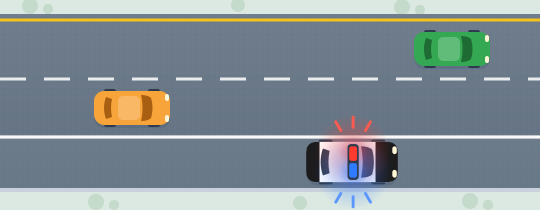
You’re on a four-lane interstate outside Chicago. Up ahead, a squad car sits on the right shoulder with its emergency lights flashing, and you can safely move left. What does Illinois’s Scott’s Law require?
Show answer
Correct answer: Slow down and move to a lane that isn’t next to the squad car
Why
Scott’s Law, the Illinois Move Over law, has you slow down and switch to a lane not next to a stopped vehicle with flashing lights when at least two lanes run your way and the move is safe; if it isn’t, slow down and pass with plenty of room. A first violation costs $250 to $10,000, and state law makes sure the written exam’s question pool covers this rule. It honors Lt. Scott Gillen of the Chicago Fire Department, killed by a drunk driver while working a crash on the Dan Ryan Expressway.
2Road signs
Driving through farm country, you pass a round yellow sign with a black X and the letters RR. On a rural Illinois road, how far ahead could the crossing still be?
Show answer
Correct answer: As much as 750 feet away
Why
The round yellow sign is an early warning, not the crossing itself. In rural Illinois it can stand up to 750 feet before the tracks, which gives you time to slow down, turn the radio down and check both ways. The white crossbuck marks the spot where the tracks actually are.
3Right-of-way
Two cars on different streets roll up to a four-way stop at exactly the same moment. You’re the one on the left. What should happen?
Show answer
Correct answer: You let the car on your right go first
Why
At an all-way stop in Illinois, the first vehicle to stop is the first to go. When two arrive together from different roads, the left-hand driver lets the right-hand one go. Before you pull out, make sure the other driver is actually staying put.
4Speed limits
Unless signs show something lower, where does the Illinois 70 mph limit apply?
Show answer
Correct answer: On interstates, tollways included
Why
Illinois tops out at 70 mph on interstates and tollways. Designated four-lane divided highways run at 65 mph, and most other roads outside towns at 55 mph. Cook and seven other counties may set lower limits by ordinance, so the posted sign always wins.
5Parking
You spot an open curb space close to a fire hydrant. How much room does Illinois law require between your car and the hydrant?
Show answer
Correct answer: 15 feet
Why
Illinois bans standing or parking within 15 feet of a hydrant, so firefighters can hook up a hose without hunting for space. The same law adds 20 feet of clearance before an intersection crosswalk and 30 feet before a stop sign. When in doubt, leave a little extra.
6Alcohol & phones
A 19-year-old driver is pulled over, and a test shows a small trace of alcohol, far below 0.08%. What happens under the Illinois Zero Tolerance law?
Show answer
Correct answer: A license suspension of at least three months
Why
For drivers under 21, Illinois allows no alcohol at all: any reading above 0.00 means a suspension of at least three months. Refusing the test is worse, at six months. Adults face the 0.08% limit, and commercial drivers 0.04%.
7Safe driving
On a dry road in clear weather, what following distance does the Illinois Rules of the Road recommend?
Show answer
Correct answer: Three seconds
Why
Pick a fixed marker; when the car ahead passes it, start counting. Reach the marker before three seconds and you’re too close. At 55 mph that gap is roughly 243 feet, and you should add time in rain, snow or fog, and keep 3 to 4 seconds behind a motorcycle.
8Permit & teen rules
What’s the youngest age for an Illinois instruction permit, and what does a teen need to get one?
Show answer
Correct answer: 15, with proof you’re enrolled in an approved driver education course
Why
Illinois issues a permit at 15 with proof from your driver ed provider that you’re enrolled or will start within 30 days, plus a parent’s or guardian’s consent. At the DMV you also pass a vision screening and the written test. Teens who wait until 17 years and 3 months can apply without driver ed.
9Lane markings
You’re in the left lane of an Illinois interstate in light traffic. You’ve just finished passing a truck, and another car is closing in behind you. What does state law expect next?
Show answer
Correct answer: Move back to the right once you’ve safely passed
Why
On Illinois interstates and other controlled-access highways, the left lane is for passing. You may stay there only in narrow cases, such as nobody directly behind you, heavy traffic, bad weather, a blocked right lane or moving over for emergency or construction vehicles. Lingering on the left pushes faster drivers to pass on the right.
10Sharing the road
You’re overtaking a bicyclist riding near the edge of a two-lane road. What’s the least space Illinois law lets you leave as you pass?
Show answer
Correct answer: 3 feet
Why
Illinois sets 3 feet as the smallest gap you may leave when you overtake someone on a bike or on foot in the road. If the bike is going under half the posted limit, you may even pass it in a no-passing zone, as long as you stay within the limit and have room. On a road with a second lane going your way, state law expects you to change lanes to pass when you safely can.
Round 2 · Questions 11–20
11Speed limits
It’s 3:15 p.m. on a school day, and children are on the sidewalk just past a five-sided yellow-green sign showing two kids walking. What is the limit in this posted Illinois school zone?
Show answer
Correct answer: 20 mph
Why
Illinois drops the limit to 20 mph in a posted school zone on school days from 6:30 a.m. to 4 p.m. whenever children are present. A ticket there costs at least $150, and $300 for a repeat. Be ready to stop for anyone in the crosswalk.
12Road signs
At a Springfield intersection, a steady red arrow pointing right is lit for your lane, and no sign forbids turning. What does Illinois law allow?
Show answer
Correct answer: A right turn after a complete stop, once you’ve yielded to pedestrians and cross traffic
Why
Illinois handles a steady red arrow much like a plain red light: stop completely, let people in the crosswalk and cross traffic go first, then turn right. A NO TURN ON RED sign or a local rule takes that option away. A left red arrow works the same way when both streets are one-way and traffic on the new street flows left.
13Right-of-way
In downtown Chicago you’re stopped at a red light on a one-way street. The cross street is also one-way, with traffic moving to your left, and that’s where you’re heading. What does Illinois allow?
Show answer
Correct answer: A left turn after a complete stop, yielding to pedestrians and traffic, unless a sign forbids it
Why
Illinois allows a left on red in just one case: both streets are one-way, and the street you’re entering carries traffic to your left. Stop completely, give way to pedestrians and cross traffic, and look for a NO TURN ON RED sign first. Anywhere else, a left turn waits for the green.
14Parking
You want to park on a block that ends at a stop sign. How far back from the sign must your car be in Illinois?
Show answer
Correct answer: 30 feet
Why
On the approach to a stop sign, Illinois wants parked cars at least 30 feet back, and the same gap applies before yield signs, flashing beacons and traffic lights. A car parked closer can hide the sign and block drivers’ view of cross traffic. Near a railroad crossing the gap grows to 50 feet from the nearest rail.
15Alcohol & phones
Arrested for DUI in Illinois for the first time, a driver refuses a breath, blood or urine test. How long is the license suspended?
Show answer
Correct answer: One year
Why
Driving in Illinois counts as agreeing to chemical testing after a DUI arrest. A first refusal costs a full year of driving privileges, while testing at 0.08% or more costs six months, so refusing only makes things worse. Repeat offenders who refuse lose their license for three years.
16Safe driving
Which of these situations requires your headlights to be on under Illinois law, even at noon?
Show answer
Correct answer: Light snow that has your windshield wipers going
Why
Illinois ties headlights to wipers: if rain, snow or fog makes you use them, your headlights go on too. They’re also required from sunset to sunrise and whenever people and vehicles aren’t clearly visible 1,000 feet away. In gray weather, lights help others see you as much as they help you see.
17Permit & teen rules
Before an Illinois teen under 18 can move from a permit to a driver’s license, what must happen?
Show answer
Correct answer: Hold the permit at least 9 months and log 50 supervised hours, 10 of them at night
Why
Illinois requires nine months or more with the permit and 50 hours behind the wheel, including 10 after dark, certified by a parent, guardian or responsible adult on the 50-hour log. A moving violation conviction in that time adds another nine-month wait. The earliest license age is 16.
18Lane markings
The center of your two-lane road is marked with two yellow stripes side by side: the one nearer you is dashed, the far one is solid. What does that mean for you?
Show answer
Correct answer: You may pass when it’s safe and the way ahead is clear
Why
Yellow center lines split traffic moving in opposite directions. Where a solid and a broken line run together, only the driver with the broken line closest to their lane may pass, and only when it’s safe. Plan the pass so you’re back on your side with at least 200 feet to spare before any oncoming car.
19Sharing the road
You’ve parallel parked on a busy street. Which habit does Illinois encourage as you open the driver’s door?
Show answer
Correct answer: Reach for the handle with your right hand, so your body turns and you look back for bikes
Why
It’s called the Dutch Reach: grabbing the handle with the hand farther from the door twists your shoulders and points your eyes at the mirror and the bike lane. Illinois law even allows the written exam to ask about it. Never swing a door into traffic unless it’s safe.
20Road signs
On a two-lane highway, a yellow sign shaped like a sideways triangle, a pennant, stands on the left shoulder. What is it marking?
Show answer
Correct answer: The start of a no-passing zone
Why
This pennant is the NO PASSING ZONE sign. Illinois puts it on the left side of two-lane, two-way roads where the no-passing stripes begin, right where a driver in the passing lane will see it. Wrap up any pass before you reach it, and keep in mind that every Illinois work zone is a no-passing zone as well.
Round 3 · Questions 21–30
21Right-of-way
You’re following a school bus on a two-lane road when it stops, flashes its red lights and swings out its stop arm. When may you drive on?
Show answer
Correct answer: Once the stop arm folds back and the red lights go off, or the bus driver waves you on
Why
Illinois law makes drivers from either direction stop for a school bus loading or unloading children and wait until the arm is back in and the red lights are off, or until the bus driver signals you ahead. Passing it illegally means a $300 fine and a three-month suspension for a first offense. Amber lights come on before the bus stops, so start slowing as soon as you see them.
22Road signs
The left-turn signal above your lane is blinking a yellow arrow. What does that let you do?
Show answer
Correct answer: Turn left after yielding to oncoming traffic and to pedestrians in the crosswalk
Why
A flashing yellow arrow allows the turn, but everyone already in the intersection or crosswalk goes before you. Pull up, watch for a safe gap and keep your wheels pointed straight while you wait, so a bump from behind can’t push you into oncoming cars. Only a solid green arrow gives you a protected turn.
23Right-of-way
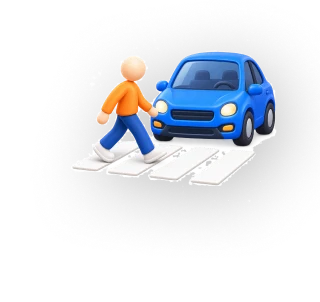
A pedestrian has just stepped into a marked crosswalk on your side of a city street. What does Illinois law require of you?
Show answer
Correct answer: Stop fully and let the person cross before you move
Why
Slowing down isn’t enough in Illinois: when someone is in a marked crosswalk, you must stop completely and yield. At unmarked crosswalks with no signals, you still have to yield to people on foot. A car stopped at a crosswalk in the next lane may be hiding someone crossing, so don’t pass it.
24Speed limits
You’re driving through an Illinois town on a street with no speed limit sign in sight. What limit applies?
Show answer
Correct answer: 30 mph
Why
In an urban district, Illinois sets 30 mph unless another limit is posted, and many cities post their own. Alleys are slower still, at 15 mph. Whatever the number, the state’s basic speed rule means easing off for traffic, weather, curves and intersections.
25Parking
Which of these parking spots would break Illinois law?
Show answer
Correct answer: 25 feet from the closest rail at a railroad crossing
Why
Railroad crossings need the most room: Illinois wants parked cars at least 50 feet from the nearest rail. The other spots clear their limits of 15 feet for a hydrant, 20 for an intersection crosswalk and 20 for a fire station driveway. Across the street from a fire station, signs can stretch that to 75 feet.
26Alcohol & phones
A 30-year-old driver holds a phone in one hand and talks on speaker while driving. Is that legal in Illinois?
Show answer
Correct answer: No: a phone held in hand breaks the law even on speaker
Why
Drivers 19 and older may talk only through a hands-free or voice-operated setup; a phone in your hand doesn’t qualify, speaker or not. Watching video, joining video calls and using social media are banned even hands-free. A first ticket can cost up to $75 and counts as a moving violation.
27Safe driving
You’re using high beams on a dark rural road. Under Illinois law, when must you dim them for an oncoming car?
Show answer
Correct answer: Within 500 feet of it
Why
Illinois has you switch to low beams within 500 feet of an oncoming vehicle, and whenever you follow another vehicle within 300 feet. If the oncoming glare is blinding, steer by the painted edge line on your right until the car goes by. Return to high beams once it’s behind you.
28Permit & teen rules
You’re 16 and licensed in Illinois. On a Saturday night, when does the state’s nighttime driving limit begin?
Show answer
Correct answer: 11 p.m.
Why
For drivers under 18, permit holders included, Illinois bans driving from 11 p.m. to 6 a.m. on Friday and Saturday nights and from 10 p.m. to 6 a.m. Sunday through Thursday. Exceptions include driving with a parent, for work or in an emergency, and local curfews may set different hours. Breaking the rule can lead to a suspension.
29Sharing the road
On a two-lane road in central Illinois, you come up behind a tractor with an orange triangle edged in red on its back. How fast do vehicles with this emblem usually travel?
Show answer
Correct answer: About 5 to 20 mph
Why
That orange triangle is the slow-moving vehicle emblem, used on farm equipment, road machinery and animal-drawn vehicles. At 5 to 20 mph, you close the gap fast, especially at night or over a hill. Ease off early and pass only where it’s legal and you can see well ahead.
30Crashes & emergencies
A fender bender in Illinois hurts no one but causes about $2,000 in damage. Both drivers are insured, and no officer has come to the scene. Does the crash have to be reported?
Show answer
Correct answer: Yes: it must be reported to police, whoever was at fault
Why
Illinois requires a crash to be reported, regardless of fault, when anyone is hurt or killed or the property damage tops $1,500, or $500 if any vehicle involved is uninsured. With no officer on the scene, report it at the nearest police station, or to the sheriff or State Police in a rural area. Every car also needs liability coverage of at least $25,000/$50,000/$20,000.
Round 4 · Questions 31–40
31Road signs
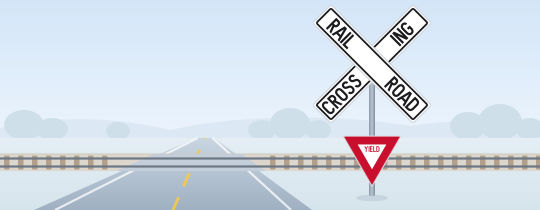
A two-lane road crosses a single track. The crossing has a white X-shaped crossbuck with a YIELD sign under it, but no flashing lights and no gate. How should you treat it?
Show answer
Correct answer: Like a YIELD sign: slow down, look and listen both ways, and stop for any train
Why
The Illinois handbook treats the crossbuck as a YIELD sign, and a train always has the right-of-way. If a small panel under the X shows a number, that’s how many tracks you’ll cross, and a second train can hide behind the first. Never assume a quiet track is out of service.
32Road signs
Red lights begin flashing at a railroad crossing as you approach. Which stopping spot meets Illinois law?
Show answer
Correct answer: 30 feet from the closest rail
Why
When crossing lights flash, a gate comes down, a flagger signals or a train is near, Illinois sets a stopping zone that begins 50 feet before the nearest rail and ends 15 feet short of it. That 15-foot minimum keeps a safe buffer between your bumper and a passing train. Don’t move until the lights go dark and any gate has risen all the way.
33Right-of-way
On a road with four lanes, two in each direction, a school bus stops with red lights flashing on the far side. You’re traveling the opposite way. Under Illinois law, what must you do?
Show answer
Correct answer: Continue with care; oncoming traffic doesn’t have to stop here
Why
Illinois excuses oncoming drivers on a road of at least four lanes, with two or more running each way, when the bus sits in the lanes going the other way. Drivers behind the bus still stop, and on a two-lane road everyone stops. Keep your speed down anyway; children don’t always wait for the bus to pull away.
34Speed limits
It’s Sunday evening, and an interstate work zone with a reduced speed limit is empty: no workers, no moving equipment. Does the lower limit still apply in Illinois?
Show answer
Correct answer: Yes, around the clock, and a first ticket costs at least $250
Why
Illinois enforces work zone limits 24 hours a day, workers or not, because lane shifts, rough pavement and barriers stay after the crew goes home. The minimum fine is $250 the first time and $750 after that. Every Illinois construction zone is also a no-passing zone.
35Parking
You parallel park on a two-way street. How close to the curb must your right wheels be under the Illinois Rules of the Road?
Show answer
Correct answer: Within 12 inches
Why
Illinois wants your right-hand wheels parallel to the curb and no more than 12 inches from it, with the car facing the same way traffic moves. Parking farther out squeezes the lane for passing cars and cyclists. Before you open your door, check the mirror for bikes.
36Alcohol & phones
Under Illinois law, which way of carrying alcohol in the passenger area of a car is legal?
Show answer
Correct answer: A bottle still in its original container with the seal unbroken
Why
Illinois bans alcohol in the passenger area unless it’s in its original container with the seal intact, and nobody, driver or passenger, may drink in the car. The narrow exceptions cover passengers in limousines, charter buses and motor homes. Picked up a bottle on the way home? Leave it sealed.
37Safe driving
The driver ahead sticks a left arm out the window and bends it straight up at the elbow. What is that driver signaling?
Show answer
Correct answer: A right turn
Why
Illinois hand signals all use the left arm: pointed up for a right turn, straight out for a left turn and down to slow or stop. They come in handy when a bulb burns out or bright sun washes out the blinkers. Waving someone past with your turn signal, by the way, is illegal in Illinois.
38Safe driving
You plan to turn right onto a side road from an open rural highway in Illinois. How far before the turn must your signal be on?
Show answer
Correct answer: At least 200 feet
Why
Outside business and residence districts, Illinois law calls for a steady signal over at least the last 200 feet before a turn or lane change; in town, the minimum is 100 feet. At highway speed, drivers behind you need that extra warning to react. Cancel the signal once you’ve finished so it doesn’t mislead anyone.
39Permit & teen rules
During your first 12 months with an Illinois license, while you’re still under 18, how many passengers under age 20 may ride with you?
Show answer
Correct answer: One, unless the others are your siblings or your own children
Why
Illinois limits newly licensed teens to one passenger under 20 for the first year or until 18, whichever comes first; brothers, sisters, step-siblings, children and stepchildren don’t count. A moving violation in that year stretches the limit by six more months. Fewer friends on board means fewer distractions.
40Permit & teen rules
You’re 18 and in the full licensing phase of your Illinois license. Which phone use is legal while you drive?
Show answer
Correct answer: Calling 911 to report an emergency
Why
Illinois bars drivers under 19 from using a phone at all behind the wheel, hands-free included. The only exception is reaching police, a hospital or doctor, the fire department or other emergency services. Once you turn 19, the adult rules apply and hands-free calls become legal.
Illinois DMV written test at a glance
Know these numbers before you head to a Secretary of State DMV.
Illinois · Class D written exam
80% to pass.
35 questions · 15 on signs
28 of 35 answers right to pass
3 triesper exam, within a year of paying the fee
$20for an original instruction permit
Spanishon request, with a Spanish handbook too
In personat a DMV; the 44 busiest need an appointment
Oral testfor language or reading needs, Mon–Thu
20/40vision, plus 140° of side vision
Under 18? Your road to a license
15Instruction permitShow proof you’re enrolled in approved driver ed (or starting within 30 days), bring a parent’s or guardian’s consent, and pass the vision and written tests.
9 moPractice and driver edHold the permit at least nine months, finish driver ed (30 hours of class, 6 behind the wheel) and log 50 hours, 10 at night, with a licensed adult 21+ beside you.
16Initial licenseBring your signed 50-hour log and pass the driving exam. With an A or B in a high school course that uses Cooperative Driver Testing, you may take that test with your instructor instead of at a DMV.
16–17Until you turn 18No driving 10 p.m.–6 a.m. Sunday–Thursday or 11 p.m.–6 a.m. Friday–Saturday, no phone use at all, and for the first 12 months only one passenger under 20 who isn’t a sibling or your child.
18Full licensingAge-based limits end, though the phone ban, hands-free included, lasts until 19.
18 to 20, never licensed and never took approved driver ed? Take a 6-hour adult course first. At 21 or older no course is required: get a permit if you want practice time, then pass the vision, written and driving exams.
What’s on the Illinois permit test
Your study guide is Illinois Rules of the Road 2026 from the Secretary of State. On the exam, 15 questions ask you to identify signs, and 20 cover traffic laws, safe driving and vehicle equipment. Start with these six areas.
Road signs
Learn shapes on sight: eight sides is STOP, three is YIELD, five means a school zone, and a pennant marks no passing.
Color tells the job: orange for work zones, yellow-green for schools and pedestrians, pink for traffic incidents.
A round yellow RR sign can stand 750 feet before a rural crossing; the crossbuck itself works like YIELD.
Right-of-way
Four-way stop: first to stop goes first. Arrive at the same moment? The driver on the right goes first.
Someone in a marked crosswalk? Illinois wants a full stop, not just a slowdown.
School bus flashing red: everyone stops, except oncoming drivers when the road has four or more lanes.
Speed limits
70 mph on interstates and tollways, 65 on designated four-lane divided highways, 55 on most other rural roads.
30 mph in cities and towns unless posted otherwise, 15 mph in alleys.
School zones: 20 mph from 6:30 a.m. to 4 p.m. on school days with kids present. Work zone limits apply 24/7.
Parking
Parking gaps: hydrant 15 feet, intersection crosswalk 20 feet, stop sign or traffic signal 30 feet.
Railroad crossing: 50 feet from the nearest rail. Fire station driveway: 20 feet.
Parallel park pointing the same way traffic moves, right wheels within 12 inches of the curb.
Alcohol & phones
BAC limits: 0.08% at 21+, 0.04% for commercial drivers, and zero tolerance under 21.
Refuse a chemical test after a DUI arrest and you lose your license for at least a year.
19 and older: hands-free only. Under 19: no phone at all, even hands-free.
Teen rules
Hold the permit at least 9 months and log 50 hours, 10 of them after dark.
Under 18: off the road 10 p.m.–6 a.m. Sunday–Thursday, 11 p.m.–6 a.m. Friday–Saturday.
First 12 months licensed: one passenger under 20, unless the others are siblings or your own kids.
Illinois numbers to know
Six Illinois figures to memorize before your DMV visit.
100/200 ftto keep your signal on before a turn: in town / elsewhere
15 ftbetween your parked car and a fire hydrant
15–50 ftfrom the closest rail when crossing signals flash
3 secfollowing distance on a dry road in good weather
500 ftto dim your high beams for an oncoming car
3 ftminimum space when passing a bicyclist
Your Illinois course, in your pocket
These 40 questions are just the warm-up. The app gives you 497 Illinois practice questions, 36 short lessons and the why behind every answer.
36 short lessonsFour levels, from fundamentals to expert, then a full practice exam.
497 Illinois questions320 of them with pictures.
Your most-missed questionsA review lesson built from the questions you miss most.
Exam simulatorTake full practice exams and watch your readiness grow.
Illinois permit
Your Illinois path is ready.
36 lessons, 497 questions and full practice exams. In English and Spanish.
How many questions are on the Illinois written test, and what’s a passing score?
35. The exam has 15 questions on identifying traffic signs and 20 multiple-choice or true/false questions on traffic laws, safe driving and vehicle equipment. You need 80%, which means 28 correct answers, and you’ll also take a vision screening (20/40 or better).
How many times can I take the Illinois permit test?
Three times per application. You get three attempts at each exam (vision, written and driving), all within one year of paying your application fee.
Can I take the Illinois written test online?
No. In Illinois, driver licensing belongs to the Secretary of State (SOS), and you take the written exam in person at one of its DMVs; express facilities don’t offer it. Under the Skip-the-Line program, the 44 busiest DMVs, including every Chicago and suburban location, require an appointment, which you book at ilsos.gov.
Can I take the Illinois permit test in Spanish?
Yes. Illinois law lets you take the written exam in Spanish when you ask, though any English words on the road sign pictures stay in English. The Secretary of State also publishes a Spanish handbook, the Manual de Conducir en Illinois, and offers an oral version of the test Monday through Thursday for anyone with a language barrier. This practice test and the app are in Spanish too.
How old do you have to be to get a permit in Illinois?
15. You need proof that you’re enrolled in an approved driver education course (or will start one within 30 days), a parent’s or guardian’s consent, and passing results on the vision and written tests. From 17 years and 3 months you can apply without driver ed. Under 18, you hold the permit at least nine months and log 50 practice hours, 10 at night, before a license at 16 or older.
What are the Illinois GDL rules for teen drivers?
Until 18, no driving 10 p.m.–6 a.m. Sunday through Thursday or 11 p.m.–6 a.m. on Friday and Saturday. Permit holders may carry one passenger up front; for the first 12 months, newly licensed drivers may carry only one passenger under 20, not counting siblings or their own children. Under 19, phones stay off behind the wheel, hands-free included.
How much does an Illinois permit cost?
$20 for an original Class D instruction permit. If you get your license before the permit expires, you may not owe another fee. A standard license costs $30 for drivers 21 to 68 and $5 for ages 18 to 20.
What’s the best way to study for the Illinois permit test?
Read Illinois Rules of the Road 2026 and give road signs extra attention, since they make up 15 of the 35 questions. Then practice until 80% feels easy: start with the 40 questions above, and let the app take you through 497 Illinois questions and 36 short lessons, each answer explained.