Get ready for both parts of the Texas DPS written test, Road Signs and Road Rules, with 40 free questions on frontage roads, Texas speed limits, teen driving limits and more. Tap an answer and see right away why it’s correct.
Four rounds of 10 questions that mix road signs with Texas road rules: right-of-way, speed limits, parking, alcohol, phones and teen limits. Every answer explains itself in a few lines.
Round 1 · Questions 1–10
1Road signs
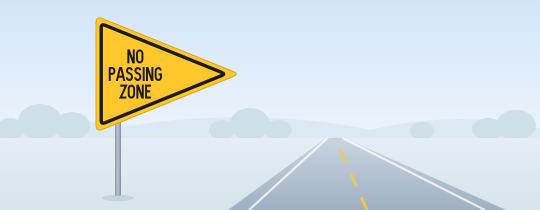
Heading down a two-lane farm-to-market road, you notice a yellow sign shaped like a long pennant lying on its side, posted on the left shoulder. What is it warning you about?
Show answer
Correct answer: A no-passing zone begins, so don't start a pass
Why
That long, sideways triangle is used for one message only: a no-passing zone is starting. Stay in your lane until the zone ends. The paint backs it up: a solid yellow stripe beside your lane carries the same message.
2Right-of-way
You and another car reach a neighborhood intersection with no signs or signals at about the same moment. The other car is coming from your right. What does Texas law require?
Show answer
Correct answer: You yield, because the other car is on your right
Why
At an uncontrolled intersection, you yield to a vehicle already in it and to one approaching from your right. At an all-way stop the order is first come, first served, and a tie also goes to the car on the right. Make eye contact before you roll forward.
3Speed limits
You're driving on a street in an urban district and haven't passed a speed limit sign. What limit applies by default in Texas?
Show answer
Correct answer: 30 mph
Why
Unless a sign says otherwise, Texas sets 30 mph on streets in an urban district, and only 15 mph in an alley. A posted limit always replaces the default, so watch for new signs as you cross city limits.
4Parking
You're hunting for curbside parking and spot an open gap next to a fire hydrant. How close to the hydrant may you legally park in Texas?
Show answer
Correct answer: No closer than 15 feet
Why
Texas keeps parked cars at least 15 feet from a fire hydrant so firefighters can hook up fast. Two more gaps to remember: 20 feet back from an intersection crosswalk, and 30 feet on the approach to a stop sign or traffic signal.
5Alcohol & phones
A 19-year-old has one beer at a cookout and then drives home. A test finds a small amount of alcohol, far below 0.08. What's true in Texas?
Show answer
Correct answer: It's an offense, because Texas has zero tolerance for drivers under 21
Why
For drivers under 21, any detectable amount of alcohol is an offense in Texas, and a first offense costs the license for 60 days. The 0.08 figure is the adult standard, not an allowance for younger drivers. Under 21, the right amount to drink before driving is none.
6Permit & provisional license
In Texas, the Class C knowledge test is split into two exams. What does it take to pass?
Show answer
Correct answer: At least 70% on each exam, Road Signs and Road Rules
Why
The DPS rule is 70% or better on each exam, so a strong Road Rules score can't cover for a weak Road Signs score. Give signs and rules equal study time, and remember that even if you test in Spanish, you need to understand signs written in English.
7Safe driving
You're cruising at 55 mph in clear, dry weather. How much space does the Texas Driver Handbook tell you to keep behind the car ahead?
Show answer
Correct answer: At least 4 seconds
Why
The handbook's rule is a gap of at least 4 seconds once you're above 30 mph, and more on wet roads or in poor visibility. To measure it, pick a fixed point such as a sign and count from the moment the car ahead passes it until you reach it.
8Lane markings
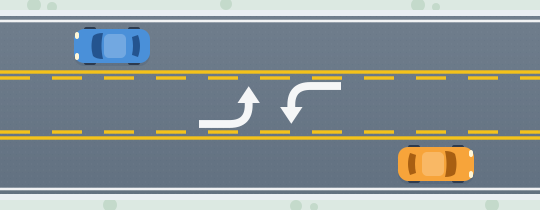
Down the middle of the road runs a lane edged with solid and broken yellow lines, marked with left-turn arrows pointing both ways. How may you use it?
Show answer
Correct answer: Only for turning left
Why
Those markings set aside a center lane that drivers turning left from either direction share. It is never for passing or for driving any distance. Move into it just before your turn, and watch for a driver turning from the opposite side.
9Road signs
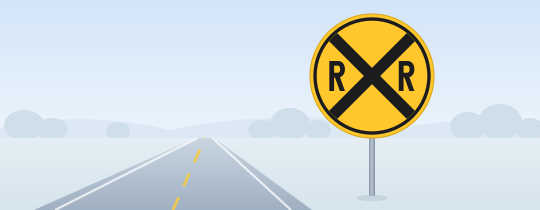
A round yellow sign with a big X and two R's comes up, and moments later the crossing lights start flashing. Where does Texas law tell you to stop?
Show answer
Correct answer: 15 to 50 feet back from the closest rail
Why
In Texas a round sign is the early warning for a railroad crossing. When lights, a gate, a flagger or a train call for a stop, pull up 15 to 50 feet short of the closest rail. Never weave around a gate that is down, lowering or rising.
10Crashes & emergencies
You're in a crash on a Texas street. Nobody is hurt, but the other car can't be driven. What must you do?
Show answer
Correct answer: Notify the police right away by the quickest means
Why
Texas requires an immediate call to police after a crash that injures or kills someone or leaves a vehicle unable to be driven. You also must stop, exchange names, addresses, registration and insurance information, and give reasonable help to anyone injured.
Round 2 · Questions 11–20
11Road signs
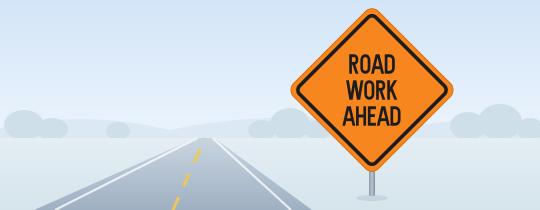
An orange diamond-shaped ROAD WORK AHEAD sign marks the start of a highway project, and crews are out on the road. What changes for you in this zone under Texas law?
Show answer
Correct answer: Traffic fines double while workers are present
Why
Orange is the color Texas uses for construction and maintenance areas, and fines for traffic violations double in a work zone while workers are present. Ease off early, leave extra room, and expect lane shifts, flaggers and equipment entering the road.
12Right-of-way
You're driving on a frontage road next to a Texas freeway. One car is coming down the exit ramp onto your road, and another wants to cross your lane to reach the entrance ramp. Who goes first?
Show answer
Correct answer: Both of them: you yield to the exiting car and to the one crossing to get on
Why
On a frontage road, you give way to vehicles leaving the highway and to vehicles crossing the frontage road to enter it. Ramps join the frontage road often, so slow down near each one and be ready to stop.
13Speed limits
Out in open country, far from any town, you're driving a farm-to-market road with no speed limit posted. What is the default limit on this kind of numbered highway?
Show answer
Correct answer: 70 mph
Why
Outside an urban district, Texas sets 70 mph on highways numbered by the state or the U.S., and that includes farm-to-market and ranch-to-market roads. Rural roads without a state or U.S. number default to 60 mph. Whatever the number, go slower when weather, curves or traffic demand it.
14Parking
You'd like to park on the street just before a stop sign. How much distance must you leave between your car and the sign?
Show answer
Correct answer: 30 feet
Why
Texas bars parking within 30 feet of the approach to a stop sign, a yield sign or a traffic signal at the roadside, because a parked car can hide it from other drivers. The 50-foot rule you may have heard is for the nearest rail of a railroad crossing.
15Alcohol & phones
An officer arrests a Texas driver for DWI and asks for a breath sample. The driver has no earlier alcohol or drug contacts and refuses. What happens to the license?
Show answer
Correct answer: It is suspended for 180 days
Why
Refusing a breath or blood test brings a 180-day suspension, and two years if there was a prior alcohol or drug contact within 10 years. That is longer than the 90 days an adult loses for failing the test the first time, so refusing doesn't spare you anything.
16Permit & provisional license
You're 15 and just got your Texas learner license. Which of these people may ride beside you while you practice?
Show answer
Correct answer: Your 22-year-old cousin, licensed for two years
Why
Your supervising driver must hold a license, be 21 or older, have driven for at least a year, and sit in the front passenger seat. That person must also be sober, awake and free to watch the road. Age and experience both count, so a 19-year-old won't qualify however skilled.
17Safe driving
Two hours into a straight, empty drive across West Texas, you notice you're zoning out and your eyelids feel heavy. What does the Texas Driver Handbook recommend for long trips?
Show answer
Correct answer: Take a break at least every two hours or 100 miles
Why
Long, unchanging roads can lull you into highway hypnosis, a drowsy, dazed state that slows your reactions. Stop at least every two hours or 100 miles even if you feel fine, get out and walk around, and keep your eyes moving between near and far.
18Lane markings
A Texas highway sign reads LEFT LANE FOR PASSING ONLY, and you're driving a little slower than the traffic around you. Where should you be?
Show answer
Correct answer: In a right-hand lane, moving left only to pass
Why
Where that sign is posted, the far-left lane is for overtaking, not cruising. Even without a sign, Texas law expects a driver slower than normal traffic to use the right-hand lane except to pass or to get ready for a left turn.
19Permit & provisional license
Before a Texas teen can move up to a provisional license, how much supervised driving practice must be logged?
Show answer
Correct answer: 30 hours, 10 of them at night
Why
Texas teens log 30 hours behind the wheel with a licensed driver 21 or older, and at least 10 of those hours must be after dark. They come on top of the in-car lessons in driver education. Spread them across the six months you must hold the learner license.
20Road signs
After a heavy storm, a barricade and a warning sign close a low-water crossing because water is over the road. A pickup ahead of you drives around it. What does Texas law say about doing the same?
Show answer
Correct answer: It's a crime: up to $2,000 and 180 days in jail
Why
Driving around a barricade or warning sign put up for high water is a Class B misdemeanor in Texas, punishable by as much as $2,000 in fines and 180 days behind bars. You can't see how deep the water is or whether the road under it has washed out. Turn around and find another route: Turn Around Don't Drown®.
Round 3 · Questions 21–30
21Right-of-way
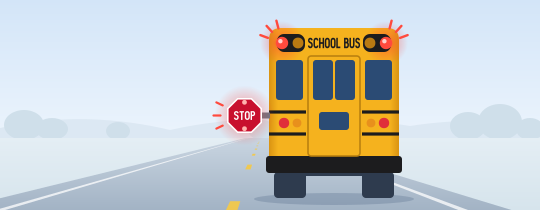
On a two-lane highway, the school bus just ahead of you stops, flashes its red lights and swings out its stop arm. Which drivers have to stop?
Show answer
Correct answer: Every driver approaching it, from either direction
Why
In Texas, a school bus showing flashing red lights halts traffic in both directions: everyone waits until it moves, the driver waves them on, or the lights shut off. Only a bus on a separate roadway of a divided highway is an exception, and a center turn lane alone doesn't divide a road. A first illegal pass costs $500 to $1,250.
22Road signs
On a city street you pass a five-sided sign shaped like a little house with a pointed roof. What should you expect ahead?
Show answer
Correct answer: A school zone or a school crossing
Why
The pentagon shape is how Texas signs flag a school zone ahead or a spot where students cross. Slow down, scan the curbs for children and crossing guards, and watch for a reduced school-zone limit with flashing yellow lights.
23Speed limits
What is the highest speed limit Texas law allows on a highway built for it?
Show answer
Correct answer: 85 mph
Why
After an engineering study, the Texas Transportation Commission may post 75 mph, and as much as 85 mph on roads designed for that speed. Nothing higher is allowed in Texas. Even on those roads, the posted figure is a ceiling for good conditions, not a goal.
24Parking
When you parallel park along a curb in Texas, how close to it must your curb-side wheels be?
Show answer
Correct answer: Within 18 inches
Why
Texas law wants your curb-side tires 18 inches or less away from the curb or the roadway's edge, so your car doesn't squeeze the traffic lane. Some spots are off-limits entirely: sidewalks, crosswalks, intersections, railroad tracks, bridges and tunnels.
25Alcohol & phones
Where can an opened bottle of wine legally ride in your car on a Texas road?
Show answer
Correct answer: In the trunk or a locked glove box
Why
An open container of alcohol is illegal anywhere in the passenger area, even while the car is parked on a public road, and the fine can reach $500. A locked glove box and the trunk sit outside that area. Stow opened bottles in the trunk before you set off.
26Permit & provisional license
You're 17 and have a provisional license. A friend asks you to drive her home from a party at 12:30 a.m. Can you?
Show answer
Correct answer: No, unless the drive is for work, a school activity or a medical emergency
Why
Drivers under 18 in Texas may not drive between midnight and 5 a.m. The exceptions are work, a school-related activity and a medical emergency, and a party is none of those. The limit doesn't apply while a licensed adult 21 or older with at least a year of experience rides beside you.
27Safe driving
Driving at night with your high beams on, you see a car approaching from the other direction. Within what distance must you switch to low beams?
Show answer
Correct answer: 500 feet
Why
Texas law calls for low beams within 500 feet of an oncoming vehicle and within 300 feet when you're following one, so you don't dazzle the other driver. Headlights go on half an hour after sunset and stay on until half an hour before sunrise.
28Right-of-way
A power outage has knocked out the traffic lights at a busy intersection, and the signal heads are completely dark. How do you proceed?
Show answer
Correct answer: Treat it like a stop sign: stop fully, then go when it's safe
Why
Under Texas law, a signal that has gone completely dark works like a stop sign. Come to a full stop, take turns with the other drivers in the order you arrived, and move only when the way is clear. A flashing red light calls for the same full stop.
29Sharing the road
You're following a motorcycle on a Texas highway. What gap does the Texas Driver Handbook recommend?
Show answer
Correct answer: At least 4 to 6 seconds
Why
The handbook asks for 4 to 6 seconds so the rider has room to dodge trouble or brake hard, and even a light bump can throw a rider down. A motorcycle has the right to a whole lane, so never squeeze in beside one.
30Crashes & emergencies
During rush hour in Dallas, you have a minor fender-bender on the freeway. No one is hurt and both cars still drive fine. What does Texas law expect?
Show answer
Correct answer: Move both cars off the main lanes, to a frontage road, cross street or other safe spot
Why
On a metro freeway, a property-damage crash with drivable cars should be moved out of the main lanes to a frontage road, a cross street or a crash investigation site. Cars left in moving traffic invite a second crash. Once you're clear, trade information as the law requires.
Round 4 · Questions 31–40
31Road signs
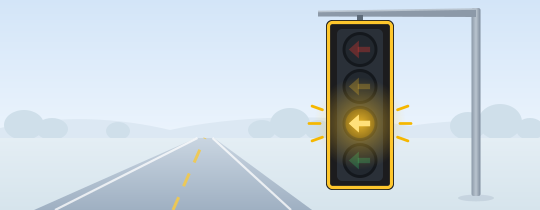
Your left-turn signal is showing a flashing yellow arrow. How should you make the turn?
Show answer
Correct answer: Turn left, but only after yielding to oncoming traffic
Why
A flashing yellow arrow lets you turn left, but the turn is not protected, so oncoming vehicles may still be coming through. Hold your position, wait for a gap long enough to complete the turn, and then go.
32Speed limits
You're in the right lane of a highway with two lanes going your way. A police car sits on the right shoulder with its lights flashing, and traffic in the left lane keeps you from moving over. The limit is 60 mph. What is the fastest you may pass the police car?
Show answer
Correct answer: 40 mph
Why
Texas's Slow Down or Move Over rule gives you two choices near a stopped emergency, tow, TxDOT or utility vehicle with its lights on: leave the lane closest to it when your side has two or more lanes, or slow to 20 mph below the posted limit (5 mph if the limit is under 25). Boxed in on a 60 mph road, that means 40 mph at most.
33Right-of-way
On a one-way street with three lanes, you move from the right lane into the middle lane just as a car from the left lane moves into that same middle lane. Who has to yield?
Show answer
Correct answer: You, the driver coming from the right
Why
Texas law settles this case: when a one-way road has at least three lanes, the car moving over from the right gives way to the car moving over from the left. Before any lane change, check your mirror and your blind spot for a car aiming at the same gap.
34Permit & provisional license
A 16-year-old with a provisional license wants to drive three classmates, all 16 and none of them family, to a football game. Is that allowed in Texas?
Show answer
Correct answer: No, only one passenger under 21 who isn't family is allowed
Why
Until 18, a Texas driver can have only one passenger younger than 21 who isn't related to them, unless a qualifying adult supervisor sits up front. Brothers, sisters and other relatives don't count toward that limit. The rule ends on your 18th birthday.
35Parking
You park facing downhill on a steep street that has a curb, then step out of the car. With the parking brake set, which way should the front wheels point?
Show answer
Correct answer: Toward the curb
Why
Turned into the curb, the front tire will catch on it if the brake ever slips, instead of letting the car roll into traffic. Facing uphill with a curb, turn the wheels away so the back of the tire rests against it; with no curb, turn them to the right. Texas law also says to shut off the engine and take the key.
36Speed limits
Near a school, a reduced school-zone speed sign has yellow lights mounted on it. When does that lower limit apply?
Show answer
Correct answer: Whenever its yellow lights are flashing
Why
Texas lets local authorities set school-zone speeds, so the number can vary from town to town; the posted school-zone speed is in force while its yellow lights flash. In an active school crossing zone you also may not use a phone unless it is hands-free or you are stopped.
37Alcohol & phones
You're 30 and moving with Houston traffic when a text arrives. What does Texas law say about reading or answering it on your handheld phone while the car is in motion?
Show answer
Correct answer: It's banned statewide, with a $25 to $99 fine the first time
Why
Texas bans reading, writing or sending electronic messages on a handheld device while the vehicle is moving, everywhere in the state. Repeat offenses cost $100 to $200, and texting that causes a death or serious injury can bring up to $4,000 and a year in jail. Pull over and stop before you reply.
38Safe driving
You plan to turn right into a parking lot. When should your turn signal go on under Texas law?
Show answer
Correct answer: At least 100 feet before the turn
Why
Texas wants your blinker running without a break through the final 100 feet before you turn. That gives drivers and cyclists behind you time to slow down. Signal even on an empty street: the car you didn't notice is the one that needs the warning.
39Permit & provisional license
A 16-year-old Texas driver wants to take a call through the car's speakers while driving. Is that legal?
Show answer
Correct answer: No, drivers under 18 may not use a phone at all, except in an emergency
Why
Under 18, Texas bans any wireless device behind the wheel, hands-free included, unless it's an emergency. A first offense costs $25 to $99, and learner license holders face the same rule. Switch on do-not-disturb before you pull out.
40Crashes & emergencies
Water is flowing across the road ahead and you can't tell how deep it is. About how deep does water need to be to float many cars?
Show answer
Correct answer: About 12 inches
Why
Roughly 6 inches reaches the underside of most cars, a foot can float many vehicles, and 2 feet of moving water can carry off pickups and SUVs. You can't judge depth or current by looking, so don't drive in: Turn Around Don't Drown®.
Texas DPS written test at a glance
The numbers that matter before your DPS appointment.
Texas · Road Signs + Road Rules exams
70% on each exam.
2 exams · Signs and rules
At least 70% of your answers right
$16learner license if you’re under 18
3 triesper application, held for 90 days
Spanishor English: your choice of test language
Onlineinside an approved driver ed course, from 15
By appt.for every test at a DPS office
20/40vision standard with no restriction
Under 18? Your road to a license
14Driver edStart the classroom part of a driver education course.
15Learner licenseFinish the first 6 hours of class (or all 24), pass both written exams, bring your school’s VOE form and pay $16.
6 moSupervised practiceDrive only with a licensed adult 21+ in the front seat, and log 30 hours, 10 of them at night.
16Provisional licenseFinish driver ed, complete Impact Texas Teen Drivers within 90 days of your road test, then pass the road test.
16–17Provisional limitsNo driving midnight–5 a.m., no more than one non-family passenger under 21, and no phone at all until you turn 18.
18 or older? Ages 18–24 take a 6-hour adult driver ed course (25 and up can skip it), then complete the 1-hour Impact Texas Adult Drivers program and pass the vision, written and driving tests.
What’s on the Texas permit test
Study the Texas Driver Handbook (DL-7, January 2026 edition). The knowledge test comes in two parts, a Road Signs exam and a Road Rules exam. Here’s what to know cold in six key areas.
Road signs
Read the shape first: eight sides means STOP, a point-down triangle means YIELD, a circle means a railroad crossing ahead.
A pennant warns of a no-passing zone; orange marks a work zone, where fines double while workers are present.
Never drive around a high-water barricade: it can cost up to $2,000. Turn Around Don’t Drown®.
Right-of-way
No signs or signals? Yield to anyone already in the intersection or coming from your right.
On a frontage road, yield to cars leaving the highway and to cars crossing over to enter it.
School bus flashing red: stop from either direction, unless it’s across a divided highway. A center turn lane doesn’t divide.
Speed limits
No sign? 30 mph in an urban district, 70 mph on numbered highways outside one, farm-to-market roads included.
Posted limits can reach 75 mph, and 85 mph on roads built for it, the highest in Texas.
Slow Down or Move Over: leave the lane next to a stopped emergency or TxDOT vehicle, or slow to 20 mph under the limit.
Parking
Leave 15 feet to a hydrant, 20 to an intersection crosswalk and 30 to a stop sign.
Park within 18 inches of the curb, and keep 50 feet or more between you and a crossing’s nearest rail.
Downhill with a curb, wheels into the curb; uphill, away from it; no curb, turn them right.
Alcohol & phones
BAC limit: 0.08 at 21 and over. Under 21, any detectable alcohol is an offense.
Refuse a breath or blood test and lose your license for 180 days.
Texting while driving is banned statewide; in an active school zone, hands-free only.
Teen rules
Learner license: a licensed driver 21+ with a year of experience in the front seat, every time.
Under 18: no driving midnight–5 a.m. and no more than one non-family passenger under 21.
Under 18, the phone stays off behind the wheel, hands-free included.
Texas numbers to know
Six Texas figures worth memorizing before test day.
100 ftof signaling before every turn
15 ftfrom a fire hydrant when you park
15–50 ftfrom the nearest rail when a crossing makes you stop
30 mphdefault limit in an urban district
70 mphdefault on numbered highways outside urban districts
30/60/25minimum liability insurance, in thousands of dollars
Your Texas course, in your pocket
These 40 questions are just the warm-up. The app gives you 439 Texas practice questions, 36 short lessons and the why behind every answer.
36 short lessonsFour levels, from fundamentals to expert, then a full practice exam.
439 Texas questions302 of them with pictures.
Your most-missed questionsA review lesson built from the questions you miss most.
Exam simulatorTake full practice exams and watch your readiness grow.
Texas permit
Your Texas path is ready.
36 lessons, 439 questions and full practice exams. In English and Spanish.
What score do I need to pass the Texas permit test?
70% on each part. The Class C knowledge test is two exams, Road Signs and Road Rules, and you need at least 70% on both. By law they cover road signs in English, Texas traffic laws, sharing the road with cyclists and the dangers of distracted driving.
How many times can I take the Texas written test?
One paid application gives you three tries at each part of the exam. After a failed first attempt, DPS holds your application for 90 days; once those 90 days pass or you fail a third time, you apply and pay again.
Can I take the Texas permit test online?
Yes, through driver education. An approved driver ed school or parent-taught course can give you both exams, online included, once you’re 15, so many teens pass the written test inside their course. If you didn’t test in a course, you take it at a DPS driver license office by appointment.
Can I take the Texas permit test in Spanish?
Yes. DPS gives the knowledge test in English or Spanish, and either way you need to understand road signs written in English. A translator may talk with the DPS specialist before and after, but no one can help you during the test. This practice test is in Spanish too, and so is the app.
How old do I have to be to get a learner license in Texas?
15. You can start the classroom part of driver ed at 14 and apply at 15 after the first 6 hours (concurrent method) or all 24 (block method). Hold the learner license six months and log 30 practice hours, 10 at night, before a provisional license at 16. Until 18: no driving midnight–5 a.m. except for work, school activities or emergencies, one non-family passenger under 21 at most, and no phone at all.
How much does a Texas learner license cost?
$16 if you’re under 18, and the provisional license that follows is $16 too; both expire on your 18th birthday. Adults pay $33 for a Class C license that’s good for eight years. The fee is paid before any test, and there’s no separate charge for the knowledge test.
Is the Texas permit test given by the DMV?
No. In Texas, driver licenses come from the Department of Public Safety (DPS), Driver License Division, while the Texas Department of Motor Vehicles (TxDMV) handles titles and registration. Every in-office DPS test needs an appointment, and you can book up to six months ahead.
What’s the best way to study for the Texas permit test?
Read the Texas Driver Handbook (DL-7), then practice until 70% feels easy on both signs and rules. Start with the 40 questions above, then let the app walk you through 439 Texas questions and 36 short lessons, with the why behind every answer.